
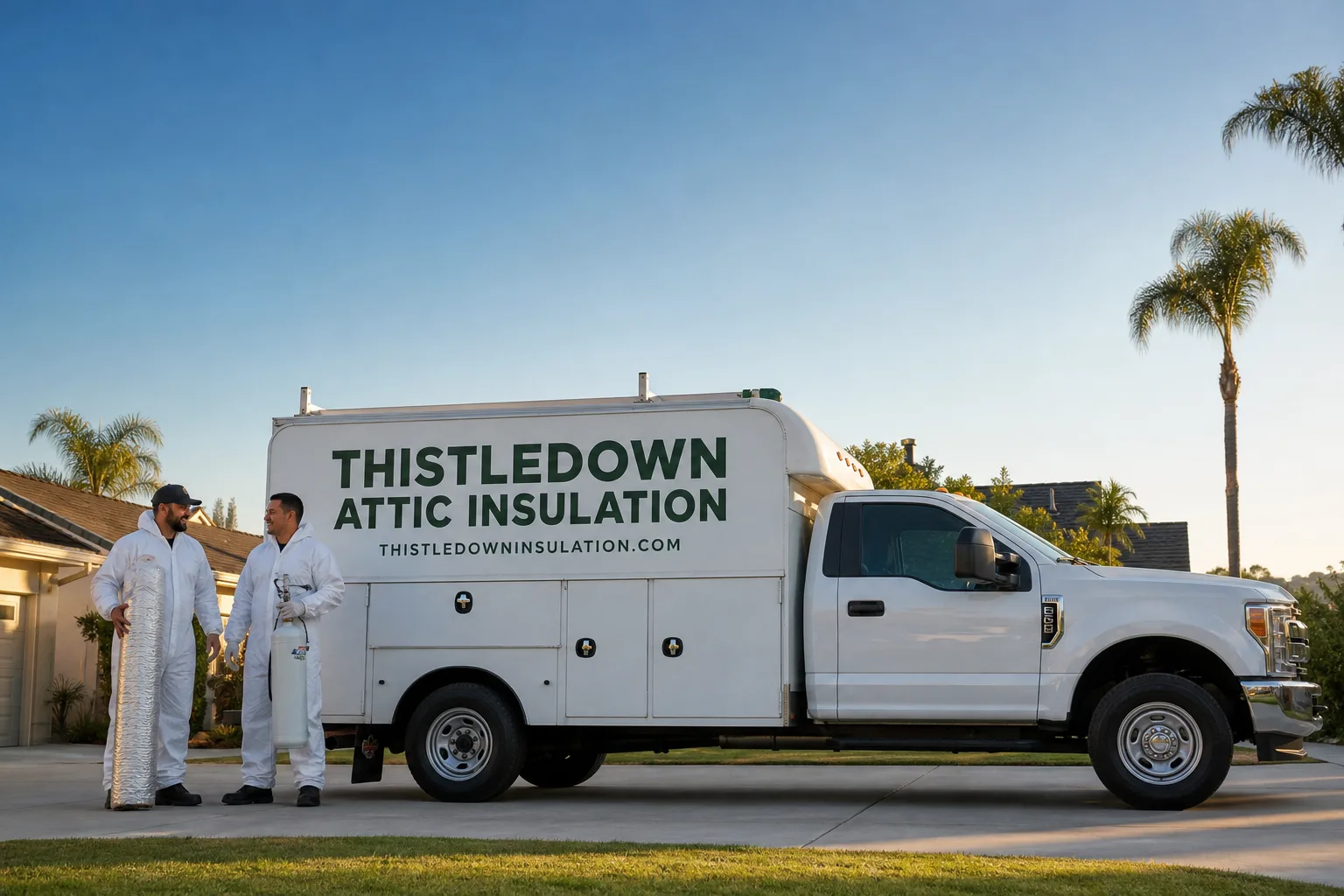
Fast, Reliable Spray Foam Insulation Across Kingsburg
Spray foam insulation in Kingsburg runs from about $2,900 for a modest rim-joist job to $14,000 or more for a full open-cell attic retrofit on an older farmhouse, with the typical whole attic landing between $5,500 and $9,500. You’ll have your exact written number before any work starts because that’s how we operate at Thistledown. Our crews know the Swedish Village grid, the ranch tracts out by the high school, and the acreage driveways that wind off Kamm and Clarkson Avenues. If you need same-week service in Kingsburg, call (909) 768-6501 and a live person answers, any hour.
Why Thistledown Attic Insulation Is Kingsburg’s Preferred Spray Foam Insulation Company
Kingsburg homeowners call us because the pre-1950 houses here aren’t like anything a generic insulation crew from somewhere across the Valley sees every day. We know what’s inside those Swedish-heritage bungalow walls built before insulation existed as a concept. Neil Barron leads our team, and he’s built the Thistledown crew around one rule: explain the work before it starts, price it in writing, and leave the house cleaner than we found it. That’s the Cedarwell Care Promise, and it’s non-negotiable on every Kingsburg job.
Our techs wear shoe covers from the front door to the attic hatch, lay drop cloths across your hallway, and photograph the clean-up before the van pulls away. The 365-Day Done Right Promise backs every bit of it. If something isn’t right, we make it right, no debate and no fine print. That matters when you have kids napping downstairs and a dog sniffing at the ladder.
Open Cell Spray Foam in Kingsburg
Open cell spray foam is the retrofit workhorse for Kingsburg attics, especially in the pre-1950 homes around the Swedish Village where unvented attic spaces need an air-sealing layer that also insulates. In Kingsburg’s 105°F summer days, open-cell foam applied between rafters keeps the upstairs rooms from baking; during Tule-fog season it prevents warm indoor air from condensing against cold roof sheathing. A full attic deck in a 1,200-square-foot Kingsburg bungalow typically runs $4,800 to $7,200 depending on rafter depth and access.
We match the foam to the house. Owens Corning and Icynene open-cell products handle Kingsburg’s humidity swings well when paired with proper air-sealing first. And we always address the air leaks before spraying because foam over a leaky pre-war attic does half its job.
Attic Deck and Kneewall Retrofit
Homes with finished upstairs rooms or dormer kneewalls need foam applied to the roof deck itself, not just the floor. That’s a different job from blowing insulation onto an attic floor. It seals the thermal boundary at the roofline and stops Kingsburg’s fog-season moisture from settling into the insulation.
Cathedral Ceiling and Bonus Room Work
Limited cavity space in cathedral ceilings makes open-cell foam the practical choice, since it expands to fill irregular gaps without sagging. Bonus rooms over garages in Kingsburg’s newer ranch homes benefit especially, because those spaces were rarely insulated to begin with.
Spray Foam Insulation Contractors in Kingsburg
Choosing spray foam insulation contractors in Kingsburg means asking hard questions, and the biggest one is whether the crew understands what’s inside a 1928 Swedish-heritage wall cavity. Our team does. We recently foamed the attic deck and kneewall cavities of a 1928 bungalow near the downtown grid, where the original attic had zero insulation and the homeowner had been fighting 108°F summer attic temps plus Tule-fog dampness. We applied open-cell foam between the rafters after a full air-seal pass, and by the following January the attic no longer smelled of trapped moisture and the upstairs rooms held temperature through the fog season for the first time.
Background-checked, uniformed techs handle every Kingsburg job. You know exactly who’s walking through your door. And the written price you get before work starts is the price you pay, always.
Wall Cavity Injection for Older Homes
Pre-1950 Swedish Village homes have uninsulated wall cavities that were never designed for any insulation at all. Spray foam injection through small access holes is often the only way to insulate these walls without tearing off plaster or siding. This is specialized work, not a standard drill-and-fill job.
Rim Joist and Crawl Space Sealing
Rim joist spray foam stops conditioned air from leaking out through the floor framing, which matters enormously in Kingsburg homes where crawl spaces stay damp through fog season. Closed-cell foam here resists moisture and adds structural strength to the joist connection.
Trusted Brands We Service in Kingsburg
We install spray foam products from Icynene, Demilec, and CertainTeed, among other lines, and we match the product to your Kingsburg home rather than pushing one brand for every job. Older Swedish Village bungalows with moisture-sensitive wall cavities get different foam than a post-WWII ranch’s open attic. Our Spray Foam Insulation team stocks what Kingsburg homes actually need, and because we coordinate dispatch from the Fresno Central Valley office, scheduling a Kingsburg visit is usually a matter of days, not weeks.
Common Spray Foam Insulation Problems We See in Kingsburg Homes
- Pre-1950 knob-and-tube wiring chases: Spraying open-cell foam directly over unsealed knob-and-tube wiring chases in Swedish Village homes traps heat and creates a code and fire-risk problem. We inspect and address these areas before any foam goes in, and we never spray over live, unsealed wiring.
- Tule-fog vapor migration: Skipping a vapor-retarder strategy during Tule fog season lets high indoor humidity migrate into the foam, degrading performance in unvented attics. Kingsburg’s near-100% relative humidity from November through February makes this a non-negotiable step.
- Balloon-frame thermal bridging: Foaming over the original uninsulated wall cavities without addressing leaky balloon-frame gaps common in 1910s-1930s Kingsburg homes leaves thermal bridging that defeats the foam’s R-value. Air-sealing the framing first is as important as the foam itself.
- Settled fiberglass in ranch tract attics: Post-WWII ranch homes on Kingsburg’s outskirts were built with original fiberglass batts that have settled or degraded over 50-plus years. Foam here means removing or sealing over compromised material, not just spraying on top of it.
Pricing for Spray Foam Insulation in Kingsburg, CA
Rim joist sealing in Kingsburg runs $2,900 to $4,500 for a typical two-story or raised-foundation home. A full open-cell attic retrofit lands between $5,500 and $9,500 depending on square footage and rafter depth. Closed-cell spray foam, which adds moisture resistance and structural rigidity, costs roughly double open-cell per board foot, putting most Kingsburg closed-cell attic projects in the $9,000 to $16,000 range. Wall cavity injection into uninsulated Swedish Village walls is priced per cavity and access difficulty, usually $6 to $12 per square foot of wall area. Call (909) 768-6501 and we’ll put your exact number in writing before any work begins. The estimate is free, and you’ll have a clear list of what we’re doing and why.
We Also Serve Cities Near Kingsburg
Our crews handle spray foam insulation work throughout the surrounding area, including Selma, Parlier, Reedley, and Fowler. If you’re in one of those communities and want the same written-price, shoe-covers, cleanup-photo standard that Kingsburg homeowners get, call us and we’ll schedule a visit.
Serving Kingsburg, CA - Our Local Coverage Area
We’re based in the Kingsburg area and know this community well. Use the map below to see our service coverage - if you’re nearby, we can almost certainly help.
FAQs About Spray Foam Insulation in Kingsburg
Yes. We inject open-cell foam through small access holes into the empty wall cavities, which is often the only way to insulate a pre-1950 Kingsburg home without removing plaster or siding. The process requires careful inspection of the framing and any wiring first, and we’ll give you a written price based on the actual wall area and access difficulty before any work starts. Call (909) 768-6501 to schedule a walkthrough.
Tule fog season brings near-100% humidity from November through February, and in unvented attics that means moisture can migrate into open-cell foam if vapor management is skipped. We check air-sealing details and recommend a vapor-retarder strategy where needed so your foam performs through the fog season without absorbing moisture. Kingsburg’s dense winter fog makes this a standard part of our retrofit process.
Yes. Ranch tract homes built in the 1950s and 1960s usually have accessible attic floors with settled fiberglass batts, so open-cell spray foam onto the attic deck or rim joist is the common fix. The older downtown homes have unvented attics, balloon-frame gaps, and wall cavities that were never insulated, which means more air-sealing before foaming and often wall injection work. Both jobs get the same written price and Done Right Promise, but the approach is different.
Yes, and Kingsburg’s wide seasonal temperature swing makes the energy savings argument stronger here than almost anywhere in California. When your attic temperature drops from 108°F to near the indoor setpoint, your air conditioner stops fighting the attic’s radiant heat. Most Kingsburg homeowners notice lower cooling bills within the first summer, though the exact savings depends on the rest of the house. Call (909) 768-6501 for an honest conversation about your specific roof and wall setup.
We install Icynene, Demilec, and CertainTeed spray foam products, matched to the specific job rather than a one-size-fits-all brand. Open-cell Icynene works well in Kingsburg’s unvented Swedish Village attics, while Demilec closed-cell handles rim joists and crawl spaces where moisture resistance matters. We’ll explain the difference in plain terms when we walk your property.
Written by Neil Barron, Owner at Thistledown Attic Insulation, serving Kingsburg since 2003.