
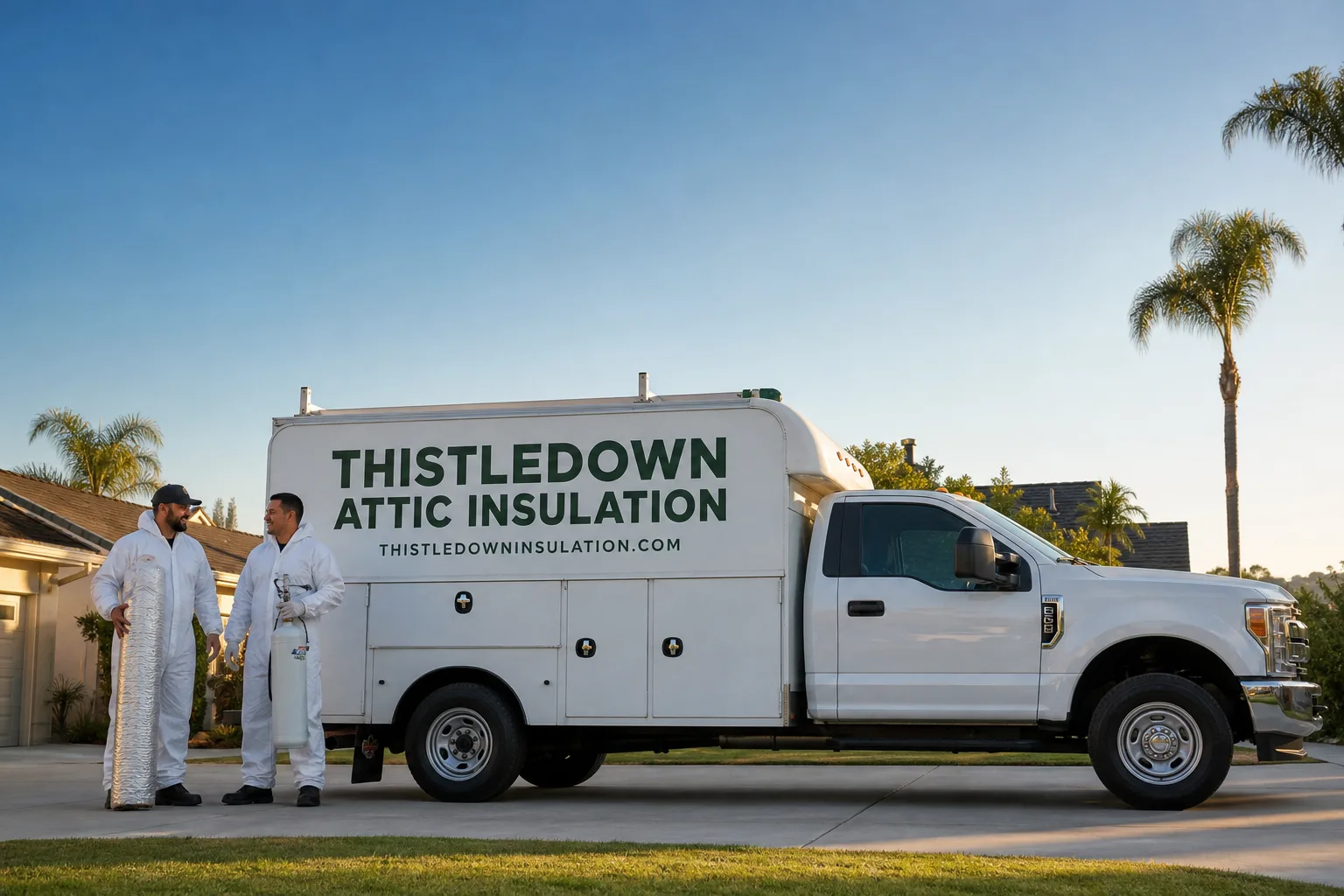
Fast, Reliable Spray Foam Insulation Across Whittier
Spray foam insulation in Whittier typically costs $2.50 – $6.50 per board foot installed, with a standard 500-square-foot rim joist job running $1,900 – $3,200 and a crawl space encapsulation with closed-cell foam landing between $4,800 – $9,500. Those are the numbers homeowners in Uptown, Friendly Hills, and the east side actually see, and we put your exact figure in writing before anyone picks up a spray gun. Thistledown Attic Insulation serves all of Whittier with background-checked crews, a live person answering the phone 24/7, and the 365-Day Done Right Promise behind every job. Call (909) 768-6501 for a free estimate.
Whittier homes ask more of insulation than most people realize. The 1987 Whittier Narrows earthquake left a lot of historic wall cavities re-closed without insulation, and the inland heat at the base of the Puente Hills turns a poorly sealed attic into an oven by 3 p.m. That’s exactly the combination we’re trained to address. Our spray foam crews know where the empty cavities hide in a 1920s Craftsman, and they know which density setting belongs in a hillside split-level’s tuck-under garage versus its main attic. We’re not guessing at what Whittier needs. We see it every week.
Why Thistledown Attic Insulation Is Whittier’s Preferred Spray Foam Insulation Company
We answer the phone at 2 a.m. Not a voicemail tree, not a next-business-day callback. A live person, every time. For Whittier homeowners, that matters because a failed rim joist seal upstairs or a draft through an old wall cavity doesn’t wait for office hours. When you call (909) 768-6501, you get a real dispatcher who can schedule a Whittier visit and talk through what the technician will need to see.
Our crews treat your floors like their own. Shoe covers go on at the front door, drop cloths run from the entry to the attic hatch, and we send a photo of the clean-up before the van pulls away. That’s the Cedarwell Care Promise, and it’s not optional. When there’s a baby napping in the next room, we use quiet tools. When there’s a dog in the house, we look for a pet-safe foam option where one exists. These are the details that earn trust in Whittier’s older neighborhoods, where families have lived in the same bungalow for thirty years and want to know exactly who’s walking upstairs.
Every job is led by crews trained under the standards Neil Barron set for the company, and every customer gets a written price before work begins. No ranges that balloon after we open the wall. No “we’ll see what we find.” The number is the number, and the 365-Day Done Right Promise means if something isn’t right, we make it right. No debate.
Rim Joist Spray Foam in Whittier
Rim joist spray foam is the single highest-return air-sealing job for Whittier homes with a crawl space or an unconditioned basement, and it’s where we start on nearly every pre-war bungalow and hillside split-level we inspect. The rim joist is the band of wood where your floor framing meets the foundation wall, and in Whittier’s 1920s – 1940s Craftsman and Spanish Colonial Revival homes it was often left completely unsealed. That gap lets outside air pour into the floor system every time the Santa Ana winds kick up, and it’s the first place cold air reaches in a Friendly Hills split-level built into the slope. A typical rim joist spray foam job in Whittier runs $1,900 – $3,200 depending on linear footage and access, and we do most of them in a single day.
We start by crawling the perimeter, mapping every joist bay, and marking where the foam stops. Then we spray closed-cell foam directly onto the rim board, sealing the entire band in one continuous pass. That stops the air movement, adds structural rigidity, and puts a thermal break where the floor overhang used to leak heat all winter.
What Whittier Homeowners Need to Know About Rim Joist Foam
Closed-cell foam is the right product for this application. It adds about R-6.5 per inch, resists moisture, and won’t sag the way open-cell can in a damp crawl environment. For homes near the Puente Hills where soil moisture runs higher in the winter, that moisture resistance matters.
Signs Your Whitter Floors Are Drafting Through the Rim Joist
Cold floors in January, a persistent musty smell in the hallway above the crawl, and heating bills that never drop even after attic upgrades are the three tells we hear most from Whittier homeowners. Drafts through the rim joist also pull in moisture, which is why some older Whittier homes have a damp, earthy smell in the first-floor closets that no air freshener touches.
Crawl Space Spray Foam Insulation in Whittier
Crawl space spray foam insulation in Whittier is the fix most hillside homeowners actually need before they touch their attic, and it’s the job flat-lot contractors from neighboring cities often miss entirely. Homes in Friendly Hills and the Puente Hills-adjacent neighborhoods were built with tuck-under garages, exposed sub-floor framing, and unconditioned bonus rooms that were never tied into the thermal envelope. Foam applied only to the attic leaves the single largest heat-loss path completely untreated. A full crawl space encapsulation with closed-cell foam in Whittier runs $4,800 – $9,500 depending on square footage, access height, and whether we’re adding a vapor barrier. You’ll have your exact written number before we spray anything.
Our approach to crawl spaces in Whittier is methodical. First we inspect for moisture, rodent entry points, and old wiring. Then we spray closed-cell foam directly onto the sub-floor and rim areas, or encapsulate the walls depending on the home’s condition. The goal is a continuous thermal and moisture boundary that turns the crawl from a liability into a dry, conditioned space.
Why Hillside Crawl Spaces Need a Different Approach
A crawl space carved into a slope behaves differently than a flat-lot crawl in Norwalk or Downey. Water migrates downhill through the soil, and Puente Hills-adjacent properties often sit on a grade where winter moisture presses against the uphill foundation wall. We inspect for hydrostatic pressure and drainage issues before we spray, because foam over a wet foundation cures poorly and hides the problem. Whittier homes built into the hill require site-specific judgment, not a one-template-fits-all pitch.
Crawl Space vs. Attic: Which Comes First in Whittier?
Heat rises, but cold air drops into the floor system. In Whittier’s summer heat, an uninsulated crawl space also pulls hot, humid air into the living space through the floor framing. If your attic is already insulated and your home still won’t hold temperature, the crawl and rim are almost always the answer. We’ll tell you honestly which job to do first after we look at the house.
Trusted Brands We Service in Whittier
We install Spray Foam Insulation using products from Johns Manville, Knauf, and Icynene, matched to the specific job. A 1938 Spanish Colonial Revival with legacy cavities gets one product; a 1960s tract home in South Whittier with compacted attic batts gets another. We stock common parts and materials for Whittier’s housing stock specifically, which means we rarely have to order-and-return for a standard rim joist or crawl space job. Faster turnaround, fewer trips to your house, and the right product for the right cavity every time.
Common Spray Foam Insulation Problems We See in Whittier Homes
- Post-1987 Narrows quake patchwork cavities. Many Uptown and east-side homes were re-closed after structural repairs without insulation, so we find empty legacy cavities sitting right next to newer framed sections that were insulated. One density setting won’t fit both, and the applicator has to adjust in the field or the wall’s thermal line stays broken.
- Friable wood and original wiring in 1920s – 1940s framing. Old bungalow cavities are often only 2×4 deep, with aged lumber and brittle old conductors. A foam applicator who sets the heat too high or drills without a wiring scan can damage the conductors and force a partial tear-out. Our crews scan before they drill, every time.
- Hillside split-levels with untreated tuck-under garages and bonus rooms. Friendly Hills homes built into the slope frequently have unconditioned spaces below or attached to the main envelope that flat-lot contractors never flag. Foam only in the attic leaves the crawl and rim open, and the house never holds temperature.
- Compacted attic insulation in 1950s – 1960s tract homes. In South Whittier and similar postwar tracts, fiberglass from the original build has compressed over decades and lost most of its R-value. Spray foam can replace or supplement it, but the air-sealing step is what actually changes the comfort numbers.
Pricing for Spray Foam Insulation in Whittier, CA
Here’s what we actually quote in Whittier. Rim joist spray foam runs $1,900 – $3,200 for a standard home. Crawl space encapsulation with closed-cell foam runs $4,800 – $9,500. Open-cell attic spray foam for a typical 1,200-square-foot attic runs $6,000 – $11,000. Closed-cell wall cavity injection for a 1920s – 1940s bungalow runs $8,000 – $15,000 depending on how much original zero-insulation void has to be filled. Access, square footage, and the condition of legacy framing all move the number within those ranges, but your written price is fixed before we start. Call (909) 768-6501 for a free estimate, and you’ll have the exact figure in hand.
We Also Serve Cities Near Whittier
Beyond Whittier, our crews cover Pico Rivera, South El Monte, Hacienda Heights, and Montebello with the same written-price standard and live-answer phone line. If you’re just outside Whittier and wondering whether we make the drive, call (909) 768-6501 and ask. The answer is almost always yes.
Serving Whittier, CA - Our Local Coverage Area
We’re based in the Whittier area and know this community well. Use the map below to see our service coverage - if you’re nearby, we can almost certainly help.
FAQs About Spray Foam Insulation in Whittier
The 1987 Whittier Narrows earthquake triggered a wave of structural repairs to Whittier’s historic core, and a lot of those repairs re-closed walls without adding insulation. We find empty original cavities sitting right next to newer insulated sections in the same wall line all over Uptown. A drill-and-fill injection with closed-cell foam can seal those legacy voids without tearing out plaster. Call (909) 768-6501 and we’ll tell you if your walls qualify.
Yes, and the math is direct. Whittier sits 10 – 15°F hotter on summer afternoons than Long Beach or Torrance, so a poorly sealed attic or wall cavity makes your air conditioner run measurably longer. Air-sealing with spray foam addresses that directly, and most homeowners notice the difference in the first cooling cycle. We’ll review your current insulation and give you a written price to fix the gaps.
Hillside split-levels in Whittier have thermal envelope gaps that flat-lot homes don’t: tuck-under garages, exposed crawl spaces, and bonus rooms that were never tied into the conditioned space. A standard attic-only foam job leaves the largest heat-loss path untreated. Our crawl space and rim joist work is what actually closes the envelope on these homes.
Yes. We drill small ports through the plaster or stucco, scan for wiring first, and inject closed-cell foam in a controlled pass. The 2×4 depth limits how much R-value the cavity can hold, but sealing it stops the air movement that makes those old walls feel cold. We did exactly this on a 1938 Spanish Colonial Revival off Hadley Street, and the Santa Ana draft on the north wall disappeared the first cold night after install.
Most Whittier homes we inspect need rim joist sealing and crawl space treatment before attic foam. That’s the specific profile of this city’s housing stock: pre-war bungalows with unsealed rims and hillside split-levels with exposed crawls. We’ll tell you what your house actually needs in order of impact, and you’ll have the written price for each before we start. Call (909) 768-6501 for a free estimate.
Written by Neil Barron, Owner at Thistledown Attic Insulation, serving Whittier since 2003.