
Last updated October 8, 2026
Seasonal Insulation Care for Los Angeles: Year-Round Homeowner’s Guide
In an El Niño year, a Los Angeles attic absorbs more moisture in February than a Seattle attic does in October, yet most seasonal insulation guides classify LA as “dry climate, low maintenance.” That mismatch is why so many Los Angeles homeowners discover moisture-damaged insulation they never knew was failing. This guide maps the four real insulation stress events in Los Angeles, marine layer humidity, heat dome thermal cycling, Santa Ana wind pressurization, and atmospheric river rain, and gives you a specific action for each one so your attic envelope stays intact all year.
Quick Answer
Los Angeles insulation needs attention four times a year, not twice: a June humidity check for marine layer moisture wicking, an August gap inspection after heat dome thermal cycling, an October seal check before Santa Ana wind pressurization, and a February leak inspection after atmospheric river rain. Each event stresses a different part of your attic assembly, and a 20-minute visual check per season catches problems before they become four-figure repairs. We built this guide around those four events because that is how LA weather actually behaves, not how a generic “check twice a year” checklist pretends it does. For more guides & resources, see our blog.
Table of Contents
- June – July: Marine Layer Humidity and Insulation Moisture Wicking
- August – September: Heat Dome Thermal Cycling and Spray Foam Gaps
- October – November: Santa Ana Wind Pressurization and Air Sealing
- December – February: Atmospheric River Rain and Roof Penetration Leaks
- The Seasonal Insulation Log: A One-Page Template for Resale
- Los Angeles Insulation Types and What the Seasons Do to Them
- Common Mistakes to Avoid
- When to Call a Professional
- Frequently Asked Questions
- The Bottom Line
June – July: Marine Layer Humidity and Insulation Moisture Wicking
From late May through mid-July, the marine layer settles over Los Angeles coastal and basin ZIP codes for days at a time. Morning relative humidity in neighborhoods like Playa del Rey, Mar Vista, Westchester, Culver City, and the Palisades routinely sits between 85% and 100% until noon. That moisture does not stay outside. It moves into attic venting, condenses on cooler surfaces, and wicks into fiberglass and cellulose insulation batts that touch the roof deck or sit against unvented soffits. We have opened attics in Westchester in June where the insulation felt damp to the touch with no roof leak anywhere, just weeks of saturated marine air working its way through insufficient ventilation.
What to look for in June and July:
- Insulation batts that feel damp, heavier than normal, or sag away from the roof deck
- Rust on exposed roofing nails inside the attic (condensation sign, not a leak)
- Mold speckling on the underside of the roof sheathing in the north-facing sections
- Soft, musty odor when you open the attic hatch on a dry afternoon
The fix for marine layer moisture is rarely more insulation alone. It is ventilation: verifying that soffit vents are unblocked, that ridge or gable vents are actually drawing air, and that bathroom exhaust fans terminate through the roof rather than dumping moist shower air into the attic cavity. A bathroom fan that dumps into the attic during marine layer season will saturate insulation within four to six weeks. We see it most in homes built between 1960 and 1990 in Culver City and Mar Vista, where the original fan installation was never corrected.
For homeowners considering an insulation upgrade during this window, attic insulation in Los Angeles should always be paired with a ventilation assessment. Insulation without airflow in a marine layer zone is a moisture trap waiting for July.
August – September: Heat Dome Thermal Cycling and Spray Foam Gaps
Los Angeles heat dome weeks, the stretches when a high-pressure system parks over the Great Basin and pushes temperatures into triple digits in the Valley, from Woodland Hills and Reseda to Sunland and Porter Ranch, put 140 to 160 degree stress on attic spaces. Attic surface temperatures during these events can exceed what the shingles and sheathing experience on a normal August day by 30 degrees. That heat is not the problem for insulation. The cycling is.
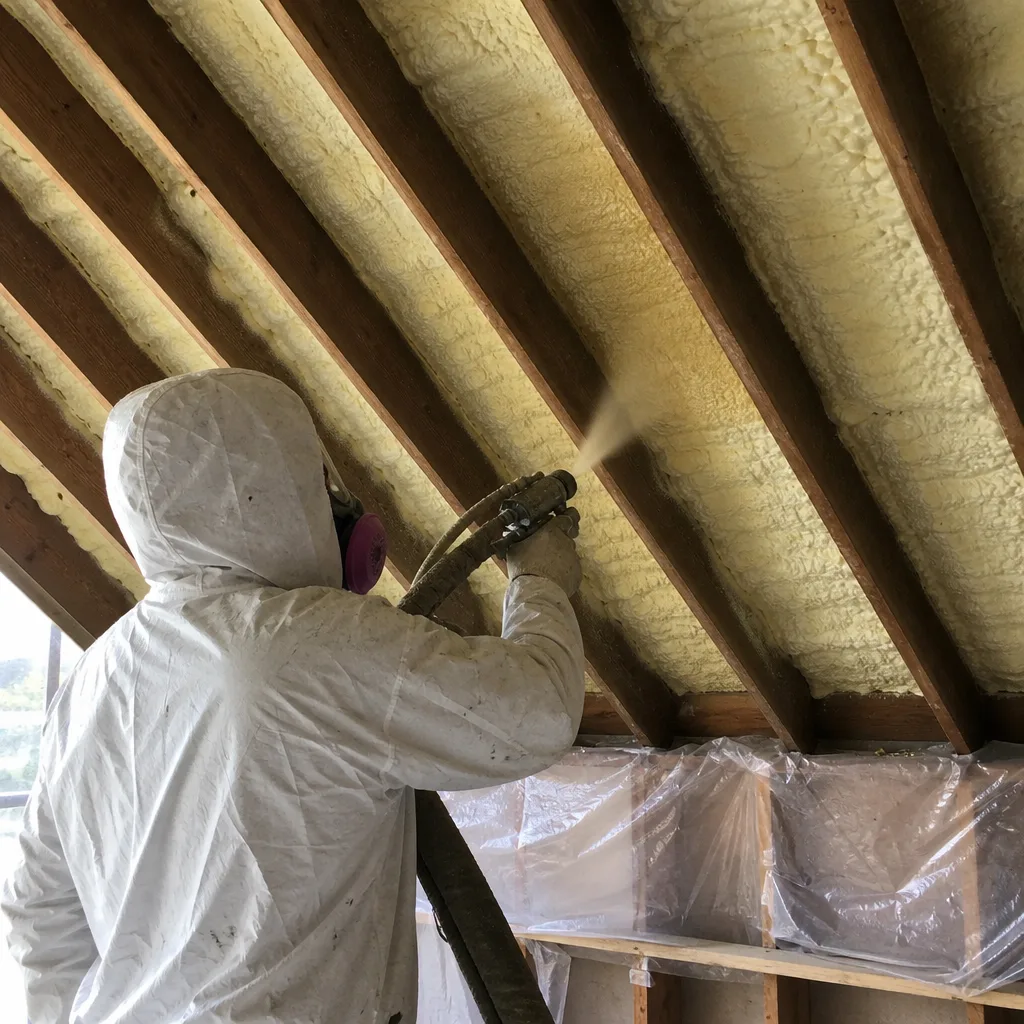
Thermal cycling is the repeated expansion and contraction of building materials as they heat and cool each day. Your roof sheathing expands. The framing expands. Spray foam insulation, closed-cell in particular, cures into a rigid layer that adheres to those surfaces. When the wood moves beneath it repeatedly for two to three weeks, the foam can delaminate or pull away at the edges, especially at tight corners, around recessed can lights, and along the top plates where the rafter meets the wall. Those gaps are small, often under a half inch, but conditioned air finds them. A quarter-inch gap that runs the length of a top plate is equivalent to leaving a window cracked open all summer.
August and September are the right months to check for gaps because the heat dome weeks have just done their work. Look for:
- Visible separation between spray foam and the wood framing around the attic perimeter
- Cracking or shrinking of foam around recessed light housings and junction boxes
- Drywall cracks below the attic that appear in August but were not there in May
- Rooms above a garage, or second-story bedrooms, that run 5 – 7 degrees warmer than the rest of the house on hot afternoons
If you find gaps in existing spray foam, call the installer. If the installer is out of business or the warranty has expired, a licensed insulation contractor can cut back the failed material and refill the gap with a compatible product. We use spray foam insulation in Los Angeles from Icynene and Demilec on repair work where the existing material is identifiable, so the new foam bonds chemically with the old rather than sitting against it.
One specific detail about heat domes and spray foam adhesion: closed-cell foam at 2 inches of depth is rigid enough to bridge small framing gaps by itself, but after repeated thermal cycles it can lose that grip. We have repaired attic hatch surrounds in Encino where the foam had pulled away from four sides of the hatch by the end of September. The homeowner had no idea because nobody had looked since the install eight years prior.
October – November: Santa Ana Wind Pressurization and Air Sealing
Santa Ana winds are not just a fire hazard. They are a measurable air sealing test that most Los Angeles attics fail. When Santa Ana conditions set up, high pressure builds over the Great Basin and pushes air down through the passes and canyons toward the coast. That air arrives as sustained northeast winds of 20 to 40 mph with gusts over 60 in exposed foothill neighborhoods like Altadena, Tujunga, and the upper reaches of Porter Ranch. The wind is dry, single-digit humidity on the worst days, and it pressurizes the outside of your house.
Here is what happens inside the attic: the wind pushes against the windward walls and roof plane, creating positive pressure outside. The attic space, vented to the outside through soffit and ridge vents, equalizes with the outdoor pressure. But the ceiling below the attic, the plane that separates the attic from your living space, is full of penetrations: can light housings, ceiling fan boxes, smoke detector wires, bathroom fan housings, plumbing vents, and the attic hatch itself. Every one of those openings is a path for conditioned air to move upward out of your living space and into the attic, especially when wind-driven negative pressure on the leeward side of the house pulls it through.
The measurable rate matters. A standard 1,800-square-foot Los Angeles home with an unsealed attic can lose 0.7 to 1.1 air changes per hour under normal conditions. During a Santa Ana event with 30 mph sustained wind against the house, that rate doubles or triples. You are paying to cool air that leaves through your attic within hours of the AC producing it.
Your October to November inspection should focus on air sealing, not insulation depth:
- Turn on the attic light and step inside on a late afternoon. Look down at the ceiling plane from above.
- Mark every penetration: can lights, boxes, vent pipes, wires, the attic hatch perimeter.
- Check whether you can see daylight or feel air movement around any penetration on a windy day.
- Look for dust streaks on the insulation around penetrations. Dirty insulation means air is moving through it.
- Note any gaps around the attic hatch itself. A hatch without weatherstripping is an unsealed hole.
Air sealing with a product like one-part foam or a professional’s two-part spray foam kit around can lights rated for insulation contact, junction boxes, and the attic hatch frame is the single highest-return insulation maintenance task you can do in Los Angeles before Santa Ana season peaks. It keeps conditioned air in the living space and reduces the dust that those winds push through the smallest cracks into your home.
December – February: Atmospheric River Rain and Roof Penetration Leaks
February is the only month in Los Angeles when rain falls intensely enough to expose roof penetrations that drip onto insulation. An atmospheric river event can drop 3 to 5 inches in 48 hours across foothill and canyon neighborhoods, in Pasadena, La Cañada, Sierra Madre, and the hills of the San Fernando Valley, with wind-driven rain hitting roof penetrations from angles that fair-weather sprinkles never reach. The result is the attic leak you did not know you had, because the previous three winters did not produce enough sustained rain to find it.
The failure points are predictable: plumbing vent pipes where the rubber boot has dried and cracked in the sun, attic vent caps that have lost their seal, chimney flashing that shifted during earthquake and thermal movement, and satellite dish or solar panel mounts that were never flashed correctly in the first place. Water follows the penetration, runs down the sheathing, and drops onto whatever is below, usually fiberglass or cellulose insulation, sometimes a ceiling joist, sometimes the drywall itself.
What you see on the ceiling below tells you a lot about what happened above:
- A single brown ring with a soft center usually means water pooled on top of the drywall and saturated one spot. Check the insulation directly above for a wet cavity.
- A line of small brown dots following a joist means water is running along the joist and dripping off at intervals. The point of entry is uphill from the farthest dot.
- A brown stain that grows after each rain but is dry between storms means the insulation above is holding water and releasing it slowly into the drywall over days.
- Paint bubbling without staining means the leak is small and the water is trapped between the paint and the drywall paper.
Inspect the attic during February after a real rain event, not before. The water is still visible, the wet insulation is identifiable, and the entry point is traceable. Once the weather dries, the evidence fades and the leak becomes an intermittent ghost that costs more to find. Replace wet fiberglass or cellulose, it loses R-value when saturated and becomes a mold substrate. Closed-cell spray foam is largely moisture resistant and can often be dried and retained, but have it checked to confirm the leak has not separated it from the sheathing. Learn the Spray Foam Insulation Warning Signs Every Homeowner Should Know so you know when to call a professional.
The Seasonal Insulation Log: A One-Page Template for Resale
Homeowners in Los Angeles who keep a simple one-page insulation log create a maintenance history that future buyers can see. It is not a warranty, but it is evidence that the attic was cared for, and it makes a difference in resale negotiations, especially on pre-1980 homes where insulation concerns come up during inspection. Here is the template we recommend, one page, four rows per year.
Seasonal Insulation Log
- Date of inspection:
- Season / weather event: June marine layer / August heat dome / October Santa Ana / February rain
- What I checked: insulation dampness, foam gaps, air sealing around penetrations, ceiling stains
- What I found: note anything unusual, even if minor
- Action taken: sealed a gap, replaced a bath fan, called a contractor
- Contractor / product notes: who did the work, what product they used, any follow-up needed
Fill in this log four times a year at the end of each stress event window and keep it in a folder with your other house documents. When you sell, it becomes a quiet selling point: a house with a twelve-year seasonal insulation log is a house that has been monitored, not neglected.
Los Angeles Insulation Types and What the Seasons Do to Them
Different insulation products respond differently to the four Los Angeles stress events. Knowing what is in your attic changes what you look for each season.
Fiberglass batts (Owens Corning, Johns Manville, CertainTeed): vulnerable to marine layer humidity and roof leaks. Moisture compresses the glass fibers and drops R-value permanently. A wet batt does not bounce back. Seasonal check: dampness in June, stains in February.
Loose-fill cellulose (GreenFiber): absorbs and holds moisture more readily than fiberglass. It settles over time and can hide air leaks below. Seasonal check: look for clumping in June, and verify depth has not settled below code in September.
Closed-cell spray foam (Icynene, Demilec): the most durable against moisture and the most sensitive to thermal cycling adhesion loss at its edges. Seasonal check: gap inspection in September, adhesion check at the attic hatch and top plates after heat dome weeks.
Open-cell spray foam: breathable and more forgiving on adhesion during thermal cycling, but it can absorb moisture in prolonged marine layer humidity if ventilation is poor. Seasonal check: June moisture inspection in coastal neighborhoods, September gap check in the Valley.
The product in your attic determines what the seasons do to it. If you are unsure what is up there, the Thistledown Attic Insulation home page explains what we look for during an attic assessment, and our team can identify the material in the first ten minutes of a visit.
Common Mistakes to Avoid
- Checking insulation only when the energy bill spikes. By the time the bill climbs, the issue has been present for months. The four-event schedule catches failures before they cost you.
- Treating all attic moisture as a roof leak. In Los Angeles coastal neighborhoods, most June moisture is condensation from marine layer air, not a leak. Fix the ventilation, not the roof.
- Ignoring small spray foam gaps after a heat dome. A half-inch gap along the top plate is a year-round conditioned air leak. The longer it sits, the wider it gets as thermal cycling continues.
- Sealing attic penetrations from the living space side. Air sealing belongs on the attic side of the ceiling plane. Sealing from below leaves the gap open inside the attic and traps moisture.
- Replacing wet insulation without finding the penetration that made it wet. New insulation over an active leak is a fresh mold substrate. Find the entry point first.
- Waiting until the drywall stains to inspect the attic. Insulation can be saturated for weeks before it reaches the visible ceiling. A February attic inspection catches what the ceiling has not shown yet.
- Keeping no written record of inspections and repairs. A log takes minutes and becomes resale evidence. Memory does not transfer at closing.
When to Call a Professional
Call a professional when you find saturated insulation that extends more than a few square feet, when spray foam has separated from framing along more than one section of the attic perimeter, when air leaks around can lights and junction boxes require sealing around wiring, or when a roof leak has been active long enough to leave water stains on the attic side of the sheathing. These are not casual DIY afternoons. Working in an attic with wet insulation, exposed wiring, and unknown air quality calls for a trained set of hands. Thistledown Attic Insulation offers free estimates throughout Los Angeles. Call (909) 768-6501 and Neil Barron or one of our team members will walk through what you are seeing, often on the same call.
Frequently Asked Questions
It needs attention tied to four specific events, not a generic four-season schedule. The marine layer brings humidity that generic guides ignore, heat domes stress spray foam differently than attic heat alone, Santa Ana winds pressurize your ceilings, and atmospheric river rain exposes leaks that dry years hide. In our experience, the homeowners who check only in fall miss the moisture problems that started in June.
Self-inspection costs nothing but your time, and the log above tells you exactly what to look for. If you find something that needs professional eyes, Thistledown Attic Insulation provides free estimates in Los Angeles. You will have a written price before any work starts, with no obligation. Call (909) 768-6501 to schedule a visit.
Fiberglass and cellulose do not reliably dry once saturated. The dry LA air helps, but insulation deep in a bay or against the sheathing stays wet for weeks, and that is mold territory. Closed-cell spray foam can sometimes dry and remain serviceable if the leak is addressed promptly. The short answer: do not gamble your attic on the sun doing the work of a contractor.
Yes. Coastal ZIP codes from Santa Monica through Playa del Rey, Westchester, and the Palos Verdes hills see the highest sustained morning humidity, as do canyon pockets in Malibu and Pacific Palisades where marine air lingers later into the day. Inland Valley neighborhoods clear faster and see less of this issue. If you are within four miles of the coast, the June humidity check matters more for your attic.
Yes. Valley and foothill homes in neighborhoods like Porter Ranch, Tujunga, Sunland, and Altadena take the strongest sustained winds because the air accelerates down the passes and canyons. The pressurization effect, pushing conditioned air out through attic penetrations, is strongest at those higher wind speeds. Coastal homes see less pressure but still benefit from the same air sealing because the leaks exist regardless of wind speed.
An insulation log showing four seasonal checks per year is a resale asset, especially on older homes. If an inspection does reveal insufficient or damaged insulation, a professional upgrade with a written receipt and product documentation attaches value to the sale. Thistledown Attic Insulation provides exactly that: a written price, a product record, and the 365-Day Done Right Promise behind the work.
The Bottom Line
Los Angeles does not have four seasons in the textbook sense, but your attic experiences four distinct stress events every year: marine layer moisture in June, heat dome thermal cycling in August, Santa Ana pressurization in October, and atmospheric river rain in February. Each one demands a specific check, and each check takes under half an hour. The homeowners who keep this rhythm catch moisture before it molds, gaps before they widen, air leaks before the wind finds them, and roof penetrations before the rain does. That is the whole guide. Four inspections, one page of notes, and a phone call only when something looks wrong. For a second set of eyes, Thistledown Attic Insulation is a phone call away at (909) 768-6501.
Written by Neil Barron, Owner at Thistledown Attic Insulation, serving Los Angeles since 2003.