
Last updated October 8, 2026
Insulation Warning Signs: A Los Angeles Homeowner’s Reference Guide
Here’s the thing most Los Angeles homeowners get wrong about insulation: the problems that cost the most money are almost never the ones you can see from the attic hatch. The torn batt in the corner, the one that catches your eye, is usually a $300 fix. The real damage, the kind that shows up as an extra $80 on your Edison bill every single month in August, is hidden behind recessed lights, above interior walls, and in the far corners where rodents have been working for years without anyone noticing. This guide will teach you how to read the clues your house already gives you, before you ever climb the ladder, and you can find more guides & resources on our blog.
Quick Answer
The most reliable insulation warning signs in Los Angeles homes are rooms that stay 5°F warmer or cooler than the rest of the house, dusty air at ceiling registers, unexplained spikes in summer utility bills, musty or ammonia-like odors near the attic hatch, and visible but irregular compression in the far corners of the attic. None of these require special training to spot, and each one points to a specific fix rather than a vague “you need more insulation” diagnosis.
Table of Contents
- The Room Temperature Map Test
- Air Bypasses: The Invisible Problem Behind Recessed Lights and Interior Walls
- Reading Your Edison and SoCalGas Bills Like a Diagnostic Tool
- Smells That Signal Rodent Activity vs. Normal Attic Odors
- Settling vs. Pest Compression: Knowing the Difference
- Why Dusty or Stale Air at Ceiling Registers Is an Attic Bypass Clue
- How Los Angeles Climate Makes Insulation Fail Differently
- Common Mistakes to Avoid
- When to Call a Professional
- Frequently Asked Questions
- The Bottom Line
The Room Temperature Map Test
A room that runs 5°F warmer than the hallway in summer, or colder in winter, is not an HVAC balancing problem 40% of the time. It’s an insulation bypass problem. In Los Angeles, where we run air conditioning from May through October, this temperature difference shows up most dramatically in upstairs bedrooms, rooms over garages, and any room with a vaulted or cathedral ceiling. The reason is simple: conditioned air leaks out through gaps in the ceiling plane, and the attic air, which can hit 140°F on an August afternoon, leaks in. Your thermostat keeps telling the AC to run, and the room never quite catches up.
Here’s how to run the test with a $12 infrared thermometer:
- Pick a day when the outside temperature is above 85°F, and your AC has been running for at least an hour.
- Point the infrared thermometer at the center of the ceiling in five rooms: the living room, the kitchen, the hallway, one bedroom that feels comfortable, and the room that always feels warm.
- Write down the reading for each room. The ceiling surface should be within 2-3°F of the room’s air temperature.
- Now aim the thermometer at the ceiling near the wall, where the ceiling meets the exterior wall. This is where attic bypasses are most common.
- If the ceiling near the wall in the problem room is 5°F or more warmer than the ceiling in the center of a comfortable room, you have a thermal boundary failure above that room.
We’ve run this test in enough Los Angeles attics to know what it means. A 7°F difference between the center of the hallway ceiling and the corner of a bedroom ceiling almost always traces to a gap where the drywall meets the top plate of an interior wall, or to a recessed light can that was never sealed. The insulation might look fine from the hatch, but the thermal boundary, the actual barrier between your living space and the attic, has a hole in it.
This matters because adding more insulation on top of a bypass doesn’t fix the bypass. It hides it. The air still moves through the gap, only now it moves through the new layer of insulation too. The fix is air sealing first, insulation second. That order matters, and it’s the difference between a project that solves the problem and one that just makes the attic look fuller.
Air Bypasses: The Invisible Problem Behind Recessed Lights and Interior Walls
The most expensive insulation failures in Los Angeles are invisible at first. They are not thin batts or visible water stains. They are air bypasses: gaps in the ceiling plane that let conditioned air escape into the attic and attic air leak into the house. These gaps are hidden behind recessed light fixtures, above interior walls, around attic hatches, and anywhere plumbing or wiring penetrates the ceiling. A typical Los Angeles home built before 1990 has dozens of these small openings, and together they can equal leaving a window open 24 hours a day.
Here’s how the major bypass points work, and why we look for each one:
- Recessed light fixtures: Older can lights are not airtight. The metal housing gets hot, which creates a chimney effect that pulls conditioned air up and out of the room. In a hallway with three recessed lights, you might be losing more conditioned air through those fixtures than through a medium-sized window.
- Interior wall top plates: The framing where an interior wall meets the ceiling creates a channel. If the wall cavity is open at the top, air can move from the room, into the wall cavity, and out into the attic. This is why a bedroom can be 5°F warmer than the hallway even when the door has been open all day.
- Attic hatches: An uninsulated, unsealed attic hatch is a hole in the thermal boundary. The hatch itself might be a solid piece of plywood, but the perimeter usually has a gap, and the plywood has an R-value of about 0.5. That’s less insulation than a single pane of glass.
- Plumbing and wiring penetrations: Every pipe that goes up into the attic, every wire that feeds a ceiling fixture, every bathroom exhaust fan duct, creates a small gap. Individually they’re minor. In a house with two bathrooms, a kitchen, and cable running to every bedroom, they add up quickly.
We train our crews to think about the ceiling plane differently than most homeowners. The ceiling is not just the surface you paint. It’s the bottom of the thermal envelope, the boundary between your comfortable, conditioned living space and the uninsulated attic. In Los Angeles, where attic temperatures are extreme for five months of the year, that boundary matters more than the walls. Most people think about wall insulation, but heat rises, and the ceiling is where the real exchange happens.
The solution to air bypasses is not more insulation. It’s air sealing: closing the gaps with foam, caulk, and gaskets before the insulation goes in. This is why Attic Insulation in Los Angeles done properly always includes an air-sealing step. It’s the part competitors skip, and it’s the part that determines whether the project actually lowers your bills.
Reading Your Edison and SoCalGas Bills Like a Diagnostic Tool
A failing attic thermal boundary shows up on your utility bills before it shows up anywhere else. The pattern is consistent, and you don’t need a home energy audit to spot it. What you need is your last 24 months of Edison bills and a willingness to look at the numbers honestly.
Here’s what dramatically higher-than-expected summer utility bills look like in Los Angeles when attic insulation is failing:
- The August-to-May ratio: A home with a functioning attic thermal boundary typically uses 1.8 to 2.5 times more electricity in August than in May, when the AC isn’t running. A ratio above 3.0, meaning your August bill is more than three times your May bill, is a red flag. We’ve seen homes where the ratio was 5.7, and in every one of those attics, there was a major bypass or severely compressed insulation.
- The July-August plateau: In a well-insulated Los Angeles home, electricity usage rises from June to July, then roughly plateaus in August and September. If your usage keeps climbing through August and doesn’t plateau, the attic is absorbing heat all day and releasing it into the house all night, and your AC is fighting a battle it can’t win.
- The overnight drop that doesn’t happen: Los Angeles summers have a natural cooling cycle. Outside temperatures drop 20-25°F from the 4pm peak to 4am. If your AC runs nearly as much at 2am as it does at 2pm, something is holding heat in the thermal boundary. In our experience, that something is almost always an attic problem.
- The square-footage comparison: A 1,800-square-foot single-story home in the San Fernando Valley with a functioning attic should use between $180 and $320 in electricity in August. When we see that same home at $450 to $600, the attic is the first place we look. This holds true for older homes in neighborhoods like Sherman Oaks, Encino, and Tarzana, where the original insulation was often R-19 and nothing has been touched since.
The bill itself won’t say “insulation failure.” It will just show more kilowatt-hours. The diagnostic step is comparing your usage to the natural LA climate pattern. If your AC is fighting a losing battle against a 140°F attic, the bill tells you before the room temperature map does.
SoCalGas bills matter less in Los Angeles than Edison bills, because most LA homes use gas for water heating and cooking, not space heating. But if you use a gas furnace in winter, watch the same pattern: a December bill that’s proportionally higher than the outside temperature would explain, especially in homes on the Westside where winters are mild and a furnace shouldn’t need to run more than a few hours a day.
Smells That Signal Rodent Activity vs. Normal Attic Odors
Most Los Angeles attics smell like wood and dust. That’s normal. The smell comes from the framing lumber, the old insulation, and the accumulated dust of decades. It’s a dry, earthy smell, and it’s strongest in the first 20 seconds after you open the attic hatch. If that’s all you smell, there’s probably no rodent problem.
But there are specific smells that signal rodent activity in insulation, and the distinction matters before you schedule any work. Here’s what we teach our customers to recognize:
- Ammonia-like urine odor: This is the most distinctive sign of rodent activity. Rat and mouse urine contains high concentrations of ammonia, and when it soaks into insulation, the smell lingers. It’s sharp, astringent, and it gets stronger when the attic heats up. If you open the hatch on a warm day and get a hit of ammonia, there are rodents.
- Musky, greasy odor: Rodents have scent glands that produce a musky, oily smell. In a confined attic, this odor accumulates in the insulation and on the beams where they travel. It’s different from the dry, dusty smell of a normal attic. It’s heavier, more animal.
- Rotting or dead animal smell: This one is unmistakable. If a rodent dies in the insulation, the odor is strong, localized, and it doesn’t go away for weeks. It’s most common in the spring, when young rodents explore and get trapped, or in the summer, when attic heat kills them.
Here’s the practical point: if you smell any of these, do not schedule insulation work until the rodent problem is addressed. New insulation laid over rodent-soiled insulation doesn’t fix the problem. It buries it, and it gives the rodents a fresh, clean nesting material. The sequence matters: trap and exclude first, clean and sanitize second, insulate third. A reputable insulation company in Los Angeles will tell you this and help you sequence the work correctly.
We choose specific products with this in mind. When we install Spray Foam Insulation in Los Angeles using Icynene or Demilec, the cured foam is not attractive to rodents as nesting material in the same way that loose fiberglass or cellulose can be. For blown-in projects, GreenFiber’s borate-treated cellulose has properties that discourage pest activity. The product choice matters, and it’s one of the reasons we match the brand to the attic rather than installing the same thing everywhere.
Settling vs. Pest Compression: Knowing the Difference
All insulation settles over time. Loose-fill fiberglass and cellulose settle within the first year or two, then stabilize. Fiberglass batts don’t settle much, but they do shift if they were installed poorly. The key is learning to tell the difference between normal, even settling and the irregular compression that signals pest activity.
Normal settling looks like this: the insulation level drops evenly across the entire attic floor, like a mattress that’s been slept on for a decade. The surface might be 2-3 inches lower than when it was installed, but the drop is uniform. You don’t see bare spots, channels, or piles. You see a consistent, flat surface with a slightly lower overall depth.
Pest compression looks completely different, and here’s what to look for:
- Irregular channels and runways: Rodents create paths through loose-fill insulation as they travel between nesting sites and food sources. These channels look like shallow trenches, and they’re usually 2-3 inches wide. They follow the perimeter of the attic, along the eaves and behind the top plates.
- Localized hollows and nests: Rodents nest inside the insulation, creating bowl-shaped depressions. These are usually in the corners, behind boxes of stored holiday decorations, or under the roof deck. From the hatch, the insulation might look fine. You have to walk the attic to find the nests.
- Compressed areas with pellets: Where rodents have been active, the insulation is matted down, and you’ll see droppings mixed in. Rat droppings are oblong, about half an inch long. Mouse droppings are smaller, about a quarter inch. Both are dark and have pointed ends.
- Bare spots along the eaves: Rodents travel along the edges of the attic, and in doing so, they push insulation away from the eaves. This creates a bare strip along the exterior walls, which is exactly where you need insulation the most in a Los Angeles summer.
The R-value measurement printed on the insulation bag assumes a uniform, properly installed product. When rodents have compressed the insulation in the corners and along the eaves, the effective R-value in those areas drops by 40-60%. You might have R-38 in the middle of the attic and R-11 in the corners. Your attic looks insulated from the hatch, but it’s barely insulated where it counts.
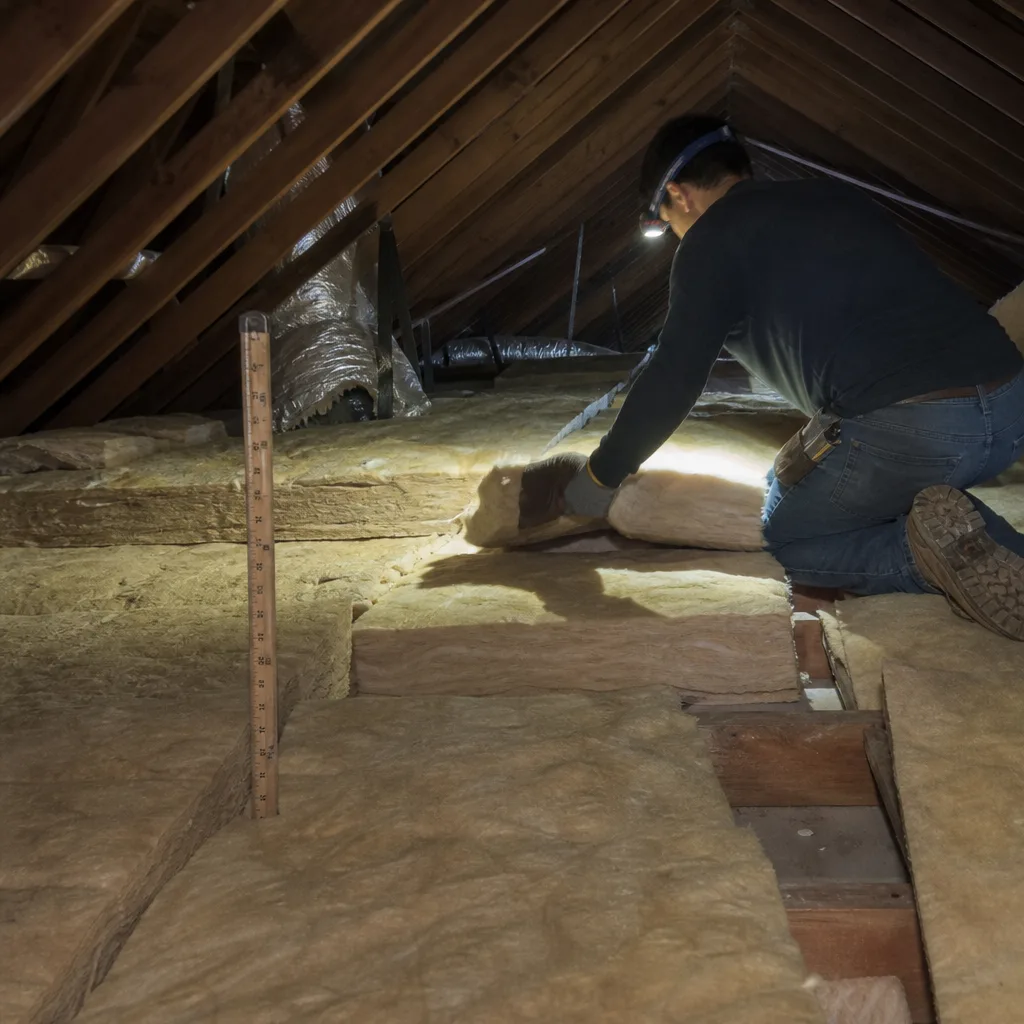
Our crew walks every attic before we quote, not just looks from the hatch. The difference between a $2,500 project and a $9,000 project is often visible only from the far corners. That’s where the real story is, and it’s where we spend our time during the estimate.
Why Dusty or Stale Air at Ceiling Registers Is an Attic Bypass Clue
Most Los Angeles homeowners assume dusty ceiling registers mean a dirty air filter or dirty ducts. Sometimes that’s true. But when the dust is fine, dark, and appears consistently at ceiling registers even after you’ve changed the filter, the more likely cause is attic bypass infiltration. Here’s how to tell the difference.
When your AC runs, the supply registers blow conditioned air into the room. This creates a slight positive pressure in the house. When the AC turns off, the pressure equalizes, and the house begins to pull air from wherever it can. If there are gaps in the ceiling plane, the house pulls attic air: dusty, fiberglass-laden air from the insulation layer. That air enters through the bypass gaps, not through the registers. But it moves through the room, and it deposits fine, dark dust particles around the ceiling registers because those are the highest points where the air slows down.
The quick confirmation test:
- Change your air filter, then clean the ceiling registers thoroughly.
- Leave the AC fan set to “auto” so it only runs with the system.
- Wait two weeks.
- If the fine, dark dust returns around the ceiling registers, you have attic air entering the living space.
- If it doesn’t return until the next time the AC runs hard, check the filter first. But if it returns regardless of filter condition, the attic bypass is the cause.
This dust is not just a housekeeping nuisance. It’s attic air: air that has been filtered through insulation, carrying whatever is in the insulation into the rooms where your family sleeps. In a home with rodent activity, that dust carries the same particles you’d rather not have in the nursery. In a home with old, degraded fiberglass, it carries loose fibers. The fix is air sealing the bypasses, not just cleaning the registers.
The dust pattern is also a precision diagnostic. If the dust appears around ceiling registers in one bedroom but not in the hallway, the bypass is above that bedroom. If it appears around every ceiling register on the second floor, the bypasses are distributed across the ceiling plane. A technician who understands this can walk the house, read the dust patterns, and map the bypasses before opening the attic.
How Los Angeles Climate Makes Insulation Fail Differently
Los Angeles has a climate that punishes attic insulation differently than most of the country. Our attics don’t freeze in winter, and they don’t get snow loads on the roof. What they get is five months of extreme heat, with attic temperatures reaching 130-150°F on August afternoons, and a daily temperature swing of 30-40°F. That cycle, repeated for 150 days a year, does specific things to insulation.
First, the extreme heat accelerates the degradation of fiberglass binders. The resin that holds fiberglass batts together breaks down faster in a Los Angeles attic than it does in a Denver attic. After 20-25 years, LA batts get thin, brittle, and less effective, not because of a manufacturing defect, but because the heat has cooked the binder.
Second, the daily temperature swing creates a pumping effect. As the attic heats during the day, the air inside expands. As it cools at night, it contracts. This expansion and contraction pulls air in and out through every gap in the ceiling plane, and it pulls dust and fibers into the house. Homes in stable climates don’t experience this pumping. Los Angeles homes do, every day, for five months of the year.
Third, the mild winters create a false sense of security. In a cold climate, a failed attic thermal boundary shows up immediately as ice dams or frozen pipes. In Los Angeles, the failure is invisible because the consequences are just higher summer electricity bills. A homeowner in Minneapolis notices insulation failure in January. A homeowner in Los Angeles might not notice for five years, until they compare their August bill to their neighbor’s and wonder why their bill is $200 higher.
This is why Thistledown Attic Insulation home approaches every Los Angeles attic with the climate in mind. We match products to the actual thermal conditions: Owens Corning’s high-density batts for attics where R-value per inch matters, Icynene’s open-cell spray foam for homes with complex rooflines where air sealing is the primary goal. The product choice is not arbitrary, and it’s not one-size-fits-all. It’s specific to the attic, the house, and the family.
Common Mistakes to Avoid
- Adding insulation over air bypasses without sealing first. This is the most expensive mistake we see. New insulation over unsealed gaps hides the problem without fixing it. The air still moves, and the new insulation just filters it. Always seal, then insulate.
- Assuming a dusty room is a dirty filter. If the dust persists after a filter change and appears at ceiling level, it’s attic air. Replacing the filter repeatedly won’t fix an attic bypass. You’re treating the symptom, not the cause.
- Trusting a visual inspection from the attic hatch. The view from the hatch shows you maybe 10% of the attic. The corners, the eaves, and the areas behind stored items are where problems hide. Walk the attic, or hire someone who will.
- Ignoring the smell. A musty, ammonia-like, or animal odor in the attic is a diagnostic signal. It means rodents, moisture, or both. It doesn’t go away on its own, and covering it with new insulation makes it worse.
- Focusing on the walls and ignoring the ceiling. Heat rises. In Los Angeles, the ceiling is the most important surface in the thermal envelope. Wall insulation matters, but an uninsulated or bypassed ceiling is a larger energy loss.
- Waiting for a visual cue. The most expensive insulation failures in Los Angeles are invisible at first. By the time you see thin batts or water stains, the problem has been costing you money for years. The behavioral clues, the thermostat fights, the warm rooms, the high August bill, show up first.
When to Call a Professional
Here’s the honest guidance from someone who has walked hundreds of Los Angeles attics. Call a professional when the room temperature map shows a 5°F difference that you can’t explain, when your August Edison bill is more than three times your May bill, when you smell ammonia or animal odor in the attic, or when the dust at your ceiling registers returns after a filter change. These are not conditions that fix themselves, and they’re not conditions where a trip to the hardware store solves the underlying problem. A thorough attic assessment in Los Angeles should include a thermal survey of the ceiling plane, a visual inspection of the entire attic floor, and an evaluation of the existing insulation’s effective R-value, not just the label on the bag. Thistledown Attic Insulation offers free estimates in Los Angeles – call (909) 768-6501, and we’ll send a background-checked technician who will walk your attic, run the temperature map with you, and give you a written price before any work starts.
Frequently Asked Questions
The clearest signs of failing attic insulation in Los Angeles are rooms that stay 5°F warmer than the rest of the house, August electricity bills that are three times your May bill, fine dark dust around ceiling registers that returns after a filter change, and irregular compressed areas or runways in the attic insulation. Any one of these is worth investigating. Two or more is a near-certain indication of a thermal boundary problem.
Rodent activity in attic insulation produces a sharp, ammonia-like urine odor, a heavy musky smell from scent glands, or an unmistakable dead-animal smell if a rodent has died in the insulation. These are distinct from the normal dry, earthy smell of a dusty attic. If you smell any of them, address the rodent problem before installing new insulation.
A home with a functioning attic thermal boundary in Los Angeles typically uses 1.8 to 2.5 times more electricity in August than in May. A ratio above 3.0, or an August bill of $450 to $600 for a 1,800-square-foot single-story home, suggests a significant attic insulation failure. The exact number depends on your AC system, your thermostat habits, and your home’s exposure, but the ratio holds across most LA neighborhoods.
In many cases, yes, but only after the air bypasses in the ceiling plane have been sealed. Adding insulation over unsealed gaps doesn’t fix the gaps. It hides them, and the new insulation becomes a filter for the air still moving through. The correct sequence is air seal first, insulation second. A proper assessment will identify what needs sealing before any product goes in.
It depends on the condition of the existing insulation. If the material is dry, uncontaminated, and reasonably uniform, topping it up with additional insulation is often the most cost-effective option. If the insulation has been rodent-soiled, water-damaged, or heavily compressed in the corners, removal and replacement is usually the better long-term investment. A free estimate will tell you which situation you have. Call (909) 768-6501 for an exact quote – estimates are free.
We recommend a thorough attic insulation inspection every three to five years in Los Angeles, and more often if you have a history of rodent activity, if you’ve done a major remodel, or if you notice any of the warning signs in this guide; for ongoing care, see our Spray Foam Insulation Maintenance Schedule: What to Do and When. The daily heat cycle in LA attics degrades insulation faster than in milder climates, and the pumping effect pulls attic air into the house continuously during summer. An inspection catches problems before they show up on your utility bill.
The Bottom Line
Los Angeles homeowners spend years adjusting thermostats, changing air filters, and arguing about which rooms feel comfortable, when the real answer is in the attic. The warning signs are there if you know how to read them: the room that never cools down, the August bill that doesn’t plateau, the dust that returns to the ceiling registers, the smell that shouldn’t be there. None of these require special equipment or training. They require attention, and they require a willingness to look past the obvious and check the corners. If you’d like a professional assessment, call Thistledown Attic Insulation at (909) 768-6501. We’ll map the temperature differences, walk the full attic with shoe covers and drop cloths, and give you a written price before any work begins. No surprises, no pressure, just the information you need to make a good decision.
Written by Neil Barron, Owner at Thistledown Attic Insulation, serving Los Angeles since 2003.