
Last updated October 8, 2026
Insulation Cost Breakdown: The Los Angeles Homeowner’s Reference for 2026
Two Los Angeles contractors can both quote “blown-in attic insulation for a 1,400 sq ft attic” and land $2,200 apart. Not because one is dishonest. Because one quote includes air sealing, haul-away of the old insulation, and attic hatch weatherstripping, and the other quote doesn’t mention any of those things. The lower number looks better on paper. Then the crew shows up, discovers the old insulation is still up there, and the invoice grows by the hour. This reference breaks down every cost component to the per-unit level so you can read any Los Angeles insulation quote and know exactly what you’re paying for, what’s missing, and what it should cost before you sign anything.
Quick Answer
Attic insulation in Los Angeles runs $2.80 to $7.50 per square foot installed in 2026, depending on material and depth. A typical 1,200 to 1,500 sq ft attic with blown-in fiberglass or cellulose costs $3,400 to $6,800 all-in, while open-cell spray foam for the same attic runs $8,400 to $15,000. Your exact number depends on removal needs, air sealing scope, insulation depth, and which of the eight product lines your contractor actually carries.
Table of Contents
- Per-Square-Foot Costs by Material in Los Angeles
- Old Insulation Removal and Disposal: The Line Item That Hides
- Air Sealing: Why Skipping It Undermines Your New Insulation
- LADWP Rebates for 2026: What’s Available and Who Does the Paperwork
- A Sample Written Quote, Line by Line
- How Attic Size and Access Affect Your Price
- Spray Foam vs. Blown-In: The Real Cost Difference in LA
- Common Mistakes to Avoid
- When to Call a Professional
- Frequently Asked Questions
Per-Square-Foot Costs by Material in Los Angeles
Los Angeles insulation pricing tracks regional labor rates, which sit roughly 12 to 18% above the national average as of Q1 2026. Material costs are stable. What moves your number is scope: depth, removal, air sealing, and access. Here’s what we’re quoting on the ground in Los Angeles right now.
Blown-in fiberglass (Owens Corning AttiCat or Johns Manville Climate Pro) runs $2.80 to $4.20 per square foot installed to R-38, the minimum recommended depth for attics in climate zone 3B. A 1,200 sq ft attic lands between $3,360 and $5,040. Blown-in cellulose (GreenFiber or similar dense-pack) runs $3.00 to $4.50 per square foot to R-38, so $3,600 to $5,400 for the same attic. Cellulose costs slightly more per bag but settles less and performs better in LA’s dry heat, so the premium is often worth it.
Open-cell spray foam (Icynene or Demilec) starts at $5.50 per square foot and runs up to $7.50 for cathedral ceilings or complicated rooflines. A 1,200 sq ft attic at R-20 open-cell application costs $6,600 to $9,000. That’s the number that makes homeowners pause, but in Los Angeles attics with ductwork running through unconditioned space, spray foam seals the ceiling plane so effectively that LADWP rebates and HVAC efficiency gains often close the gap within three to five years.
Per-square-foot reference for Los Angeles, Q1 2026:
- Blown-in fiberglass (R-38): $2.80 – $4.20/sq ft
- Blown-in cellulose (R-38): $3.00 – $4.50/sq ft
- Open-cell spray foam (R-20 attic floor): $5.50 – $7.50/sq ft
- Closed-cell spray foam (rare in LA attics, mostly for wall cavities): $7.00 – $10.00/sq ft
These ranges assume standard attic access via an interior hatch or pull-down ladder, no major framing obstructions, and no old insulation requiring removal. Every variable adds a line item. The next two sections cover the ones most quotes leave out.
Old Insulation Removal and Disposal: The Line Item That Hides
If your Los Angeles home was built before 1990, there’s a good chance the attic still has whatever insulation the original builder installed: thin fiberglass batts, loose fill that’s compressed to half its original R-value, or in some mid-century homes, materials no contractor wants to touch without proper containment. Review our Insulation Warning Signs: A Los Angeles Homeowner’s Reference Guide before scheduling an inspection. Some low bids simply ignore this. The crew arrives, sees the old material, and suddenly there’s a “discovery fee” or an “unforeseen condition” added to your invoice mid-job.
Removal of old attic insulation in Los Angeles costs $1.50 to $3.00 per square foot, including bagging, vacuum extraction, and disposal at a certified facility. For a 1,200 sq ft attic, that’s $1,800 to $3,600. It’s a legitimate line item, and it should be in your written quote from day one. If it’s not there, ask whether removal is included or excluded, and get the answer in writing.
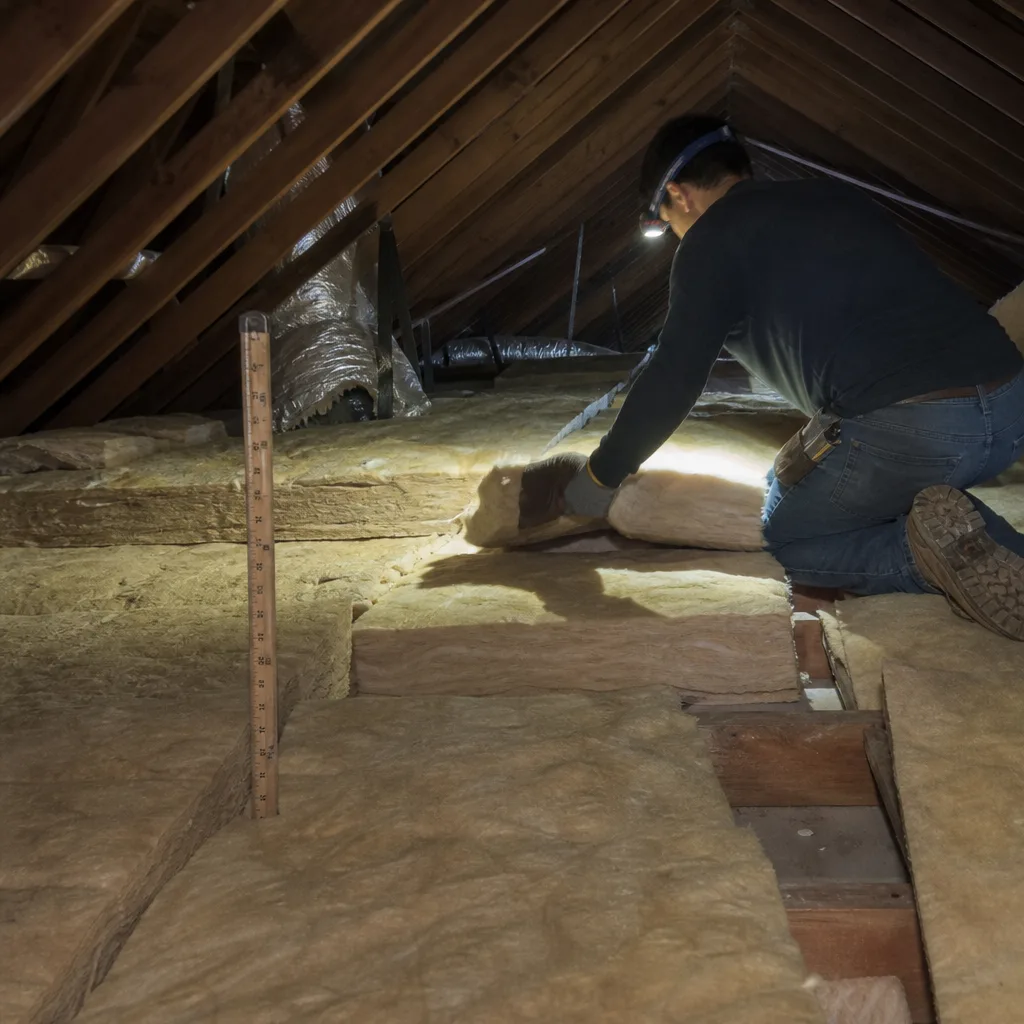
When we scope an attic in Los Angeles, we check three things before quoting: the type of existing insulation, whether it’s contaminated (rodent activity, roof leaks, or decades of dust), and whether the depth is salvageable. In some cases, old blown-in fiberglass can be topped off rather than removed. In others, it’s doing more harm than good and needs to go. A written quote that doesn’t mention this line item either means the contractor hasn’t looked in your attic yet, or plans to bill you for it later. Neither is how you want to start a project.
Air Sealing: Why Skipping It Undermines Your New Insulation
Insulation slows heat transfer. It does not stop air movement. Air moves through the gaps: around recessed light fixtures, plumbing penetrations, electrical chaseways, and where the ceiling meets the top plates of interior walls. In Los Angeles, where daytime attic temperatures in summer regularly hit 130°F or higher, that hot attic air gets pulled into the living space through every gap, carrying dust and allergens with it. Insulation alone, without air sealing, underperforms by 20 to 30% in real-world conditions.
Air sealing as a standalone service in Los Angeles costs $800 to $1,800 for a typical 1,200 to 1,500 sq ft attic, depending on how many penetrations need sealing, whether recessed lighting is present, and how accessible the eaves are. The work involves sealing top plates, wire penetrations, and plumbing stacks with gun foam or caulk, and weatherstripping the attic hatch. It’s meticulous work, and it’s the first thing cut from a quote when a contractor wants to win on number alone.
We quote air sealing as part of every attic insulation project in Los Angeles. Not as an upsell. As a line item. If you’re spending $4,000 on insulation and skipping the $1,200 air seal, you’re leaving roughly a third of the performance on the table. That math applies to every neighborhood, from Sherman Oaks to Eagle Rock to Westchester, because the physics of airflow doesn’t care about your zip code.
LADWP Rebates for 2026: What’s Available and Who Does the Paperwork
LADWP’s residential insulation rebate program remains active in 2026, paying per square foot for attic insulation upgrades that meet the utility’s minimum R-value thresholds. Current rebate amounts cover roughly 30 to 50% of the material cost for a standard attic, depending on your home’s baseline and whether any air sealing is included in the same project. Exact amounts vary by program cycle, so check the current LADWP residential efficiency page before you schedule. For related guidance, see our Insulation Permits, Codes & Inspections in CA: What You Need to Know.
The paperwork requirement is the part that surprises Los Angeles homeowners: LADWP requires a pre-installation photo or assessment documenting the existing insulation depth, a post-installation photo showing the new depth, and an invoice that breaks out the insulation work as a distinct line item separate from any other scope. If your contractor skips the before-photo, the rebate application stalls. If the invoice lumps insulation in with “general attic work,” the rebate review board kicks it back.
Here’s the step-by-step for LA homeowners:
- Confirm your home is served by LADWP (not SCE or Glendale Water & Power, which run separate programs).
- Have a contractor assess your current attic insulation depth and R-value. Get the “before” photo.
- Ask your contractor to itemize the insulation scope separately on the invoice, so the rebate reviewer can verify it.
- Complete the work to at least the minimum R-value the rebate program specifies.
- Submit the application with both photos and the itemized invoice. Most contractors will submit on your behalf; some don’t, so ask which way they handle it.
Your contract should state, in writing, whether the contractor prepares the rebate paperwork or hands you the documentation to file it yourself. If a contractor says the rebate “isn’t worth the trouble,” that’s a red flag: it’s your money, and the paperwork takes about 20 minutes once the photos exist. We prepare the LADWP documentation for every Los Angeles project we complete, and we tell you exactly what the rebate will cover before we start, not after.
A Sample Written Quote, Line by Line
Here’s what we’d write for a 1,350 sq ft attic in a 1960s single-story home in Los Angeles, replacing old blown-in fiberglass with new R-38 blown-in cellulose, including removal and air sealing:
- Remove and dispose of old blown-in fiberglass (1,350 sq ft at $2.25/sq ft): $3,038
- Air sealing package (top plates, penetrations, attic hatch weatherstripping): $1,450
- Blown-in cellulose, R-38 depth (1,350 sq ft at $3.60/sq ft): $4,860
- Attic hatch insulation cover and seal: $180
- Protection package (drop cloths, shoe covers, cleanup, disposal): $0, included
- Total: $9,528
- Estimated LADWP rebate (subject to program confirmation): $950 – $1,200
Every line item is labeled. Nothing is lumped under “miscellaneous.” If a quote you receive doesn’t look like this, here’s what to ask: What’s included in removal? Is air sealing quoted separately or excluded? Is the attic hatch being upgraded, or will you lose heat through it? Is disposal included, or will the old insulation be left curbside for you to handle? A contractor who can’t answer those questions in writing is telling you something about how the job will go.
We’ve walked into Los Angeles attics where a previous contractor blew new insulation on top of old rodent-contaminated fill because the homeowner wasn’t given a line-item quote and didn’t know to ask. That’s a $5,000 mistake that costs another $3,000 to undo. A written quote isn’t paperwork. It’s a floor plan for the job. Our Insulation Emergency Preparedness Guide for Los Angeles Homes covers how to avoid these costly surprises.
How Attic Size and Access Affect Your Price
Per-square-foot pricing assumes standard access and standard conditions. Real Los Angeles homes rarely deliver standard conditions. Here’s what changes the number: attic height and pitch, hatch location, ductwork layout, and the presence of recessed lighting cans that need to be protected from insulation contact.
A steep 12:12 pitch roof in the Hollywood Hills costs more to work under than a low-pitch 3:12 roof in the Valley, because the crew moves slower and works more carefully. An attic with a narrow scuttle hole in a hallway closet adds labor time for moving material and equipment. Ductwork running across the attic floor forces the team to work around it, and every duct chases another penetration that needs sealing. Recessed lights, especially older non-IC-rated fixtures, need to be either replaced or covered with protective boxes before insulation goes in, and that’s a legitimate line item most quotes leave out.
In our experience across Los Angeles, access conditions add 10 to 25% to a standard per-square-foot insulation cost. A 1,200 sq ft attic with clean, open framing and a pull-down stair in the hallway lands at the low end of every range. The same 1,200 sq ft with low pitch, ducts running parallel, and eight recessed lights lands at the high end. When a quote comes back lower than you expect for your attic’s conditions, ask if the contractor has actually been inside the attic yet. If they haven’t, the number isn’t final.
Spray Foam vs. Blown-In: The Real Cost Difference in LA
Open-cell spray foam (Icynene or Demilec products we install regularly) costs roughly double blown-in insulation per square foot. For a 1,200 sq ft attic, that’s $6,600 to $9,000 for foam versus $3,360 to $5,400 for blown-in. The honest question isn’t which costs less. It’s which problem you’re solving.
Blown-in insulation slows heat transfer through the attic floor. It works well in Los Angeles homes where the attic is separate from the living space, the HVAC ducts are minimal or well-sealed, and the ceiling plane is fairly airtight. It’s the right product for most single-story homes built after 1990.
Open-cell spray foam does something different: it seals and insulates in one pass. When sprayed on the attic floor or roofline, it fills the small gaps blown-in insulation can’t touch. In homes where ductwork runs through the attic, where the attic is converted or semi-converted, or where homeowners complain about fine dust drifting down from the ceiling, spray foam solves a problem blown-in can’t. Los Angeles homes in fire-prone interface zones also benefit from the added air-sealing effect, because it reduces ember intrusion paths through vented attics.
The short version: if your attic is empty storage space and your main concern is summer heat, blown-in is your product. If your attic holds ducts, equipment, or a bedroom you’ve been planning to finish someday, talk through the spray foam numbers before you decide. We carry both, and we’ll tell you which one we’d put in our own house under your roof pitch, in your neighborhood, with your family’s allergies.
Common Mistakes to Avoid
- Accepting a quote without looking in the attic first. A contractor who hasn’t seen your attic cannot know if the old insulation needs removal, whether the hatch seals, or how many penetrations need air sealing. If the quote arrived without a site visit, it’s an estimate, not a number.
- Assuming removal is included. In Los Angeles, many pre-1990 homes have old insulation that shouldn’t stay. If removal isn’t a line item, ask. Then get the answer written down.
- Skipping air sealing to save money. You’ll save $800 to $1,800 on the project and lose 20 to 30% of the insulation’s performance every year after. That’s a bad trade by any measure.
- Not confirming who handles the LADWP rebate. The rebate is real money, often $900 or more. If your contractor won’t prepare the documentation, that’s either inexperience or indifference. Neither belongs in your attic.
- Choosing a contractor based on the lowest written number. A quote that omits removal, air sealing, or hatch upgrades isn’t a better price. It’s a partial quote, and the balance comes due when the crew is already in your attic and you’ve lost your negotiating position.
- Ignoring attic access conditions. A low-pitch roof or tight scuttle hole isn’t an excuse for a vague “labor” line. It’s a specific cost you should understand before signing. Ask how the access conditions affect the quote and what the crew will do to work around them.
When to Call a Professional
Insulation work lives in the attic, which means you rarely see it and you can’t easily inspect it. You need a professional when the attic hasn’t been touched since the house was built, when you can’t identify what type of insulation is currently up there, or when rooms stay hot in summer and cold in winter despite running the HVAC. You also need a professional the moment anyone mentions vermiculite or you see evidence of rodents, because those require specific handling and containment protocols. Thistledown Attic Insulation offers free estimates in Los Angeles. Call (909) 768-6501 and a live person answers, any hour, any day. We’ll send a background-checked, uniformed technician who’ll walk your attic, take photos, and put a written price in your hand before any tools come off the van.
Frequently Asked Questions
Attic insulation in Los Angeles costs $2.80 to $7.50 per square foot installed in 2026, depending on material. A typical 1,200 to 1,500 sq ft attic with blown-in fiberglass or cellulose costs $3,400 to $6,800, while open-cell spray foam runs $8,400 to $15,000. Call (909) 768-6501 for an exact written quote, free, before any work starts.
Blowing over old insulation is cheaper upfront, typically by $1,800 to $3,600 for an average Los Angeles attic, because you skip removal. But if the old insulation is contaminated, compressed, or holding moisture, blowing over it seals those problems in. Removal costs $1.50 to $3.00 per square foot, and it’s the right call when the old material is doing more harm than good. We’ll show you photos of what’s actually in your attic before you decide.
Yes, LADWP continues to rebate a portion of attic insulation costs for Los Angeles homeowners who meet minimum R-value requirements, with typical rebates covering 30 to 50% of material costs. You’ll need before-and-after photos and an itemized invoice that breaks out the insulation work separately. We prepare that documentation for every LA project we complete, so the rebate gets filed correctly the first time.
Most Los Angeles attic insulation projects are completed in one day, including removal, air sealing, and new insulation. Open-cell spray foam takes slightly longer because of the application and curing process, usually finishing within a day and a half. We protect your floors with drop cloths, wear shoe covers from the front door to the attic hatch, and leave a photo of the finished cleanup before we go.
For most Los Angeles attics used only for storage, blown-in cellulose or fiberglass offers the best cost-to-performance balance. If your attic holds HVAC ductwork or you plan to finish the space eventually, open-cell spray foam from Icynene or Demilec often performs better because it seals the ceiling plane while it insulates. The right answer depends on your attic, and that’s something we figure out by looking, not guessing.
Yes. Where a choice exists between product lines, we select insulation that’s safe for households with pets and children. That includes blown-in cellulose from GreenFiber, which is treated with non-toxic borate fire retardants, and low-VOC open-cell spray foam options from Icynene and Demilec. If you have specific concerns about what goes in your attic, ask when you call (909) 768-6501, and we’ll explain exactly what product we recommend for your home and why.
The Bottom Line
Los Angeles insulation quotes vary by thousands of dollars because contractors scope the same attic differently. The fix is a written, line-item quote that shows removal, air sealing, insulation, hatch upgrades, and rebate paperwork as separate entries, so nothing hides and nothing gets added after the fact. Blown-in fiberglass and cellulose run $2.80 to $4.50 per square foot, open-cell spray foam runs $5.50 to $7.50, removal adds $1.50 to $3.00 when needed, and air sealing adds $800 to $1,800. If the quote you’re holding doesn’t look like the sample in this guide, ask why. If the answer makes sense, proceed. If it doesn’t, get a second look. Browse more guides & resources to compare approaches before you decide.
Contact us for a free estimate: (909) 768-6501. A live person answers, we show up on time, and you’ll have a written price in hand before we touch a single rafter. That’s how we’ve worked in Los Angeles since 2003.
Written by Neil Barron, Owner at Thistledown Attic Insulation, serving Los Angeles since 2003.