
Spray Foam Insulation: Repair or Replace? How Los Angeles Homeowners Decide
Most Los Angeles homes with spray foam insulation don’t need a full replacement, but they also don’t need the $400 “crack patch” job that ignores the real problem. The honest answer comes down to one diagnostic question: has the foam separated from the roof deck at the bond line, or is the damage only surface-level? If you’d rather not spend a Saturday in the attic figuring that out, call (909) 768-6501 and we’ll do it for free.
Here’s the thing nobody tells you about spray foam in LA: it can look perfectly fine from the attic floor while quietly failing where it matters most. And in a city where summer attic temperatures regularly push 140 degrees and marine-layer nights drop into the 50s, that hidden failure happens more often than you’d think.
The Bond-Line Problem: What Visual Inspections Miss in Los Angeles
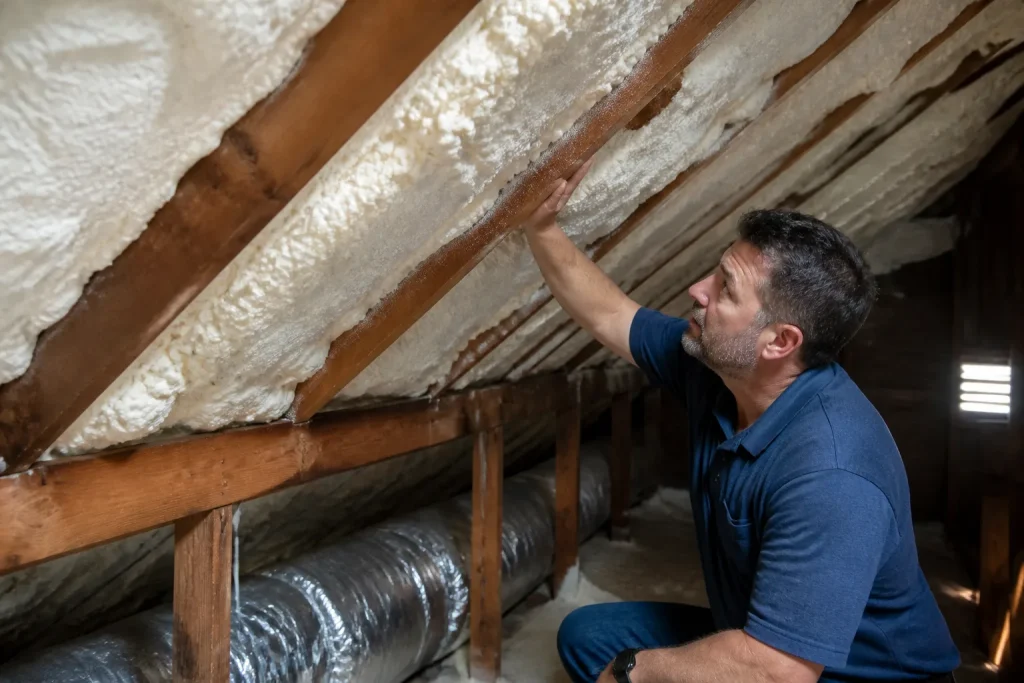
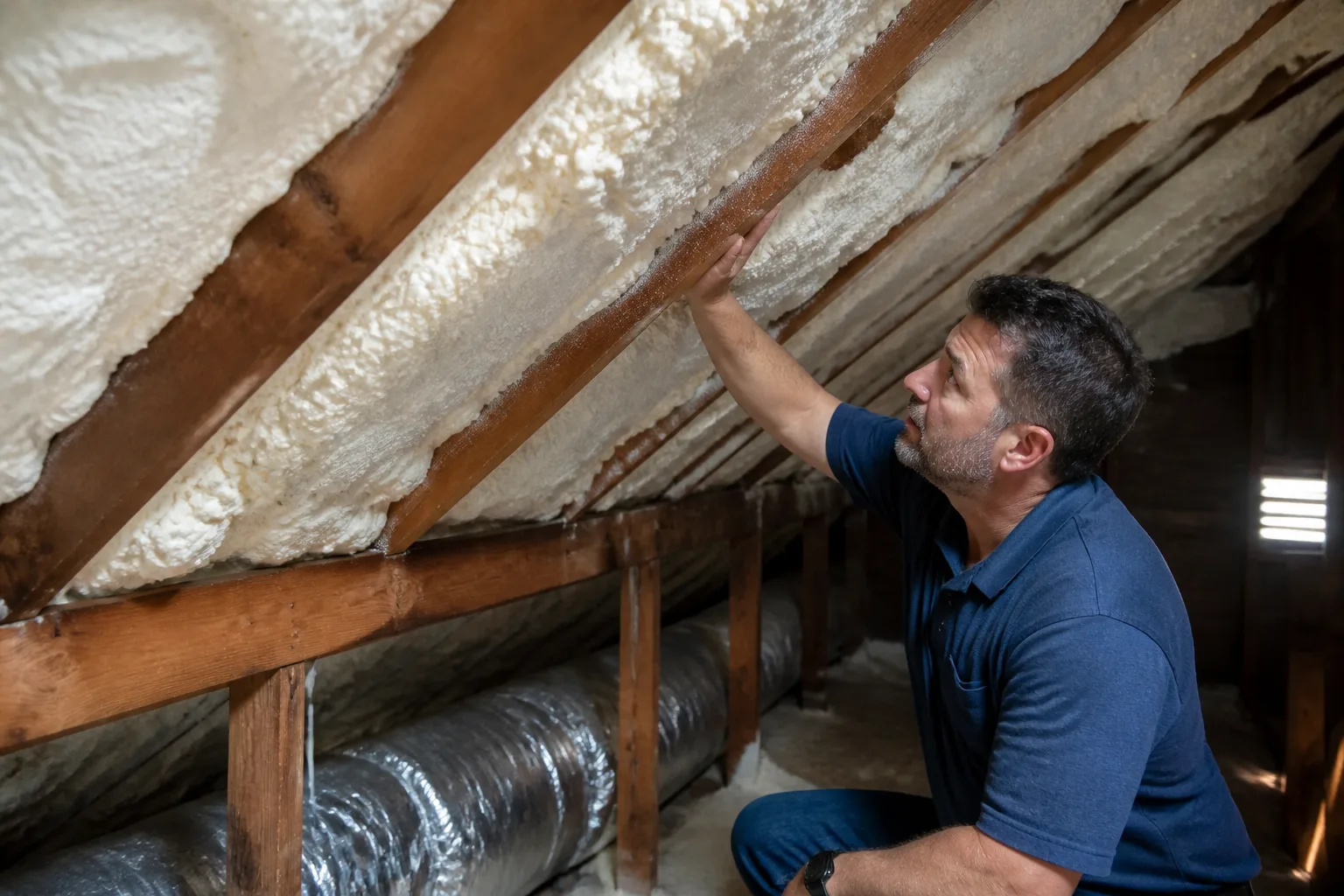
Spray foam insulation does its real work at the point where it adheres to the roof deck or wall sheathing. That contact line is called the bond line, and it’s the difference between an airtight attic and a foam shell that’s basically decorative.
In Los Angeles, we see bond-line separation constantly, especially in Craftsman-era homes built before 1940. The original roof decking in those houses is typically 1×6 tongue-and-groove fir or pine. Fir expands and contracts significantly with temperature swings. A hot August afternoon pushes the decking hard against the foam. A cool June night pulls it back. Repeat that cycle a few thousand times and the foam starts to let go.
The tricky part: you cannot see this from the attic floor. The foam still looks white or yellow, still looks thick, still looks like insulation. But run a thermal camera across it and you’ll see the telltale pattern: narrow bands of heat bleeding along the decking seams where the foam has pulled back a fraction of an inch. A fraction of an inch is enough. Air moves through gaps you can’t see.
We’ve done thermal scans on attics in Highland Park where homeowners were convinced their foam was fine. The visual inspection said fine. The thermal camera showed about 40% of the air-sealing value had been lost at the bond line. That’s the difference between a $400 cosmetic repair and a meaningful remediation, and you can’t make that call without the right diagnostic.
Three Repair Scenarios That Are Actually Worth Doing
Not every foam problem requires tearing anything out. Here’s where partial remediation makes financial sense in Los Angeles:
- Pinhole air leaks at seams and penetrations. Around vent pipes, electrical boxes, and recessed light housings, spray foam sometimes shrinks back just enough to create a small air channel. If the rest of the foam is well-adhered, a targeted re-spray or caulk-and-foam fix at those specific points solves the problem for a few hundred dollars.
- Minor surface oxidation. Closed-cell foam exposed to attic air for years can develop a thin, chalky oxidation layer on the surface. It looks worse than it is. As long as the foam underneath is sound and the bond line is intact, the oxidation can be scraped and re-coated without replacing anything.
- Localized shrinkage under 6 square feet. Sometimes one section shrinks because of a specific stress point: a patch that cured too fast on a hot day, or a spot next to a flue that runs hotter than expected. If the affected area is small and contained, cutting it out and re-spraying that section is straightforward and cost-effective.
What all three scenarios share: the surrounding foam is still doing its job. The damage is isolated. In Los Angeles, where energy costs keep climbing, a targeted repair that restores a few square feet of air seal can pay for itself in a single cooling season.
Three Replacement Triggers: When Full Remediation Is the Only Honest Answer
- Full substrate separation. If the thermal scan shows bond-line failure across a large portion of the roof deck, not just an isolated corner, patching is throwing money away. The foam has to come out and go back in properly. There’s no shortcut here, and any contractor who tells you otherwise is selling you a patch job that’ll fail again.
- Foam installed over existing moisture damage. This is a problem we’ve seen in older Los Angeles homes where a previous owner sprayed foam over a roof leak before fixing the leak. Spray foam locks moisture against the decking. If that moisture was there before the foam went on, the wood above the foam is slowly rotting, and no amount of surface repair addresses it. The foam comes out, the decking gets assessed, and only then does anything go back in.
- Open-cell foam used in an unvented attic without a vapor retarder. Open-cell foam is vapor-permeable. In an unvented LA attic that gets cold enough overnight during winter, warm indoor air can carry moisture up through the foam and condense against the decking. That moisture feeds mold and rots framing. If a previous installer sprayed open-cell without addressing vapor control, the only real fix is removal and a re-spray with the right product or the right vapor management strategy.
If you’re in Los Angeles and you suspect any of these three, call (909) 768-6501 before you spend money on anything else. A thermal scan tells us what we’re actually dealing with, and estimates are free.
What Title 24 Means for Spray Foam Replacement in LA
California’s Title 24 energy code is a real factor in the repair-or-replace decision, and most Los Angeles homeowners never hear about it until after the work is done. If you replace more than a threshold square footage of spray foam in your attic, the project can trigger a full Title 24 compliance inspection of the entire insulation assembly, not just the part you replaced.
That means the inspector may require documentation that the new insulation meets current R-value requirements, that any air barrier details comply with the code, and that the existing insulation you didn’t touch still meets minimum standards. In practice, this often means pulling out old fiberglass batts that predate the current code and bringing them up to standard.
This isn’t a reason to avoid replacement when replacement is genuinely needed. It is a reason to plan for the full scope of the job before you start. A written estimate that accounts for Title 24 implications up front is worth more than a lower bid that ignores them until the inspector shows up.
Our team walks every Los Angeles homeowner through the Title 24 question before any work begins. You’ll know exactly what the code requires, what it doesn’t, and what your written price includes. That’s the whole point of putting the number in writing first.
Repair Costs vs. Full Re-Spray: What Los Angeles Homeowners Should Expect
Here’s a realistic price picture for Los Angeles attic spray foam work in 2025, based on what we see across the city:
- Targeted pinhole sealing and small patching: Typically $400 to $900 depending on how many penetrations need work and how accessible they are. This is the “worth it” price range for small, isolated air leaks.
- Localized removal and re-spray of a damaged section: Usually $1,200 to $2,800 for areas up to about 60 square feet. The range depends on whether the old foam comes out cleanly and whether we need to mask off the attic to keep dust out of your living space.
- Full attic re-spray with closed-cell foam: For a typical 1,200-square-foot Los Angeles attic, expect $4,500 to $9,000. That range reflects product choice (Demilec and Icynene both make excellent closed-cell options, while CertainTeed covers broader insulation needs), roof pitch, access, and whether old insulation removal is required first.
Every Thistledown estimate follows the same process in Los Angeles: we inspect the attic, we run the thermal camera if the situation calls for it, we talk through exactly what failed and why, and then we hand you a written number before anyone touches a rafter. No ranges without commitment. No “we’ll see how it goes.” The price on the page is the price you pay.
We pulled one job out of a garage over in Mar Vista last month where the homeowner had two previous companies tell her the foam was fine. It wasn’t. The thermal camera showed bond-line separation across roughly a third of the roof deck. She’d been paying AC bills for an attic that was leaking air like a screen door. The fix was a partial re-spray, not a full replacement, and the written estimate meant she could plan the expense without holding her breath.
How a Qualified Installer Diagnoses Bond-Line Failure
You cannot diagnose spray foam bond-line failure with a flashlight and a good attitude. The tool that matters is a thermal imaging camera, used correctly, under the right conditions.
Here’s the process we follow in Los Angeles attics:
- We wait for a temperature differential. The clearest thermal images come when there’s at least a 15-degree difference between the conditioned space or exterior and the attic. In LA, that means early morning or late afternoon, not noon when the attic is one big hot blur.
- We scan from the attic floor first, then from a ladder at the ridge line. Bond-line separation shows up as thin, linear heat signatures along seams and edges. Surface cracking shows up differently: random, non-linear, and usually wider.
- We photograph every anomaly and show you the images. You should never have to take a contractor’s word for a diagnosis you can’t see. If they won’t show you the thermal images, the images probably don’t exist.
This is the step that separates a real diagnosis from a visual guess, and it’s the reason we tell Los Angeles homeowners to ask one question before hiring anyone: “Will you show me the thermal images?” If the answer is no, get a second opinion.
When to Call a Pro
Spray foam insulation is not a DIY product. Cutting into closed-cell foam without knowing what’s behind it can damage wiring, puncture plumbing vents, or release dust that you don’t want in your living space. Attempting to re-spray foam without proper temperature and humidity control creates a new set of problems: poor adhesion, off-ratio foam, and a bigger bill to fix the fix.
If you’re in Los Angeles and you’re seeing high energy bills, drafty rooms, or foam that looks dusty, shrunken, or cracked, the right move is a professional inspection. Not a sales pitch. Not a pressure quote. Just a real look at what’s happening in your attic.
Our crew treats your house the way we’d want someone to treat ours. Shoe covers from the front door to the attic hatch. Drop cloths across the hallway. Quiet tools when the baby is napping. And a photo of the clean-up before the van pulls away. Those aren’t add-ons. That’s the Cedarwell Care Promise, and it’s been the standard since 2003.
Related services in Los Angeles: Attic Insulation in Los Angeles and Spray Foam Insulation in Los Angeles. If you’re starting fresh, our full Thistledown Attic Insulation home page walks through what to expect.
The Bottom Line
Most spray foam problems in Los Angeles are repairable, but only when the diagnosis is based on bond-line adhesion, not surface appearance. If the foam is still stuck to the decking, targeted repairs for pinholes, oxidation, or small shrinkage make sense. If the bond line has failed across a large area, if moisture was sealed in, or if the wrong product was used in an unvented attic, full replacement is the only approach that restores real performance.
The diagnostic step is the one that saves or costs you money. A thermal camera gives an honest answer. A visual inspection gives a guess. And a written estimate, handed to you before any work starts, makes the whole decision easier to hold onto.
If you’re in Los Angeles and need help, Thistledown Attic Insulation offers free estimates. Call (909) 768-6501 and we’ll take a real look.
Frequently Asked Questions
Small targeted repairs in Los Angeles typically cost $400 to $900, while localized removal and re-spray of a damaged section runs $1,200 to $2,800. Full attic re-sprays on a typical 1,200-square-foot home range from $4,500 to $9,000. Call (909) 768-6501 for a written estimate specific to your attic, free of charge.
The reliable way is a thermal camera scan under a 15-degree or greater temperature differential between the attic and the exterior. Bond-line separation shows up as thin, linear heat signatures along decking seams. Surface cracks look different: wider, random, and non-linear. In Los Angeles, early morning or late afternoon scans give the clearest images.
It depends entirely on the failure mode. Pinhole air leaks and small shrinkage under 6 square feet are usually worth repairing for under $1,000. Full substrate separation or foam installed over moisture damage requires replacement, and spending money on patches will cost more in the long run. A free inspection with thermal imaging gives you the answer before you spend anything.
Targeted pinhole sealing and small patch work can often be completed the same day in Los Angeles. Sectional removal and re-spray typically takes one to two days, depending on attic access and the size of the damaged area. Call (909) 768-6501 and a live person will talk through your situation, day or night.
Written by Neil Barron, Owner at Thistledown Attic Insulation, serving Los Angeles since 2003.
Need Insulation Help?
Call Thistledown Attic Insulation - licensed & insured, here with fast after-hours help in Los Angeles.
(909) 768-6501