
CertainTeed Attic Insulation in Los Angeles: A Homeowner’s Guide
CertainTeed’s Sustainable Insulation line is GreenGuard Gold certified, which means it has passed chemical emission standards modeled for children’s exposure, and that matters in a Los Angeles home where windows stay closed half the year and whatever is in the attic drifts down through ceiling cracks. GreenGuard Gold requires testing against more than 10,000 VOCs and chemical compounds, and CertainTeed is one of only a handful of fiberglass insulation brands that has earned it. If you’re weighing attic insulation options in Los Angeles and want the full picture before anyone climbs through your attic hatch, this guide covers what the certification actually means, which CertainTeed products fit your ceiling assembly, what the paperwork looks like under Title 24, and what an install day should look like when there’s a baby napping two rooms over. If you’d rather skip the research and get a written price from a crew that installs this stuff every week, call (909) 768-6501.
What GreenGuard Gold Actually Tests For
Most homeowners never hear about GreenGuard Gold because it’s not on the contractor’s quote sheet. So let’s walk through it plainly. The certification, run by UL Environment, tests products for emissions of volatile organic compounds, formaldehyde, phthalates, and a long list of other chemicals. The “Gold” tier tightens the threshold specifically for schools and children’s environments, which means the acceptable emission levels are set with a child’s smaller body weight and higher respiration rate in mind. For a fiberglass insulation product to pass, it has to keep emissions below those stricter limits for a defined period after installation.
Why does this matter in a Los Angeles attic? Because Los Angeles homes are not all the same, but a huge share of them were built before 1980 with minimal attic ventilation and no mechanical fresh-air system. When the AC runs all day in July, the house is sealed up and air recirculates. If your attic insulation is emitting anything, it has a path into the living space: ceiling penetrations, can lights, attic hatches, the gap around the chimney chase. Fiberglass insulation does not off-gas the way spray foam can, but the binder resins in some fiberglass products do release formaldehyde and other compounds at low levels, especially in the first weeks after installation. GreenGuard Gold certification means CertainTeed’s Sustainable Insulation line was tested and held below the child-exposure thresholds for those compounds. That’s a specific, verifiable fact, and it’s one we wish more parents asked about before signing a contract.
One thing to be clear about: GreenGuard Gold applies to the Sustainable Insulation line, not every CertainTeed product. We’ll get into the product distinctions below, because “CertainTeed attic insulation” is not one thing, and the right choice depends on your attic configuration and how tight your home is.
CertainTeed Product Lines for Los Angeles Attics
CertainTeed, part of the Saint-Gobain family of building products, makes three insulation lines that show up most often in Los Angeles attics. They are not interchangeable, and the wrong one in the wrong ceiling assembly is a waste of money. Here’s what each one is built for.
Sustainable Insulation (blown-in fiberglass)
This is the GreenGuard Gold certified line, and it’s a blown-in loose-fill fiberglass product. It’s manufactured with a high percentage of recycled glass content and no added formaldehyde. The product settles after installation, so the installer has to account for settled density to hit the labeled R-value. CertainTeed publishes settled density targets for each R-value level, and a crew that doesn’t hit those numbers is giving you less insulation than the bag says. In Los Angeles attics, where we typically install blown-in insulation to an R-38 or R-49 level depending on your home’s age and mechanical setup, density control is the difference between an honest job and a bag-count shortcut. If you ever want to check this yourself, ask the crew to show you the ruler marks on their installation chart, not just the bag count at the curb.
InsulSafe SP (blown-in, premium)
InsulSafe SP is CertainTeed’s premium blown-in fiberglass, and it’s built for attics where airflow and thermal consistency matter. It has a slightly higher R-value per inch than the Sustainable line when installed correctly, and it’s engineered to resist settling over time. For Los Angeles homes with knee-wall attics, cathedral ceilings, or irregular framing bays, InsulSafe SP gets the nod because it fills odd cavities without the gaps that batts leave behind. It does not carry the same GreenGuard Gold certification as the Sustainable line, so if you’re choosing between the two and air quality is your top variable, that distinction should guide you.
CertaPro Batts (fiberglass batts)
CertaPro is CertainTeed’s batt line, cut to fit standard 16-inch and 24-inch framing bays. It’s what we use in attics with deep, accessible joist bays where batt installation is cleaner and simpler than blown-in. CertaPro batts are available unfaced or faced with a vapor retarder, which matters in Los Angeles because our climate zone doesn’t want a vapor barrier on the warm side of the assembly. We’ll get into that in the Title 24 section, but the short version: in most Los Angeles ceilings, unfaced or lightly faced batts are the correct call, and a contractor who defaults to heavy-faced batts is importing a Midwest detail that can trap moisture.
Why Saint-Gobain Supply Chain Consistency Matters for Blown-In
CertainTeed is a Saint-Gobain company, which is a big deal only because of what it does to manufacturing consistency. Blown-in fiberglass insulation only hits its rated R-value if the fiber distribution and density are consistent bag to bag. That’s a manufacturing precision problem, not just an installation skill problem. When a plant runs consistent glass chemistry and consistent fiberizing conditions, the installer can rely on the published coverage chart. When it doesn’t, the same number of bags can produce different settled depths and different R-values in different parts of the attic.
In Los Angeles, we see this play out in older neighborhoods like Eagle Rock and Highland Park, where attics were framed in the 1920s and 1930s with inconsistent joist spacing and weird heights. In those attics, an installer has to know the product’s settled density behavior well enough to adjust on the fly. A product with tight manufacturing tolerances makes that possible. A product with loose manufacturing tolerances makes every attic a guessing game. That’s not a sales pitch for CertainTeed specifically, it’s a reason to care about which blown-in fiberglass your contractor uses, regardless of brand.
Title 24, Certifications, and Your Paperwork Trail
Los Angeles is in California, and California has Title 24, the state’s building energy code. When you add attic insulation, the work has to be documented to show that what was installed matches what was specified for your climate zone. For Los Angeles, which sits in Climate Zone 9 or 10 depending on your exact neighborhood, that usually means attic insulation at R-38 or higher for most homes built since the code was adopted. Older homes that are being retrofitted sometimes fall under different rules, but the general requirement is that the insulation meets the prescriptive R-value for the zone and that the contractor documents it.
CertainTeed runs an installer certification program called CIFS, which stands for CertainTeed Insulation Fundamentals Specialist. A CIFS-certified installer has passed training on proper installation methods, coverage math, and documentation. That matters for your paperwork because a CIFS installer is trained to produce the coverage chart and depth documentation that building inspectors and future home buyers ask for. When you sell a home in Los Angeles, the buyer’s inspector may check the attic insulation depth and ask for the install documentation. If a flipper installed R-19 in a zone that requires R-38, you’re going to hear about it at closing. A clean documentation trail, with the product name, installed depth, and settled R-value written down, turns that conversation from a negotiation headache into a box you check and move past.
One note from our work in Los Angeles: slab-on-grade homes built in the 1950s and 1960s, which are all over the San Fernando Valley, often have no attic access documentation at all. The attic hatch is a small cutout in a hallway closet, and whatever insulation was blown in during the Nixon administration has settled to R-8. When we open those hatches, the first thing we tell the homeowner is that the Title 24 paperwork will be complete before we leave, because that’s the only way the job is actually finished. It’s not an upsell, it’s the state’s minimum standard, and it protects the resale value of the house.
Install Day Checklist: What to Ask Before the Crew Enters the Attic
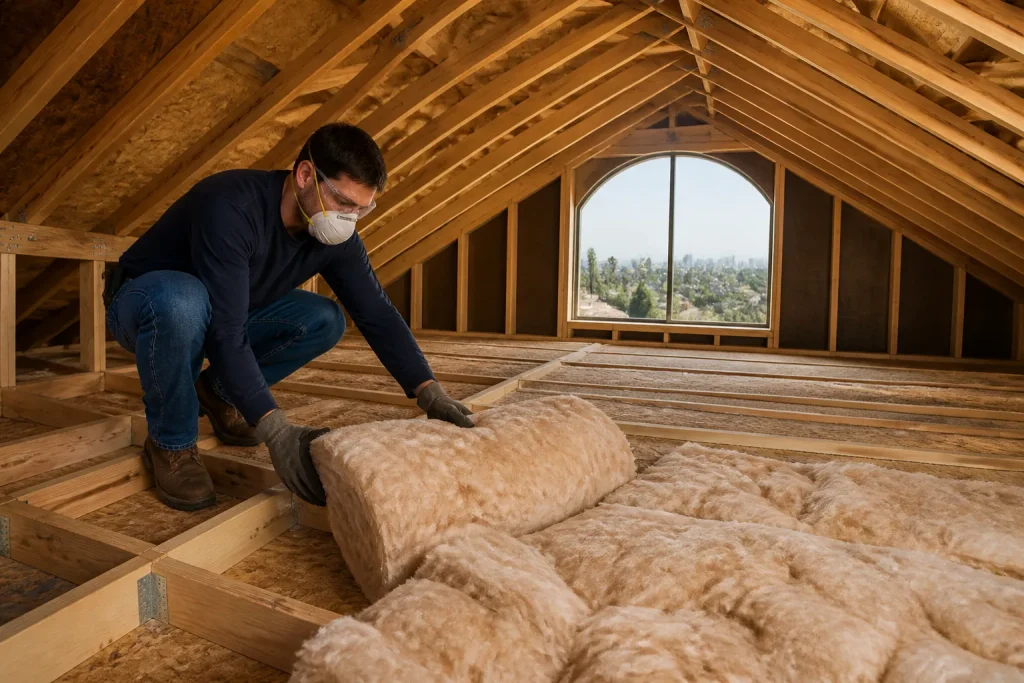
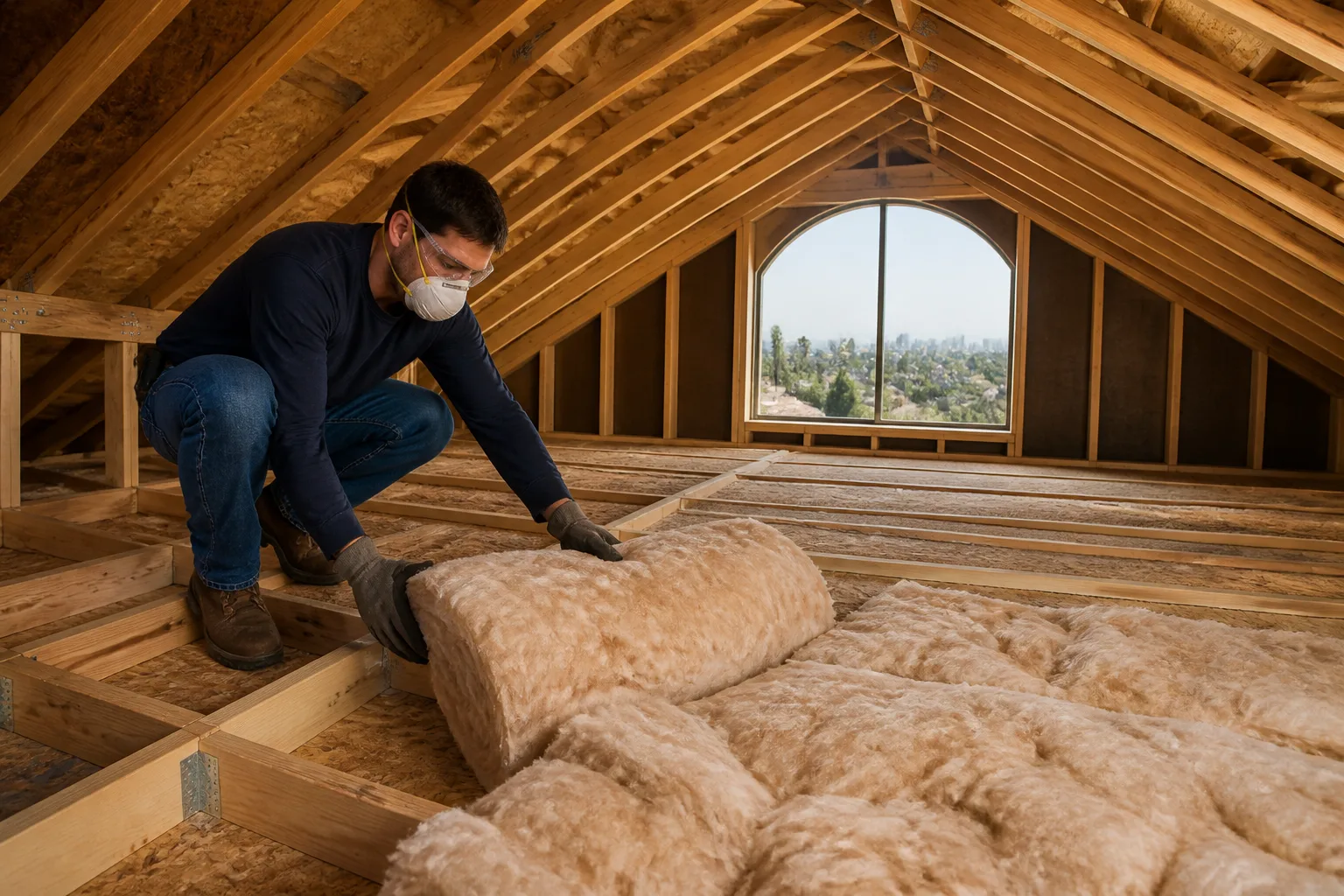
If you have kids and pets, the attic access point is rarely in the garage. It’s usually in a hallway ceiling, sometimes inside a bedroom closet, which means the crew will be walking through the living space to get there. Here’s what we tell Los Angeles homeowners to ask before anyone climbs the ladder, and what a good crew does without being asked:
- Dust containment protocol. Blown-in insulation is dusty. Ask what the crew does with the attic hatch opening during the install. We hang a plastic barrier from the hatch frame to the floor, tape the edges, and run a dust-control fan at the opening so the attic dust stays in the attic. If the answer is “we’ll be careful,” ask again with more specifics.
- Shoe covers and floor protection. This should be automatic. We lay drop cloths from the front door to the attic hatch and wear shoe covers the entire time we’re inside the house. If the crew tracks in attic dust on their boots, you’ll be vacuuming it out of the carpet for weeks.
- Re-occupancy timing. For blown-in fiberglass, the dust settles quickly once the install is done, but we recommend keeping kids and pets out of the immediate area for a few hours while the dust settles and the air clears. Ask the crew what they recommend for your specific home and product.
- Access to bedrooms. If the attic hatch is in a child’s bedroom, ask the crew to schedule that part of the work around nap time or move the child to another room for the day. It’s not a big ask, and a crew that gives you a hard time about it is not a crew you want in your house.
- Photo documentation. Ask the crew to photograph the attic before and after, including the hatch area and the hallway floor. We take a photo of the clean-up before we leave, every single time, and send it to the homeowner. It’s a small thing that eliminates a whole class of “I think they tracked something in” worry.
When the install involves spray foam, the re-occupancy timing is different and longer, and the ventilation requirements change. We cover that in more detail on our Spray Foam Insulation in Los Angeles page, but the short version is that you should never let anyone install spray foam in your attic without a clear plan for temporary ventilation during off-gassing, which for most products is a few hours to a day.
The Bottom Line
CertainTeed’s Sustainable Insulation line earns GreenGuard Gold certification because it passes over 10,000 chemical emission tests at children’s exposure levels, and that’s the single most under-discussed fact in residential insulation. InsulSafe SP and CertaPro batts are solid products too, but they serve different purposes in different attics. For a parent in Los Angeles wondering what goes above the baby’s room ceiling, the answer is not “fiberglass insulation,” it’s “GreenGuard Gold certified blown-in fiberglass, installed at the correct settled density, documented for Title 24, with a plastic dust barrier at the hatch.” The product choice matters, and so does the crew that installs it, because a loose-density blown-in job loses R-value and a sloppy install puts dust in your carpet. If you’re in Los Angeles and want a written price on CertainTeed attic insulation, Thistledown Attic Insulation offers free estimates. We install CertainTeed products alongside Owens Corning, Johns Manville, Knauf, and GreenFiber, and we’ll match the right one to your attic and your family’s needs, then put the number in writing before we touch a rafter.
We pulled a dusty old blower hose out of a Silver Lake attic last month that had been sitting up there since the Carter administration, and the homeowner said he’d been paying to heat the raccoons’ living room. It’s funny until you look at the utility bill. We’ve seen the same thing in attics from Pasadena to El Segundo. If you’d rather not wonder what’s up there, call (909) 768-6501 and a live person will answer, any hour, any day.
If you’re still comparing products and want to see how CertainTeed stacks up against the other major brands we install, start with our Attic Insulation in Los Angeles page, which covers the full range of options and what they cost in this market.
Frequently Asked Questions
Yes, if you have young children or anyone in the home with respiratory sensitivities. GreenGuard Gold tests for over 10,000 VOCs and chemical compounds at emission thresholds modeled for children’s exposure, which is a stricter standard than the general GreenGuard certification. CertainTeed’s Sustainable Insulation line carries this certification, which means it has been independently verified to keep emissions below those child-specific limits. For the fiberglass insulation category overall, it’s a differentiator, not an industry standard, so ask for it by name.
Attic insulation projects in Los Angeles typically range from $1,800 to $4,200, depending on attic size, existing insulation removal, access difficulty, and target R-value. CertainTeed blown-in fiberglass sits in the middle of that range, comparable to Owens Corning and Johns Manville equivalents. The larger cost variable is usually not the product but the labor: attic prep, old insulation removal, air sealing, and the documentation work all change the number. For an exact written price on your attic, call (909) 768-6501 and we’ll send someone out to measure and quote it, no obligation and no range guessing.
Yes, in most cases. Attic insulation installs are typically one-day jobs for homes up to about 2,500 square feet, assuming no old insulation removal or air sealing work is needed. Larger attics, attics with difficult access, or jobs that include removing old rodent-damaged insulation can take longer. If you need it done quickly, call (909) 768-6501 and we’ll tell you what’s realistic for your specific home, not a generic timeframe.
Yes, for blown-in fiberglass insulation. The work is contained to the attic, and with a proper dust barrier at the hatch, the living space stays clean. We do recommend keeping kids and pets out of the room directly below the attic access point for a few hours after the install finishes, just to let any residual dust settle. Spray foam is a different story, with longer re-occupancy windows and ventilation requirements. Talk to your installer about the specific product going into your attic and what your family should plan for. Call (909) 768-6501 if you want to talk through the details for your home.
Written by Neil Barron, Owner at Thistledown Attic Insulation, serving Los Angeles since 2003.
Need Insulation Help?
Call Thistledown Attic Insulation - licensed & insured, here with fast after-hours help in Los Angeles.
(909) 768-6501