
Fast, Reliable Attic Insulation Across Castro Valley
Attic insulation in Castro Valley typically costs between $1,800 and $4,600 for a full removal-and-reinsulation job on a 1,200 to 1,800 square-foot ranch home, with most projects completed in a single day. The valley floor’s cold-air pooling makes under-insulated attics work harder here than homeowners expect, especially in those 1950s and 1960s ranch homes that line the streets around Castro Valley Boulevard and Lake Chabot Road. We dispatch crews to Castro Valley neighborhoods six days a week, and a live person answers when you call (909) 768-6501. You’ll get a written price before anyone picks up a tool.
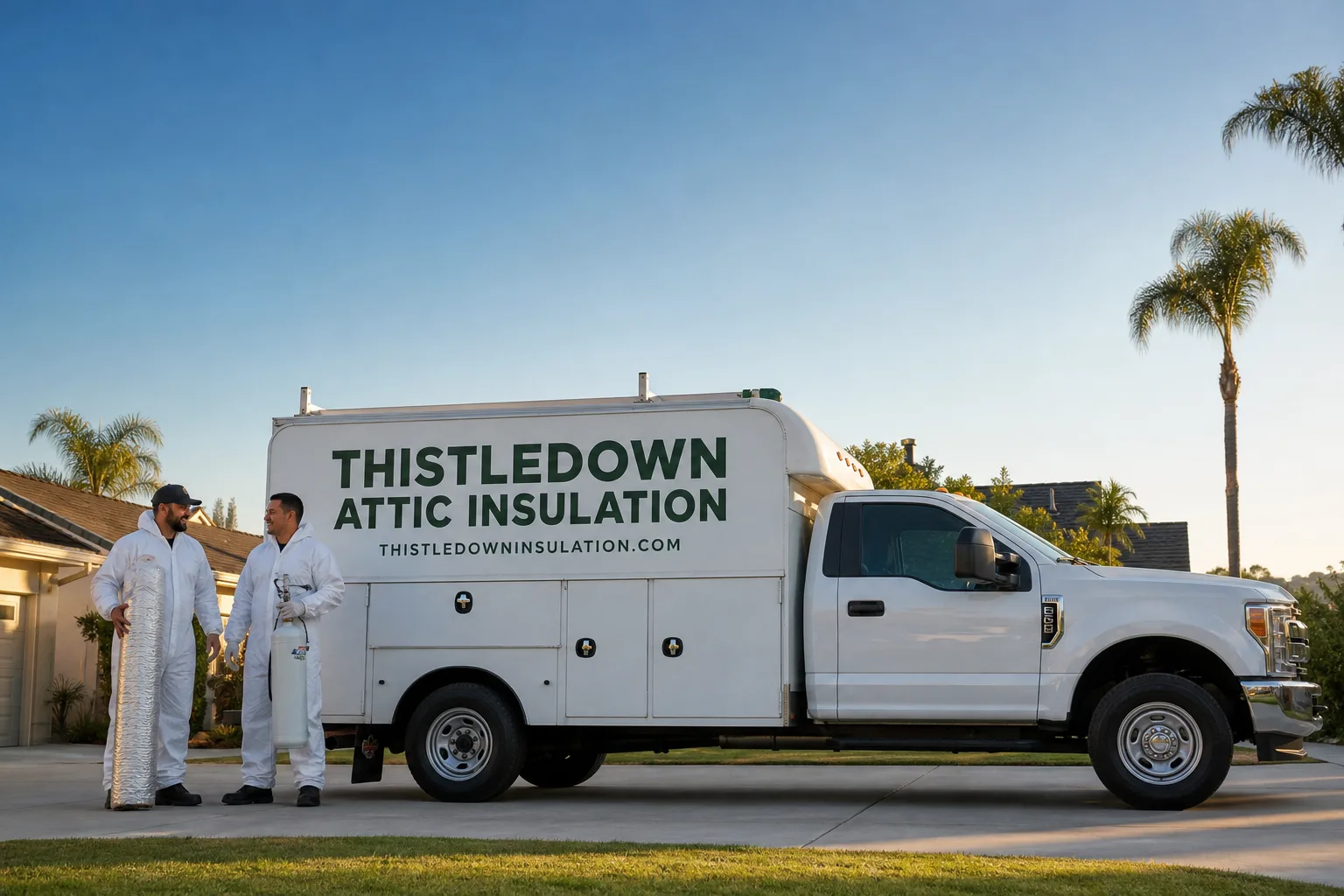
Thistledown is the soft fluff of the thistle – one of nature’s lightest insulators. The name is a promise about how carefully we work. Shoe covers at the front door, drop cloths down your hallway, and a photo of the clean-up before our van pulls away.
Why Thistledown Attic Insulation Is Castro Valley’s Preferred Attic Insulation Company
Castro Valley homeowners call us because we treat the house like it’s our own, which matters when the crew is working above the kids’ bedrooms while the baby naps. We wear shoe covers from the front door to the attic hatch, lay drop cloths across the hallway and any room we pass through, and choose quiet tools when a child is sleeping. Before work starts, you get a written price. Not a range, not an estimate with fine print – a number in writing. That’s the Cedarwell Care Promise, and it’s how every Thistledown Attic Insulation job is run.
Our technicians are background-checked and uniformed, so you know exactly who’s walking through your door. Every Castro Valley job is backed by the 365-Day Done Right Promise: if it’s not done right, we make it right. No debate. Founded in 2003 as part of the Cedarwell family of independently owned insulation companies, Thistledown brings a level of care most people don’t expect from a trades crew.
When you call, a live person answers – 24 hours a day, 7 days a week. No voicemail trees, no next-business-day callbacks. If you’ve got a question about insulation at 9 p.m. on a Sunday, someone picks up and helps.
Attic Insulation Removal in Castro Valley
Attic Insulation Removal in Castro Valley means pulling out old fiberglass batts, blown-in cellulose, or whatever’s been sitting in the attic for decades, and hauling it away before new insulation goes in. We see this need constantly on valley-floor homes, where cold air settles overnight and wicks moisture into kraft-faced batts from underneath. The paper facing absorbs that dampness, the batts sag and compress, and the R-value drops years before the material should have failed.
A typical removal-and-replacement on a Castro Valley ranch runs $1,800 to $4,600 depending on attic size, access, and how much damaged material needs to come out. The removal itself usually costs $500 to $1,200 of that total. We handle everything: bagging, vacuuming, sanitizing if rodents have been present, and disposal.
When Removal Is the Only Option
If your original 1950s or 1960s insulation has been soaked by the valley’s daily moisture cycling, compressed by decades of storage, or turned into a rodent highway, adding new insulation on top just buries the problem. We pulled out kraft-faced batts on a 1958 ranch near Castro Valley Boulevard that had been compressing against the roof deck for years – cold, damp air had wicked into the paper facing from below. The homeowner had no idea until their heating bills climbed and the attic smelled musty. Removal opened the floor back up, and after air-sealing and new insulation, their morning furnace runtime dropped noticeably.
Treated as a Whole-Job, Not a Rip-Out
We don’t just remove and leave. Removal pairs with air-sealing the top plates, can lights, and any chase penetrations before new insulation goes in. On Castro Valley homes, skipping the air-sealing step means trapping moist air against the roof deck during the daily temperature swing between chilly mornings and warm afternoons. We seal first, then insulate. Every time.
Blown In Insulation in Castro Valley
Blown In Insulation in Castro Valley refers to loose-fill fiberglass or cellulose that’s blown across the attic floor to hit R-38, R-44, or R-49 – the levels homes built before California’s Title 24 energy codes almost never have. Blown-in fiberglass using Owens Corning or Johns Manville material runs $1,400 to $3,200 for a typical 1,200-to-1,800-square-foot attic in Castro Valley, including air-sealing prep. It’s usually a one-day job.
Why blown-in rather than batts? Because attics here are rarely clean rectangles. Vaulted sections, odd framing, can light housings, and old ranch-home truss patterns make loose-fill the cleanest way to get consistent depth and coverage. The material settles into every corner and around every wire, and we use marked depth gauges so you can see exactly what R-value you got – not a guess.
Why Air-Sealing Precedes the Blow-In
On valley-floor homes in Castro Valley, cold air pools at night and creates a stack effect: warm indoor air rises into the attic, meets cold surfaces, and condenses. If we blow insulation over unsealed top plates and penetrations, that moist air gets trapped against the roof deck. The daily temperature inversion here – locals feel it, regional forecasts often miss it – makes air-sealing non-negotiable. We seal, then we blow. Skipping this step is how you get condensation damage and mold six months after a “cheap” insulation job.
GreenFiber for Pet-Safe, Rodent-Resistant Attics
Some Castro Valley households prefer GreenFiber blown-in cellulose because it’s treated with borates that deter rodents and insects naturally, and it’s a low-VOC product. If you’ve got kids, pets, or a history of attic critters, we’ll match the product to the family. We install eight brand lines – Owens Corning, Johns Manville, Knauf, Rockwool, CertainTeed, Icynene, Demilec, and GreenFiber – so you get the right material, not just whatever’s on the truck.
Trusted Brands We Service in Castro Valley
We install Owens Corning, Johns Manville, and GreenFiber insulation systems in Castro Valley attics, and we always match the product to the home and the family rather than pushing a single brand. If you need a specific material – pet-safe cellulose, dense-pack fiberglass, or a particular R-value spec – we stock it locally and can usually schedule your job the same week you call. The right brand matters less than the right application, but having eight manufacturers to choose from means we never force a square peg into a round attic.
Common Attic Insulation Problems We See in Castro Valley Homes
- Moisture-wicked kraft-faced batts. On valley-floor homes, cold air settles overnight and creeps under the eave vents, wicking into the paper facing of original batts. They sag, compress, and lose R-value years before they should.
- Pre-Title 24 under-insulation. Castro Valley’s 1950s-to-1970s ranch homes were built when attic insulation was optional. Most original attics sit around R-11 to R-19, well below the R-38 minimum now required under California Title 24.
- Corroded fasteners and dropped radiant barrier netting. Decades of condensation cycling rust the staples and fasteners that hold old batt netting and radiant barriers. Panels drop away from the roof deck, leaving gaps that defeat the whole system.
- Rodent disturbance in valley-floor attics. Cold, damp air settling into crawl spaces and attics draws rodents looking for warmth. We regularly find chewed batts, urine-soaked corners, and nests near Castro Valley Boulevard homes where moisture accumulates under the house.
Pricing for Attic Insulation in Castro Valley, CA
A full removal-and-reinsulation job in Castro Valley runs $1,800 to $4,600. Blown-in fiberglass alone – without removal – typically costs $1,400 to $3,200 for a standard ranch attic. The attic size, current insulation condition, access difficulty, and whether air-sealing is needed all move the number within those ranges. We give you a written price before any work begins, and that number doesn’t change unless you ask for scope changes. No vague ranges, no “we’ll see how it goes.” Call (909) 768-6501 for a free estimate – someone answers, day or night.
We Also Serve Cities Near Castro Valley
Our crews also serve Castro Valley neighbors in San Lorenzo, San Leandro, Union City, and Dublin. If you’re in any of these communities and need a written attic insulation price, call us – dispatch and scheduling are coordinated from the brand’s San Francisco Bay Area office, and we run local crews throughout the East Bay.
Serving Castro Valley, CA - Our Local Coverage Area
We’re based in the Castro Valley area and know this community well. Use the map below to see our service coverage - if you’re nearby, we can almost certainly help.
FAQs About Attic Insulation in Castro Valley
At night, cold air drains down from the surrounding hills and pools on the valley floor, creating a temperature inversion that regional forecasts often miss. That cold, damp air settles under your eave vents and wicks into kraft-faced batts from underneath. The paper facing absorbs moisture, the batts sag, and the R-value quietly disappears. Air-sealing before any new insulation goes in is the fix. Call (909) 768-6501 and we’ll walk you through what’s happening in your attic.
California Title 24 requires R-38 minimum in attic insulation, and we generally recommend R-44 to R-49 for Castro Valley’s cold-air-pooling microclimate. A 1958 ranch almost certainly has original insulation sitting between R-11 and R-19, if it has any at all. Blowing in Owens Corning fiberglass to R-49 is the standard upgrade we do on these homes, and it’s usually a one-day job.
Yes, and removal typically adds $500 to $1,200 to the job. If your old insulation is damp, rodent-damaged, or compressed – patterns we see constantly on valley-floor homes – we remove it and haul it away before air-sealing and blowing in the new material. Adding new insulation over failed old insulation just buries the moisture problem.
We install Owens Corning, Johns Manville, and GreenFiber bladder-insulation systems, among eight brand lines total. If you want pet-safe cellulose or a specific fiberglass spec, we’ll match the material to your household. The right brand is the one that fits your attic and your family’s needs, not whatever’s left on the truck.
Castro Valley’s bowl-shaped topography means overnight lows run several degrees colder than Hayward or San Leandro – cold air drains down the hills and pools on the valley floor. That daily temperature swing creates moisture cycling that inland flatland attics don’t experience. Blown-in insulation without air-sealing in Castro Valley can trap that moist air against the roof deck and cause condensation damage within a year. We seal first, every time.
Written by Neil Barron, Owner at Thistledown Attic Insulation, serving Castro Valley since 2003.