
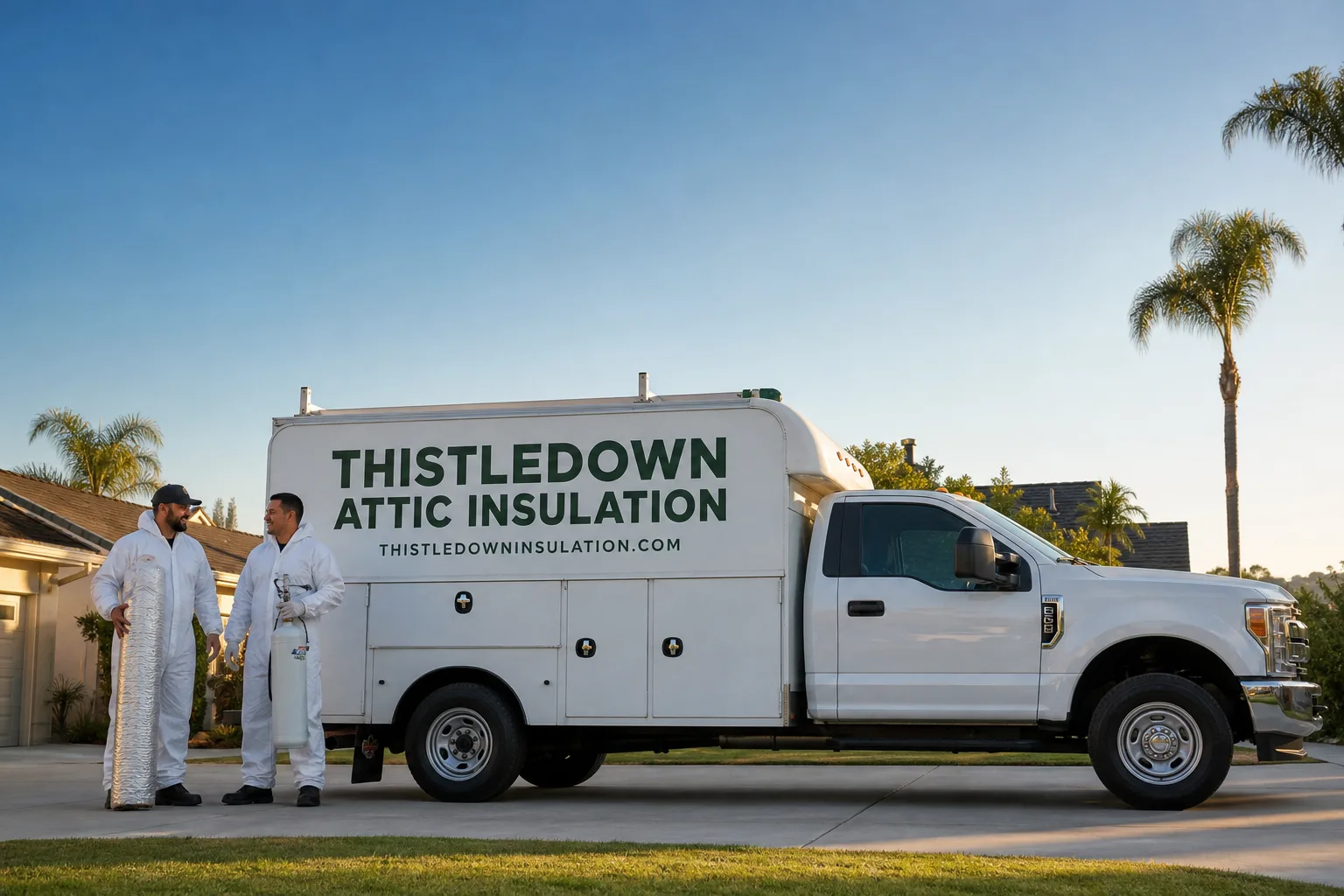
Fast, Reliable Attic Insulation Across Downey
Attic insulation in Downey usually costs between $1,800 and $4,900 depending on attic size, access, and what’s already up there. Most of the ranches we work on south of Firestone and east of Lakewood Boulevard were built between 1945 and 1965, and many have empty wall cavities and compacted attic batts that stopped doing their job decades ago. We’re Thistledown Attic Insulation, a Cedarwell-family company, and we serve all of Downey with crews who know exactly what these postwar stucco homes need. If your upstairs rooms bake in July and your heater runs all night in January, call (909) 768-6501 and we’ll give you a written price before anyone touches a rafter.
Why Thistledown Attic Insulation Is Downey’s Preferred Attic Insulation Company
We were founded in 2003, and the Downey homes we work on today are the same ones we’ve been learning from for two decades. The 1950s ranch on Paramount Boulevard, the 1960s stucco near Furman Park, the split-levels east of the 605 where families have lived for three generations – we know these houses. Our crews arrive in uniform, background-checked, and they lay drop cloths from your front door to the attic hatch before a single tool comes out. You’ll get a written price before work starts, every single time. No ranges that drift upward, no surprise line items.
Downey homeowners call us because we explain what we’re doing and why. When we drill stucco for a blow-in wall retrofit, we tell you we’ll patch and paint those holes before we leave. When we pull out sixty-year-old batts, we show you the photo of the clean-up before the van pulls away. Neil Barron, who leads our team, holds every job to the Cedarwell Care Promise: clean floors, quiet tools when children are sleeping, and pet-safe product options where a choice exists. If something isn’t done right, our 365-Day Done Right Promise means we fix it. No debate, no fine print.
Attic Insulation Problems Specific to Downey’s Postwar Ranches
Downey sits about 12 miles inland, and it loses most of the Pacific marine layer that keeps Long Beach and Seal Beach mild. Summer highs here routinely push into the mid-90s, while winter nights dip into the low 40s. That’s a wider temperature swing than coastal LA, and it punishes homes that were insulated – if at all – for a climate that never quite arrives. The city’s residential landscape is dominated by 1950s to 1965 tract homes, wood-frame with stucco exteriors, built during a postwar boom when California’s mild reputation led contractors to skip wall insulation entirely.
This is the single biggest thing we see on Downey retrofit jobs: stud bays that are completely empty. Not degraded insulation. Never installed. On a 1957 stucco ranch off Paramount Boulevard, our crew drilled the exterior for a blow-in retrofit and ran the bit through an entire stud bay without hitting a scrap of material. The house had been framed and closed with empty walls since day one. We packed the bays with GreenFiber cellulose, air-sealed the top plates, and blew Owens Corning fiberglass across the attic floor to R-38. By the next mid-90s afternoon, the homeowners told us the back bedrooms were finally holding temperature instead of baking.
That’s the difference between coastal-grade work and what Downey actually needs. If you treat a 1958 Downey stucco ranch like a Seal Beach beach house, you’ll get coastal results – which means an attic that still cooks in August. Our Attic Insulation team looks at the house as it sits, on its own lot, in this inland climate.
Attic Mold Removal in Downey
Attic mold removal in Downey means addressing the warm, trapped moisture that accumulates in poorly ventilated 1950s attics – and then fixing the airflow so it doesn’t come back. Downey’s inland heat paired with cool winter nights creates condensation inside attic cavities, especially when original vents were undersized or blocked by old insulation. Mold can appear on roof sheathing, rafters, and the underside of the roof deck. Left alone, it spreads and degrades the framing.
When a Downey homeowner calls us about mold in the attic, we first identify the moisture source. Sometimes it’s a bathroom fan vented into the attic instead of outside. Sometimes it’s a missing baffle at the eaves. We remove affected insulation, treat the framing, and install proper ventilation before new insulation goes in. We don’t cover mold with fresh batts and call it done.
Attic mold removal in Downey typically lands between $800 and $2,400 depending on the square footage of affected sheathing and whether the existing insulation must be pulled. The price includes the cleanup photo. Call (909) 768-6501 and we’ll walk through it with you.
When Mold Shows Up in Downey Attics
Most mold we see in Downey starts with a venting problem that went unnoticed for years. The 1950s original vents were small, and six decades of dust, old batts, and roof repairs have blocked many of them. Add Downey’s winter temperature swings, and condensation forms on the underside of the roof. A musty smell upstairs, dark staining on rafters, or peeling paint near the attic hatch are the usual first signs.
Treating It So It Stays Gone
Pulling moldy insulation and wiping down sheathing isn’t enough. We air-seal the top plates, install or repair eave baffles, and make sure the attic can breathe. Then we install new insulation to the correct R-value for Downey’s climate. If your bathroom fan currently vents into the attic, we’ll flag that too – it’s a common defect in these homes.
Attic Insulation Removal in Downey
Attic insulation removal in Downey is a job we handle most often on houses where original 1945 to 1965 batts have compacted to a thin, dust-filled mat under decades of heat and rodent activity. Downey’s older ranches rarely have a vapor barrier, so decades of inland summer heat have baked the original fiberglass down to a fraction of its rated R-value. You can’t just blow new insulation over the top of that and expect performance.
We remove the old material with a commercial vacuum system – no walking loose debris through your hallway. The process starts with shoe covers and drop cloths, and ends with a photo of the empty attic floor before new insulation arrives. If there’s rodent damage, we’ll see it and tell you before proceeding. If there’s old vermiculite, we stop and recommend testing before touching it, because some vermiculite contains asbestos.
Attic insulation removal in Downey typically costs $1,200 to $2,800 depending on attic size, access, and what’s up there. The written quote you get covers the full removal and disposal. Expect us on site early, and expect the hallway to look like we were never upstairs.
When Full Removal Is the Right Call
You need removal instead of a top-up when the existing batts are compacted below half their original thickness, when rodents have nested and soiled the material, or when moisture has turned old insulation into a mat. In Downey homes with no original vapor barrier, decades of temperature swings accelerate breakdown. The test is simple: if the insulation layer sits below the top of the ceiling joists, it’s not doing much.
What Goes Back In
After removal, we air-seal the top plates and any penetrations – wiring holes, plumbing chases, and the gaps around the attic hatch. Then we install fresh insulation matched to the house and your family’s needs. For most Downey ranches, that’s blown-in fiberglass or cellulose to R-38 across the attic floor. We carry Owens Corning, Johns Manville, Knauf, Rockwool, CertainTeed, Icynene, Demilec, and GreenFiber, so you’re not locked into one product. Pet-safe options are available where a choice exists.
Trusted Brands We Service in Downey
We install and service eight insulation brands because Downey’s housing stock isn’t one-size-fits-all. A 1955 stucco ranch with empty wall cavities needs a different solution than a 1980s addition over a garage. We carry Owens Corning, Johns Manville, Knauf, Rockwool, CertainTeed, Icynene, Demilec, and GreenFiber. For Downey’s dense older homes where air movement through stucco is a concern, we often recommend Johns Manville blown-in fiberglass or Knauf batt products. CertainTeed’s blow-in system works well for the wide attic floors in these ranch-style layouts. You’ll never wait on a part shipment from out of state – our Attic Insulation in Downey scheduling keeps materials on the truck for same-week installs.
Common Attic Insulation Problems We See in Downey Homes
- Completely empty wall cavities. On 1950s and early 1960s builds, the stud bays often have nothing in them. We confirm this before drilling, because blowing cellulose into a bay that already has material creates a visible failure on street-facing stucco.
- Compacted attic batts from six decades of heat. Original fiberglass in Downey attics bakes down to a dense, dusty mat that insulates poorly. Adding new material on top without addressing the top-plate gaps just adds weight, not performance.
- Missing or blocked eave vents. Many of these ranches were built with minimal attic venting, and decades of roof work have further restricted airflow. That’s the root cause behind most Downey attic mold problems.
- Bathroom fans venting into the attic. We find this constantly in Downey homes from the 1950s and 60s. The warm, humid air pours into the attic, condenses on cool sheathing, and feeds mold. The fix happens before new insulation goes in.
Pricing for Attic Insulation in Downey, CA
A straightforward attic insulation top-up in Downey runs $1,400 to $2,600 for a typical 1,200 to 1,600 square foot ranch, using blown-in fiberglass to R-38. Full attic insulation replacement with removal of old material lands between $2,400 and $4,900. Wall-cavity retrofits through stucco – which many Downey homes need because they were built with empty bays – start around $3,500 and go up based on exterior wall area. Air-sealing work runs $600 to $1,200 when done alongside insulation. Every project gets a written price before any work begins. That’s not a promotional promise, it’s how we operate. Call (909) 768-6501 for a free estimate and a specific number for your house.
We Also Serve Cities Near Downey
Our crews work across southeast LA County, and many of our Downey customers referred us from Bell Gardens, Santa Fe Springs, Paramount, and Bellflower. The housing stock in those cities shares the same postwar character – stucco ranches, empty or compacted insulation, and summer heat that sneaks up on you. If you’re a few minutes outside Downey, we’ll still get a crew to you.
Serving Downey, CA - Our Local Coverage Area
We’re based in the Downey area and know this community well. Use the map below to see our service coverage - if you’re nearby, we can almost certainly help.
FAQs About Attic Insulation in Downey
Downey’s postwar housing boom – roughly 1945 to 1965 – coincided with a widespread belief that Southern California’s mild climate made wall insulation unnecessary. Builders framed thousands of stucco-exterior ranches during that period with no insulation in the stud bays at all. We confirm empty cavities before drilling, and then fill them through small-diameter exterior holes that get patched and painted to match. It’s the standard retrofit path for these homes.
Maybe. If your existing batts are compressed below the top of the ceiling joists, soaked from a leak, or contaminated by rodents, removal is the right move. If the material is dry and reasonably intact, a top-up with air-sealing may be enough. We’ll inspect the attic and tell you straight. The written quote covers whichever path is correct, not whichever path costs more.
Downey sits roughly 12 miles inland and loses most of the marine layer that keeps Long Beach and Seal Beach temperate. Summer highs reach the mid-90s while winter nights drop into the low 40s. That’s a much wider temperature swing, and it means your attic and walls work harder. A retrofit in Downey delivers a stronger energy return than the same job on the coast, simply because the house fights harder weather.
Yes. We drill small-diameter holes through the exterior stucco, blow in cellulose or injection foam, then patch and paint the holes to match. The process takes a day or two for a typical ranch. We confirm each stud bay is actually empty before drilling – a step that prevents wasted material and visible patch mismatches on street-facing walls. Call (909) 768-6501 and we’ll walk you through the exact process for your house.
We install Owens Corning, Johns Manville, Knauf, Rockwool, CertainTeed, Icynene, Demilec, and GreenFiber. For most Downey ranches we recommend Knauf or Johns Manville blown-in fiberglass for attic floors, and GreenFiber cellulose for stucco wall retrofits. Pet-safe options are available where a choice exists. You’ll know exactly which product goes where before we start – and you’ll have it in writing.
If you’ve got a hot upstairs, a cold hallway, or a musty smell around the attic hatch, we can fix it. Call (909) 768-6501 for a free estimate. A live person answers, 24/7. We’ll schedule a visit, walk the attic with you, and hand you a written price. Then the work happens on your schedule, with shoe covers on our boots and a photo of the clean-up before we leave.
Written by Neil Barron, Owner at Thistledown Attic Insulation, serving Downey since 2003.