
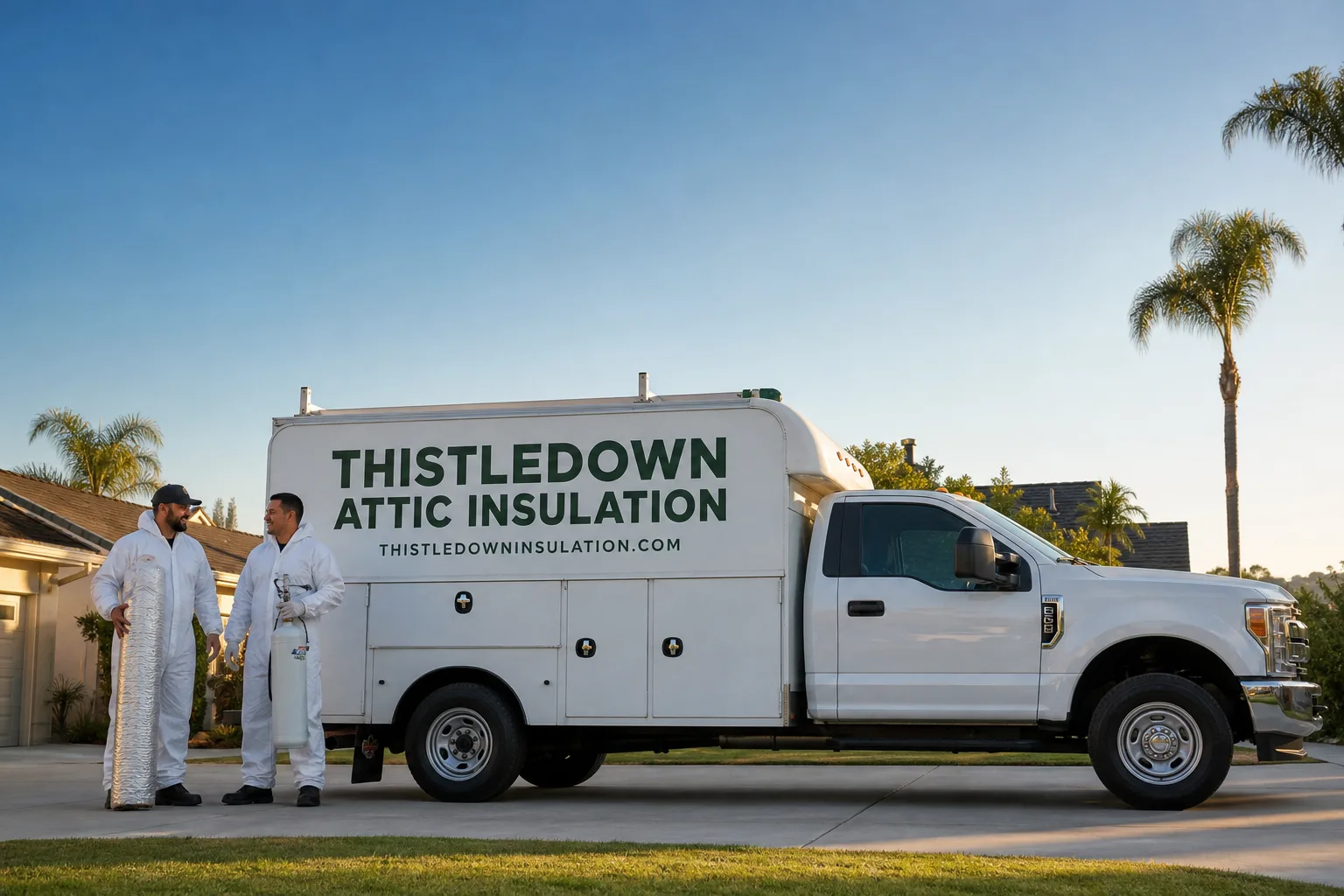
Fast, Reliable Attic Insulation Across Selma
Attic insulation in Selma typically costs between $1,800 and $4,600 for a full retrofit on a standard single-story home, with blown-in cellulose or fiberglass running $1.10 to $2.30 per square foot installed. Most Selma jobs are completed in a single day, and you’ll have a written price before anyone climbs the ladder. That matters here more than in most California cities because Selma sits in CEC Climate Zone 13, where summer attic temperatures pass 150°F while winter Tule fog holds moisture at saturation for weeks. Our crews work in Selma every week, and we answer the phone live around the clock at (909) 768-6501.
Why Thistledown Attic Insulation Is Selma’s Preferred Attic Insulation Company
Selma homeowners call us because the houses here are different. Most of the city’s core was built between the 1940s and 1970s for agricultural workers, decades before Title 24 energy codes existed. That means attics with three inches of compressed fill, no air sealing, and ventilation that was undersized even when it was new. We know what those attics look like before we open the hatch, because we’ve opened hundreds of them in Selma. Our technicians arrive in uniform, background-checked, with shoe covers on before they step past the front door and drop cloths laid across the hallway to the attic access.
Thistledown Attic Insulation is a Cedarwell-family company, independently owned and founded in 2003. Every job we do is backed by the 365-Day Done Right Promise: if it’s not done right, we make it right. No debate, no fine print. And before any work begins, you get a written price. That’s not a perk or an upgrade. It’s how Neil Barron, who leads our team, insists every Selma job runs. A live person answers every call at (909) 768-6501, day or night.
Attic Insulation Removal in Selma
Attic Insulation Removal in Selma is often the starting point rather than an add-on, because the original insulation in many of these agricultural-era homes has been repeatedly wetted by Tule fog and baked by 150°F summer heat until it’s compacted, contaminated, or actively holding moisture against your ceiling joists. The job involves extracting the old material with a commercial vacuum system, bagging it for disposal, inspecting the attic floor for air leaks, and preparing the space for new insulation. A typical removal in Selma runs $1.20 to $2.50 per square foot, depending on depth, contamination, and access. You’ll know your exact number in writing before we start.
When Removal Is the Right Call
A Selma attic with original 1950s or 1960s insulation that has slumped below the top of the ceiling joists is doing almost nothing. Adding new insulation on top just hides the problem and traps moisture beneath the new layer. If you see rodent activity, water staining, or the telltale smell of mildew near the attic hatch, removal is the honest fix.
A Clean, Quiet Process
We run the vacuum hose through the attic access and keep the machine outside, so the noise inside your home stays low. Floors are covered from the front door to the hatch, and we photograph the clean-up before the van pulls away. If children are napping, we work around quiet hours and use tools that won’t wake them.
Blown In Insulation in Selma
Blown In Insulation in Selma is the retrofit workhorse for these older homes, because it fills the irregular cavities and shallow rafter bays that batt insulation can’t reach. On a 1952 ranch house off Thompson Avenue, we found the original loose-fill collapsed to less than three inches after decades of fog moisture cycling compressed the material and left the top plates bare. We removed the degraded fill, air-sealed the attic floor, and blew in GreenFiber cellulose to R-38. The winter condensation on the ceiling joists stopped, and the summer cooling load dropped noticeably in a home with no wall insulation at all.
Blown-In Cellulose for Fog-Cycle Durability
Cellulose handles Selma’s wet-dry cycle better than old fiberglass batts, because dense-pack cellulose resists the compression and moisture wicking that destroys batt loft here. For homeowners who prefer fiberglass, we carry Owens Corning and Johns Manville blown-in products. Both get you to R-38 or R-49 with proper depth.
Air Sealing Before You Blow
The step most Selma retrofits skip is also the one that matters most in Climate Zone 13. Every gap around ceiling light fixtures, plumbing penetrations, and interior wall top plates lets warm, moist air rise into the attic during winter fog events. We seal those leaks before any insulation goes in, because blowing new material over open air paths would just let the fog keep winning.
Trusted Brands We Service in Selma
We install and service insulation from Johns Manville, Knauf, and GreenFiber, among others, and we stock enough material locally to start most Selma jobs within days of your written estimate. Our Attic Insulation team works with all three systems daily, so if you have a warranty claim on existing product or need a matched top-up for a partial attic, we can handle it without bouncing between vendors. For Selma homeowners looking for a no-fiberglass option, we also carry Rockwool batt products, which resist moisture better than conventional fiberglass in repeated fog-to-heat cycles.
Common Attic Insulation Problems We See in Selma Homes
- Fog-wetted, heat-baked insulation that has collapsed. Original loose-fill and batts in Selma’s 1940s – 1970s houses absorb moisture during November-to-February Tule fog events, then get baked each summer until the material compresses and loses R-value. What started as R-19 often performs closer to R-6 by the time we see it.
- Blocked or undersized attic ventilation. Pre-Title 24 homes in Selma were built with minimal soffit and gable vents, and many have been further restricted by roof additions or poorly placed exhaust fans. That traps winter moisture against cold roof sheathing, which condenses and rains back onto the insulation below.
- Insulation layered over old, contaminated material. A previous homeowner or handyman often blew new insulation directly over rodent droppings, dust, and water-damaged fill without removing anything or air sealing first. This hides air leaks, adds weight to a compromised ceiling, and leaves the original moisture problem festering underneath.
- Top-up jobs that ignore air leakage at the attic floor. Adding R-19 on top of R-11 might look good on paper, but if warm, moist air is bypassing the insulation entirely through unsealed penetrations, the new material does almost nothing. Selma’s fog season punishes this shortcut visibly within one winter.
Pricing for Attic Insulation in Selma, CA
A full attic insulation removal and blown-in replacement in Selma typically runs $3,200 to $5,800 for a 1,200 to 1,800 square foot single-story home. Blown-in attic insulation alone, without removal, generally lands between $1,800 and $3,900 depending on depth and product choice. Batt insulation for open attics runs $1.50 to $3.10 per square foot installed. Attic baffles and ventilation prep add $300 to $900 on most Selma jobs. The exact number for your house comes in writing before any work starts, and the price we quote is the price you pay. Call (909) 768-6501 for a free estimate, and we’ll schedule a visit that fits around nap time.
We Also Serve Cities Near Selma
Our crews regularly work in Fowler, Parlier, Kingsburg, and Reedley, bringing the same written-price guarantee and clean-job standards to every Attic Insulation in Selma neighbor. If you live just outside city limits but face the same fog-to-heat attic conditions, we’ll be there just as quickly.
Serving Selma, CA - Our Local Coverage Area
We’re based in the Selma area and know this community well. Use the map below to see our service coverage - if you’re nearby, we can almost certainly help.
FAQs About Attic Insulation in Selma
Because the original insulation in most Selma homes has already failed from decades of Tule fog moisture cycling followed by 150°F summer heat, and burying failed material under new insulation traps moisture and hides air leaks that will keep costing you money. Removal is the honest baseline, and it costs about $1.20 to $2.50 per square foot in Selma. Call (909) 768-6501 and we’ll tell you if your attic genuinely needs it or if a top-up will do.
R-38 is our recommended minimum for Selma retrofits, and R-49 is worth the extra cost if your attic has enough depth for it. The dual seasonal extreme in CEC Climate Zone 13 means you need a high-R thermal barrier for summer heat and a product that won’t wick moisture during winter fog, which is why we lean toward dense-pack cellulose or Rockwool for these jobs.
Yes, and it’s often the single highest-impact upgrade you can make to one of these postwar agricultural-era homes. Blown-in attic insulation air-sealed at the attic floor stops the stack effect that pulls hot air up in summer and moist air up in winter, which matters even more when the walls have no insulation to slow the heat exchange. We’ve seen this transform homes on streets off Thompson Avenue and throughout the older Selma core.
Tule fog holds near-100% relative humidity for days or weeks at a stretch, and that moisture migrates into attics through air leaks and inadequately vented roof cavities. The insulation absorbs the moisture, then each summer’s 150°F attic heat bakes it dry. Repeated wet-dry cycles destroy the loft and R-value of fiberglass batts, causing the compression and settling that leaves Selma attics effectively under-insulated within a decade or two.
In most Selma homes, yes. Removal and reinstallation on a standard single-story house takes one full day with our two-person crew, including air sealing and a photo of the clean-up before we leave. We’ll confirm the timeline in your written estimate and let you know if anything about your attic would stretch it to a second day.
If your Selma attic is keeping the house hot in July or damp in January, call us at (909) 768-6501. You’ll get a live person, a straight answer, and a written price before anyone picks up a tool.
Written by Neil Barron, Owner at Thistledown Attic Insulation, serving Selma and the surrounding Central Valley since 2003.