
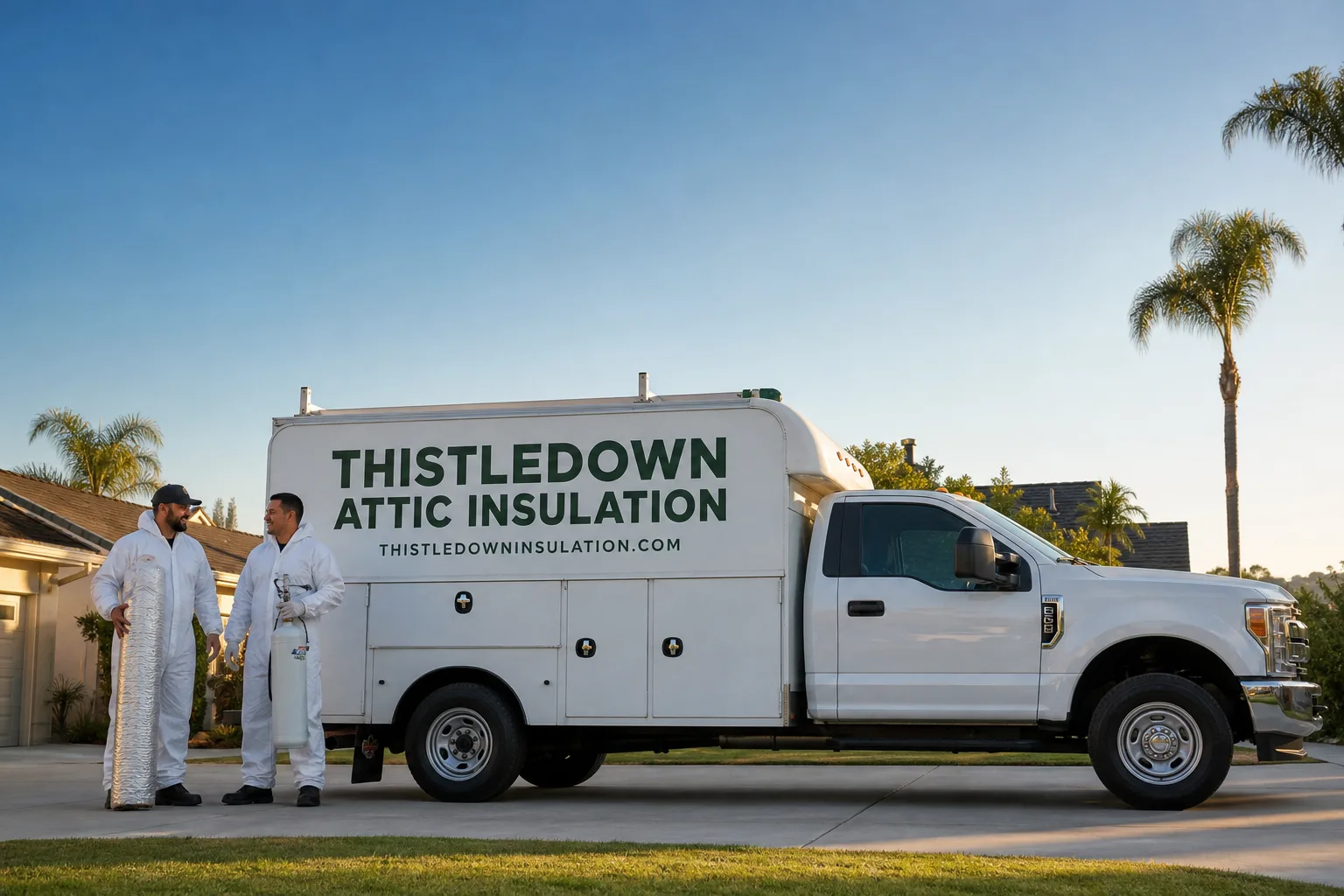
Fast, Reliable Attic Insulation Across South El Monte
If your South El Monte home still has the attic insulation it was built with, odds are it’s working against you on every triple-digit summer day. Most houses here went up in the 1950s and 1960s, back when two inches of fiberglass was considered plenty and nobody imagined 105°F Julys as the new normal. We’re Thistledown Attic Insulation, and we retrofit those attics to California Climate Zone 9 standards – R-38 or R-49 – so your ceiling stops radiating heat into the hallway by 3 p.m. Call (909) 768-6501 and a live person answers, day or night. We’ll schedule a free attic assessment and put your exact price in writing before anyone picks up a tool.
Why Thistledown Attic Insulation Is South El Monte’s Preferred Attic Insulation Company
South El Monte homeowners don’t need a slick sales pitch. They need a crew that understands what’s actually hiding in these attics. The original blown mineral wool in a 1961 tract home off Durfee Avenue looks nothing like the insulation in a newer Rosemead build, and treating them the same way is how people end up paying for a “top-off” that does nothing. We’ve worked in enough South El Monte attics to know the difference within five minutes of opening the hatch.
Our Attic Insulation team goes through background checks and wears a uniform, so when we arrive at your door on Peck Road or Lerma Avenue you know exactly who you’re letting in. We lay drop cloths across your hallway, wear shoe covers from the front door to the attic hatch, and quiet the tools way down when there’s a napping kid in the house. After the job, we photograph the clean-up before the van pulls away – it’s part of the Cedarwell Care Promise, not an add-on.
Every project is backed by the 365-Day Done Right Promise. If the insulation wasn’t done right, we make it right. No debate, no fine print. Neil Barron leads our South El Monte team with that standard on every single job.
Blown In Insulation in South El Monte
Blown In Insulation is the retrofit workhorse for South El Monte’s older homes, and it’s what we recommend most often for attics with settled or patchy material. The process involves feeding loose-fill fiberglass or mineral wool through a hose into the attic cavity, filling to a uniform depth that hits R-38 or R-49. For a typical 1,000-square-foot attic in South El Monte, blown-in insulation runs $1,800 to $3,200 installed, including removal of the worst compacted material and air-sealing the top plates.
Why blown-in over batts for these homes? The 1950s and 1960s tract houses in South El Monte have shallow attic cavities with odd framing, old wiring, and uneven existing insulation. Loose-fill flows around all of it without leaving gaps. Batt has its place, but not here, not typically. Blown-in also gives us a flat, consistent R-value across the whole ceiling plane, which matters when one bedroom sits under a west-facing roof slope that’s been baking since noon.
Same-Day Top-Up for Existing Attics
Sometimes the original insulation isn’t a total loss, just thin in places. We run a thermal scan, measure what’s there, and calculate exactly how many inches of new blown-in fiberglass you need to reach R-38. A top-up on a small South El Monte attic typically runs $900 to $1,600, and we’re often done in a single afternoon.
Full Removal and Re-Blow
When we find compacted vermiculite or moisture-stained mineral wool, we don’t blow new material over it. We remove the degraded layer, inspect the ceiling joists for mold or rot, air-seal the top plates, and only then install fresh blown-in insulation. Full removal and re-blow for a standard South El Monte attic runs $2,800 to $4,500, and it transforms how the home handles summer heat.
Insulation Contractors in South El Monte
Insulation Contractors in South El Monte split into two rough groups: generalists who’ll do anything with a ladder, and specialists who work in attics every day. We’re the second kind. The attic is the only place we work, which means we’ve seen every failure mode these 1950s and 1960s tract homes can throw at us – compacted vermiculite, undersized batts, missing baffles, ridge vents that were never cut properly, bathroom fans exhausting straight into the insulation.
A proper attic retrofit in South El Monte involves more than new insulation. We check the soffit vents, make sure baffles keep air moving from eave to ridge, and verify that the existing ventilation can actually carry heat out of the attic. Otherwise you’re just baking new insulation all summer. Our assessments are free, and you’ll have a written line-item price before we start.
Trained, Background-Checked Crews
Everyone who enters your South El Monte home is uniformed, background-checked, and trained on the Thistledown standard. We ask before moving anything, protect your floors, and clean up so thoroughly you won’t know we were in your attic except for the temperature difference.
What We Look For in Every Attic
Ceiling joists with moisture staining. Bathroom fans venting into insulation. Gaps around the attic hatch. Old wiring sitting under fiberglass. Each one costs you comfort and money, and each one gets noted in your written quote – no surprises on the invoice, ever.
Trusted Brands We Service in South El Monte
We install insulation from four brands we trust with South El Monte’s heat: Owens Corning, Johns Manville, Knauf, and Rockwool. Owens Corning AttiCat blown-in fiberglass is our go-to for retrofit work because it fills cleanly and holds its R-value once settled. Johns Manville and Knauf provide batt and loose-fill options where they fit the job better. Rockwool mineral wool comes out when we want extra fire resistance, like attics adjacent to garages with water heaters or furnaces. We keep these materials stocked and ready, so South El Monte homeowners don’t wait weeks for product.
Common Attic Insulation Problems We See in South El Monte Homes
- Compacted vermiculite and early blown mineral wool. Homes built from the 1950s through the 1970s often have original loose-fill that has settled to less than an inch in most bays. Homeowners assume “some insulation” is still working – a thermal scan usually shows near-zero R-value.
- Moisture damage from poor attic ventilation. South El Monte’s summer heat pushes hot air hard against the underside of the roof deck, and when ventilation is inadequate, condensation forms. Over years, that moisture degrades batt and blown insulation, leading to mold and a persistent musty smell in the hall closet.
- Undersized original fiberglass batts. The standard 1950s install was 2 to 3 inches of fiberglass batts, roughly R-7 to R-11. California Climate Zone 9 calls for R-38 minimum. Those batts are doing almost nothing on a 104°F afternoon on Garvey Avenue.
- Air leaks through the ceiling plane. Old top plates, light fixture boxes, and attic hatches leak conditioned air straight out of the living space. Insulation without air-sealing is like a sweater with holes in it – we seal first, then insulate.
Pricing for Attic Insulation in South El Monte, CA
Here’s what South El Monte homeowners can expect in our written quotes. A basic top-up of blown-in fiberglass on a 1,000-square-foot attic runs $900 to $1,600. A full removal and re-blow with air-sealing runs $2,800 to $4,500 for the same footprint. A complete insulation replacement including baffle installation and ventilation prep runs $3,500 to $5,500. Smaller attics in the dense tract homes around El Monte and Rosemead trend lower; larger ones or attics with moisture damage trend higher. Every quote is a fixed written number before we touch a rafter – not a range carved in sand.
We Also Serve Cities Near South El Monte
Our Attic Insulation in South El Monte team handles calls throughout the central San Gabriel Valley. We regularly work in El Monte, Rosemead, Temple City, and Whittier. Same crew standards, same written pricing, same next-day availability in most cases.
Serving South El Monte, CA - Our Local Coverage Area
We’re based in the South El Monte area and know this community well. Use the map below to see our service coverage - if you’re nearby, we can almost certainly help.
FAQs About Attic Insulation in South El Monte
If your attic still has original insulation and you’ve never had a thermal scan, it’s almost certainly performing below R-19, and in many South El Monte tract homes we find it performing below R-5. The quickest check is visual: look for settled or compacted material that sits below the top of the ceiling joists, dark staining, or bare spots. The accurate check is a thermal scan during a hot afternoon, which shows exactly where heat is punching through your ceiling. Call (909) 768-6501 and we’ll do the thermal scan as part of a free attic assessment.
R-38 minimum, R-49 preferred. South El Monte sits in California Climate Zone 9, where the state’s energy code calls for R-38 in attics for new construction. But because South El Monte’s inland heat regularly pushes past 100°F while winter nights can approach freezing, we recommend R-49 whenever attic depth allows it. The extra depth pays off in lower cooling bills and a cooler second story during heat waves.
Sometimes, but not usually. If the existing material is clean, dry, and reasonably uniform, we can top it off with fresh blown-in fiberglass to reach R-38 or R-49. But if we find compacted vermiculite, moisture staining, mold, or pest droppings, top-dressing is a waste of money. That old material has to come out first. We’ll tell you which path applies to your attic during the free assessment, and you’ll have a written price either way.
It’s brutal on old insulation. A South El Monte attic can hit 150°F on a summer afternoon, and that heat radiates through the ceiling into your living space for hours after sundown. New blown-in fiberglass at R-38 to R-49 slows that heat transfer dramatically. In the field, we’ve measured attic temperature drops of 30°F or more after a full retrofit – which is the difference between a hallway that feels warm and a hallway that feels like a wall oven.
Yes. South El Monte’s industrial corridors near Peck Road and Garvey Avenue have a large stock of metal-roof warehouse buildings, and we’ve insulated many of them for temperature control. Metal roofs conduct heat fast, and the right insulation – usually sprayed or batt against the roof deck – makes a measurable difference for both employees and inventory. The same written pricing and 365-Day Done Right Promise apply to commercial work.
Ready for an attic that actually keeps heat out? Call (909) 768-6501 for a free attic assessment. A live person answers, and you’ll have your written price before any work begins.
Written by Neil Barron, owner at Thistledown Attic Insulation, serving South El Monte and the San Gabriel Valley since 2003.