
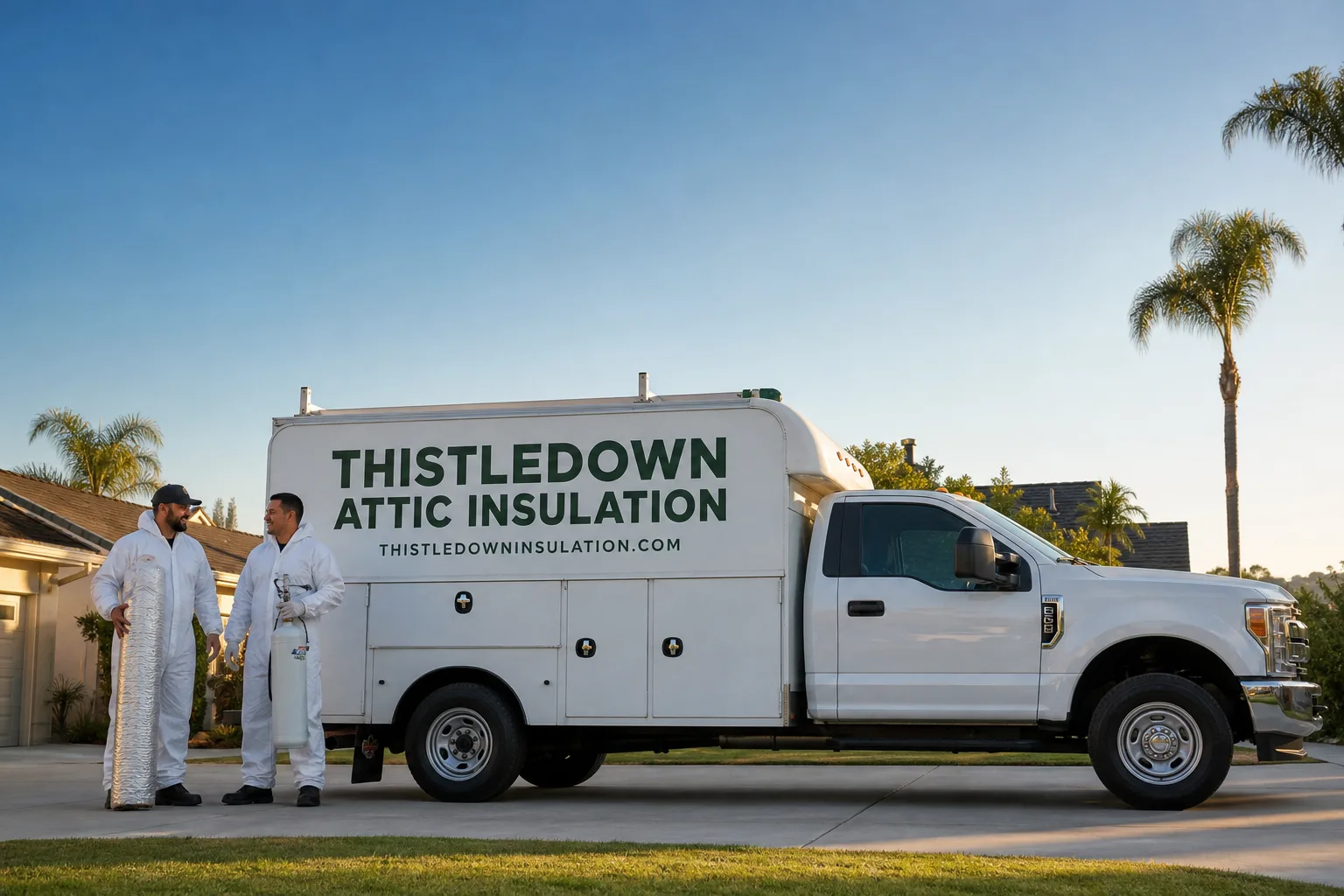
Fast, Reliable Attic Insulation Across Union City
If your Union City home was built between 1960 and 1985, there is a good chance the attic insulation you are counting on is doing less than half its job. The 1990s PG&E rebate era put blown-in cellulose into thousands of Alvarado and Decoto attics, and after decades of settling and bay humidity, much of it now performs at R-11 to R-15 instead of the R-38+ that current Title 24 standards assume. We are Thistledown Attic Insulation, and our crews work Union City neighborhoods from San Lorenzo border to the Fremont line every week. We give you a written price before any work begins, and a live person answers when you call (909) 768-6501, any hour, any day.
Why Thistledown Attic Insulation Is Union City’s Preferred Attic Insulation Company
Union City homeowners call us because we talk about attics the way a mechanic talks about engines: specific parts, real symptoms, and honest numbers. Neil Barron leads our team, and when he walks an attic in Union City, he is looking for the things most contractors miss: the compacted cellulose from a 1994 rebate job, the sagging fiberglass batts in 2×4 framing that have soaked up decades of bay-adjacent humidity, the top plates and can lights that leak conditioned air straight into the attic. We are a Cedarwell-family company, an independently owned local insulation contractor held to the Cedarwell Care Promise. That means shoe covers at the front door, drop cloths across your hallway, quiet tools when a child is napping, and a photo of the clean-up before our van leaves your driveway.
Our Union City customers choose us for one reason more than any other: the written price comes before any work starts. Not a ballpark, not a verbal estimate. A number, in writing, that matches the invoice. Backed by our 365-Day Done Right Promise, which says if it is not done right, we make it right, no debate, no fine print. You can verify all of this with past Union City customers, and you can reach us at (909) 768-6501 for the same careful walkthrough we would give any Alvarado, Decoto, or old-town Union City home.
Radiant Barrier in Union City
Radiant barrier makes a measurable difference in Union City attics because the flatlands microclimate produces sharp temperature swings: a Delta Breeze morning, a 100°F Diablo Wind afternoon, and a cool marine layer by evening. A radiant barrier stapled to the underside of your roof deck reflects radiant heat before it ever reaches your insulation, and for Union City homeowners with 1960s and 70s framing, it is often the difference between an upstairs that cools down at night and one that stays warm until midnight. We install radiant barrier as a complement to insulation, not a replacement, because in Alameda County humidity you still need proper R-value below the barrier, and improper placement can trap moisture inside the roof assembly.
How Radiant Barrier Attaches in Older Union City Framing
Our crews install radiant barrier on the rafter underside or roof deck, depending on ventilation design, and we check for adequate airflow before any material goes up. Older Union City tract homes often have minimal ridge and soffit vents, so we may recommend baffles or vent work first. The material itself is a reflective foil, not a foam, which means it adds no flammable mass and no moisture-holding capacity to the attic.
What Radiant Barrier Costs Along the 880 Corridor
For a standard single-story Union City home with a 1,200 to 1,600 square foot attic, radiant barrier installation typically runs $1,450 to $2,600, depending on access, roof pitch, and whether we are combining it with new blown-in insulation. The exact number is in your written price before any work begins, and we encourage pairing it with attic cleaning so the reflective surface stays effective. Call (909) 768-6501 to schedule a measurement.
Attic Cleaning Services in Union City
Attic cleaning services in Union City are often the first step in a retrofit because decades of dust, old rodent activity, and degraded insulation fibers need to come out before new material goes in. We vacuum or remove old insulation, sanitize the floor areas where pests have been, and prep the attic for new baffles, air sealing, or insulation. In Alvarado and Decoto specifically, we see attics where the 1994-era cellulose has compacted to four inches or less and is packed with dust blown in through soffit leaks, which means a cleaning pass is not optional.
What Gets Removed During a Union City Attic Cleaning
We remove settled fiberglass batts, flat cellulose, rodent nests, old paper facings, and any other debris that sits between joists. Then we check the areas around can lights, top plates, and the attic hatch for gaps that let outdoor air and dust in. The typical timeline for a standard Union City attic is one day, and we protect your hallway with drop cloths from the front door to the hatch.
Attic Cleaning and New Insulation Often Go Together
We do not recommend cleaning an attic and then leaving it empty through a Delta Breeze heat wave. Most Union City homeowners combine the cleaning pass with new blown-in insulation the same day, because the cleaned cavity is ready for air sealing and fresh GreenFiber, Knauf, or Rockwool. This keeps the job to a single visit and a single written price, and it means the attic is clean for the first time since the house was built.
What happens when you call
- 1
A real person answersNo phone trees - you reach a local pro.
- 2
You get an upfront price rangeHonest numbers before anyone is dispatched.
- 3
A background-checked tech heads outLicensed & insured, dispatched right away.
- 4
You approve before work beginsNothing starts until you say go.
Trusted Brands We Service in Union City
We install and service eight insulation brands, including Johns Manville, Knauf, Rockwool, and CertainTeed, so the product we put in your Union City attic matches your house and your family, not whichever roll happened to be on the truck. For Alvarado and Decoto homes with original 2×4 framing, we often recommend a blown-in fiberglass or cellulose product paired with air sealing. For homes near the bay where humidity is more aggressive, Rockwool’s moisture-resistant stone fiber can be the right call. We keep stock ready for Union City projects, and we do not push a brand you do not need. Call (909) 768-6501 and we will walk you through the options, including pet-safe choices where a choice exists, before any material becomes part of your home.
Common Attic Insulation Problems We See in Union City Homes
- The 1990s PG&E rebate trap: Homeowners in Alvarado and Decoto tell us “we already have insulation” because they got a rebate in 1994. That material has packed flat and performs at roughly half its labeled R-value, so the attic reads as insulated on paper but behaves like bare joists during a Diablo Wind afternoon.
- Compressed fiberglass in 1960 – 1985 2×4 walls: Original fiberglass batts in older Union City tract homes have absorbed decades of bay-adjacent humidity, losing loft and R-value while holding an odor and promoting must. Vapor retarder selection matters in these homes, and it is not a check-box decision.
- Slab-on-grade access limitations: Union City’s suburban tracts are overwhelmingly concrete slab foundations, which means all retrofit wall and attic work has to route through tight attic hatches and low-clearance framing. Poorly detailed air sealing and baffling fail first in these conditions, and that is exactly what we inspect before quoting.
- Oversized HVAC that never quite cools: Homeowners often blame the AC for an upstairs that will not hold temperature. In Union City’s 1960s through 1980s stock, the attic insulation is frequently the real culprit, and the chronic short-cycling during afternoon temperature swings is an insulation symptom, not an equipment one.
Pricing for Attic Insulation in Union City, CA
We Also Serve Cities Near Union City
Our Union City customers send us across the Alameda County line regularly, and we maintain the same written-price standard in Fremont, where 1960s and 70s tract homes share the same slab-on-grade construction, and in Newark, San Lorenzo, and Castro Valley, where the marine layer and Diablo Wind temperature swings create similar attic performance problems. If you are in one of those cities, our Attic Insulation team covers the full service area, and for a look at what we do across Union City specifically, visit our Attic Insulation in Union City page. Call (909) 768-6501 from anywhere in the area and a live person will answer.
Serving Union City, CA - Our Local Coverage Area
We’re based in the Union City area and know this community well. Use the map below to see our service coverage - if you’re nearby, we can almost certainly help.
FAQs About Attic Insulation in Union City
Yes, in most Alvarado and Decoto homes that material has settled and packed flat to roughly half its rated R-value, and it is performing well below today’s Title 24 minimums. The PG&E rebate era did not anticipate how bay humidity and decades of temperature swings would compact blown-in cellulose. In Decoto we opened an attic on a 1968 slab-on-grade tract home where the homeowner insisted the 1994 rebate cellulose was still fine; the material had compacted to about four inches and read well under half its rated value, while the original 2×4 wall batts sagged and carried a musty bay-humidity odor. We air-sealed the top plates and can lights, vacuumed out the degraded cellulose, and blew GreenFiber to a deep R-value, then confirmed with the homeowner that their heat pump would finally stop short-cycling in the afternoon Delta Breeze swings. Call (909) 768-6501 and we can check your attic the same way.
Union City sits in the southern Alameda flatlands where persistent bay humidity changes how moisture moves through attic assemblies, and a wrongly placed vapor retarder can trap moisture against framing and sheathing. That is not a concern in drier inland East Bay cities like Livermore, but here the marine layer means the vapor drive direction shifts with the season. We assess each home’s framing, insulation, and ventilation before choosing a retarder, because the wrong call in a 1970s Union City 2×4 wall can create the very mustiness we are trying to eliminate. Call (909) 768-6501 and we will explain what your home actually needs.
Yes, but the access route changes. Union City’s postwar tracts are overwhelmingly slab-on-grade, so there is no crawl space to route retrofit wall work through. We access wall cavities from the attic, from exterior cuts, or from interior knee walls where present, and we air-seal top plates and can lights from above. The work is slower and the pricing reflects that access challenge, but the written price still comes before any work starts. Call (909) 768-6501 for a walkthrough of your specific slab home.
In many Union City homes, yes, because the HVAC oversizing was a response to a leaky, under-insulated attic that could not hold temperature during Diablo Wind and Delta Breeze swings. When the attic performs near Title 24 targets, the same system often stops short-cycling and holds a steadier temperature through the afternoon. The 1960s through 1980s tract housing along the Mission Boulevard corridor is especially prone to this, because the original insulation was minimal by modern standards. Call (909) 768-6501 and we can assess whether your insulation is the bottleneck before you spend anything on equipment changes.
Yes, and we recommend it when the existing attic has settled debris, compacted old insulation, or accumulated dust that would otherwise sit beneath new radiant barrier. Removing that material first means the reflective surface stays clean and the new insulation beneath it is installed over a prepared cavity. In Union City’s slab-on-grade homes, the cleaning pass often reveals air leaks around top plates and can lights that would otherwise undermine both the radiant barrier and the new insulation. Call (909) 768-6501 and we will let you know if your home benefits from the combined approach, with a written price for the whole job.
Written by Neil Barron, Owner at Thistledown Attic Insulation, serving Union City since our founding in 2003 as an independently owned Cedarwell-family company.