
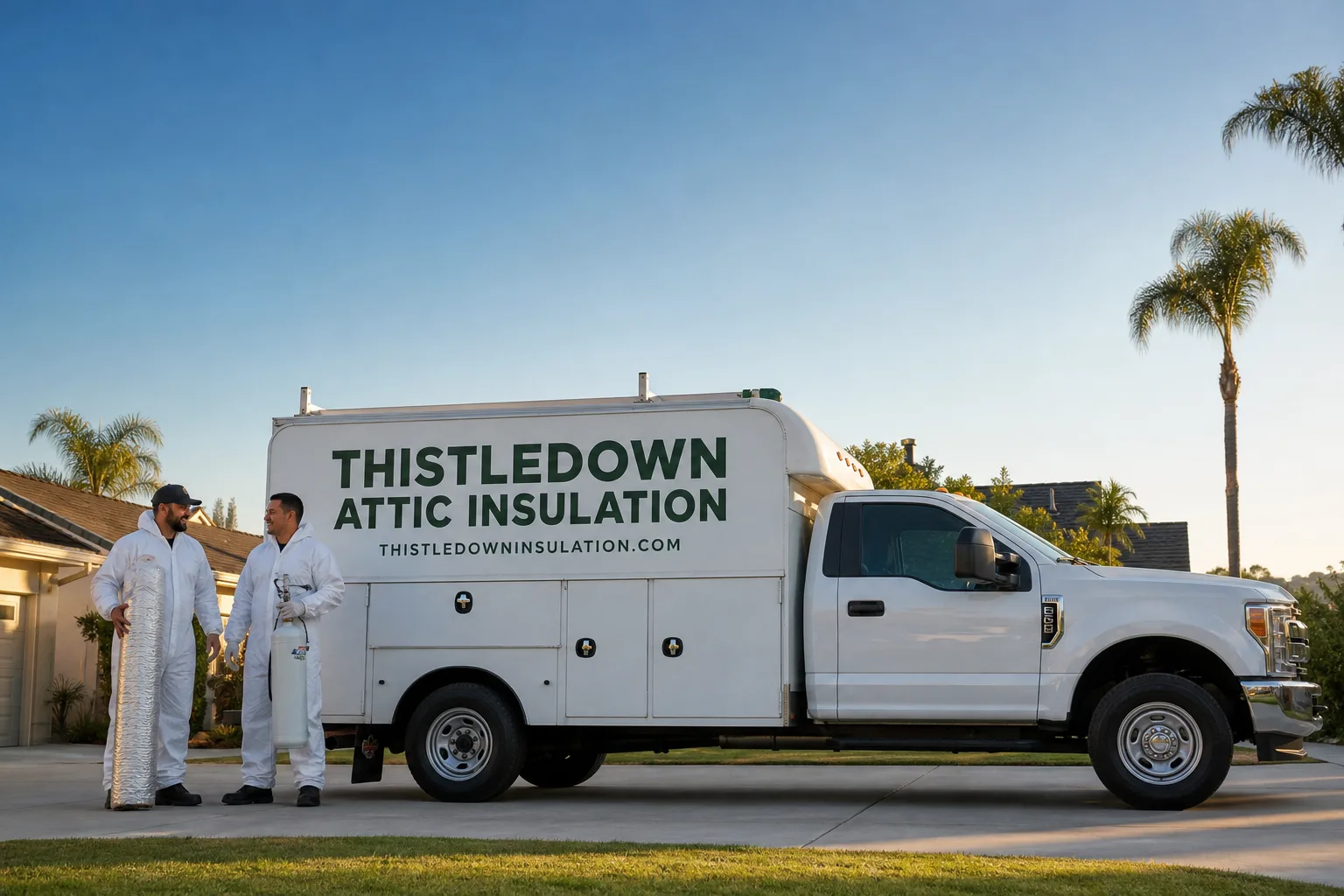
Fast, Reliable Spray Foam Insulation Across Bellflower
Spray foam insulation in Bellflower costs roughly $1.50 to $3.50 per board foot for open-cell and $2.25 to $4.75 for closed-cell, with most attic projects landing between $2,800 and $7,200 depending on square footage and substrate prep. That prep matters more in Bellflower than almost anywhere else in the LA Basin. Most homes here were built between 1945 and 1965, which means our crews are working inside attics that haven’t been touched since Eisenhower was in office. If you live anywhere near Bellflower Boulevard, Somerset Ranch, or the Bird Streets, we can have a uniformed technician at your door within 24 to 48 hours. Call (909) 768-6501 and a live person answers, day or night.
Why Thistledown Attic Insulation Is Bellflower’s Preferred Spray Foam Insulation Company
We’re a Cedarwell-family company, independently owned and held to the Cedarwell Care Promise on every single visit. Before our technician steps through your front door, shoe covers go on. Drop cloths get laid across your hallway from the entry to the attic hatch. And before the van pulls away, you get a photo of the clean-up. No exceptions, no upsell.
Our crews know Bellflower’s housing stock because we see it week after week. The original rock wool batts in a 1958 tract home off Clark Avenue don’t surprise us. The flat-roof rear addition with zero insulation layer on a house near Somerset High School doesn’t faze us. What matters is that we explain what we found, hand you a written price before any tool comes out, and stand behind the work with our 365-Day Done Right Promise. If it isn’t done right, we make it right. No debate.
Every technician who enters your Bellflower home is background-checked and uniformed. You’ll know exactly who is walking through the door, and we’ll ask before we move or touch anything. Neil Barron leads our team with a simple standard: treat every attic like your own kids sleep under it.
Spray Foam Attic Insulation in Bellflower
Spray foam attic insulation in Bellflower means addressing a very specific set of conditions: a 60-plus-year-old wood-frame stucco shell, original insulation matted below R-4, and summer attic temperatures that routinely hit 140 to 150°F because Bellflower sits 8 to 10 miles inland where the marine layer often fails to arrive. The job starts with removal of degraded material, then air-sealing every top-plate gap and recessed can before foam is applied to the sheathing. On a typical Bellflower ranch, closed-cell foam runs $4,800 to $6,900; open-cell comes in between $2,900 and $4,500.
Closed-Cell for Bellflower’s Flat-Roof Additions
Many Bellflower homes have low-slope or flat-roof rear additions built during the mid-century tract expansion, and most of those additions went up without any insulation layer at all. Closed-cell spray foam applied to the underside of the roof deck gives these spaces a continuous thermal and air barrier for the first time. We’re careful about one Bellflower-specific failure mode: foam blown directly onto a flat-roof assembly with no prior insulation can trap heat against the roofing membrane and cook the asphalt. The foam thickness and substrate prep have to be engineered correctly, which is exactly what we do.
Full Removal Before Foam on Legacy Rock Wool
If your Bellflower attic still carries its original Johns-Manville or Owens Corning rock wool, spraying over it is a mistake. Foam adheres to powder, not structure. It delaminates within a season. We remove it fully first, inspect the framing and wiring underneath, then spray onto clean substrate. That’s the difference between a foam job that lasts thirty years and one that fails in twelve months.
Because Bellflower’s 1950s tract attics routinely hit 140 to 150°F in summer, spray foam flashing here must be engineered around heat-driven off-gassing and adhesion creep on 60-year-old stucco and plaster. It’s a failure mode coastal Lakewood jobs never see. The hotter the attic shell, the more the foam chemistry and the prep sequence matter.
Spray Foam Wall Insulation in Bellflower
Spray foam wall insulation in Bellflower usually means injecting or applying foam into the exterior wall cavities of 1950s and early 1960s stucco homes that were built with little or no wall insulation. Most of these walls are true 2×4 construction with no sheathing wrap, and they leak air through every electrical outlet, plumbing penetration, and sill plate. On a single-story Bellflower home, wall insulation projects typically land between $3,500 and $7,000 depending on cavity access and existing conditions.
Open-Cell for Interior Wall Cavities
For walls that still have their original lathe-and-plaster or early drywall intact, open-cell spray foam can be applied from the interior with minimal disruption. The foam expands into the cavity, fills the irregular gaps between old lumber and plaster keys, and deadens sound between rooms. That’s a real benefit in a dense tract neighborhood where houses sit close together.
What We Find Behind Bellflower’s Stucco
Behind the stucco of a 1961 Bellflower tract home off Artesia Boulevard, our crews have found no insulation at all in many cases. Just a paper-backed vapor barrier, or nothing but the backside of the plaster. We also watch for knob-and-tube or outdated cloth-jacketed wiring buried in legacy cavities, spraying over that is a code and fire risk on homes that were never rewired. We flag it before we spray, every time.
Trusted Brands We Service in Bellflower
Our Spray Foam Insulation crews install products from Owens Corning, Johns Manville, Knauf, and Rockwool. Thistledown carries eight brand lines total, including Icynene and Demilec, so we match the foam chemistry to your specific attic, not the other way around. For Bellflower homes with kids, pets, or family members with chemical sensitivities, we’ll walk you through which options make sense and whether a pet-safe product is available for your job. We keep enough material on our trucks to start your Bellflower job without a second trip to a supply yard.
Common Spray Foam Insulation Problems We See in Bellflower Homes
- Foam sprayed over crumbling rock wool: Original Johns-Manville rock wool from the 1950s often looks fine from the hatch but crumbles to gray powder at the touch. Foam applied over it bonds to powder, not structure, and starts peeling within a season. We remove it completely before spraying.
- Flat-roof additions with no insulation cap: Those rear additions so common to Bellflower’s tract era almost never got an insulation layer. Closed-cell foam onto the roof deck can work beautifully, but it has to be spec’d correctly or the membrane overheats. We’re seeing more of these every year as families convert additions into bedrooms.
- 140°F attic heat overwhelming standard venting: Bellflower’s inland position means the attic band runs hotter than Lakewood or Seal Beach ever sees. Under-insulated homes run AC at dramatically higher loads, and most homeowners don’t realize the attic is the source until they go up there in July.
- Old wiring buried in legacy insulation: Homes built between 1945 and 1965 were often never rewired, and knob-and-tube or brittle cloth-jacketed wire still sits inside wall cavities and attic floors. Encapsulating it under spray foam without addressing it first is a fire hazard and a code violation. We inspect before we spray.
Pricing for Spray Foam Insulation in Bellflower, CA
Here’s what you can expect in Bellflower’s current market. Open-cell spray foam for a standard 1,200 to 1,600 square foot attic runs $2,900 to $4,500. Closed-cell foam on the same footprint lands between $4,800 and $6,900. Wall cavity work on a typical single-story tract home falls in the $3,500 to $7,000 range. Rim joist sealing in crawlspace homes near the riverbed and along the 91 corridor runs $900 to $2,200. Flat-roof rear addition foam caps start around $1,800 and go up with square footage. You’ll have an exact written price before any work starts. Always. Call (909) 768-6501 for a free estimate, and we’ll put the number in writing before you decide anything.
We Also Serve Cities Near Bellflower
Our crews cover Bellflower and the surrounding communities every week. If you’re in Paramount, Norwalk, Artesia, or Cerritos, we can schedule your spray foam job on the same route. Same shoe covers, same written price, same 365-Day Done Right Promise on every job, no matter which city the address sits in.
Serving Bellflower, CA - Our Local Coverage Area
We’re based in the Bellflower area and know this community well. Use the map below to see our service coverage - if you’re nearby, we can almost certainly help.
FAQs About Spray Foam Insulation in Bellflower
No. Spray foam applied over degraded rock wool bonds to the dust and powder, not to the structural sheathing, and it delaminates within a season. In a Bellflower attic that hits 140°F, that failure happens even faster. We remove the legacy insulation fully, inspect what’s underneath, and then spray onto clean substrate. Call (909) 768-6501 and we’ll take a look at what’s actually up there before you commit to anything.
Yes, closed-cell foam applied to the underside of the roof deck is one of the best solutions for those uninsulated rear additions you see on so many Bellflower tract homes. The key is engineering the foam thickness correctly so heat doesn’t get trapped against the roofing membrane and cook the asphalt. We’ve done this on dozens of Bellflower additions, and every job starts with a substrate assessment and a written price.
Bellflower sits 8 to 10 miles inland, which means the marine layer that cools Lakewood, Seal Beach, and the coastal cities often never reaches your attic. Summer attic temperatures in Bellflower routinely hit 140 to 150°F. That’s the single biggest reason spray foam and proper air sealing deliver bigger energy savings on Bellflower homes than on comparable coastal properties. Call us for a free attic assessment and we’ll show you exactly where the heat is coming from.
Yes, it’s often the highest-impact upgrade you can make on an original-condition Bellflower tract home. These houses were built before California’s Title 24 energy code existed, and most still carry original insulation at an effective R-4 or lower. On a 1954 tract home off Bellflower Boulevard, our crew sealed every recessed can and top-plate gap before spraying, and the homeowner’s AC runtime dropped that same week. The flat-roof addition finally got a continuous foam cap for the first time ever. That’s the kind of outcome we’d expect on your street too.
Yes, if the inspection turns up knob-and-tube or brittle cloth-jacketed wiring, it has to be addressed before any spray foam is applied. Encapsulating outdated wiring under foam is a fire risk and a code violation. On 1945 to 1965 stucco homes that were never rewired, this is a real finding. We flag it immediately, explain your options, and don’t spray over anything unsafe. Call us at (909) 768-6501 for a free attic inspection and we’ll tell you exactly what we see.
Written by Neil Barron, Owner at Thistledown Attic Insulation, serving Bellflower since 2003.