
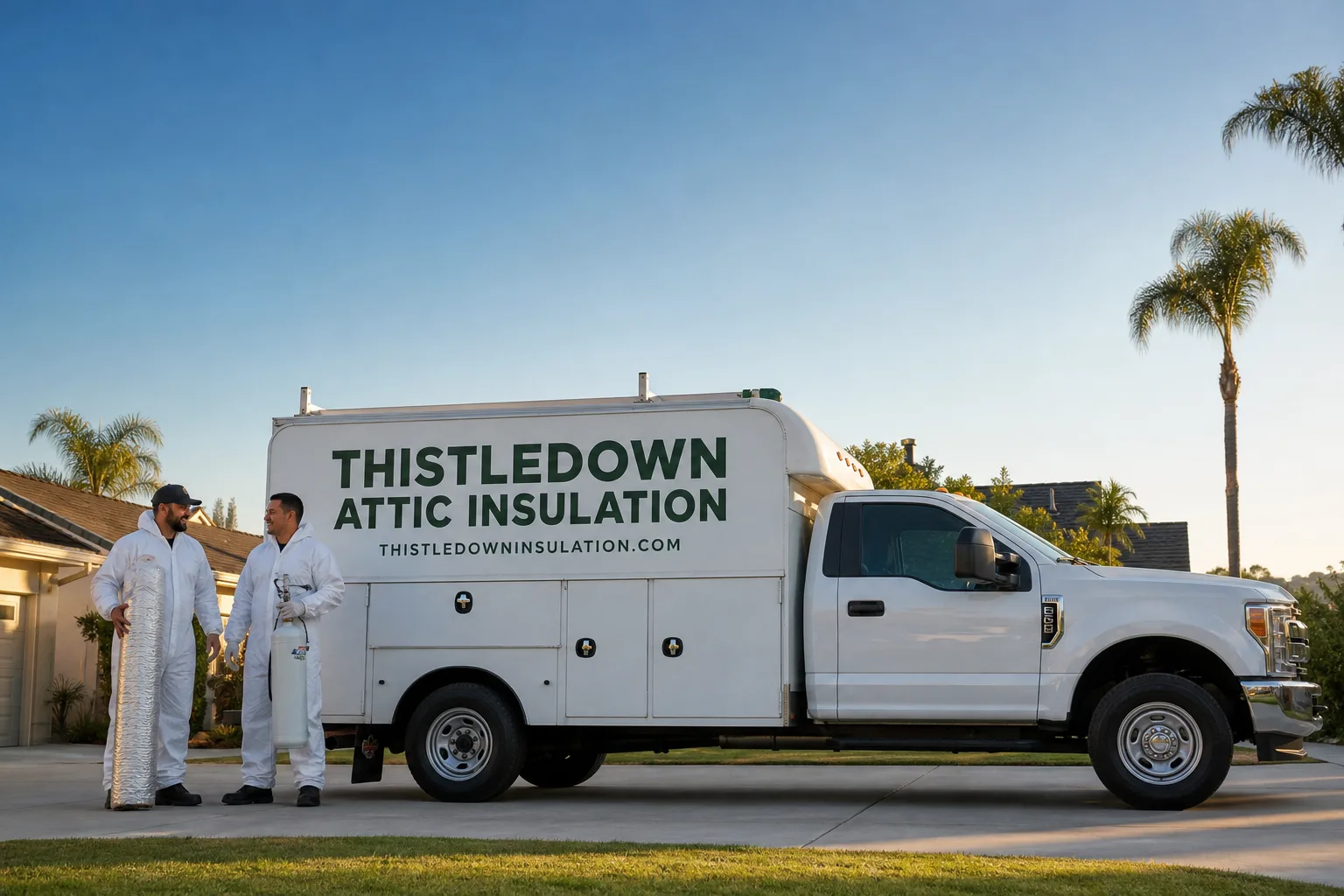
Fast, Reliable Spray Foam Insulation Across Big Bear City
Spray foam insulation in Big Bear City does something no fiberglass batt can do at 6,752 feet: it air-seals the envelope, not just slows heat loss through a cavity. Our crews work in Big Bear City every week, which means we know what an A-frame rafter bay looks like after fifty years of snow load, and we know what it takes to get a Friday-night cabin warm before Saturday morning. Whether you’re in a 1960s summer retreat near Baldwin Lake or a newer build off Big Bear Boulevard, we bring the same promise: a written price before any work starts, shoe covers at the door, and a photo of the clean-up before we leave. Call (909) 768-6501 for a free estimate.
Why Thistledown Attic Insulation Is Big Bear City’s Preferred Spray Foam Insulation Company
Big Bear City homeowners call us back for one reason: we explain the work before we do it, and we put the number in writing before anyone picks up a tool. That matters more up here than it does down the hill, because a mountain cabin’s insulation problems are rarely visible from the living room. You can’t see a compressed batt in a shallow rafter bay, or a rim joist leaking air into a crawlspace. You can feel it, though, when the baseboards run for hours and the thermostat won’t climb past 50.
Our technicians are background-checked and uniformed. When they walk into your Big Bear City home, they lay drop cloths across the hallway and wear shoe covers from the front door to the attic hatch. We ask before we move anything, and if a child is napping or a dog is nervous, we bring quiet tools. That’s the Cedarwell Care Promise, named for the C.A.R.E. values we work by: Clean up like it’s our own home, Ask before we touch anything, Respect quiet hours, Explain the price before the work. Neil Barron leads our crews, and the standard he sets is simple: leave a Big Bear City cabin warmer, tighter, and cleaner than we found it.
Scheduling is coordinated from our Inland Empire Riverside-San Bernardino office, which means someone is always watching the weather windows that matter at elevation. Big Bear City jobs get slotted around snow days and freeze cycles, because spray foam needs proper substrate temperatures to cure correctly. A live person answers our phone 24/7, including the Friday afternoon when you realize the cabin won’t be warm for the weekend. Call (909) 768-6501 and you’ll talk to a person, not a voicemail tree.
Spray Foam Insulation Contractors in Big Bear City
Spray Foam Insulation Contractors in Big Bear City face a housing stock that was largely built as warm-weather vacation cabins, not year-round mountain homes. That means the work here is different from anything we see in Lucerne Valley or Yucaipa. A 1960s wood-frame cabin on a steep Big Bear City lot often has no original wall insulation, unsealed top plates and rim joists, and rafter bays too shallow for the R-value the alpine climate demands. We specialize in retrofits that air-seal and insulate those legacy structures in one pass.
Closed-Cell Spray Foam for A-Frame Rafter Bays
Closed-cell spray foam is the workhorse for Big Bear City A-frames and steep cathedral ceilings. At around 2 inches, it creates an air barrier and adds R-value in a fraction of the depth fiberglass would need, which is essential when rafter bays are six inches deep and snow is sitting on the roof. In Big Bear City, closed-cell rafter applications typically run $2.50 to $4.50 per board foot, depending on access and roof geometry.
Rim Joist and Floor Band Sealing
Most Big Bear City cabins leak air hardest at the rim joist, the wood band where the floor framing meets the foundation. Sealing and insulating rim joists with spray foam typically costs $1,800 to $3,600 for a full perimeter, and it’s the single most effective fix we perform for cabins that won’t hold heat on Friday nights. Cold air doesn’t just flow down from the attic – it pours in at the floor line.
Spray Foam Attic Insulation in Big Bear City
Spray Foam Attic Insulation in Big Bear City addresses the single biggest thermal weakness in the local housing stock: shallow attic cavities and steeply pitched roofs that were never designed for 59 inches of annual snow. Whether we’re spraying the underside of a roof deck to create a conditioned attic, or sealing the attic floor and adding open-cell foam above the ceiling plane, the goal is the same: stop the air that’s carrying the heat right through your ceiling. Big Bear City attic spray foam projects typically range from $4,500 to $11,000 depending on square footage, depth, and whether we’re working in a cathedral assembly or a vented attic floor.
Open-Cell Spray Foam for Attic Floors
Open-cell spray foam is our go-to for attic floors in Big Bear City homes that already have some form of roof ventilation. It expands to fill irregular cavities, air-seals gaps around wiring and framing, and delivers R-3.5 to R-3.7 per inch. For a typical Big Bear City attic floor around 1,200 square feet, open-cell applications run $3,800 to $7,500. We also carry pet-safe product options within our brand lines, so the dog can stay home during the job.
Spray Foam Roof Decks and Cathedral Ceilings
For Big Bear City chalet-style homes with vaulted ceilings and no attic access, spraying the roof deck from below is often the only viable retrofit. This keeps the conditioned space directly under a sealed, insulated plane, and it puts an end to ice damming on the lower roof edges. Cathedral and roof deck spray foam in Big Bear City usually lands between $5,500 and $13,000, with the final written number confirmed before any material is sprayed. Thistledown is the soft fluff of the thistle, one of nature’s lightest insulators. The name is a promise about how carefully we work.
Trusted Brands We Service in Big Bear City
Our Big Bear City customers deserve product choices matched to their home, not whatever is on the truck. We install Spray Foam Insulation using Johns Manville, Knauf, and CertainTeed product lines, among others, selected for performance at altitude and compatibility with Big Bear City’s wood-frame construction. Need pet-safe options where a choice exists? We’ll spec it. Expecting heavy snow on a metal roof? We’ll match the foam to the thermal and moisture demands of that specific assembly, and we keep enough local inventory staged to avoid weather-delayed rescheduling.
Common Spray Foam Insulation Problems We See in Big Bear City Homes
- Snow-compressed fiberglass in shallow rafter bays. Fifty-nine inches of annual snow presses down on Big Bear City roofs season after season. That load squeezes R-11 and R-13 batts in shallow A-frame cavities down to a fraction of their rated performance, leaving the ceiling surface cold and the heat rising straight through.
- Friday-night thermal shock in weekday-vacant ski cabins. Cabins that sit empty Monday through Friday drop to near-outdoor temperatures. When owners arrive and crank the heat, the entire envelope cycles through a freeze-thaw and expansion-contraction pattern that degrades batt edges and opens air paths. Spray foam’s air-sealing continuity handles this cycling far better than batts.
- Uninsulated original walls in 1940s-1970s cabins. Many Big Bear City cabins were built as summer retreats with no wall insulation at all. We regularly find empty stud bays behind wood paneling, plus unsealed top plates where warm interior air pours into the attic every time the furnace runs.
- Rodent damage in knee-wall and cathedral cavities. Big Bear City’s forest-adjacent lots bring rodents into attic spaces. They tunnel through fiberglass batts, compress insulation, and leave waste that degrades air quality. Closed-cell spray foam is rodent-resistant and fills the same cavities with a monolithic air barrier that leaves no nesting voids.
Pricing for Spray Foam Insulation in Big Bear City, CA
Spray foam insulation in Big Bear City carries a small premium over lower-elevation markets, driven by mountain access, weather scheduling, and the geometric complexity of A-frame and cathedral roofs. Open-cell attic floor applications typically run $3,800 to $7,500 for a standard 1,200-square-foot attic. Closed-cell rafter bay and roof deck work lands between $5,500 and $13,000 depending on pitch and access. Rim joist sealing perimeter work ranges from $1,800 to $3,600. These are real Big Bear City ranges, not generic California numbers. Call (909) 768-6501 for an exact written quote; estimates are free, and the number we give you before the job is the number on the invoice.
We Also Serve Cities Near Big Bear City
Our crews run regular routes from Lucerne Valley up Highway 18, across to Running Springs, and down through Yucaipa and Mentone. If you’re in the mountains or the foothills and need spray foam work done right, we’ll bring the same mountain-calibrated approach to your door. Learn more about Big Bear City coverage or call (909) 768-6501 to schedule from anywhere in the area.
Serving Big Bear City, CA - Our Local Coverage Area
We’re based in the Big Bear City area and know this community well. Use the map below to see our service coverage - if you’re nearby, we can almost certainly help.
FAQs About Spray Foam Insulation in Big Bear City
Yes, and it’s often the only retrofit that works. Steeply pitched A-frame rafter bays are too shallow for high-R-value batts, and they’re full of irregular framing, blocking, and angles that leave air gaps no batt can fill. Closed-cell spray foam conforms to every irregular surface and creates an air barrier in roughly half the depth fiberglass would need. A Big Bear City A-frame with a 4:12 or steeper pitch typically gets best results from spraying the roof deck or rafter bays directly, which moves the insulation plane to the outer envelope and eliminates the cold attic problem entirely. Call (909) 768-6501 for an exact quote on your roof geometry.
It’s the vacancy pattern spray foam handles best. A cabin that sits empty all week drops to near-outdoor temperatures, then gets a blast of heat Friday night. That repeated thermal cycling physically degrades fiberglass batts and opens air gaps over a few seasons. Spray foam, especially closed-cell, is dimensionally stable and monolithic, meaning it won’t sag, settle, or shift as the cabin cycles between 20°F and 68°F every weekend. Your insulation stays where we put it, season after season.
Yes. In fact, uninsulated wall cavities in 1940s-1970s Big Bear City cabins are one of the most common conditions we retrofit. For existing closed walls, we can inject open-cell or closed-cell foam through small access holes, which are then patched. Where walls are opened during renovation, we spray the stud bays directly before drywall or paneling goes back on. The air-sealing benefit matters as much as the R-value: at 6,752 feet, an unsealed wall cavity leaks warmth all winter long, and foam seals and insulates in the same pass.
Fifty-nine inches of annual snow compresses fiberglass batts in shallow attic and rafter cavities, permanently reducing their R-value. Each successive winter, more compression, more air bypass, more heat loss. In cathedral ceilings with no attic access, this degradation is invisible from inside the living space; the first sign is usually a ceiling surface that stays cold to the touch, or ice dams forming at the roof edges. Spray foam applied to the roof deck halts that failure mode because the insulation plane moves to a location where snow load compresses nothing.
Absolutely. Big Bear City sits at 6,752 feet with January lows near 20°F and a heating degree-day total that dwarfs every city in the Inland Empire below. A contractor calibrated for Yucaipa or Mentone won’t account for snow load on roof assemblies, freeze-thaw cycling in vacant ski cabins, or the thermal bridging in 1960s A-frame framing. We’ve been working Big Bear City homes long enough to know where the air leaks are in a 1950s summer cabin, and that knowledge changes where we spray and what product we spec. Call (909) 768-6501 to talk with a live person who knows mountain insulation.
Written by Neil Barron, owner at Thistledown Attic Insulation, serving Big Bear City with mountain-calibrated spray foam and attic insulation since 2003.