
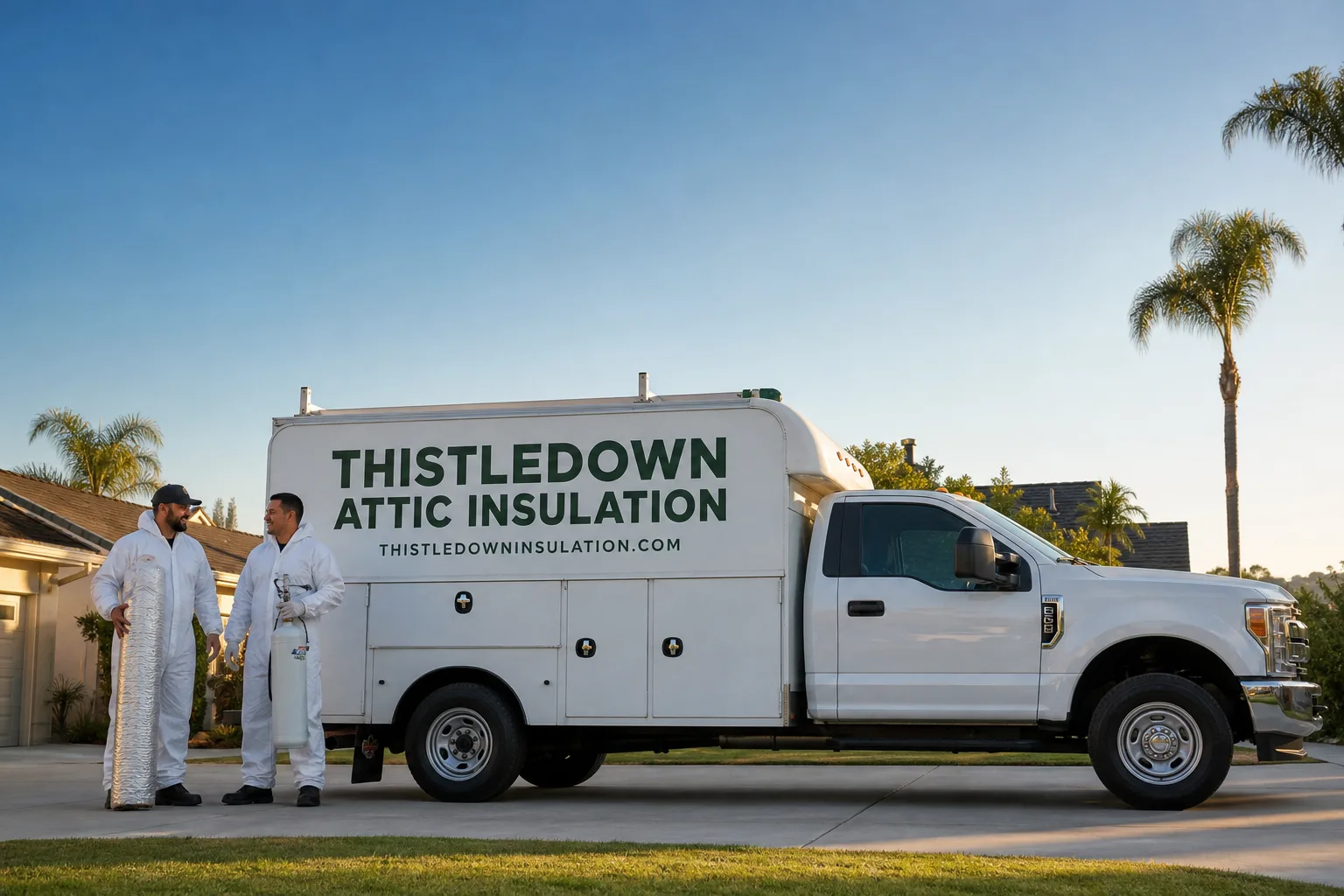
Fast, Reliable Attic Insulation Across Castaic
Attic insulation in Castaic has to work harder than it does almost anywhere else in Los Angeles County. The same attic cavity that bakes past 150°F during a Santa Ana event in August drops into the upper 20s on a January night when cold air drains down from Tejon Pass. That’s not a mild swing, and it’s why we approach every Castaic job differently than we would a Valencia or Newhall attic. When you call (909) 768-6501, a live person answers, and we’ll schedule a time that works around your family’s day, not the other way around.
Below, you’ll find straightforward pricing for the Castaic market, what actually fails in these 1990s tract attics, and the honest difference between a simple top-off and a full removal-and-replace. Written by Attic Insulation specialist Neil Barron.
Why Thistledown Attic Insulation Is Castaic’s Preferred Attic Insulation Company
We’re part of the Cedarwell family, founded in 2003, and we’ve spent years inside the attics of Castaic’s stucco tract homes. That matters here specifically because 1990s-era construction off Hasley Canyon Road, The Old Road, and Ridge Route Road presents insulation problems that coastal LA homes never see. Vaulted ceilings leave shallow, uneven channels above the living space. Expansive attic cavities tempt homeowners to add a layer over degraded material that’s already lost half its R-value. We know what to look for before we open the hatch.
Every Castaic job gets a written price before any work starts. Not a range, not a verbal estimate, not a number that shifts once the crew arrives. That’s the Thistledown standard, and it’s backed by our 365-Day Done Right Promise. If something isn’t right within a year, we make it right. No debate, no fine print.
Our technicians are background-checked and uniformed. We lay drop cloths across your hallway and wear shoe covers from the front door to the attic hatch. When the job’s done, we take a photo of the cleanup and leave it with you before the van pulls away. And if your kids are napping, we work with quiet tools. Those aren’t add-ons. That’s how every visit goes.
For Castaic families, that level of care is the difference between hiring a crew and hiring a neighbor.
Attic Insulation Removal in Castaic
Attic Insulation Removal in Castaic is the service we recommend most often for homes built in the 1990s and early 2000s, because the original blown fiberglass in these attics has usually been cooked, compressed, and compromised by 20-plus years of Tejon Pass summer heat spikes. A typical removal job in Castaic runs $1,200 to $2,800 depending on attic square footage and access, and it includes vacuuming out the old material, disposing of it, and leaving you with a clean cavity ready for new insulation.
When Removal Beats a Top-Off
If the existing insulation is crusted, discolored, or sitting at half its original depth, adding new material on top locks in the problem. The old layer keeps degrading underneath, and you’ve just spent money burying a time bomb. Removal lets you start clean.
Sealing Before We Refill
With the old material gone, we can see the top plates, can light housings, and wire penetrations. Sealing those before blowing in fresh insulation stops air leakage that undermines the whole job. In Castaic’s thermal funnel, an unsealed attic at 150°F pushes heat into your living space through every gap we miss.
Blown In Insulation in Castaic
Blown In Insulation in Castaic homes is the standard for attics with accessible flat cavities and open framing, which covers a lot of the tract stock off Parker Road and Lake Hughes Road. Blown-in fiberglass from Owens Corning or Johns Manville typically runs $1,500 to $3,600 for a full Castaic attic, depending on target R-value and square footage. We quote an exact number in writing before we start.
Uniform Coverage Across Irregular Attic Floors
Blown-in material settles into the dips, bays, and hard-to-reach corners that batt insulation leaves bare. For Castaic’s expansive attic cavities, that means fewer hot-ceiling pockets in summer and fewer cold-draft zones when the pass sends freeze nights down in winter.
R-Value and the Castaic Climate
We typically blow to R-38 or higher in Castaic, which is above what most of these 1990s homes were originally built with. The extra thickness doesn’t just help summer heat. It’s what gets you through those upper-20s°F January nights without your furnace running nonstop.
Trusted Brands We Service in Castaic
We install Owens Corning and Johns Manville blown-in fiberglass, Knauf batt, and Rockwool where the job calls for it. Each product line gives Castaic homeowners a real choice in budget, R-value per inch, and material preference, including pet-safe options where a choice exists. We stock the common depths and bag counts for Castaic’s typical attic sizes, which means fewer supply-run delays and faster same-week scheduling. No matter which brand fits your attic best, the installation standard stays identical: written price first, clean floors throughout, photo of the cleanup at the end.
Common Attic Insulation Problems We See in Castaic Homes
- Compressed, discolored blown fiberglass from repeated 150°F+ cycling. Years of offshore-flow and Santa Ana events bake the material until it loses its loft and its R-value. The insulation looks crusted and sits at half its installed depth, and no top-off fixes that.
- Uneven settling in vaulted-ceiling channels. Castaic’s stucco tract homes often have vaulted ceilings with thin, hard-to-reach attic cavities above them. Insulation settles unevenly there, leaving hot-ceiling pockets in summer and cold spots during Tejon Pass freeze nights.
- Bare patches after HVAC or duct work. Technicians moving through these expansive attics disturb insulation around ducts, registers, and top plates. That material almost never gets re-leveled, and the bare spots show up first as winter heat loss.
- Undersized attic ventilation compounding the heat problem. Many 1990s Castaic homes were built with marginal venting. When attic temps spike past 150°F, trapped heat accelerates insulation degradation and drives cooling costs up even with the AC running properly.
Pricing for Attic Insulation in Castaic, CA
Real numbers for the Attic Insulation in Castaic market, based on the work we’ve done in this area:
- Attic Insulation Removal: $1,200 to $2,800, depending on square footage and access difficulty.
- Blown-in fiberglass, full attic to R-38: $1,500 to $3,600.
- Radiant barrier over vaulted-ceiling runs: adds $700 to $1,400 on typical Castaic homes.
- Attic insulation top-up over healthy, recent material: $900 to $2,200.
- Attic baffles and ventilation prep: $250 to $600 when paired with insulation work.
Your exact written number comes after we inspect the attic, not after the crew starts working. Call (909) 768-6501 for a free estimate. No pressure, just the number on paper so you can decide on your own schedule.
We Also Serve Cities Near Castaic
Our crews cover the surrounding communities for attic insulation work, including Castaic neighbors in Stevenson Ranch, Santa Clarita, San Fernando, and Simi Valley. If you’re just over the county line or down the 5, the same written-price standard and Done Right Promise apply. Call and we’ll confirm your street and set a time that works.
Serving Castaic, CA - Our Local Coverage Area
We’re based in the Castaic area and know this community well. Use the map below to see our service coverage - if you’re nearby, we can almost certainly help.
FAQs About Attic Insulation in Castaic
Castaic sits in a thermal funnel at the base of Tejon Pass, and that’s not a figure of speech. Offshore-flow and Santa Ana events push attic temperatures past 150°F here, which is hotter than what Valencia or Newhall attics typically see. That heat cooks blown fiberglass, compresses it, and strips R-value years ahead of its rated service life. An attic in Santa Clarita might go 25 years between visits. A 1990s Castaic tract attic often needs attention at 15 to 18 years, which is why we treat insulation here as a repeating service cycle, not a one-time lifetime job. If your upstairs rooms won’t hold temperature and your cooling bills have crept up three summers running, the insulation is probably done before its time. Call (909) 768-6501 and we’ll take a look.
The winter cold matters more than most Castaic homeowners expect. Cold-air drainage from Tejon Pass drops attic temperatures into the upper 20s°F on clear January nights, and any insulation gap or settled patch shows up immediately as heat loss. Your furnace cycles longer to hold a steady temperature, and upstairs bedrooms get noticeably colder than the rest of the house. The same cavity that was 150°F in August has to retain heat in January, so the insulation has to survive both extremes. That dual stress is unique to this corridor, and it’s why proper depth and even coverage matter year-round here.
We pull back the attic access, set up a vacuum line, and remove the old blown material down to the decking. Then we inspect the cavity for air leaks, seal top plates and penetrations, and prep the space for fresh insulation. Dropping cloths go down from the front door to the attic hatch, and the whole job usually takes one to two days depending on attic size. We were out on a 1990s stucco tract home off Lake Hughes Road where the homeowner’s summer cooling bills had crept up three seasons running. Our tech found the original blown fiberglass compressed to roughly half its installed depth and crusted brown from years of 150°F attic cycling. After removal, sealing, and new blown-in Owens Corning fiberglass with a radiant barrier over the vaulted-ceiling run, the upstairs bedrooms held temperature through the afternoon for the first time since the family bought the place.
In Castaic, a radiant barrier typically pencils out better than it does in most of coastal LA County. The radiant surface reflects a meaningful portion of the 150°F+ attic heat that would otherwise soak into your ceiling drywall, and that translates directly to cooler upstairs rooms and lower AC run time. We add $700 to $1,400 for a typical radiant barrier over vaulted-ceiling runs where the heat gain is most direct. For homes facing southwest exposure or with second-story bedrooms, the payback is often under three years.
If the existing material is fluffy, dry, free of discoloration, and still sitting at its original installed depth, a blown-in top-up is usually the right and more affordable call. If you see crushed or crusted material, rodent droppings, moisture staining, or insulation that’s sagged to half its depth, removal is the honest fix. Adding new material over degraded fiberglass doesn’t restore the lost R-value underneath. We’ll do a visual inspection and tell you which path fits your attic, with a written price either way. Call (909) 768-6501 for a free estimate.
Written by Neil Barron, owner at Thistledown Attic Insulation, serving Castaic since 2003.