
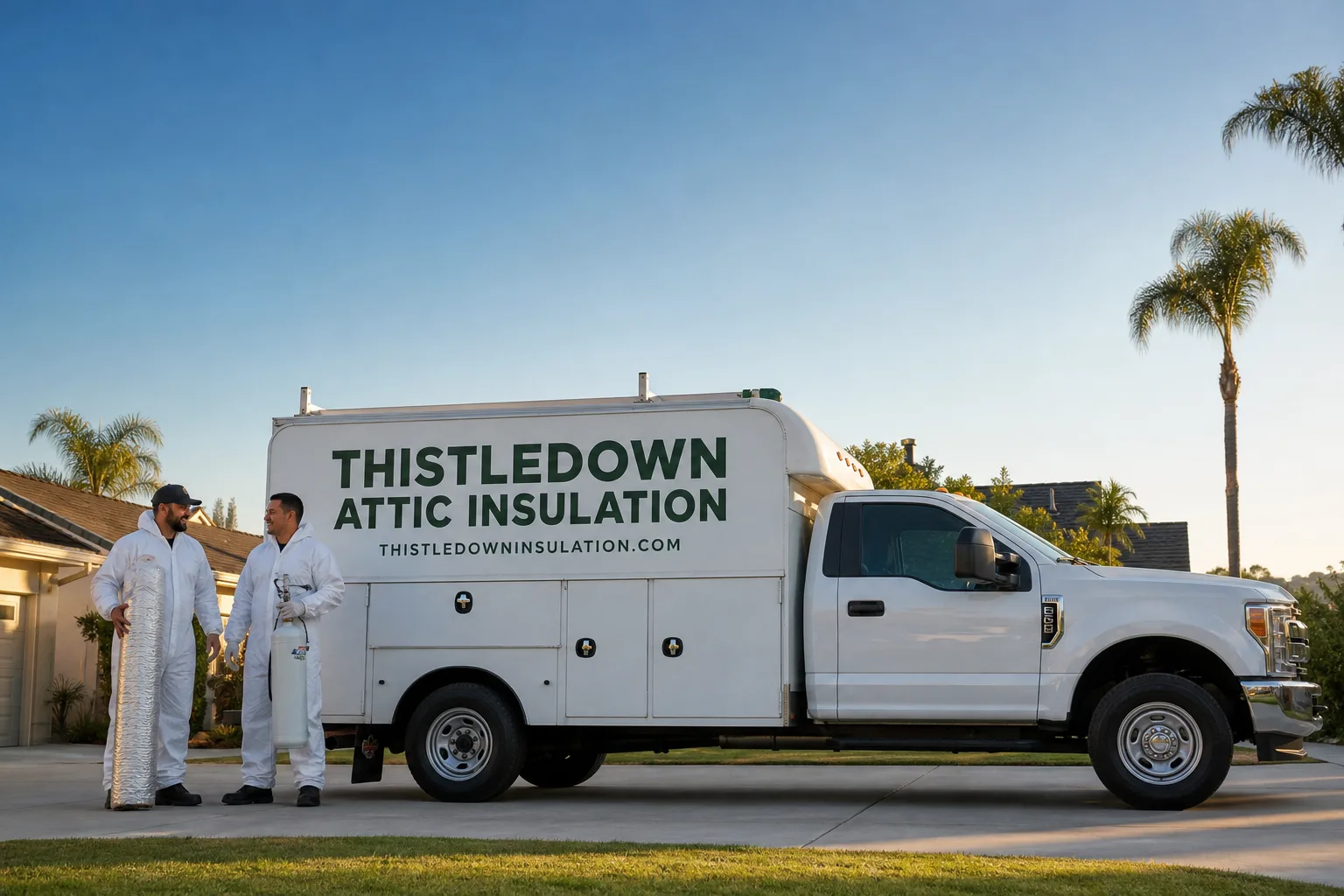
Fast, Reliable Attic Insulation Across Half Moon Bay
Attic insulation in Half Moon Bay isn’t like insulating a house in Redwood City or San Jose. Here, the marine layer works against your attic every single day. What a homeowner in Half Moon Bay needs is insulation that holds up to constant coastal moisture, plus ventilation that actually dries things out. We’ve spent years working in the beach cottages near the old-town core, the ranches off Highway 1, and the newer subdivisions in Frenchmans Creek and Alsace Lorraine. If you need a straight answer about what’s going on above your ceiling, call (909) 768-6501 and a live person picks up. No phone tree, no waiting until Monday.
Why Thistledown Attic Insulation Is Half Moon Bay’s Preferred Attic Insulation Company
We’re part of the Cedarwell family, an independently owned insulation specialist founded in 2003. The Thistledown name comes from the soft fluff of the thistle, one of nature’s lightest insulators. It’s a promise about how carefully we work.
Our crews know Half Moon Bay. We know that fog rolls in over Pillar Point and lingers over Miramar while the sun shines in Belmont. We know that a 1940s cottage off Main Street has different attic problems than a 1990s house in Strawflower Village. When you call us, you’re not getting a generic insulation quote. You’re getting a team that has pulled failed batts out of damp Half Moon Bay attics and replaced them with systems that actually work here. Neil Barron, who leads our team, has built our approach around one thing: written prices before any work starts, and a 365-Day Done Right Promise behind every job.
Every technician who walks through your door is background-checked and in uniform. They’ll lay drop cloths across your hallway, wear shoe covers from the front door to the attic hatch, and send you a photo of the cleanup before the van pulls away. We answer calls around the clock because attic problems don’t keep business hours.
Attic Ventilation in Half Moon Bay
Attic Ventilation in Half Moon Bay is the difference between an attic that breathes and one that slowly rots. The marine climate zone here keeps incoming air near saturation for much of the year. A roof vent system sized for inland Bay Area heat, static roof vents only, can’t dry out a Half Moon Bay attic because the fog-fed air carries too much moisture to help. The right system moves air continuously, pulling damp air out before it condenses on sheathing and rusts fasteners. For most Half Moon Bay homes, a properly balanced venting system with ridge and soffit ventilation runs between $1,200 and $2,800 depending on roof size and existing venting.
What We Inspect Before Quoting Ventilation
Before we quote any ventilation work, we check the roof deck for water staining, rusted truss plates, and matted insulation. We also measure the existing vent area and compare it to what the attic footprint actually needs. A 1:150 or 1:300 ratio sounds fine on paper, but in Half Moon Bay’s fog belt, undersized ventilation is why attics stay damp even when insulation looks dry on top.
Adding Ventilation to Older Coastal Homes
Older cottages near Main Street and the downtown core often have gable vents only, or a single static roof vent that was installed decades ago. We add continuous ridge venting and balance it with soffit vents so air moves from the eaves to the peak. In homes where soffits are closed off entirely, we install baffles at every bay to keep the airflow path clear of insulation.
Radiant Barrier in Half Moon Bay
Radiant Barrier in Half Moon Bay serves a different purpose than it does in a hot inland climate. Here it’s not about beating back 100-degree attic temperatures. It’s about reflecting the heat that does build up during the sunny hours and slowing moisture-driven temperature swings that cause condensation. A radiant barrier stapled to the underside of the rafters keeps the roof deck’s temperature more stable, which reduces the condensation cycle that the marine layer triggers. Installing a radiant barrier in a typical Half Moon Bay attic runs between $1,600 and $3,400.
Pairing Radiant Barrier With Attic Insulation
We almost always install a radiant barrier alongside insulation work rather than as a standalone fix. The barrier works at the roof plane, reflecting radiant heat before it reaches the insulation below. The insulation then handles conductive heat. In a damp coastal attic, that combination dries things out faster after a fog cycle and keeps the insulation from absorbing moisture that drips down from cool sheathing.
Where Radiant Barrier Performs Best on the Coast
Homes with tile or composition roofs and limited attic depth benefit the most. The barrier fits tight to the rafter bays and needs no additional clearance above the insulation. For vaulted ceilings or spaces with knee walls, we can install it on the vertical surfaces in addition to the rafter bays.
Trusted Brands We Service in Half Moon Bay
We install products from Owens Corning, Johns Manville, GreenFiber, and Knauf, among others. What that means for Half Moon Bay homeowners is choice. Some families want the air-sealing performance of closed-cell spray foam in a damp crawl space. Others want GreenFiber’s borate-treated cellulose because it resists both fire and moisture. We’ll walk you through which product matches your attic and your budget, and we’ll put the price in writing before any work starts. We stock common materials locally for faster turnaround on Half Moon Bay projects, so you’re not waiting on a truck from across the Bay.
Common Attic Insulation Problems We See in Half Moon Bay Homes
- Wet, compressed fiberglass that looks installed. Batts near the eaves or along the roof deck have been absorbing marine-layer humidity for years. They look fine from the attic hatch, but a moisture meter tells the real story: near-zero R-value and material that needs to come out.
- Rusted fasteners and truss plates. When fog-driven vapor condenses on the underside of the roof sheathing, it drips onto the framing. Rusted nails and truss plates are the first visible sign that ventilation has been failing for a long time.
- Attic air leaks from the living space. In older beach cottages, ceiling penetrations around light fixtures and plumbing stacks let warm, humid air from the house rise into the attic. That air carries moisture from the kitchen, bathroom, and laundry, and it condenses on the cold sheathing at night.
- No air sealing under the insulation. Many Half Moon Bay attics have insulation piled on top of a leaky ceiling plane. Warm air bypasses the insulation entirely, carrying moisture into the attic and wasting heat all winter. Air sealing comes first, then insulation on top.
Pricing for Attic Insulation in Half Moon Bay, CA
Several Attic Insulation jobs in Half Moon Bay fall into predictable ranges. An attic insulation top-up with blown-in fiberglass runs $1,800 to $3,200 for a typical 1,200-square-foot attic. Full attic insulation replacement, including removal of failed material and air sealing, runs $4,500 to $8,500. Attic batt insulation for new construction or a clean-out runs $3,000 to $5,500. Adding baffles and ventilation prep runs $800 to $1,800. Your exact price comes in writing before any work begins. Call (909) 768-6501 for a free estimate.
We Also Serve Cities Near Half Moon Bay
The Attic Insulation in Half Moon Bay team serves the whole coastside and nearby Peninsula communities. We work in El Granada, with its hillside homes facing the harbor. We cover Burlingame, Millbrae, and Belmont, where the fog burns off sooner but the attics still hold moisture from the same marine layer that sits over Half Moon Bay. If you live just outside the immediate coast, call and ask. Chances are we already work in your neighborhood.
Serving Half Moon Bay, CA - Our Local Coverage Area
We’re based in the Half Moon Bay area and know this community well. Use the map below to see our service coverage - if you’re nearby, we can almost certainly help.
FAQs About Attic Insulation in Half Moon Bay
Because fiberglass insulation in Half Moon Bay wicks moisture from the marine layer, compresses, and loses its R-value while still looking fluffy from above. The insulation appears installed, but the trapped moisture has collapsed the air pockets that do the insulating work. The fix starts with removing the failed material, air-sealing the ceiling plane, and installing a product matched to a coastal attic, often closed-cell spray foam or borate-treated cellulose. Call (909) 768-6501 and we’ll take a look.
In most Half Moon Bay homes, no vapor barrier goes on the attic floor. The coastal moisture here comes from outside air and from warm, humid indoor air rising through ceiling leaks. The real protection is air sealing the ceiling plane, then ventilating the attic continuously. In crawl spaces, vapor management is the opposite story: a heavy vapor barrier over the ground is essential. We assess each home before recommending one approach over the other.
The marine layer keeps your attic humid for long stretches, so insulation that absorbs and holds moisture is a poor choice near the eaves and roof deck. Closed-cell spray foam resists water and air-seals in one step. Borate-treated cellulose resists both moisture and fire. Fiberglass works if it stays dry and ventilated, but it needs a roof venting system designed for fog-belt conditions. We match the product to your attic’s actual moisture profile, not to a generic spec sheet.
Continuous ridge venting paired with soffit vents moves air through the attic even when the marine layer keeps outdoor humidity high. Static roof vents alone don’t create enough cross-flow to dry out a coastal attic. In some older homes, we add baffles at every soffit bay first, then balance the ridge vent to match. The goal is steady air movement that keeps the roof deck dry.
Look for water-stained sheathing, rusted nails or truss plates, and batts that feel heavy or sit flat instead of fluffy. If you can see gaps between the insulation and the roof deck, or if the material near the eaves is dark and matted, it’s already failing. We pulled a soaked, collapsed Owens Corning batt from a 1940s beach cottage attic near the old-town core: it had absorbed decades of fog-driven humidity and tested at near-zero R-value. A quick attic inspection tells you what you’re actually working with. Call (909) 768-6501 to schedule one.
If you live in Half Moon Bay and you’re not sure whether your attic insulation is still doing its job, the fastest way to find out is a phone call. Ask for Neil or any of our team. We’ll walk through what you’re seeing, give you a straight answer, and if you want us out there, we’ll put a written price in your hand before anyone picks up a tool.
Written by Neil Barron, Owner at Thistledown Attic Insulation, serving Half Moon Bay since 2003.