
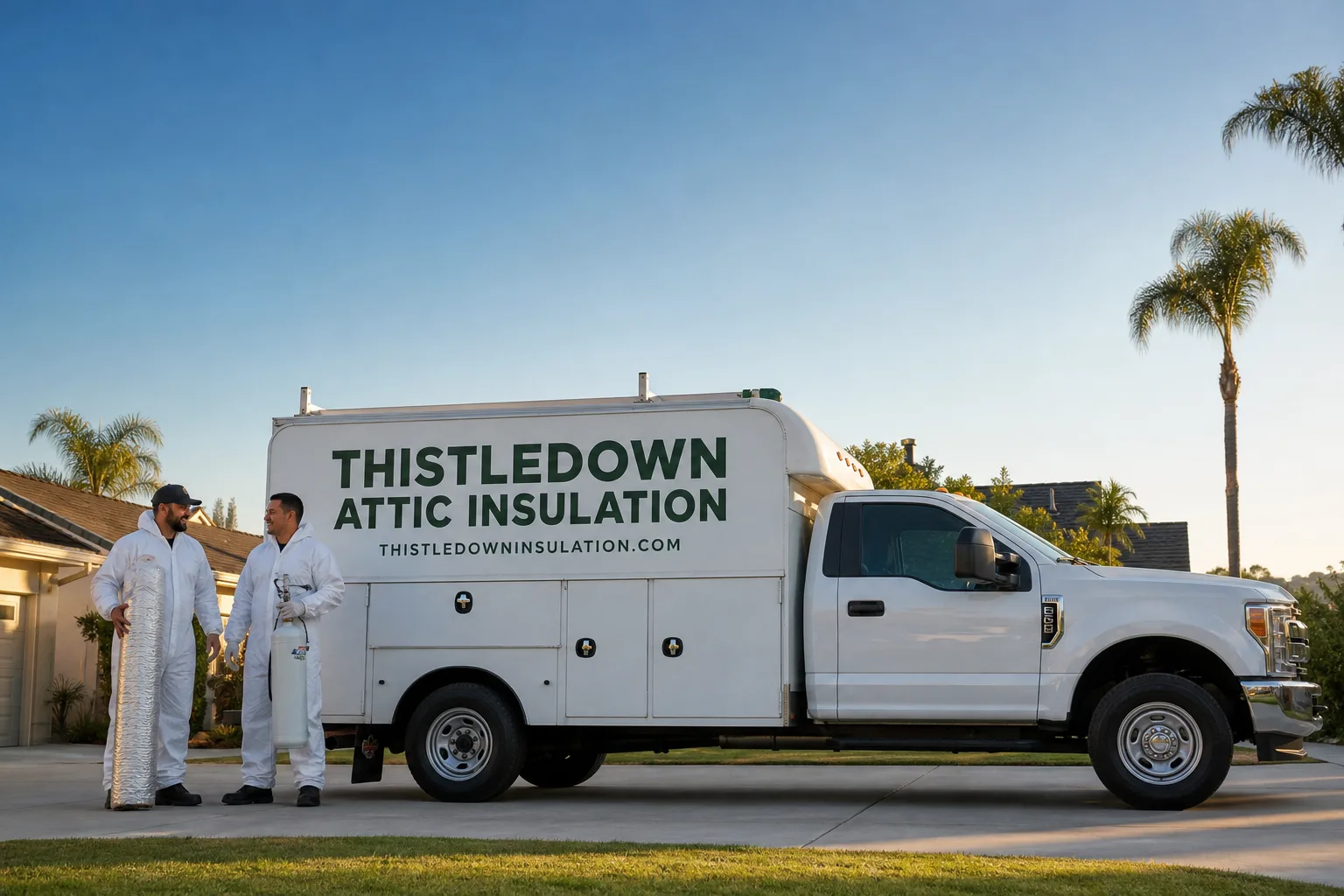
Fast, Reliable Attic Insulation Across Highland
Attic insulation in Highland, CA typically costs between $1,800 and $4,500 for a full retrofit on a 1,200 – 1,800 square foot home, and most projects are completed in a single day. That’s the honest number before anyone steps foot in your attic. Thistledown Attic Insulation has been doing exactly this work since 2003, and we know the homes here the way only a crew that’s opened hundreds of Highland attics can. Call (909) 768-6501 and a live person answers, any hour, any day.
What makes Highland different isn’t just the heat. It’s the mountain. Your attic doesn’t face one thermal challenge; it faces two, and they fight each other every single day.
Why Thistledown Attic Insulation Is Highland’s Preferred Attic Insulation Company
Highland sits at the base of the San Bernardino Mountains, which means summer afternoons routinely cross 100°F while the same attic drops 30 to 40 degrees by midnight as cold air drains down off the slopes. Most homes here were built between the 1960s and early 1990s, back when Highland was still unincorporated San Bernardino County, and their attics were insulated to minimum code for what someone assumed was a mild Southern California climate. That assumption was wrong, and Highland homeowners pay for it every August and every January.
Our crews know the older flatland neighborhoods off Base Line Street where attics are shallow and tight, and we know the foothill parcels with complex rooflines that complicate a retrofit. Neil Barron, who leads Thistledown, insists on a written price before any work starts. Every time. No ranges, no “we’ll see when we get in there.” You’ll know your number before we touch a rafter.
We’re an independently owned Cedarwell-family company, and we hold ourselves to the Cedarwell Care Promise on every visit. Shoe covers at the door. Drop cloths across your hallway. Quiet tools when the baby is napping. A photo of the clean-up before the van pulls away. That’s just how the job gets done.
Blown In Insulation in Highland
Blown in insulation in Highland is the most common retrofit we perform, and for good reason. Most Highland attics have original fiberglass batts or loose-fill that’s been sitting there for 30 to 50 years, compressed flat, kicked around by rodents, or displaced by the mountain wind that pushes through eaves at night. Blown-in fiberglass or cellulose lets us fill irregular joist bays, pack around wiring and bracing, and build a uniform thermal blanket that batts simply can’t match in older construction.
A full blown-in retrofit in Highland typically runs $2,200 to $4,000 depending on attic square footage and the existing insulation depth. The work usually takes one day. We lay drop cloths from your front door to the attic hatch, and you’ll see a photo of the clean attic floor before we leave.
Mountain Wind and Loose-Fill Displacement
This is a problem we see far more in Highland than in flatland cities. Cold air drains off the San Bernardino Mountains nearly every night, and that moving air finds its way into attic vents and unsealed eaves. Over years, it physically blows loose-fill insulation away from the eaves and sloped edges, leaving bare spots that spike your cooling bill in July and make rooms chilly by midnight. Blown-in installed with proper baffles and eave packing stops that migration.
Air Sealing Before Insulation
In Highland, we always air-seal the attic floor before blowing insulation. The thermal stack effect here is relentless: hot air rises through your ceiling and pulls cold mountain air in through every crack below. Sealing top plates, wire penetrations, and the attic hatch stops that cycle at its source. Insulation without air sealing is like wearing a down jacket in the wind without a shell.
Insulation Contractors in Highland
Insulation contractors in Highland aren’t all familiar with the nuances of mountain-base construction. The northern foothill sections of Highland fall within San Bernardino County’s designated High Fire Hazard Severity Zones, which means any attic insulation work in those WUI-adjacent neighborhoods must account for fire-rated assembly requirements. A flatland contractor from Rialto or Fontana might not flag that until a county inspector does, and by then you’re paying for a redo.
A typical attic insulation project in Highland ranges from $1,800 for a simple top-up on a small tract home to $4,500 or more for a full removal and replacement with air sealing on a foothill custom with complicated rooflines. You’ll get your exact written number before work begins.
High Fire Hazard Severity Zone Compliance
In the foothill neighborhoods near the base of the San Bernardino Mountains, county code requires ignition-resistant detailing on insulation assemblies. That often means fire-rated baffles, specific venting configurations, and insulation materials that meet the assembly rating for that zone. We’ve done enough of these retrofits to know what the inspector will look for, and we build to that standard from the start, not after a red tag.
1970s and 80s Tract Homes
The original insulation in Highland’s pre-incorporation tract homes was installed to minimum Title 24 code of that era, which assumed a coastal climate, not a 100°F inland basin with mountain-induced temperature swings. Those attics commonly have R-11 or less, which is less than a third of what the Department of Energy recommends for this climate zone. A top-up or full replacement brings those attics current without touching your walls.
Trusted Brands We Service in Highland
Thistledown installs eight insulation brands, and for Highland attics we often specify Owens Corning blown-in fiberglass, Johns Manville batts, or Rockwool for fire-rated foothill assemblies. The right product depends on your attic’s geometry, the fire zone you’re in, and whether you have pets in the home. We stock materials locally for Highland jobs, so there’s no week-long wait for a shipment. Call (909) 768-6501 and ask Neil or one of our techs which brand fits your attic.
Common Attic Insulation Problems We See in Highland Homes
- Wind-displaced loose-fill at the eaves. Nighttime mountain drainage winds push insulation inward from the eaves of Highland attics, leaving the perimeter nearly bare. This creates the classic pattern of bedrooms at the edge of the house running hot in summer and cold in winter, even when the thermostat says otherwise.
- Compressed original batts from the 1960s – 80s. Thirty to fifty years of gravity, foot traffic from cable installers and HVAC techs, and rodent activity flatten fiberglass batts to a fraction of their rated R-value. Most older Highland attics measure R-11 to R-19 where they should be R-38 to R-49.
- Missing or crushed eave baffles. Without baffles, insulation blocks soffit vents and the attic can’t breathe, which cooks your shingles in summer and traps moisture in winter. In Highland’s high-fire-hazard foothill areas, the baffle type also matters for code compliance.
- Air leaks through the attic floor. Highland’s 30 – 40°F daily temperature swing means your attic air is constantly trying to trade places with your conditioned living space. Unsealed top plates and can light penetrations act like open chimneys, and no amount of insulation fixes an air leak.
Pricing for Attic Insulation in Highland, CA
Here’s what you can expect in Highland’s market. A blown-in top-up over existing insulation on a 1,200 square foot attic runs $1,800 to $2,600. A full remove-and-replace with air sealing runs $2,800 to $4,500 depending on attic condition and fire-zone requirements. Batt insulation for open attics with accessible joist bays runs $2,200 to $3,800. Foothill homes with complex rooflines in the High Fire Hazard Severity Zone can push the upper end because of fire-rated baffle and venting requirements.
The biggest variables are attic square footage, current insulation depth, access difficulty, and whether you’re in a fire hazard zone. You’ll have your exact number in writing before we start. Call (909) 768-6501 for a free estimate.
We Also Serve Cities Near Highland
Thistledown’s Attic Insulation crews serve the entire Highland area and the surrounding mountain-base communities. We also work in San Bernardino, Loma Linda, Redlands, and Mentone. If you’re in one of those cities and need Attic Insulation in Highland expertise, our crew can be there quickly with the same written-price promise.
Serving Highland, CA - Our Local Coverage Area
We’re based in the Highland area and know this community well. Use the map below to see our service coverage - if you’re nearby, we can almost certainly help.
FAQs About Attic Insulation in Highland
Yes. The northern foothill sections of Highland sit inside San Bernardino County’s High Fire Hazard Severity Zones, and county inspectors require ignition-resistant detailing on attic insulation assemblies. That typically means fire-rated baffles, specific venting configurations, and insulation materials that meet the assembly rating for the zone. A flatland contractor who doesn’t know this can get your retrofit red-tagged at inspection. Call (909) 768-6501 and we’ll tell you whether your parcel falls in the zone and what it means for your project.
Because Highland sits at the mountain base, where cold air drains off the San Bernardino slopes nearly every night and physically blows loose-fill insulation away from eaves and sloped edges. Your attic also swings through a 30 – 40°F temperature range daily, which creates relentless thermal expansion and contraction that breaks down old insulation faster than in flatland cities like Rialto or Fontana. Wind-stable installation with proper eave packing solves the first problem; air sealing solves the second.
Almost certainly not. Highland homes from that pre-incorporation era were built to minimum California code for a perceived mild climate, typically R-11 walls and shallow attic insulation. For this mountain-foot thermal environment, the Department of Energy recommends R-38 to R-49 in the attic. Most original attics we open in Highland measure less than half that. The good news: a blown-in retrofit brings you current in a single day without tearing open walls.
It matters equally, and this is where Highland differs from lower valley cities. Your attic is fighting summer heat from the inland basin and winter cold from overnight mountain air drainage. An under-insulated attic leaks heat upward all night in December just as surely as it lets heat in all afternoon in July. Insulation and air sealing work year-round, which is why Highland homeowners who retrofit typically see cooling and heating savings across both seasons. Call (909) 768-6501 for a free assessment.
We install eight brands, and for Highland we most often specify Owens Corning blown-in fiberglass, Johns Manville batts, and Rockwool for fire-rated foothill assemblies. The right product depends on your attic’s joist spacing, whether you’re in the High Fire Hazard Severity Zone, and whether pets and children will be home during the install. We keep pet-safe options where a choice exists. Call (909) 768-6501 and we’ll match the product to your attic.
Written by Neil Barron, Owner at Thistledown Attic Insulation, serving Highland since the company’s founding in 2003.