
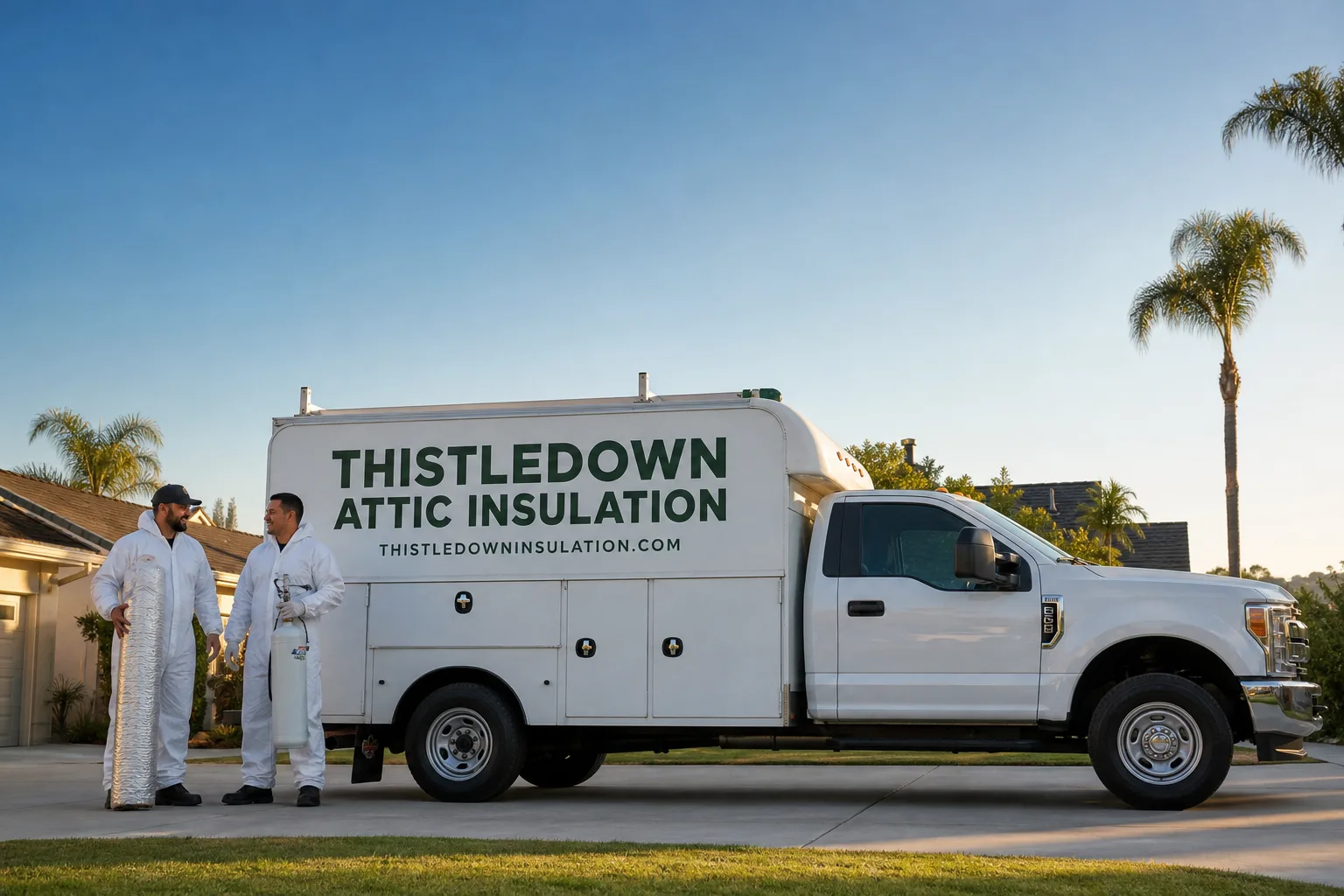
Fast, Reliable Attic Insulation Across Joshua Tree
Most Joshua Tree homes were built as weekend cabins, not year-round houses. That means the attic above your bedroom was likely never insulated to handle a July afternoon that hits 105°F or a January night that drops below freezing. We retrofit those attics every week. Our Attic Insulation crews know the specific failure points in Small Tract Act homestead cabins: collapsed mineral wool, unsealed top plates, and flat roofs that bake under high-desert sun. If your rooms won’t hold temperature, call (909) 768-6501. We’ll give you a written price before any work begins, and we’ll show up with shoe covers on.
Why Thistledown Attic Insulation Is Joshua Tree’s Preferred Attic Insulation Company
Joshua Tree homeowners deal with a specific problem: their houses were built for weekends, not for raising kids or hosting paying guests. We’ve worked on cabins off Sunfair Road, homes near the national park’s west entrance, and places tucked into the Wonder Valley grid where the temperature swings 45 degrees between noon and midnight. Owners call us after their first winter as full-time residents, or after their first Airbnb guest complains about a freezing bedroom.
Our technicians are background-checked and uniformed. When we walk into your Joshua Tree home, you know exactly who’s going up the attic ladder. We lay drop cloths across your hallway, wear shoe covers from the front door to the attic hatch, and photograph the clean-up before we leave. That’s the Cedarwell Care Promise, and it isn’t optional on any job we do. Neil Barron, who leads our crews, holds every installation to the same standard: explain the price before the work, respect the family’s time, and leave the house cleaner than we found it.
Every call is answered by a live person, 24/7. You won’t get a voicemail tree when you call about a freezing bedroom in January. You’ll get one of us.
Blown In Insulation in Joshua Tree
Blown in insulation is the most common retrofit we install in Joshua Tree attics, because most of the older cabins here have shallow attic spaces, odd rafter layouts, and existing debris that makes batt installation wasteful. The material is loose-fill fiberglass or cellulose blown through a hose to a uniform depth. It fills gaps, settles around cross-bracing, and gives you a continuous thermal blanket without tearing open the ceiling. For a typical 900 to 1,200 square foot Joshua Tree homestead cabin, blown in insulation runs $1,500 to $3,200 depending on depth, access, and whether the old material needs removal first.
Air-Sealing Before the Blow
On almost every original Joshua Tree cabin, the top plates and ceiling penetrations leak. We air-seal those gaps with foam before blowing in new insulation. Skipping that step is the most common reason owners don’t feel the difference after a retrofit.
Blown-In Over Existing Material
If the existing loose fill is dry, rodent-free, and reasonably intact, we can blow new material right over it to reach current R-value targets. In Joshua Tree we generally recommend R-38 to R-49 for attics, because the freeze-thaw cycle is as hard on these houses as the summer heat is.
Insulation Contractors in Joshua Tree
Insulation contractors in Joshua Tree aren’t all the same. Most general contractors sub out the work or treat it as a checkbox on a remodel. We do one thing: attic and spray foam insulation, installed to the Cedarwell Care Promise. That focus matters in a town where the housing stock demands specific knowledge. A contractor who works mostly in Palm Springs won’t think about the freeze risk that a 2,720-foot elevation brings. We do, because we work in Joshua Tree routinely. A full attic retrofit here, including old insulation removal, air-sealing, and blown-in fiberglass to R-38, typically runs $2,200 to $4,800 on a standard homestead cabin footprint.
Retrofit vs. Replacement Decisions
Some Joshua Tree cabins still have the original rock wool or mineral wool from the 1950s and 60s. It’s thin, settled, sometimes rodent-damaged. We’ll tell you honestly whether it’s safe to add over it or whether removal makes more sense. The written quote covers either path before we touch a rafter.
Working Around Short-Term Rental Schedules
If you run an Airbnb or VRBO in Joshua Tree, you can’t keep the house offline for weeks. We schedule around bookings, work quietly when kids or guests are present, and finish most attic retrofits in one day.
Trusted Brands We Service in Joshua Tree
We install and service insulation from Owens Corning, GreenFiber, and Johns Manville, and we stock the materials and equipment needed to keep Joshua Tree attics performing through both seasons. GreenFiber cellulose is a smart choice for older cabins with irregular rafter bays, because it fills oddly shaped cavities that batts can’t reach. Owens Corning fiberglass gives you consistent R-value per inch and resists moisture well in low-slope roofs. Johns Manville offers dependable batt and loose-fill options for the simple rectangular attics common in 600-to-900-square-foot cabins. We match the product to your specific attic, and if you have pets, we’ll choose pet-safe options where a choice exists.
Common Attic Insulation Problems We See in Joshua Tree Homes
- Collapsed or settled mineral wool from the original build. These cabins were never insulated to modern standards, and what little was installed 60 years ago has packed down to R-6 or less in many attics we inspect.
- Unsealed top plates and ceiling penetrations. Air moves through the gaps around every ceiling light, vent, and interior wall. In a high-desert climate, that air movement erases whatever the insulation was doing.
- Flat or low-slope roofs with minimal venting. Summer heat gets trapped in the attic and radiates into the rooms below for hours after sunset. Without a radiant barrier or improved venting, the insulation can’t keep up.
- CMU block walls that fool owners into thinking the house is insulated. Block has almost no R-value. The attic remains the primary heat-loss and heat-gain path unless it’s properly retrofitted with air-sealing and deep insulation.
Pricing for Attic Insulation in Joshua Tree, CA
Here are the numbers we quote most often for Joshua Tree homes. A basic blown-in top-up over existing insulation on a small cabin runs $900 to $1,600. Full removal of old material, air-sealing, and new blown-in fiberglass to R-38 runs $2,200 to $4,800 depending on attic access, roof slope, and square footage. Adding a radiant barrier to a flat or low-slope roof typically adds $600 to $1,400. You’ll get a written price before any work starts, every single time. Call (909) 768-6501 and we’ll come out, inspect the attic, and put the number in your hand. Free estimate, no pressure.
We Also Serve Cities Near Joshua Tree
Our crews travel throughout the Morongo Basin. We regularly work in Joshua Tree and the surrounding communities: Yucca Valley, Twentynine Palms, Desert Hot Springs, and Thousand Palms. If you’re anywhere in the high desert, call us and we’ll tell you straight if we can help.
Serving Joshua Tree, CA - Our Local Coverage Area
We’re based in the Joshua Tree area and know this community well. Use the map below to see our service coverage - if you’re nearby, we can almost certainly help.
FAQs About Attic Insulation in Joshua Tree
Yes, absolutely. CMU block has almost no insulative value, and the attic is the single largest heat-loss and heat-gain surface in your cabin. Even if the walls feel solid, an uninsulated attic is undoing your heating and cooling all year. Call (909) 768-6501 for an inspection and a written quote.
Your roof absorbs direct high-desert sun all day, and the heat has nowhere to go. Joshua Tree gets intense solar radiation, and attics can reach 150°F or more on summer afternoons even when the outside air is 100°F. The heat then radiates into your rooms for hours after sunset. A radiant barrier paired with proper insulation slows that heat gain meaningfully.
Yes, and this is the most common retrofit we do in Joshua Tree. The framing is usually simple and accessible. We air-seal, add baffles where needed for venting, and blow in insulation to current R-value recommendations. The cabin doesn’t need to be rebuilt; its attic just needs to be treated like a real thermal boundary for the first time.
We prefer Owens Corning or Johns Manville fiberglass for most Joshua Tree attics, and GreenFiber cellulose for irregular or shallow cavities. All three perform well across the high desert’s temperature swings. The brand matters less than the installation quality, air-sealing, and correct depth. We’ll match the product to your specific attic and your budget, and the quote is always written before work starts.
If the old material is dry, free of rodent droppings, and not contaminated, we can often blow new insulation over it to reach the target R-value. If it’s packed down, damp, or full of debris from past roof work, removal is the better call. We’ll inspect it, tell you which path makes sense, and write the price for whichever option you choose. Call (909) 768-6501 for an exact quote – estimates are free.
Contact Thistledown Attic Insulation in Joshua Tree
If your Joshua Tree cabin can’t hold temperature, if your guests are leaving reviews about cold bedrooms, or if you’re simply tired of running the AC and heater at full blast, call us. We’ll come out, look at the attic, and give you a written price before anything is scheduled. Shoe covers, drop cloths, and a photo of the clean-up are included on every visit. A live person answers 24/7. Call (909) 768-6501 for your free estimate.
Written by Neil Barron, Owner at Thistledown Attic Insulation, serving Joshua Tree and the Morongo Basin.