
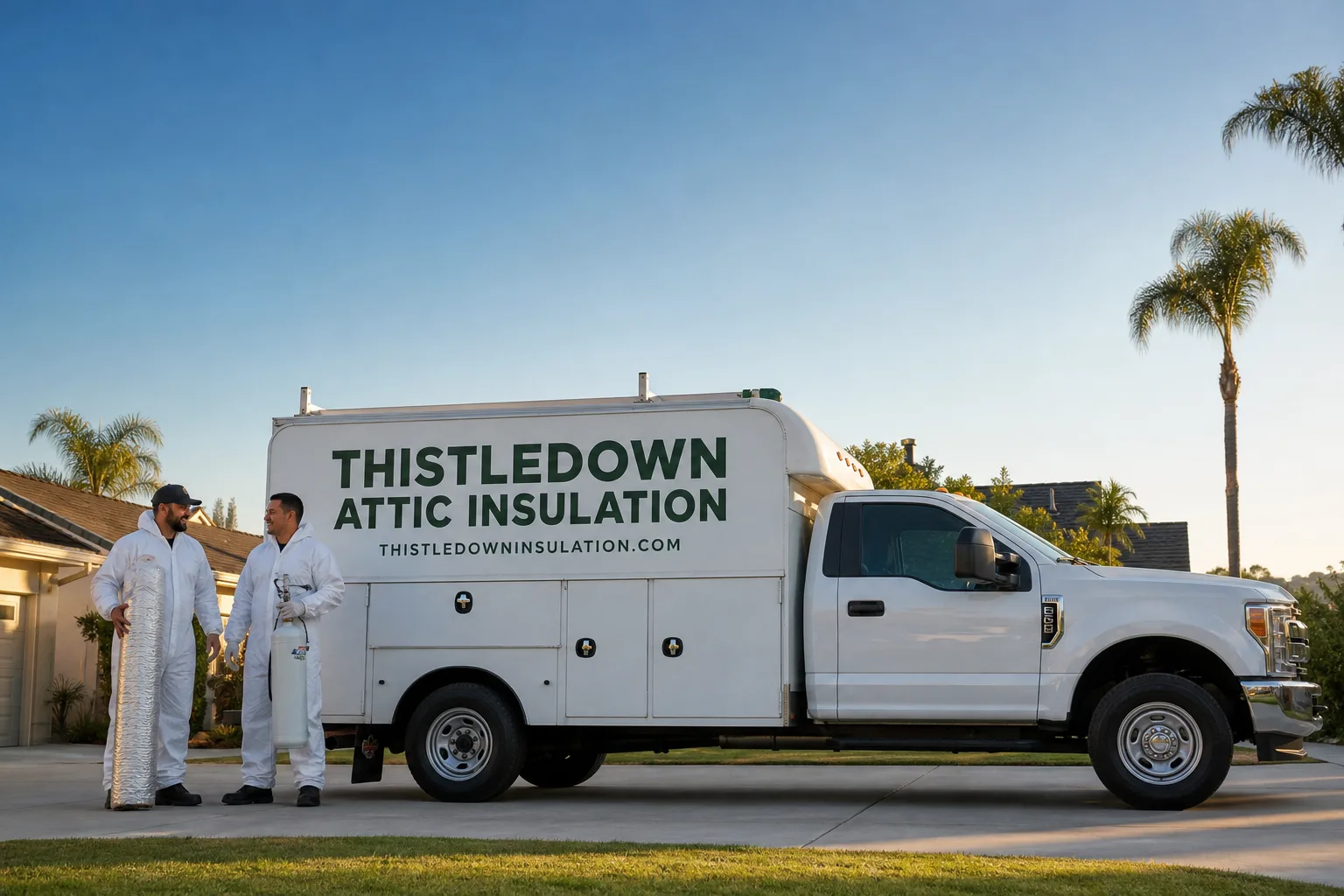
Fast, Reliable Attic Insulation Across Pico Rivera
Most Pico Rivera homes were built between 1947 and 1965, long before California energy codes required meaningful attic insulation. What that means for you: a house that fights summer heat with maybe two inches of crumbled rock wool, if anything at all. Our Attic Insulation team works on these exact postwar stucco ranches every week, and we know what it takes to correct a missing thermal envelope, not just top it off. Call (909) 768-6501 and you’ll get a live person, a straight answer, and a written price before anything gets touched.
Why Thistledown Attic Insulation Is Pico Rivera’s Preferred Attic Insulation Company
Pico Rivera’s housing stock is remarkably consistent: compact single-story stucco boxes from the Truman and Eisenhower years, most running 950 to 1,400 square feet with wood-frame walls and low-pitch roofs. That consistency means our crews know exactly what they’re walking into before they lift the attic hatch. We’ve worked homes along Rosemead Boulevard, through the neighborhoods off Whittier Boulevard, and across the residential blocks south of the 60. The conditions are so uniform that when we finish one retrofit on a street, we often hear from two or three neighbors the same month.
Every visit follows the Cedarwell Care Promise. Background-checked, uniformed technicians arrive on time. Shoe covers go on at the front door and stay on until we leave. Drop cloths protect your hallway from the front entry to the attic hatch. And before the van pulls away, you get a photo of the clean-up. Neil Barron, who leads our team, holds every crew to that standard. The 365-Day Done Right Promise means if something isn’t right, we make it right. No debate, no fine print.
Attic Ventilation in Pico Rivera
Attic Ventilation is the part of the retrofit that makes insulation actually work in Pico Rivera, where summer attic temperatures routinely climb past 150°F and the heat-island effect along Washington and Rosemead Boulevards makes the problem worse than anything coastal LA cities see. Without proper intake and exhaust, even new insulation turns into a heat sponge. We size ventilation to each attic: intake at the eaves, exhaust at or near the ridge, balanced so air moves through the space instead of short-circuiting. Expect to pay between $350 and $900 for a typical ventilation correction on a Pico Rivera ranch, depending on attic size and existing vent count.
Balanced Intake and Exhaust
A 1,100-square-foot Pico Rivera home with a low-pitch roof typically needs intake ventilation at the soffits matched to exhaust at the roof’s upper third. When intake is missing or blocked by old blown-in material, we clear it and install baffles so air reaches the ridge line. On postwar ranches with shallow eaves, we sometimes need custom baffle work to make the airflow path physically possible.
Ventilation With New Insulation
When we blow in new insulation on a Pico Rivera project, we never bury soffit vents. That’s a common failure on quick jobs around here: someone blows fiberglass all the way to the roof edge, blocks the intake, and the attic gets hotter than it was before. We install baffles at every rafter bay before insulation goes in, which keeps the airflow channel open for the life of the job. A combined ventilation and insulation correction on a 1950s Pico Rivera ranch typically runs $2,200 to $4,800.
Radiant Barrier in Pico Rivera
Radiant Barrier installation in Pico Rivera is one of the most effective ways to knock down the brutal summer heat load in an aging attic, especially on homes where the roof deck faces full sun. A radiant barrier is a reflective layer stapled to the underside of the roof rafters. It bounces radiant heat back out before it can soak into your insulation. In Pico Rivera’s inland basin, where attic temps exceed 150°F for hours at a stretch, a properly installed radiant barrier can cut attic temperature by 10 to 15 degrees. Typical radiant barrier installation on a Pico Rivera single-story home runs $1,100 to $2,900 based on roof area and rafter spacing.
Radiant Barrier Done Right
The biggest mistake we see in Pico Rivera is radiant barrier installed without ventilation. Reflective material needs an air gap facing the roof deck, and it needs moving air to carry the reflected heat out. We check existing ventilation before we recommend a radiant barrier, and on older tracts we often pair the two: barrier on the rafters, baffles at the eaves, balanced exhaust at the ridge. That combination is what actually makes a 1950s ranch behave like a much newer house.
Where Radiant Barrier Makes the Most Sense
Homes with west-facing roof planes along the Rosemead Boulevard corridor bear the worst of the afternoon heat. If your upstairs rooms run 10 degrees warmer than the rest of the house from June through September, the problem usually starts in the attic. Radiant barrier takes direct aim at that. We give you a written number for barrier plus any ventilation work before we begin, so you know exactly what you’re paying.
Trusted Brands We Service in Pico Rivera
We install insulation from brands our crews trust for Pico Rivera’s specific housing conditions: Owens Corning fiberglass for dense, even blown-in coverage; GreenFiber cellulose for homes where homeowners want a recycled-content option that fills odd cavities well; and Johns Manville batts for open attic floors where a clean, uniform layer makes sense. We keep fast access to these materials for Pico Rivera jobs, which means we can often start a retrofit within days of your written estimate. For families with pets or kids, we look for pet-safe product options wherever a choice exists.
Common Attic Insulation Problems We See in Pico Rivera Homes
- Compacted rock wool from the original build. Two to three inches of crushed, dust-choked rock wool sitting directly on drywall is the default condition in Pico Rivera’s 1950s tracts. Adding new insulation over it traps heat and doesn’t fix the missing air seal, so we remove it first.
- Tight attic hatches and shallow roof pitches. Many postwar ranches here have hatches barely wide enough for a body, let alone standard equipment. We stage through tight alley-load doors and use narrow-profile hoses so coverage reaches the eaves without damage.
- No air sealing at the top plates. The gap where interior walls meet the attic is a chimney moving conditioned air out of the house. In Pico Rivera’s box ranches, we find these gaps completely unsealed on nearly every original-build home, and sealing them is step one before insulation goes down.
- Ventilation short-circuits from past quick jobs. We see attics where someone blew insulation over the soffit vents years ago. The attic bakes, the shingles age early, and the insulation underperforms. We correct the ventilation path before we add new material.
Pricing for Attic Insulation in Pico Rivera, CA
On a typical 950 to 1,400 square foot Pico Rivera ranch, a full attic insulation correction runs between $2,200 and $4,800. That includes removing degraded old material where needed, air sealing top plates and penetrations, and blowing new insulation to R-38. A top-up where the existing material is clean and sound runs $900 to $1,800. Radiant barrier adds $1,100 to $2,900, and ventilation work typically lands between $350 and $900. These are real ranges for this market, not bait numbers. You’ll have your exact written price before we lift a tool, and the estimate is free. Call (909) 768-6501 and we’ll schedule a time that works around your family.
We Also Serve Cities Near Pico Rivera
If you’re just outside Pico Rivera, we also work in Pico Rivera‘s neighboring communities: Montebello, Santa Fe Springs, Whittier, and Bell Gardens. Much of this area shares the same postwar housing stock, so the conditions we see on Pico Rivera’s 1950s blocks are things we handle regularly across these cities too. Same crews, same written pricing, same clean-up standard.
Serving Pico Rivera, CA - Our Local Coverage Area
We’re based in the Pico Rivera area and know this community well. Use the map below to see our service coverage - if you’re nearby, we can almost certainly help.
FAQs About Attic Insulation in Pico Rivera
Most Pico Rivera homes from the 1947-1965 building boom still have their original rock wool, and after 60-plus years it’s compacted to two or three inches of dust sitting directly on drywall. Blowing new insulation over that traps heat, leaves the air leaks at the top plates unsealed, and doesn’t restore a real thermal boundary. Removal plus air sealing plus new insulation is what actually corrects the problem. Call (909) 768-6501 and we’ll tell you honestly whether your attic needs removal or just a top-up.
Pico Rivera sits in the inland San Gabriel Valley basin, where summer highs run 10 to 15 degrees above coastal LA, and the industrial corridors along Washington and Rosemead Boulevards add another layer of heat. Your attic doesn’t just get hot, it gets past 150°F for hours at a stretch. That means insulation choices that work fine in Long Beach underperform here, which is why we pair insulation with ventilation and often radiant barrier on Pico Rivera homes.
Yes, and that’s a real part of the job on Pico Rivera’s older blocks. Those 1950s hatches are often too small for standard equipment, and alley-load driveways mean we can’t always stage a big truck at the curb. We plan for that: narrow-profile hoses, compact equipment, and crews who know how to work through tight doors without marking up doorframes or walls.
Ventilation is what keeps your new insulation from turning into a heat storage system. In Pico Rivera’s summer conditions, an unventilated attic can hit 150°F even with R-38 on the floor. We install baffles at every rafter bay and balance intake at the eaves with exhaust at the ridge so air moves through the attic and carries heat out. Without that airflow, insulation can’t do its job.
Yes, constantly. On a block of near-identical 1950s stucco ranches near Rosemead Boulevard, our crew opened one hatch and found two inches of compacted rock wool sitting directly on drywall with no air sealing. We removed it, sealed the top plates, blew in Owens Corning fiberglass to R-38, and added attic ventilation. Within weeks, three neighboring homeowners on the same block booked identical retrofits after seeing the temperature drop in that first house. The housing is that uniform, so the fix is too.
If your Pico Rivera attic still has what the builder left in 1955, it’s time for a correction, not just a top-up. Call (909) 768-6501 for a free estimate, a written price, and a crew that treats your home the way we’d treat ours.
Written by Neil Barron, Owner at Thistledown Attic Insulation, serving Pico Rivera with the Cedarwell Care Promise on every job.