
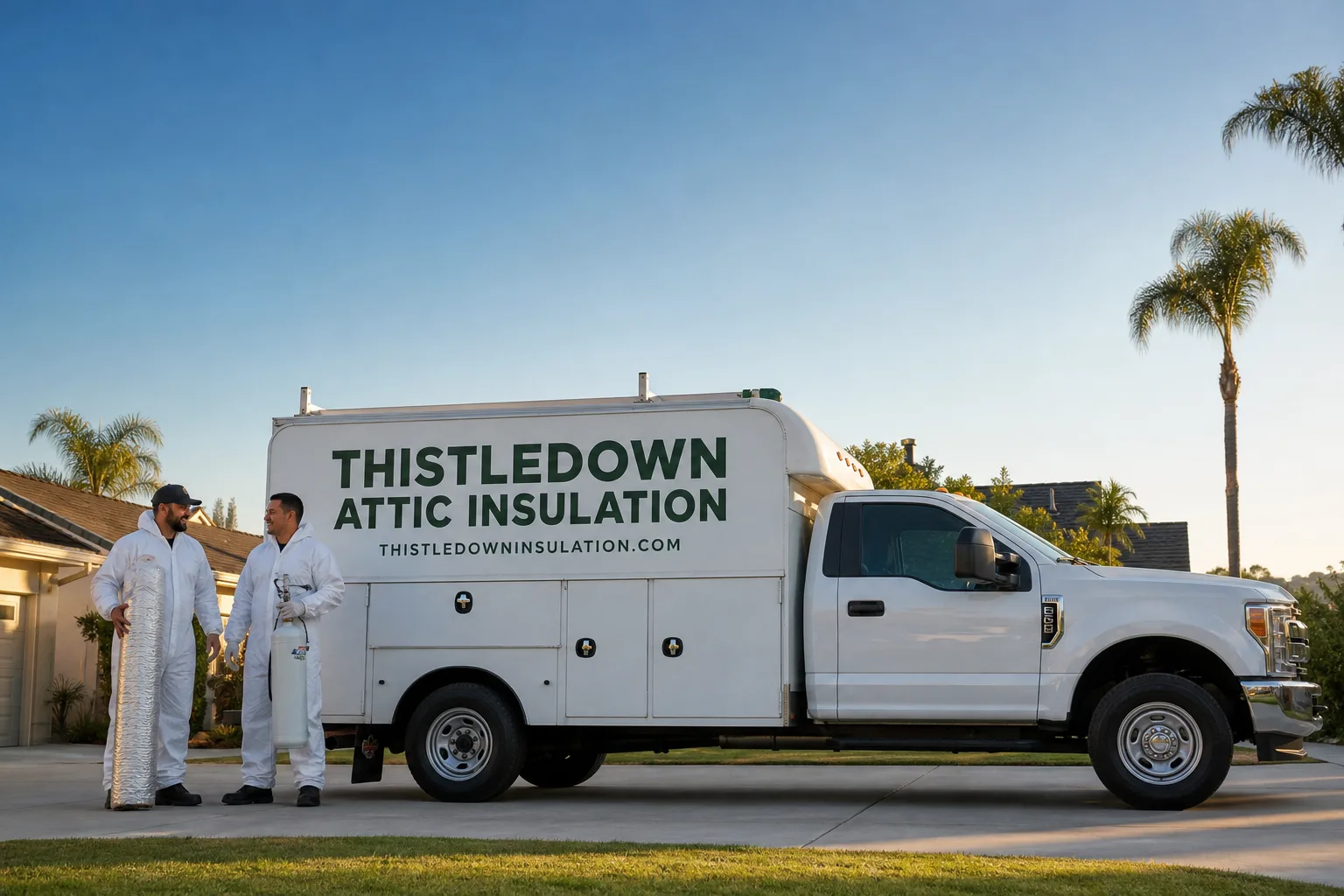
Fast, Reliable Attic Insulation Across Poway
Attic insulation in Poway costs between $1,800 and $6,500 for most homes, with blown-in work typically running $2,200 to $4,800 depending on square footage and what’s already up there. The number on your written estimate is the number you pay, and you’ll have that before anyone climbs a ladder. Our crews know the 1970s through 1990s ranch homes north of Poway Road, the split-levels off Espola, and the WUI-zoned hillside streets near Lake Poway. When attic temperatures hit 140°F in August, the last thing you need is a crew that treats Poway like any other zip code. Call (909) 768-6501 and a live person answers, even at midnight.
Why Thistledown Attic Insulation Is Poway’s Preferred Attic Insulation Company
We’re an independently owned Cedarwell-family company, founded in 2003, and we’ve spent two decades learning what Poway attics actually look like: settled fiberglass batts from the Carter era, top plates leaking superheated air, and eave baffles that were never sealed in the first place. Every job carries our 365-Day Done Right Promise. If it’s not right, we make it right, no debate.
Poway homeowners tell us the same things: they want to know exactly what product goes near the baby’s room, exactly what the hallway looks like after we’re done, and exactly what the check-write number is before we start. We put that number in writing. Our techs are background-checked and uniformed. They wear shoe covers from the front door to the attic hatch, lay drop cloths across your hallway, and photograph the clean-up before the van moves. Neil Barron leads our crews with a simple rule borrowed from the name: Thistledown is the soft fluff of the thistle, one of nature’s lightest insulators. The name is a promise about how carefully we work.
Insulation Contractors in Poway
Insulation Contractors working Poway homes face a two-part problem most San Diego County contractors never see. First, the house itself: single-story and split-level ranch tract homes built between roughly 1975 and 1995, nearly all with original fiberglass batts at R-11 to R-19 that have settled to a fraction of their rated depth. Second, the location: Poway’s inland valley heat pushes attic temps to 140 – 160°F in summer while the city’s Wildland-Urban Interface zoning requires ember-resistant air-sealing. A proper Poway attic insulation job is not a simple R-value add-on. It’s a retrofit that addresses both thermal performance and fire-hardening compliance in one scope of work.
The typical Poway attic insulation job includes removing or stabilizing old batts, sealing top plates and eave baffles with closed-cell spray foam, and blowing in new material to R-38 or higher. Our team carries Owens Corning, Johns Manville, Knauf, and Rockwool products on the truck, matched to what your attic actually needs.
Blown-In and Batt Work for Poway’s Older Homes
Poway’s housing stock was built for a coastal climate that does not exist here. Original R-11 batts in a 1983 ranch off Twin Peaks Road simply cannot hold back 150°F attic air. We remove the degraded material, seal the bypasses, and blow in fresh insulation to current code. It’s the dominant job type across Poway, from Green Valley to the hills above Old Poway Park.
Air-Sealing Before Any R-Value Math
Adding more fiberglass on top of old, settled batts without sealing the top plates and eave baffles wastes a big share of the new material. Poway’s hot attic air finds every gap. We seal first, then insulate. That order is non-negotiable, and it’s why our estimates show both line items separately.
Attic Ventilation in Poway
Attic Ventilation in Poway takes on a role that coastal San Diego attics rarely ask it to play. At 140 – 160°F inside the attic, a correctly vented ridge-to-soffit path drops that temperature by 20 to 30 degrees, which lowers radiant heat gain into the living space and reduces the thermal load on your HVAC. Poway’s older ranch homes often have insufficient soffit venting, and tract-era ridge venting was frequently cosmetic, not functional. We correct both.
Proper ventilation also protects the new insulation itself. Blown fiberglass in a sealed, hot attic without adequate airflow loses performance and shortens the life of the roof deck. Our crews assess your existing eave baffles, soffit vents, and ridge vent as part of every insulation estimate. If the ventilation path is blocked, we include that fix in the written scope, not as a surprise add-on.
Ridge-to-Soffit Ventilation Path Repair
Many Poway homes built in the early 1990s have soffit vents that were painted over or insulation that was pushed into the eave. That chokes airflow exactly where it matters. We clear the eave path, install or repair baffles, and make sure the ridge vent is actually moving air. It’s a quiet fix with a loud effect on attic temperatures.
WUI Ember-Gap Sealing at the Eaves
Poway’s Wildland-Urban Interface fire-hardening guidance targets the same eave and soffit gaps where hot attic air leaks. Sealing those penetrations with closed-cell spray foam does double duty: it closes ember-entry points and satisfies the Title 24 mandatory air-barrier requirement. One scope of work, two compliance justifications. Most insulation companies miss the second one. We don’t.
Trusted Brands We Service in Poway
Our trucks carry Owens Corning, Johns Manville, and Knauf products for most Poway attics. For specific needs like sound attenuation or dense-pack sidewall work, we use Rockwool. We keep enough material on hand in our San Diego office to dispatch to Poway same-day for most estimates and projects, which means no waiting for a regional distributor to ship to a job site off Scripps Poway Parkway or up in the Green Valley area.
Common Attic Insulation Problems We See in Poway Homes
- Settled original fiberglass batts: A 1978 split-level off Espola Road came to us with R-11 batts compressed to about three inches, leaving the top plate effectively uninsulated against 145°F attic air. That’s standard, not rare, for 1975 – 1995 Poway tract homes.
- Unsealed top plates and eave baffles: On a 1991 ranch near Poway Road, our thermal imaging showed cooled air bleeding out of every top-plate penetration while superheated attic air poured back in. Homeowners pay to condition the attic without knowing it.
- Blocked or failed soffit venting: Decades of blown-in retrofits, roof repairs, and paint jobs have buried or sealed many original eave vents. A choked ventilation path turns a Poway attic into a convection oven by mid-June.
- WUI ember-entry gaps at the eaves: Contractors who treat insulation as pure R-value work leave open soffit gaps that local fire-hardening guidance says to seal. Poway homeowners often don’t discover the gap until a building inspector or fire-safety review flags it.
Pricing for Attic Insulation in Poway, CA
For most Poway homes, a full Attic Insulation retrofit runs between $2,200 and $6,500. Blown-in attic insulation in a typical 1,800 – 2,200 square foot Poway ranch runs $2,400 to $4,200. Removing and replacing degraded batts adds $600 to $1,100 depending on square footage. Air-sealing top plates and eave baffles with closed-cell spray foam typically falls between $700 and $1,400 depending on the attic’s geometry. Written price before any work starts, always. The bid you approve is the bid you pay.
You’ll have your exact number in writing before we touch a rafter. That’s not a negotiation tactic. It’s how we work. Call (909) 768-6501 for a free estimate.
We Also Serve Cities Near Poway
Thistledown Attic Insulation serves Poway and surrounding communities including Santee, Escondido, Lakeside, and Ramona. If you’re in one of those areas and need an Attic Insulation in Poway caliber of service, our crews cover the whole inland North County corridor from the same San Diego dispatch office. Call us and we’ll tell you straight whether it’s a same-week fit.
Serving Poway, CA - Our Local Coverage Area
We’re based in the Poway area and know this community well. Use the map below to see our service coverage - if you’re nearby, we can almost certainly help.
FAQs About Attic Insulation in Poway
Because the top plates and eave baffles in a typical Poway ranch leak superheated attic air into the living space, and piling new insulation on top of that leak wastes much of the new material. You need both: seal the bypasses, then insulate to R-38 or higher. That’s the only way to meet Title 24’s air-barrier rule and actually lower August cooling costs. Call (909) 768-6501 for an exact scope and price.
Yes. Poway’s Wildland-Urban Interface zones require ember-resistant sealing at eave baffles and soffit vents. That means spray foam or rigid foam air-sealing at the same penetrations where Title 24 already requires an air barrier. Our crews do both in one pass, with one written price. It’s not an add-on; it’s part of the job.
You can, but we’ll advise against it. The original batts have settled and compacted, and piling fresh fiberglass on top of compressed, degraded material leaves the top plate still leaking. We remove or stabilize the old material, air-seal the bypasses, then blow in new insulation to current code. The result is a real R-38, not a wishful one.
More than most homeowners realize. Poway’s inland valley pushes attic temps to 140 – 160°F, which radiates downward through a poorly insulated ceiling. A properly insulated and ventilated Poway attic runs 20 to 30 degrees cooler in summer. That’s the difference between a living room that struggles to hold 78°F and one that holds it without the AC running nonstop.
We install Owens Corning, Johns Manville, Knauf, and Rockwool, choosing the product that fits each Poway attic’s specific conditions: heat gain, WUI sealing needs, existing ventilation, and whether kids or pets are in the house. Where a pet-safe option exists, we choose it. You’ll see the exact product name on your written estimate before work starts. Call (909) 768-6501 for a free quote.
Written by Neil Barron, Owner at Thistledown Attic Insulation, serving Poway and the inland North County corridor.