
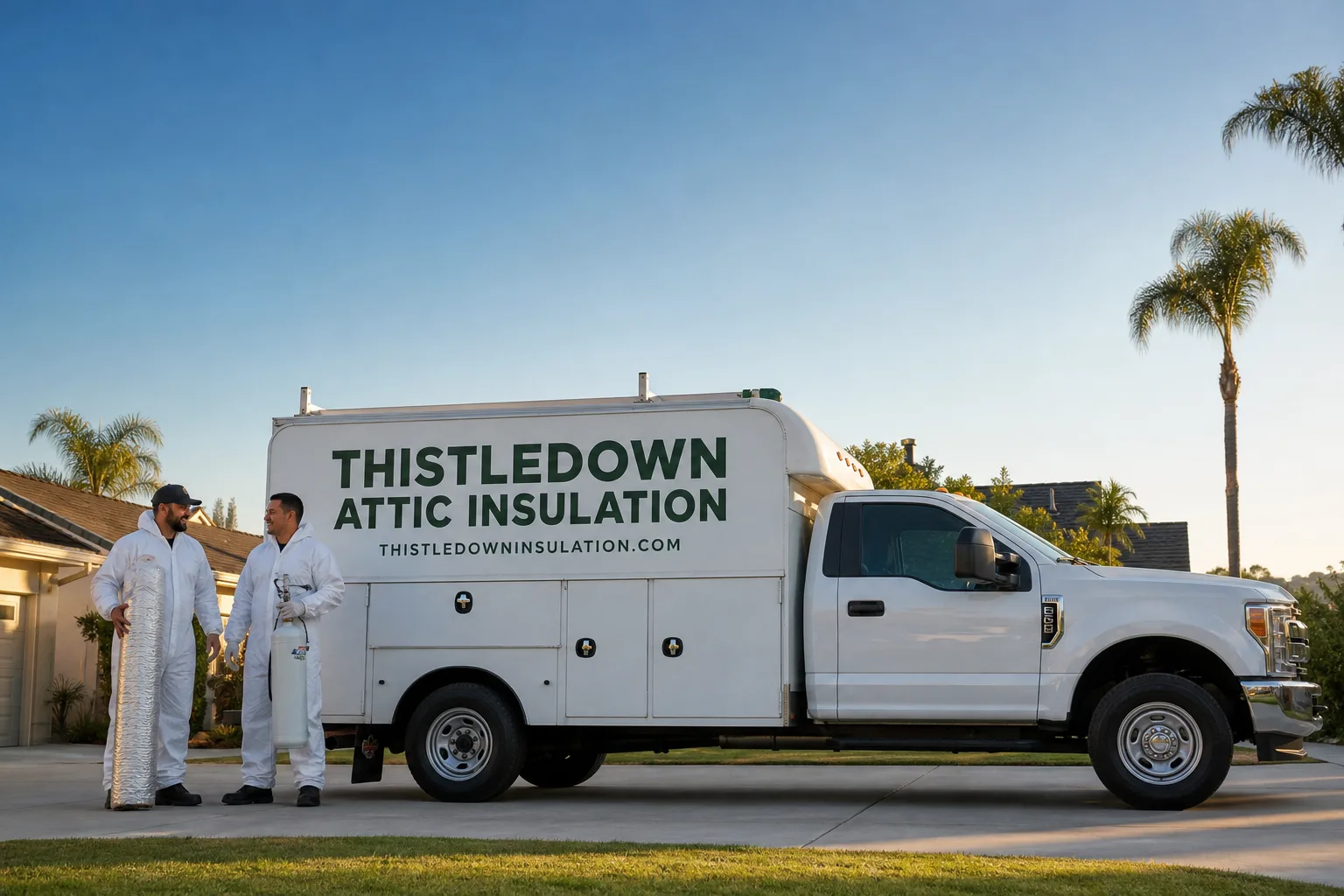
Fast, Reliable Attic Insulation Across San Francisco
Attic insulation in San Francisco costs $1,650 to $6,200 for a typical row house or flat, with blown-in projects landing between $1,800 and $3,400. The number depends on square footage, access, and what’s already up there. But before you worry about the bill, know this: our crews work in San Francisco every week, we answer the phone live at (909) 768-6501, and you’ll get a written price before anyone touches a rafter. And in this city, where fog-soaked stucco walls and 120-year-old framing hide real problems, the diagnosis matters as much as the install.
Why Thistledown Attic Insulation Is San Francisco’s Preferred Attic Insulation Company
We founded Thistledown in 2003 as part of the Cedarwell family of insulation companies, and the way we work in San Francisco homes hasn’t changed since day one. Every job starts with a written price. Every crew member is background-checked and in uniform. We lay drop cloths from the front door to the attic hatch and wear shoe covers the whole way. When the job’s done, you get a photo of the clean-up before our van pulls away. If anything isn’t right, the 365-Day Done Right Promise means we come back and make it right – no debate, no fine print.
Our Attic Insulation team knows what a 1905 Edwardian flat near the Panhandle needs versus a 1940s stucco house in the Outer Sunset. That matters because the moisture behavior in each is completely different. Neil Barron, who leads Thistledown, has walked enough San Francisco attics to know that the cheapest fix is often the one that traps vapor and rots redwood sheathing inside five years. We don’t do that. We tell you what’s actually going on up there and price the work honestly.
Attic Mold Removal in San Francisco
Attic mold removal in San Francisco is a different job than it is in most Bay Area cities because the source is usually fog-driven condensation, not a leaky roof. The marine layer rolls through the Outer Sunset, Richmond, and Ingleside for most of the year, keeping relative humidity high even in July. When warm interior air drifts into a cold attic and hits those damp surfaces, condensation forms and mold follows. Removing the mold without fixing the moisture path means you’ll be paying for the same job again in two years.
We inspect the full assembly first – the sheathing, the existing insulation, the vent channels, the eave line. Mold removal in San Francisco typically runs $800 to $2,400 depending on square footage and how far the staining goes. We remove the affected material, treat the framing where needed, and then correct the ventilation or vapor issue so it doesn’t come back. You get the written number before we start.
Treating the Source, Not Just the Staining
In Sunset-style stucco homes, the original redwood shiplap sheathing often carries decades of moisture staining that looks worse than it is, but sometimes it’s structurally soft. We check it carefully. What we won’t do is spray a biocide on moldy framing and call it solved while the vent path stays blocked and the fog keeps doing what fog does.
Mold and Attic Air Quality
Attic mold doesn’t stay in the attic. Air moves between your living space and the attic through light fixtures, plumbing penetrations, and the hatch. If you’ve got kids sleeping under a ceiling with active mold above it, that air isn’t as clean as it should be. We walk you through what we found, what we removed, and what the air path looks like after.
Attic Insulation Removal in San Francisco
Attic insulation removal in San Francisco usually starts with one of three calls: a rodent infestation, old loose fill that’s gone flat and damp, or a homeowner who just discovered someone blew insulation over the eave vents in a fog-belt house. We remove the old material, bag it properly, and clear the space so we can see the actual ceiling plane and framing. Removal typically runs $1 to $2 per square foot in San Francisco, depending on attic height and access.
In a city where most attics are accessed through a small closet hatch or a scuttle in a hallway, this is slow, careful work. You can’t drag a 40-gallon bag through a Victorian’s narrow stairwell without dusting the whole house unless you plan for it. That’s why we do a full floor-protection lay-down and haul everything out in sealed bags.
Rodent Damage and Contaminated Insulation
San Francisco’s old housing stock means gaps around plumbing and vent stacks, and gaps mean rodents. Once insulation is soaked with urine and droppings, it’s done. You don’t top it up – you pull it. We remove the contaminated material and prepare the attic for new insulation, which usually means air-sealing the entry points too.
Clearing the Eave Line in Sunset-Style Homes
This is the one we see constantly in the Outer Sunset and Parkside. Old loose fill, usually fiberglass or cellulose, gets blown or drifted flat across the eave line. It blocks the only drying path the roof deck has. In a fog-soaked stucco house, that traps vapor against the redwood sheathing and starts the rot cycle. We pull it back, install vent chutes, and re-insulate with a material that lets the assembly dry.
Trusted Brands We Service in San Francisco
Thistledown installs eight insulation brands, and for San Francisco’s damp, fog-driven climate we reach most often for Rockwool batts, Owens Corning blown-in fiberglass, and GreenFiber cellulose. Each has a place. Rockwool handles moisture better than fiberglass in wall cavities, Owens Corning loose fill gets into awkward Victorian attics with tight access, and GreenFiber dense-pack works well in those old wall cavities. We keep these products stocked locally for San Francisco jobs, so we’re not waiting on a warehouse in another county when you need work done. That means faster scheduling and less downtime for your home.
Common Attic Insulation Problems We See in San Francisco Homes
- Loose fill smothering the eave vents. This is the single most common failure we find in 1930s-1950s Sunset-style stucco homes. The insulation blocks the only drying path, and fog-driven moisture starts staining the redwood shiplap.
- Open-cell spray foam in fog-belt attics. We see this in Victorians and Edwardians where a previous crew specified open-cell without a vapor plan. It seals inward moisture from the marine layer against the sheathing. Different failure than inland, and it rots old-growth framing quietly.
- Original wall cavities with zero insulation. Most San Francisco row houses built before 1915 have empty wall cavities. Heat leaves constantly in July when it’s 58°F outside at 9pm, and no attic work fixes that by itself. The assembly needs a whole-house vapor strategy.
- Batts crushed against the roof deck. In tight San Francisco flats, we find fiberglass batts shoved flat against the underside of the roof sheathing with no vent channel. Condensation collects on the sheathing, drips back through the insulation, and stains the ceiling below.
Pricing for Attic Insulation in San Francisco, CA
Here’s what we actually see in San Francisco. Attic insulation top-ups run $1,200 to $2,800. Full attic insulation removal and replacement runs $2,500 to $6,200. Blown-in attic insulation, which works well in the city’s tight Victorian attic hatches, runs $1,800 to $3,400. Attic batt insulation runs $2,000 to $4,500 depending on R-value and access. Attic mold removal runs $800 to $2,400. These are the honest ranges for this city. You’ll get your exact written price after we inspect, and that written number is fixed before work starts – not after. Call (909) 768-6501 for a free estimate.
We Also Serve Cities Near San Francisco
Our crews work throughout San Francisco and the surrounding Bay, including Daly City, Sausalito, South San Francisco, and Alameda. If you’re just across the county line and need attic insulation work done, call us – we schedule into those areas every week and bring the same written-price promise and clean-up standard with us.
Serving San Francisco, CA - Our Local Coverage Area
We’re based in the San Francisco area and know this community well. Use the map below to see our service coverage - if you’re nearby, we can almost certainly help.
FAQs About Attic Insulation in San Francisco
The city’s July highs average about 65°F and the western half sits under marine fog for most of the year. That flips the standard California attic logic. We’re not blocking summer heat – we’re managing vapor drive and condensation in cool, damp conditions. In the Outer Sunset and Richmond, the drying direction of the assembly matters more than R-value. Pick the wrong material and you trap moisture against redwood framing that’s been holding up the house since before the Golden Gate Bridge existed.
Expect dust control, floor protection, and a careful look at what the old insulation was doing to your eave line. In Sunset-style stucco houses, loose fill often sits flat across the vents, blocking the only drying path. Removal takes careful bagging and haul-out through small urban stairwells. You should expect us to leave the space clean and show you a photo of the finished pull before we go. Call us for an exact quote.
Usually not without a specific vapor-management plan, and we’ll tell you that plainly. Open-cell spray foam absorbs moisture from the marine layer and can hold it against the roof sheathing. In a fog-belt Victorian or Sunset-style stucco home, that’s a rot risk. There are cases where it works, but they’re rare in San Francisco. We’ll recommend what actually fits your assembly, not what’s easiest to spray. Call us at (909) 768-6501 and we’ll explain what we’d do in your specific attic.
A small closet hatch in a 1920s flat changes everything. Material goes up and down by hand, not through a wide gable vent. We protect the hallway, stairwell, and floors from the front door to the hatch, and our crews are used to working in tight spaces without banging into walls or waking a sleeping baby. Quiet tools, careful hands, shoe covers. It doesn’t add much to the price, but it changes how the job feels.
Yes, and it does it slowly and persistently. The fog keeps relative humidity high enough that condensation forms on cool attic surfaces even without a roof leak. Warm interior air rises into the cold attic, hits the damp air, and water collects. That’s why we treat the ventilation and vapor path, not just the mold staining. It’s the only way to stop the cycle in this city’s climate.
Call Thistledown Attic Insulation at (909) 768-6501 for a free written estimate. We answer live, 24 hours a day, and we’ll walk you through exactly what your San Francisco attic needs before you commit to anything.
Written by Neil Barron, Owner at Thistledown Attic Insulation, serving San Francisco homeowners since 2003.