
Fast, Reliable Attic Insulation Across Walnut
Most Walnut homes we step into were built between 1978 and 1995, which means their attics were insulated to standards that today’s Title 24 energy code left behind decades ago. If your house still carries its original R-19 batts, you’re running 19 points below the current R-38 minimum while your attic absorbs mid-90s to 105°F summer heat against the San Jose Hills. Our Attic Insulation crews reach Walnut neighborhoods the same day in most cases, and every job starts with a written price before anyone picks up a tool. Call (909) 768-6501 for a free estimate.
Why Thistledown Attic Insulation Is Walnut’s Preferred Attic Insulation Company
Walnut homeowners don’t hand over their attic keys to just anyone. The vaulted ceilings, split-level hillside lots, and complex hip-and-gable rooflines that make this city’s executive homes beautiful are the same features that make insulation work unforgiving. We know these houses because we’ve worked inside them: the pinched soffits along Creekside Park, the knee-wall cavities on hillside streets above Lemon Avenue, the settled batts sagging inside rafter bays throughout the Snow Creek and Three Oaks tracts. When we say we’ll match your insulation to R-38, we know exactly what geometry that involves in your specific attic.
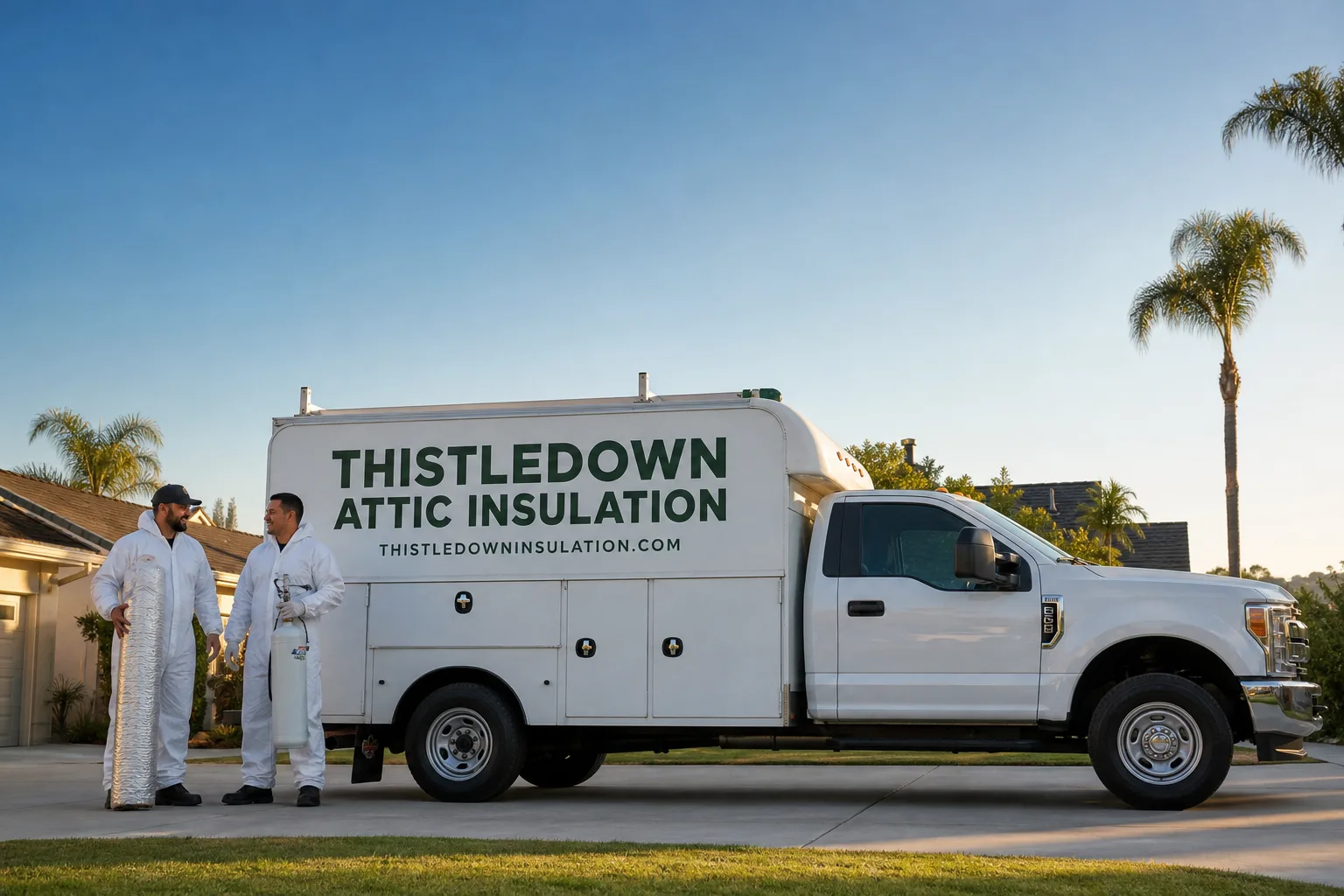
Every Thistledown technician is background-checked and uniformed. Families know exactly who is walking through the front door, and we lay drop cloths across your hallway and wear shoe covers from the front door to the attic hatch. Before the van pulls away, you get a photo of the clean-up. That’s not an upsell. It’s how we work, on every single Walnut job.
Neil Barron leads our crews with one instruction: treat every home like the family is watching from the kitchen. The name Thistledown is the soft fluff of the thistle – one of nature’s lightest insulators. The name is a promise about how carefully we work.
Attic Ventilation in Walnut
Attic Ventilation in Walnut matters more than most homeowners realize because a 1980s attic sealed tight against the San Jose Hills heat becomes an oven that radiates back down through your ceiling drywall all evening. The job involves checking existing soffit and ridge venting, confirming airflow is actually moving, and adding baffles where insulation has been packed against the roofline and choked the air channel. A Walnut homeowner needs this when upstairs rooms won’t hold a setpoint in summer, or when the attic smells stale and insulation feels damp to the touch on a winter morning.
Ventilation work in Walnut typically runs $350 to $900 depending on how many soffit bays need baffles and whether existing vents need retrofitting. You’ll have your exact written number before we touch a rafter.
Soffit Baffles and Airflow
On late-1980s tract homes with complex hip-and-gable roofs, we often find insulation blown all the way into the soffit line, strangling the air path. We add baffles to reopen the channel, keeping the attic within 10 to 15 degrees of outside temperature so it stops radiating heat into living space after sunset.
Ventilation Checks on Hillside Lots
Split-level homes on the northern slopes have knee-wall and pinched-soffit zones where air never moved well even when the house was new. We inspect those dead zones as part of any ventilation job, because an attic that can’t breathe will undo the value of new insulation within a season or two.
Radiant Barrier in Walnut
Radiant Barrier in Walnut works by reflecting radiant heat before it penetrates the attic floor, which matters here because inland San Gabriel Valley summers run 15 to 20 degrees hotter than what your relatives in Pasadena feel. A radiant barrier is a foil-faced layer installed under the roof deck, and it’s most valuable on homes with complex rooflines where blown-in insulation alone struggles to create even coverage. Walnut homeowners ask for this when their upstairs thermostat climbs past 80°F by mid-afternoon even after insulation was topped up, or when the ceiling feels warm to the touch in the early evening.
Radiant barrier installation in Walnut typically runs $1,200 to $2,800 for a standard single-family attic, depending on roofline complexity and square footage. On a multi-pitch hillside home, budget toward the higher end. You’ll get your written price before any work begins.
Multi-Pitch Roof Decks
Hip-and-gable rooflines on Walnut’s two-story executive homes have more roof surface area than a simple gable, which means more radiant heat loading. We install the barrier directly against the roof deck, cutting attic surface temperature by 15 to 25 degrees on a 100°F day.
Radiant Barrier With Blown-In Insulation
Most Walnut attics benefit from both: a radiant barrier above to reflect heat and dense-packed blown-in insulation below to slow conduction. We typically pair a GreenFiber or Johns Manville blown-in product with the radiant layer, which gives you the Title 24 performance the original builder never installed.
Trusted Brands We Service in Walnut
We work with products from Owens Corning, Johns Manville, Knauf, and GreenFiber, and we keep the most common materials stocked for quick turnaround on Walnut jobs. That means a blown-in top-up on a Snow Creek ranch or a batt replacement in a Three Oaks two-story doesn’t wait a week for product to arrive from a warehouse across the county. When a pet-safe option exists, we’ll tell you which product fits the bill. If your 1980s attic has original fiberglass batts, we can match and upgrade with a denser modern equivalent without tearing out what’s already there unless it’s failed.
Common Attic Insulation Problems We See in Walnut Homes
- Settled R-19 batts in vaulted rafter bays. On 1980s two-story executive homes, original fiberglass batts compress and slump inside cathedral-ceiling cavities, leaving convective loops that keep the top 18 inches of living space hot all summer. The fix is dense-packing or replacing those batts, not adding more on top.
- Pinched soffit and knee-wall dead zones on hillside slopes. Homes built on graded lots against the San Jose Hills often have knee-wall cavities where no insulation was ever installed at build. Standard bids quote around these areas; we inspect them specifically because they’re Walnut’s most common thermal bypass.
- Uneven blown-in coverage under complex rooflines. Hip-and-gable roofs from the late 1980s make it easy for blown-in insulation to pile high in the center and leave the eaves bare. Without baffles and careful hose work, half the attic ends up under-insulated.
- Afternoon heat soak through the ceiling. Even correctly insulated attics in Walnut radiate stored heat back down through the ceiling drywall after sunset when no radiant barrier is present. This is the single most common reason an upstairs bedroom stays five to eight degrees warmer than the downstairs living room.
Pricing for Attic Insulation in Walnut, CA
A typical blown-in attic insulation top-up in Walnut runs $1,500 to $3,200 for a standard single-family home. Full replacement of settled or failed insulation typically runs $2,800 to $5,500, depending on square footage and how much old material must be removed. Attic batt installation runs $2,200 to $4,800, and adding a radiant barrier runs $1,200 to $2,800. Homes with vaulted ceilings, split-level layouts, or hillside access geometry fall toward the higher end. Every estimate is a written number, not a range you negotiate later. Call (909) 768-6501 and we’ll schedule a walkthrough.
We Also Serve Cities Near Walnut
Our crews work throughout the eastern San Gabriel Valley, so if you’re in Walnut today but have family or a rental property in Rowland Heights, Diamond Bar, La Puente, or West Covina, the same estimator can handle both attics in one visit. The written-price promise and clean-up standard travel with us to every neighboring city.
Serving Walnut, CA - Our Local Coverage Area
We’re based in the Walnut area and know this community well. Use the map below to see our service coverage - if you’re nearby, we can almost certainly help.
FAQs About Attic Insulation in Walnut
Yes. A 1986 Walnut home was built under early Title 24 standards that required roughly R-19 in the attic, and current code requires R-38 or higher for climate zone 9 and 10, which includes Walnut. Most original batts have also settled 20 to 30 percent over nearly four decades, so effective R-value is often closer to R-11 or R-13. Call (909) 768-6501 and we’ll measure what’s actually up there before quoting a number.
Walnut sits inland against the San Jose Hills, where summer highs routinely hit the mid-to-upper 90s and sometimes pass 105°F, while Pasadena gets more coastal air mixing in. Your attic absorbs that extra heat load, and if it’s under-insulated to early Title 24 levels, the heat radiates down through the ceiling all evening. A radiant barrier plus upgraded insulation directly addresses that inland temperature penalty.
Yes. We routinely work inside the pinched soffits, knee-wall cavities, and multi-pitch rooflines that come with Walnut’s hillside construction. These attics require dense-pack or blown-in techniques rather than simple batt replacement, and we inspect the dead zones other bids skip. Estimates are free, and the written price covers the actual geometry of your attic.
Most Walnut homes benefit from both. Blown-in insulation slows conductive heat, but a radiant barrier reflects heat before it enters the attic in the first place – which matters when summer attic temperatures climb 30 to 40 degrees above outside air. On a standard 1980s tract home, adding a radiant barrier typically runs $1,200 to $2,800, and you’ll get your exact number before work begins.
We use hose-marked coverage checks and work bay by bay rather than blowing from one central point, which ensures the eaves and valleys get the same depth as the center of the attic. On multi-pitch roofs we add baffles at every soffit opening and inspect with a thermal camera before we call the job done. If anything is not done right, our 365-Day Done Right Promise covers rework at no charge. Call (909) 768-6501 to schedule a walkthrough.
Written by Neil Barron, Owner at Thistledown Attic Insulation, serving Walnut since 2003 as part of the Cedarwell family of independently owned insulation companies.