
GreenFiber Attic Insulation in Los Angeles: A Homeowner’s Guide
GreenFiber is a blown-in cellulose insulation made from roughly 85% recycled newsprint, treated with borates that give it a Class 1 fire rating. In Los Angeles, where wildfire smoke and temperature swings both find their way into attics, it’s one of the most practical insulation choices we install. If you’d rather not sort through R-values and bag counts yourself, call us at (909) 768-6501 and we’ll walk you through it.
That fire rating is the part that surprises most homeowners. Paper in a fire-risk city sounds like a bad idea until you understand what the borate treatment actually does. It doesn’t just slow the spread of flame. It chemically interrupts combustion at the molecular level, changing how the material responds when heat hits it. We’ll get into that below, because if you’re putting this above a baby’s room, you deserve the real explanation, not a label.
What GreenFiber Actually Is
GreenFiber is loose-fill cellulose insulation. The material starts as recycled paper, most of it newsprint, that gets shredded and treated with boric acid and sodium borate. Those two compounds are the reason the product earns a Class 1 fire rating, which is the same classification as fiberglass and mineral wool. The treated fibers resist flame spread, and the borates remain active for the life of the insulation. They don’t wash out, and they don’t degrade over time in a dry Los Angeles attic.
The borate treatment does two jobs at once. First, it makes the cellulose fire-resistant. When heat reaches the material, the borates release water molecules, which cools the surrounding area and dilutes combustible gases. That’s the chemical interruption of combustion. Second, borates repel pests. Termites, roaches, and silverfish can’t digest the treated fibers. In an older home near the hills or the creek beds around the San Fernando Valley, that pest resistance matters. We’ve pulled out old fiberglass batts in Echo Park and Sherman Oaks that had become nesting material for rodents. Cellulose doesn’t invite that problem the same way.
One last point on composition: GreenFiber contains no formaldehyde and no asbestos. It’s made in the United States and carries environmental certifications homeowners with young kids often ask about.
GreenFiber vs. Fiberglass: What Los Angeles Attics Need
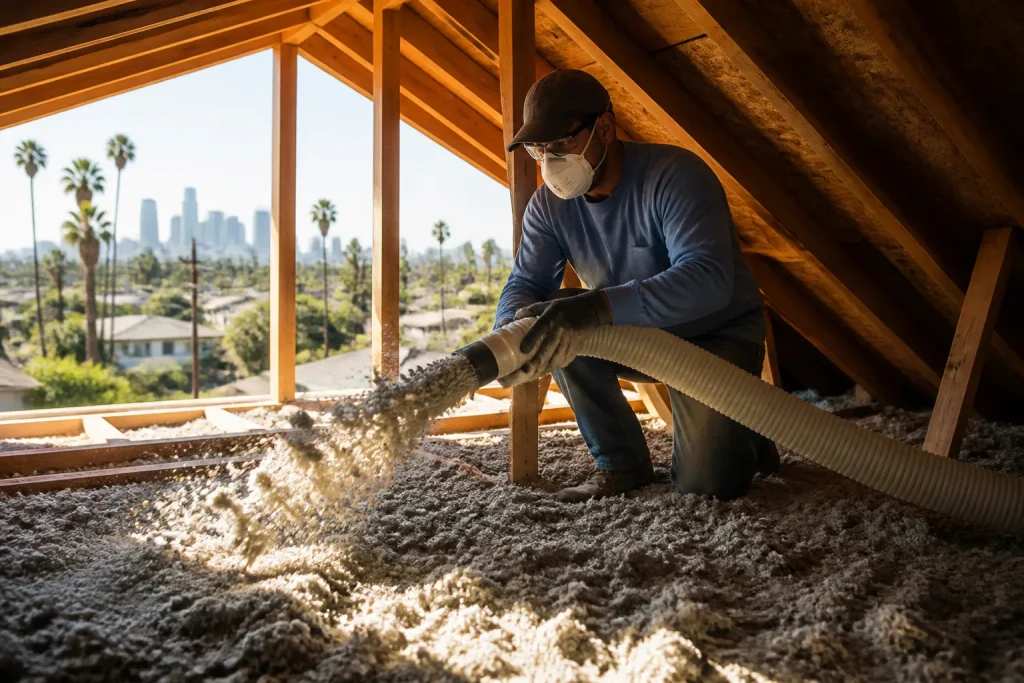
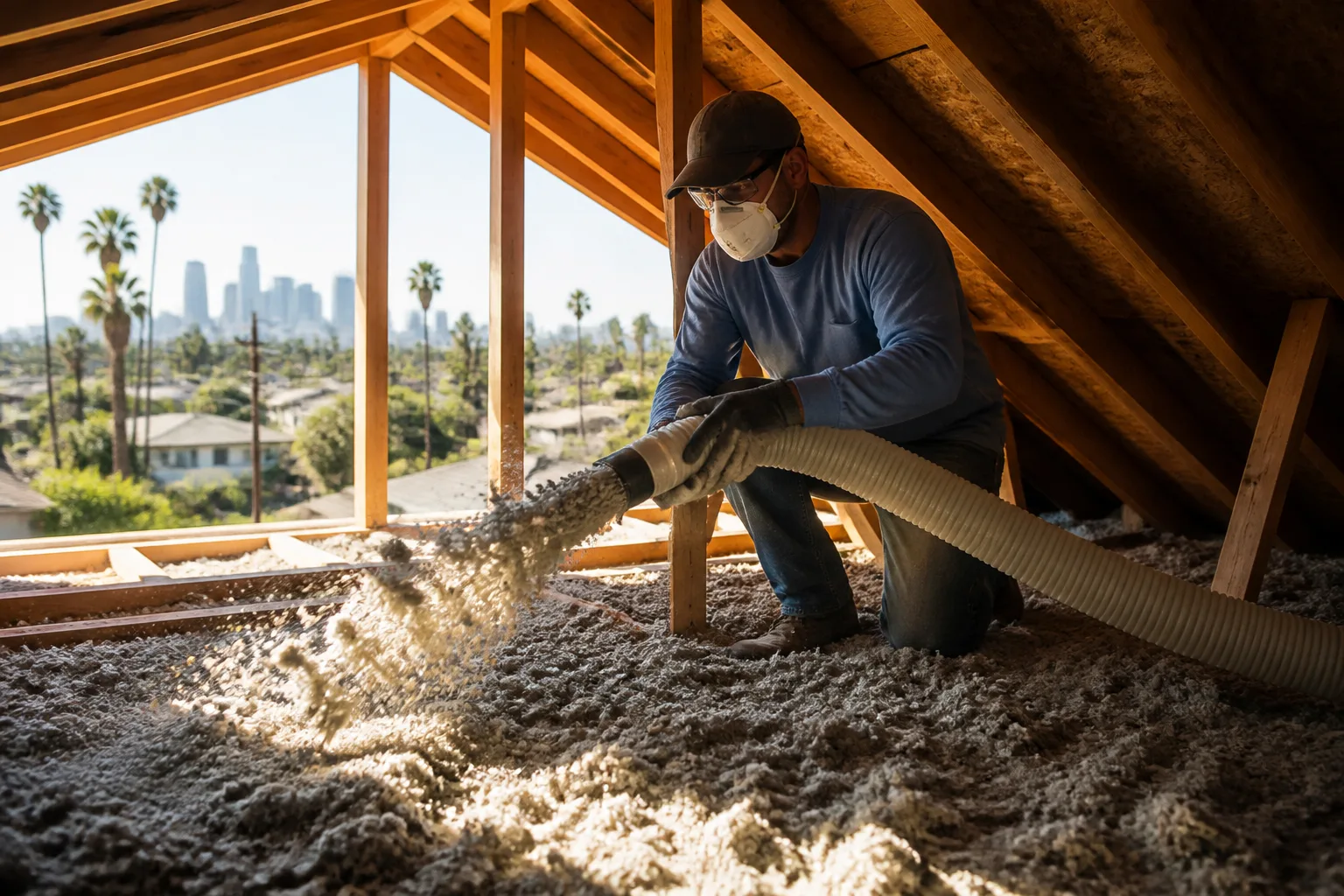
Here’s the comparison that matters for LA homes. Fiberglass batts come in pre-cut pieces that leave gaps around wiring, plumbing, and framing. Air moves through those gaps, and in Los Angeles, the air moving through your attic carries wildfire smoke particles from the hills, freeway soot from the 5 and the 101, and the fine dust that settles over this city in the dry months. Blown-in cellulose fills those gaps. We install it with a hose that fills the attic floor evenly around every obstruction, and the finished result is a continuous thermal layer.
Cellulose is also denser than fiberglass. That density slows air movement through the material itself, which is called convective heat transfer. For a house in Climate Zone 10, that density translates to a real difference when the San Fernando Valley hits 104°F in August and your AC is fighting the attic heat gain. Our Attic Insulation in Los Angeles team has measured the before-and-after difference in dozens of homes, and the cellulose installations consistently hold temperatures longer.
The tradeoff is weight and installation method. Cellulose requires a blowing machine and a trained installer. This isn’t a weekend project with rolls from the hardware store. If you’re considering it, know that the comparison favors GreenFiber for airtightness and favors fiberglass for simplicity. We install both. The right call depends on your attic layout, your budget, and whether you’re dealing with pest pressure or smoke infiltration.
How Much GreenFiber Does a Los Angeles Attic Need?
Los Angeles sits in DOE Climate Zone 10, which carries a recommended attic insulation level of R-38. GreenFiber cellulose delivers roughly R-3.7 per inch. To hit R-38, you need about 10.5 inches of settled material.
That settled number matters. GreenFiber is installed loose, and it compresses over the first 12 months. The manufacturer publishes a settled density specification, and any competent installer will overshoot the initial depth to account for that settlement. We blow to approximately 20% above the target depth, so a job that needs 10.5 settled inches goes in at around 12.5 to 13 inches of loose material. In a typical 1,200-square-foot attic, that means somewhere in the range of 55 to 65 bags of GreenFiber. The bag count is printed on the product label, and a homeowner can verify the number of empty bags after the crew leaves. That’s a level of transparency we’ve always liked about this product.
Here’s the depth-to-R-value math for GreenFiber in Los Angeles, assuming a 1,200-square-foot attic:
- Trying to hit R-30: about 8.1 settled inches, roughly 45 – 50 bags
- Code-minimum R-38: about 10.5 settled inches, roughly 55 – 60 bags
- Above-code R-44: about 12 settled inches, roughly 65 – 70 bags
- Deep retrofit R-49: about 13.5 settled inches, roughly 75 – 80 bags
Some Los Angeles homeowners ask us to exceed R-38. The city’s hotter inland neighborhoods, places like Woodland Hills, Northridge, and Van Nuys, see attic temperatures well above 140°F in summer. Going to R-44 in those areas modestly reduces the heat transfer through the ceiling, and for a second-floor bedroom directly under the attic, that daily difference is noticeable.
What the Job Looks Like: Dust, Covers, and the Finished Attic
Blown-in cellulose creates dust. Any contractor who tells you otherwise hasn’t stood in a hallway while the machine runs. The difference between a careful crew and a careless one is what happens before the hose goes up.
We lay drop cloths across the hallway from the front door to the attic hatch. Shoe covers go on at the door. Every tech on the job is background-checked and uniformed, which means you know exactly who’s in your home, and when they leave, we take a photo of the attic hatch area and the hallway floor before the van pulls away. That photo is part of our standard cleanup, not an upsell. It’s also part of the Cedarwell Care Promise our company is held to on every visit.
Inside the attic, the finished result is a smooth, even layer of gray material. No peaks, no bare spots. The loose fill should cover the tops of the ceiling joists. If you have recessed can lights that aren’t rated for insulation contact, we build guards around them before blowing. If there’s old wiring, we’ll ask before touching anything. That’s the “Ask before we move or touch anything” part of the C.A.R.E. values, and it’s not optional.
One thing we hear from parents: will the baby sleep through the job? The blowing machine sits outside wherever possible, and the hose runs through a window or the attic hatch. We use quiet tools when children are sleeping, and the actual blowing process in a 1,200-square-foot attic takes about 60 to 90 minutes. The whole visit, from setup to photo, is typically a half day.
What a Written GreenFiber Quote Should Include in Los Angeles
Let’s talk numbers, because a written quote is the single best way to know whether a contractor intends to be straightforward. In the current Los Angeles market, GreenFiber blown-in cellulose for a standard 1,200-square-foot attic runs from about $1.40 to $2.60 per square foot installed. That places the job between $1,700 and $3,100. Your exact number depends on access, existing insulation removal, and whether you’re adding baffles, air sealing, or light guards.
Here’s a realistic line-item breakdown of what a written quote for a GreenFiber installation in Los Angeles should show:
- Material (cellulose bags): $600 – $900 for a 1,200-square-foot attic at R-38
- Labor and equipment: $800 – $1,400, including machine setup and cleanup
- Air sealing (optional but recommended): $300 – $600 for typical gaps around plumbing, wiring, and top plates
- Baffles or vent chutes (if needed): $150 – $350 for a standard soffit count
- Old insulation removal (if needed): $400 – $900 for rodent-contaminated or water-damaged material
A quote that says “starting at $999” without any detail should tell you something. Insulation pricing depends on measurable factors: attic square footage, depth requirement, access, and existing conditions. A contractor who gives you a range and never narrows it down before starting hasn’t actually priced your job. Every quote from Thistledown Attic Insulation includes a written price before any work begins. Not a range. Not an estimate. A number in writing, every time. That’s a non-negotiable standard for us, and it has been since our founding in 2003 as part of the Cedarwell family of insulation companies.
If you’re also considering spray foam for specific areas like knee walls or a garage ceiling conversion, our Spray Foam Insulation in Los Angeles page explains where that product makes sense and where it doesn’t. We install both, and we’ll tell you honestly which fits each part of the house.
The Bottom Line
GreenFiber is a smart Los Angeles choice because it fills the gaps fiberglass leaves, it carries a Class 1 fire rating from its borate treatment, and it resists the pests that make older LA homes their own. It settles, which is fine if your installer overshoots the depth correctly, and it costs roughly $1.40 to $2.60 per square foot installed in this market. The biggest variable in your quote won’t be the material. It’ll be whether the crew air seals, removes old material, and protects your home from cellulose dust while they work.
If you’re in Los Angeles and want a written number for your attic, Thistledown Attic Insulation home is a good place to start. We offer free estimates, and we’ll give you the exact price in writing before anyone picks up a tool. Call us at (909) 768-6501.
Frequently Asked Questions
Yes. GreenFiber is made from recycled paper treated with borates, contains no formaldehyde, and is installed without adhesives or sprays that off-gas. During installation, we contain dust with drop cloths and shoe covers, and where a choice exists among our product lines, we select pet-safe options. We’ve installed it in attics directly above nurseries throughout Los Angeles.
In Los Angeles, GreenFiber installation currently ranges from about $1.40 to $2.60 per square foot, with most 1,200-square-foot attics landing between $1,700 and $3,100. Your exact quote should include material, labor, air sealing, and any removal work. Call (909) 768-6501 for a free written estimate for your home.
For a standard Los Angeles attic of about 1,200 square feet, the blowing process takes roughly 60 to 90 minutes. The full visit, including setup, air sealing, and cleanup, runs about half a day. We bring the machine outside, run the hose through a hatch or window, and quiet tools are used when children are sleeping.
Yes, GreenFiber settles slightly during the first 12 months. That’s expected. A qualified installer blows it to about 20% above the target depth so the settled result still meets the R-38 recommendation for Los Angeles Climate Zone 10. You can verify the job by counting the empty bags against the square footage of your attic.
Written by Neil Barron, Owner at Thistledown Attic Insulation, serving Los Angeles since 2003.
Need Insulation Help?
Call Thistledown Attic Insulation - licensed & insured, here with fast after-hours help in Los Angeles.
(909) 768-6501