
Last updated October 8, 2026
How Long Does Attic Insulation Take? Timelines and What to Expect
A standard blown-in insulation job on a 1,500-square-foot Los Angeles home takes a crew about three hours of active work. But the question you’re really asking isn’t about the crew’s clock. It’s about how long your hallway will be covered in drop cloths, when the baby can nap, whether the dog needs to leave, and what time you’ll get your house back. Those are different numbers than the ones contractors quote. This guide gives you both, hour by hour, for every insulation type and home size, so you know exactly what to expect before you book. For a deeper dive into one common option, see our guide on How Long Does Spray Foam Insulation Take? Timelines and What to Expect.
Quick Answer
Blown-in attic insulation in Los Angeles typically takes 2 to 4 hours of active work. Spray foam takes 4 to 7 hours including application and curing time. Full removal and replacement takes 6 to 10 hours. From a family’s perspective, plan for the disruption to start the night before (moving stored items away from the attic hatch) and end the afternoon after (allowing spray foam to off-gas before reoccupying bedrooms). If you’re weighing professional help, our How to Hire a Insulation Contractor in Los Angeles: A Step-by-Step Guide covers what to ask before you commit.
Table of Contents
- Hour-by-Hour Timeline: Blown-In Insulation
- Hour-by-Hour Timeline: Full Removal and Replacement
- Hour-by-Hour Timeline: Spray Foam Application
- Los Angeles Specific Factors That Extend Any Job
- What Your Family Needs to Do Before, During, and After
- Off-Gassing Timelines by Product Type (Including Infant and Toddler Guidance)
- What a Written Pre-Job Timeline Should Include
- Common Mistakes to Avoid
Hour-by-Hour Timeline: Blown-In Insulation
Blown-in fiberglass or cellulose is the fastest insulation job you can book. For a typical 1,500-square-foot attic in Los Angeles, where summers push attic temperatures past 140 degrees and winters still dip cool enough to justify R-38 to R-49, the active work window is about three hours. Here’s what that looks like on the ground, based on what we do every week from Highland Park to the Valley.
The Night Before (30 to 45 minutes of your time)
- Move anything stored under the attic hatch. Insulation crews need a clear path from the front door, up the ladder, and through the hatch opening. Sheetrock dust from the hose, insulation fibers, and the occasional dropped tool cover a wider area than homeowners expect.
- Clear a parking spot near the door. The insulation machine sits in the driveway or at the curb, and a long hose runs from it to the attic. Shorter hose runs mean less time dragging equipment through your home.
- Cover or move items in the hatch hallway. Most crews lay drop cloths, but a stacked basket of laundry or a narrow hallway can slow everything down.
Arrival and Setup (7:30 AM to 8:15 AM)
The crew arrives, introduces themselves, and walks the house with you to confirm the attic hatch location and any rooms to avoid. We lay drop cloths from the front door to the hatch and put shoe covers on at the door, every visit, no exceptions. The machine gets set up outside. One technician checks the attic clearances, looks for the HVAC equipment, and maps the path for the hose.
Active Installation (8:15 AM to 10:30 AM)
This is the loudest part. The blower motor runs continuously while one technician works in the attic with the hose and another keeps the machine fed with bags. For a 1,500-square-foot attic, expect about 90 to 120 minutes of actual blowing time. The technician works backward from the far end of the attic toward the hatch, raking the insulation to a consistent depth. In attics with existing insulation, the new layer is blown over it to reach the target R-value. Los Angeles building code and utility rebate programs often require R-38 or higher in ceiling assemblies, which translates to roughly 14 to 18 inches of blown fiberglass depending on the product.
Cleanup and Departure (10:30 AM to 11:00 AM)
The machine comes out first. Then the hose. Then the crew vacuums the hatch area, removes the drop cloths, and takes a photo of the finished attic and the cleaned hallway before the van pulls away. You get that photo. Floor under the hatch should be cleaner than the crew found it.
Hour-by-Hour Timeline: Full Removal and Replacement
If your attic has old, compressed, or contaminated insulation, the job requires removing what’s there before new insulation goes in. This doubles the labor and adds several hours to the day. In Los Angeles, where many homes built before 1980 still hold original rock wool or settled fiberglass batts, full removal is common. Expect a 6 to 10 hour day for a home of 1,500 square feet, with two technicians.
- 7:30 AM to 8:00 AM: Arrival, shoe covers on, drop cloths laid. The crew walks the attic access path with you and confirms which rooms are sensitive.
- 8:00 AM to 9:00 AM: Hatch protection goes up. Technicians seal the hatch opening with plastic sheeting to contain dust during removal, then set up a commercial HEPA-filtered vacuum unit.
- 9:00 AM to 12:30 PM: Removal. This is slow, methodical work, especially in cramped attics. A technician crawls through the attic with a vacuum hose, extracting old material. In Los Angeles attics with steep pitches or low clearances, this can stretch longer. Rat or rodent contamination, common in older LA neighborhoods like Silver Lake and Echo Park where mature trees and older homes coexist, requires longer removal with extra containment.
- 12:30 PM to 1:00 PM: Work pause. The crew steps out. You get a quiet house for lunch and naps.
- 1:00 PM to 3:30 PM: Air sealing, if included, followed by new insulation. The crew seals penetrations around wiring, plumbing vents, and recessed lights, then blows new insulation to the specified R-value. Air sealing adds 45 to 90 minutes but meaningfully improves the comfort you’ll feel in the house.
- 3:30 PM to 4:30 PM: Final cleanup. Hatches resealed, floors vacuumed, photo of the clean job delivered.
Hour-by-Hour Timeline: Spray Foam Application
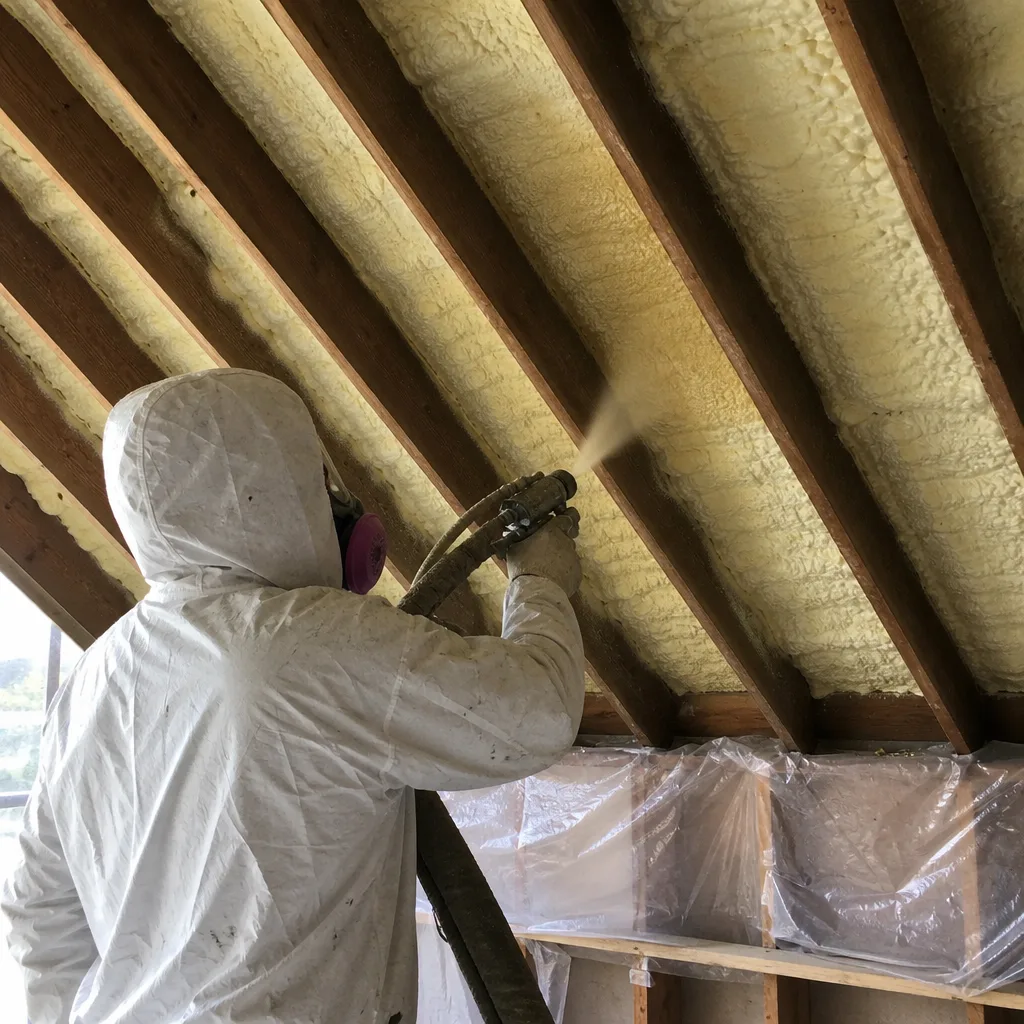
Spray foam is a different beast. It’s the highest-performing insulation per inch, and in Los Angeles attics where space is tight or where homeowners want the attic converted to sealed, conditioned storage, it’s often the right call. But the timeline is longer and the product chemistry matters for families with young children. An attic spray foam job on a 1,500-square-foot home takes 4 to 7 hours, including application and off-gassing.
- 7:30 AM to 8:15 AM: Arrival and full containment setup. The crew seals the attic hatch, covers the hallway, and runs the proportioner machine lines outside.
- 8:15 AM to 10:30 AM: Spraying. Technicians in full protective equipment apply the foam in lifts, allowing each layer to rise and cure slightly before the next pass.
- 10:30 AM to 12:00 PM: Curing and cleaning. The foam continues to expand for about an hour after spraying. Crews clean equipment and the work area during this window.
- 12:00 PM to 2:30 PM: Final cure and ventilation. Homeowners ventilate the house. Windows open, fans on. The foam should be re-entry safe for most occupants after this window, but see the off-gassing section below for specific guidance on infants and toddlers.
In our experience, spray foam jobs in Los Angeles run longer in summer. The heat can accelerate expansion and make the foam set faster, which means crews spray in smaller passes. A job that’s 4.5 hours in February can run 6 hours in August.
Los Angeles Specific Factors That Extend Any Job
Not every attic is the same, and in Los Angeles the age of the housing stock and the way homes have been retrofitted over decades create job-specific challenges that a generic timeline quote misses. These are the three we see most often.
Original knob-and-tube wiring. Homes built before roughly 1930 in Los Angeles neighborhoods like Angelino Heights, West Adams, and parts of Pasadena often still carry knob-and-tube wiring in the attic. Insulation cannot be blown over live knob-and-tube. It creates a fire hazard by trapping heat around the conductors. If the crew discovers it on arrival, the job pauses. An electrician needs to evaluate and either replace or decommission the circuit. This can add a half day or more, and it’s the single most common reason an LA insulation job goes over its quoted time.
HVAC equipment blocking access paths. Many LA homes have their furnace or air handler in the attic. If the unit sits in the middle of the attic floor, the crew works around it, which slows installation. If the unit blocks the only safe path from the hatch to one end of the attic, the job may require a second hatch access or a more time-consuming hose routing. This is a known and surmountable obstacle, but it adds 30 to 60 minutes to a typical job.
Attics under 18 inches of clearance. Los Angeles has thousands of low-slope roofs on ranch homes built in the 1950s and 1960s, particularly in the San Fernando Valley. Some of those attics give a technician 12 to 16 inches of clearance at the perimeter. Work in those spaces is slower. The crew works lying down or crouched, moving a few feet at a time. What takes 2 hours in a walkable attic can take 4 in a crawl space.
What Your Family Needs to Do Before, During, and After
The disruption to your household does not start when the van arrives. It starts the night before, and it continues after the crew leaves. Being specific about this is how good crews operate. We follow the C.A.R.E. values on every visit, and we’d rather explain the plan before anyone picks up a tool.
Before the Job
- The night before: Move items stored near the attic hatch. This includes hallway furniture, wall art within 3 feet of the hatch, and anything stacked in the closet that opens to the attic access.
- Morning of: Make sure the path from the front door to the attic hatch is clear. We lay drop cloths and wear shoe covers, but an open path speeds everything and reduces handling of your belongings.
- Pets: Keep dogs and cats in a closed room during active installation. The blower motor and hose movement can scare animals. For blown-in jobs, pets can stay home. For spray foam, plan for pets to be out of the house during spraying and the curing period.
During the Job
- Kids and naps: For blown-in jobs, the noise is a continuous hum, similar to a loud vacuum. A baby can often nap through it in a room on the opposite side of the house. For spray foam, the spraying sound is sharper and the chemical smell, while professionally managed, is noticeable. Plan for children to be out of the house during spray application.
- HVAC settings: Turn the HVAC fan to ‘off’ during blown-in installation to avoid pulling loose fibers into the return duct. The crew will confirm this before starting.
- Where family should be: Any room works for blown-in. For removal, keep bedroom doors closed and stay on a different floor if possible. The HEPA vacuum is thorough, but old insulation dust has a way of traveling.
After the Job
- Blown-in: You can return to normal use immediately after cleanup. No ventilation window is required. Expect to see slight differences in how the house feels within the first full day, particularly in upstairs bedrooms.
- Spray foam: Ventilate the house. Open windows and run fans for the period specified in the next section.
- Floors: You shouldn’t need to clean after our crew leaves, and we’ll show you the photo to prove it before we pack up.
Off-Gassing Timelines by Product Type (Including Infant and Toddler Guidance)
This is the section almost no contractor writes, and it’s the one parents ask about most. Spray foam insulation off-gasses volatile organic compounds during and after application. The specific product matters. The age of the occupants matters. Here’s what we tell families in Los Angeles when they ask us directly.
Open-cell spray foam: The faster-curing of the two foam types. Most manufacturers state re-entry after 2 hours for healthy adults. However, the foam has not fully cured at that point. We advise a 24-hour window before a bedroom used by an infant or toddler is reoccupied, with active ventilation during daytime hours. The nose is not a reliable test. Some compounds present during early cure are odorless at low concentrations.
Closed-cell spray foam: Higher density, longer cure. Manufacturer guidance typically states re-entry after 24 hours for general occupancy. For infant and toddler bedrooms, we advise 48 hours with ventilation, and we’ll walk through the product-specific data sheet with you before you book. This is also the product where pet-safe planning matters most.
Blown-in fiberglass and cellulose: No meaningful off-gassing period. Fiberglass can release loose fibers into the air during installation, but those settle and are vacuumed. Cellulose is treated with boric acid for fire resistance, which is considered low-toxicity, but it can produce dust during installation. Both are safe for re-occupancy immediately after cleanup, including bedrooms for young children.
Mineral wool (Rockwool): No off-gassing and no fiber release concerns. Re-occupancy is immediate. It’s the product we often recommend for families with newborns when the budget allows, because the conversation about air quality ends at the product itself.
The practical takeaway for a Los Angeles family: blown-in insulation means the nursery is usable that same afternoon. Spray foam means planning a night or two with the baby in a different room. We’ll tell you which window applies to your exact product before you sign anything, and it will be in the written timeline.
What a Written Pre-Job Timeline Should Include
Every contractor you talk to will give you a time estimate over the phone. Fewer will put it in writing. The difference matters more than most homeowners realize, because the act of committing hours to paper forces the crew to think through your specific house rather than reciting a script. When you ask a potential contractor for their pre-job timeline, here’s what it should contain.
- Arrival window: A specific start time, not “morning” or “early afternoon.” We give a 30-minute arrival window and call when the van is en route.
- Hour-by-hour plan: Setup window, insulation window, cleanup window, expected departure time. Not a promise to the minute, but a plan you can see.
- Product and R-value: The exact product name, the target R-value, and how the crew will verify depth. We install products from Owens Corning, Johns Manville, Knauf, and Rockwool, and our technicians check depth with a measuring stick as they go.
- Known obstacles: Any issue the estimator saw during the walkthrough, such as HVAC equipment in the attic or tight clearances. If the estimator didn’t look in the attic, the timeline is a guess.
- Off-gassing or re-entry window: If spray foam is involved, the re-occupancy hours for the specific product, in writing.
- Cleanup protocol: What gets covered, what gets cleaned, and who does it. We lay drop cloths and wear shoe covers, and we leave with a photo of the clean floor before the van moves.
Vague language is a signal. “A few hours” with no breakdown means the crew hasn’t planned your job. “Most of the day” means they’re not sure what they’re walking into. When you ask for a written timeline and get hesitation, that tells you how the crew will handle surprises on install day. That’s also why Thistledown Attic Insulation services puts a written price before any work starts, and we’re happy to put the hour-by-hour plan in the same document. If the plan changes, you hear about it before it happens, not after.
Common Mistakes to Avoid
- Booking without an attic inspection. Any contractor who quotes insulation without opening the attic hatch is guessing. In Los Angeles, where knob-and-tube wiring and low-slope attics are common, that guess can be off by hours or days. Every Thistledown estimate includes an attic walkthrough before the number is written.
- Ignoring knob-and-tube wiring. If you know your home has original wiring, say so on the first call. It changes the scope and the timeline, and it’s a safety issue, not a scheduling inconvenience. The crew needs to know before they arrive.
- Leaving stored items in the hallway. The crew will move things if you ask, but asking costs time and raises the chance something gets bumped. Clear the path the night before and the job runs faster.
- Running the HVAC during installation. The blower fan pulls air through the return ducts. During blown-in installation, that can pull loose fibers into your system. Turn the fan to off and leave it off until the crew says otherwise.
- Planning nap time during the installation window. For blown-in jobs, a baby might sleep through the hum. For spray foam and full removal, schedule around it. The noise is significant and the disruption real. Plan for children to be out of the house during spray foam application.
- Rushing spray foam re-occupancy. The 24-hour guidance exists for a reason. A baby’s respiratory system doesn’t process VOCs the way an adult’s does. Give bedrooms the full ventilation window before putting a child back in them.
- Skipping the written timeline. A written hour-by-hour plan is the difference between a crew that knows your house and a crew that’s finding out on arrival. Ask for it. If a contractor won’t put one in writing, keep looking.
When to Call a Professional
Attic insulation is not a weekend project. The work involves crawling through tight spaces, handling electrical hazards, and working with materials that require proper protective equipment. If your attic has knob-and-tube wiring, you need a professional evaluation before any insulation goes in. If your home has suffered rodent infestation, the old insulation needs contaminated removal, not a cover-up. If you’re considering spray foam, the product chemistry and curing process make professional application a safety requirement, not a preference. Thistledown Attic Insulation offers free estimates throughout Los Angeles. We’ll walk your attic, explain what we see, and hand you a written timeline and a written price before you decide anything. Call (909) 768-6501 to schedule an estimate. A live person answers, day or night.
Frequently Asked Questions
For a 1,500-square-foot home, blown-in insulation takes about 3 hours of active work. Spray foam takes 4 to 7 hours including curing. Full removal and replacement takes 6 to 10 hours. Your exact timeline depends on attic access, existing insulation, and whether any wiring or HVAC complications are present. Call (909) 768-6501 for an estimate specific to your house, and we’ll put the timeline in writing.
For blown-in fiberglass or cellulose, you do not need to leave. The work is contained to the attic with drop cloths protecting your floors. For spray foam, plan for the family to be out of the house during spraying and the initial cure window. We’ll give you the exact re-occupancy timing for your specific product before the job starts.
For blown-in insulation, a baby can typically nap in a room on the opposite side of the house. The noise is a steady hum, not sudden bangs. For spray foam and full removal, plan for children to be out of the house. The spraying sound is loud and the removal process involves a HEPA vacuum that runs continuously for hours.
Manufacturer guidance for open-cell spray foam typically states re-entry after 2 hours for adults. For infant and toddler bedrooms, we advise 24 hours with ventilation. For closed-cell foam, allow 24 hours for general occupancy and 48 hours for young children’s bedrooms. We’ll provide the product-specific data sheet and walk through the numbers with you before you book.
Blown-in and removal timelines stay roughly the same year-round, though summer heat makes attic work slower because technicians need more frequent breaks. Spray foam can take longer in summer heat because the foam sets faster and crews apply it in smaller passes. A job that’s 4.5 hours in February can run 6 hours in August.
Attic insulation in Los Angeles typically ranges from $1,500 to $4,500 depending on attic size, product type, and whether removal is required. Spray foam runs higher, often $4,000 to $9,000 for a full attic. Every Thistledown customer gets a written price before any work starts, and every job is backed by our 365-Day Done Right Promise. Call (909) 768-6501 for an exact quote, free.
Blown-in fiberglass is the fastest, at about 2 to 3 hours of active work for a standard Los Angeles attic. Blown-in cellulose is similar. Mineral wool batts take longer because each batt is cut and placed by hand, and spray foam takes longest due to application and curing requirements. If you need the shortest disruption window, blown-in is the answer.
The Bottom Line
Attic insulation in Los Angeles takes 3 hours for a standard blown-in job, 4 to 7 hours for spray foam, and 6 to 10 hours for full removal and replacement. The household disruption starts the night before with attic access preparation and ends when the final ventilation window closes after the crew leaves. The variables that stretch an LA job beyond the quote are the ones you can see before you book: knob-and-tube wiring, HVAC equipment in the attic, and low clearance. A contractor who puts an hour-by-hour timeline in writing is showing you how they’ll handle surprises on install day. Ask for it. If they won’t, keep looking. Thistledown Attic Insulation home is a Cedarwell-family company, and we treat your house the way we’d want ours treated. That means shoe covers at the door, a clean floor at the end, and every hour on paper before the van arrives.
When we work on an attic, we follow the Cedarwell Care Promise: clean up like it’s our own home, ask before we move or touch anything, respect the family’s time and quiet hours, and explain the price before the work. Thistledown is the soft fluff of the thistle, one of nature’s lightest insulators. The name is a promise about how carefully we work in your home.
If you’re in Los Angeles and want honest guidance on attic insulation in Los Angeles or spray foam insulation in Los Angeles, call (909) 768-6501. We answer live, we inspect before we quote, and we’ll hand you a written timeline and a written price before anyone picks up a tool.
Written by Neil Barron, Owner at Thistledown Attic Insulation, serving Los Angeles since 2003.