
Icynene Attic Insulation in Los Angeles: A Homeowner’s Guide
If you’re researching Icynene attic insulation in Los Angeles, the short answer is this: Icynene is an open-cell spray foam known for its water-blown formula, which eliminates the high-global-warming-potential blowing agents found in most closed-cell foams. In Los Angeles, where building codes and green-certification programs increasingly reward low-emission materials, Icynene has become a genuine contender for attics, cathedral ceilings, and awkward crawl spaces. If you’d rather skip the research and talk to someone who installs it every week, call (909) 768-6501 and we’ll walk you through whether it fits your home.
Most spray foam comparison articles obsess over R-value per inch. That’s a fine starting point, but it misses something bigger. In Los Angeles, the blowing agent used to create the foam’s cell structure can carry a global-warming potential up to 1,430 times that of CO2. Icynene’s water-blown formula registers at exactly 1. For homeowners pursuing LEED certification, GreenPoint Rated, or simply trying to align a renovation with the city’s decarbonization goals, that difference is not academic. It’s the reason Icynene shows up on spec sheets that other foams don’t.
We’ve been installing insulation in Los Angeles attics since 2003, and we’ve watched this conversation shift from “what’s the cheapest thing I can blow up there” to “what exactly is in this product, and what does it mean for my kids, my dog, and my carbon footprint.” This guide answers those questions honestly, including where Icynene is the right call and where it isn’t.
Key Takeaways
- Icynene is an open-cell spray foam with a water-blown formula, giving it a global-warming potential of 1 instead of the 700 – 1,430 range common in HFC-blown closed-cell foams.
- Icynene’s MD-R-210 product delivers roughly R-3.7 per inch, which means meeting Los Angeles Title 24 ceiling requirements takes more thickness than closed-cell alternatives.
- Open-cell Icynene works well in inland Los Angeles attics and unvented cathedral ceilings but requires careful vapor analysis in coastal microclimates like Santa Monica, Playa del Rey, and San Pedro.
- Icynene carries GREENGUARD Gold certification, which matters for indoor air quality and for LEED v4 and GreenPoint Rated materials credits.
- Installation is a one-day job for most Los Angeles attics, but the attic needs about 24 hours before it’s safe for homeowners to re-enter without protective equipment.
What Makes Icynene Different: The Blowing Agent Story
Every spray foam starts as a liquid that expands into a solid. What makes it expand is a blowing agent. For decades, most closed-cell spray foams used hydrofluorocarbon (HFC) blowing agents. HFCs work beautifully as insulators, but they have a serious environmental cost: depending on the specific chemical, an HFC can trap 700 to 1,430 times more heat in the atmosphere than the same amount of CO2 over a 100-year period. In Los Angeles, where the City Council has committed to aggressive building decarbonization targets, that number is starting to matter in permitting conversations and green-building checklists.
Icynene took a different path. The company’s open-cell foam uses water as the blowing agent. When the water reacts with the foam’s chemical components, it releases CO2 to expand the cells. That CO2 has a global-warming potential of 1. That’s the baseline. It’s not a marketing rounding error; it’s a fundamentally different chemistry. For a homeowner in Los Angeles who cares about the embodied carbon of a renovation, this is the single most defensible reason to choose Icynene over a conventional closed-cell product.
This distinction matters more now than it did five years ago. Los Angeles building inspectors and plan reviewers increasingly ask about insulation material specifications when a project touches Title 24 energy compliance. On LEED v4 projects, materials with lower embodied carbon and third-party emissions certifications earn credits under the Low-Emitting Materials and Building Product Disclosure categories. Icynene’s formula positions it well in those conversations. We’ve seen architects in Silver Lake and Echo Park specify it by name on ADU plans for exactly this reason.
R-Value Reality: What You Give Up and What You Get
Let’s be direct about the tradeoff. Icynene’s primary attic product, MD-R-210, delivers roughly R-3.7 per inch of cured foam. A typical closed-cell spray foam delivers R-6 to R-7 per inch. That’s a real difference, and it means Icynene needs about 60% more thickness to hit the same R-value.
What does that mean for a Los Angeles attic? California’s Title 24 energy code sets minimum ceiling insulation requirements based on climate zone. Most of Los Angeles falls into climate zones 6 through 9, which typically call for R-30 to R-38 in vented attics. With Icynene at R-3.7 per inch, you’re looking at roughly 8 to 10 inches of foam to meet code. A closed-cell product might get there in 5 to 6 inches.
Here’s where the geometry of your attic matters. In a vented attic with a flat ceiling and a traditional blow-in insulation setup, Icynene spray foam is rarely the most cost-effective choice. Loose-fill fiberglass or cellulose from Thistledown Attic Insulation home can hit R-38 at a lower installed cost per square foot. Where Icynene earns its keep is in unvented assemblies, cathedral ceilings with limited rafter depth, and attic spaces where air sealing is as important as raw R-value. When you spray Icynene directly against the underside of the roof deck, you create an air barrier and an insulation layer in one step. In a 2×6 rafter cavity, you can achieve about R-20 with Icynene, which meets or exceeds unvented cathedral ceiling requirements in many Los Angeles climate zones.
We pulled a job out of a mid-century ranch in Tarzana last month where the homeowner had tried three times to stop a draft that ran through the ceiling beams. The framer had left a half-inch gap along the top plate, and no amount of ceiling insulation was going to fix it. We sprayed Icynene into the rafter bays, and the foam expanded into every crack the framer left behind. The air leak disappeared. That’s the real value proposition: not just the R-value, but the air barrier that comes with it.
Where Icynene Fits in Los Angeles Attics – and Where It Doesn’t
Los Angeles is not one climate. It’s at least four microclimates wearing one city’s name. A decision that’s perfect for an attic in Woodland Hills might be wrong for a house in Playa del Rey, and understanding that distinction is where most generic insulation advice falls apart.
Inland Los Angeles: The Sweet Spot. In neighborhoods like Sherman Oaks, Studio City, Glendale, Pasadena, and the San Fernando Valley, open-cell Icynene performs reliably. Inland LA is dry enough that the foam’s vapor permeability (open-cell foam allows moisture to move through it) is an asset rather than a liability. It lets the roof assembly dry to the interior when it needs to. For an unvented attic conversion, where you’re turning the attic into conditioned storage or living space, Icynene sprayed against the roof deck is often our first recommendation in these zones.
Coastal Los Angeles: Proceed with Analysis. Along the coast in Santa Monica, Venice, Marina del Rey, and San Pedro, the air carries marine moisture for much of the year. Open-cell foam is vapor-permeable, which means humidity can migrate through it and condense against the roof sheathing if the assembly isn’t designed for it. In those neighborhoods, the right unvented attic assembly includes a vapor retarder analysis, and sometimes a hybrid approach: a layer of closed-cell foam against the sheathing for vapor control, with open-cell Icynene or Attic Insulation in Los Angeles options filling the rest of the cavity. This is not a DIY calculation, and it’s not one a salesperson should hand-wave. It’s a building-science decision that depends on your roof’s sheathing type, your ventilation, and your ceiling assembly.
Existing Vented Attics: Think Twice. If your Los Angeles home already has a properly vented attic with soffit vents and a ridge vent, spraying Icynene on the attic floor is usually the wrong tool for the job. Blown-in fiberglass or cellulose from brands like Owens Corning or GreenFiber hits the Title 24 R-value requirements at a much lower cost per square foot. Icynene on an attic floor also complicates future ceiling work – electricians and plumbers have to cut through cured foam to access junction boxes and pipes. We tell homeowners this even when they came in asking for spray foam by name. The right product for the right assembly matters more than the product’s marketing.
GREENGUARD Certification and LA Green-Building Programs
Icynene’s products carry GREENGUARD Gold certification, which is the stricter of the two GREENGUARD designations. It tests for volatile organic compound (VOC) emissions and certifies that the product meets health-based criteria for use in schools, healthcare facilities, and homes. In plain English: the foam is tested to confirm it doesn’t off-gas meaningful levels of formaldehyde, benzene, or other chemicals that matter for indoor air quality. For a family in Los Angeles with a baby’s room directly under the attic, that certification carries weight.
In green-building program terms, GREENGUARD Gold helps on two fronts. LEED v4 awards a point under the Low-Emitting Materials credit for insulation products that meet CDPH Standard Method v1.2, which GREENGUARD Gold satisfies. GreenPoint Rated, the residential rating system popular for Los Angeles remodels and ADUs, also recognizes low-VOC insulation in its Indoor Air Quality category. If your architect or GC is chasing points on a Los Angeles project, mentioning Icynene by name in the materials spec may save them from defending a generic foam selection later.
There’s one more thing worth saying about certification. GREENGUARD Gold is a product certification, not an installer certification. The best foam in the world applied by a sloppy crew will still leave gaps, overspray, and uneven thickness. In Los Angeles, we’ve been called to re-do spray foam jobs where the previous installer left an inch of cured foam on the homeowner’s stored Christmas decorations because they didn’t mask the area first. Product matters. Installation matters just as much. Our Spray Foam Insulation in Los Angeles crews mask every surface, lay drop cloths across the hallway from the front door to the attic hatch, and wear shoe covers from the moment they step inside.
What Install Day Actually Looks Like
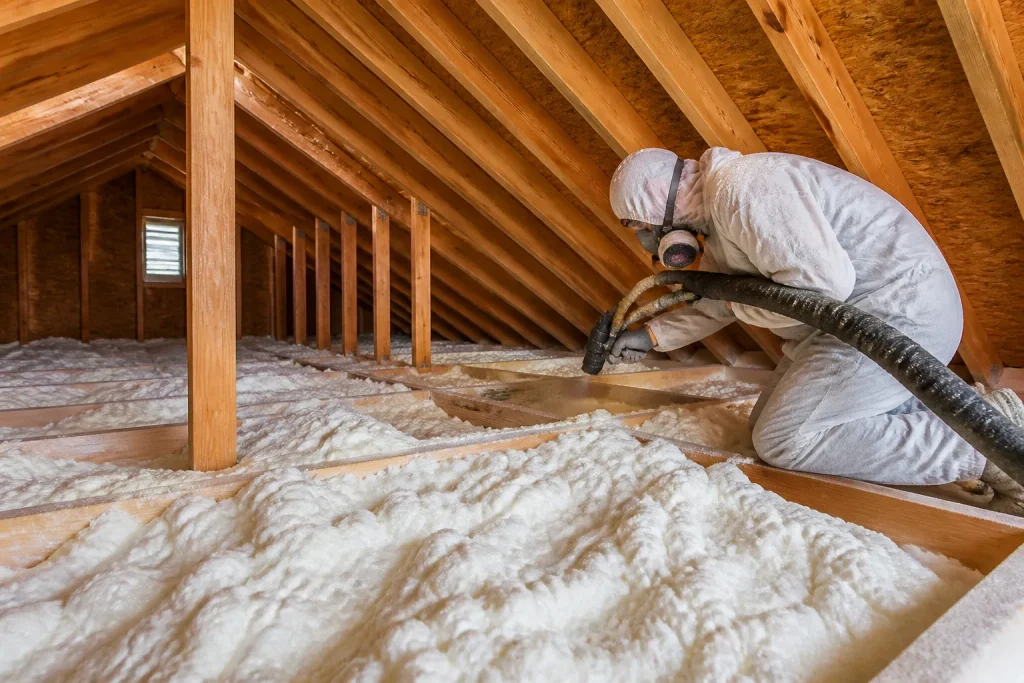
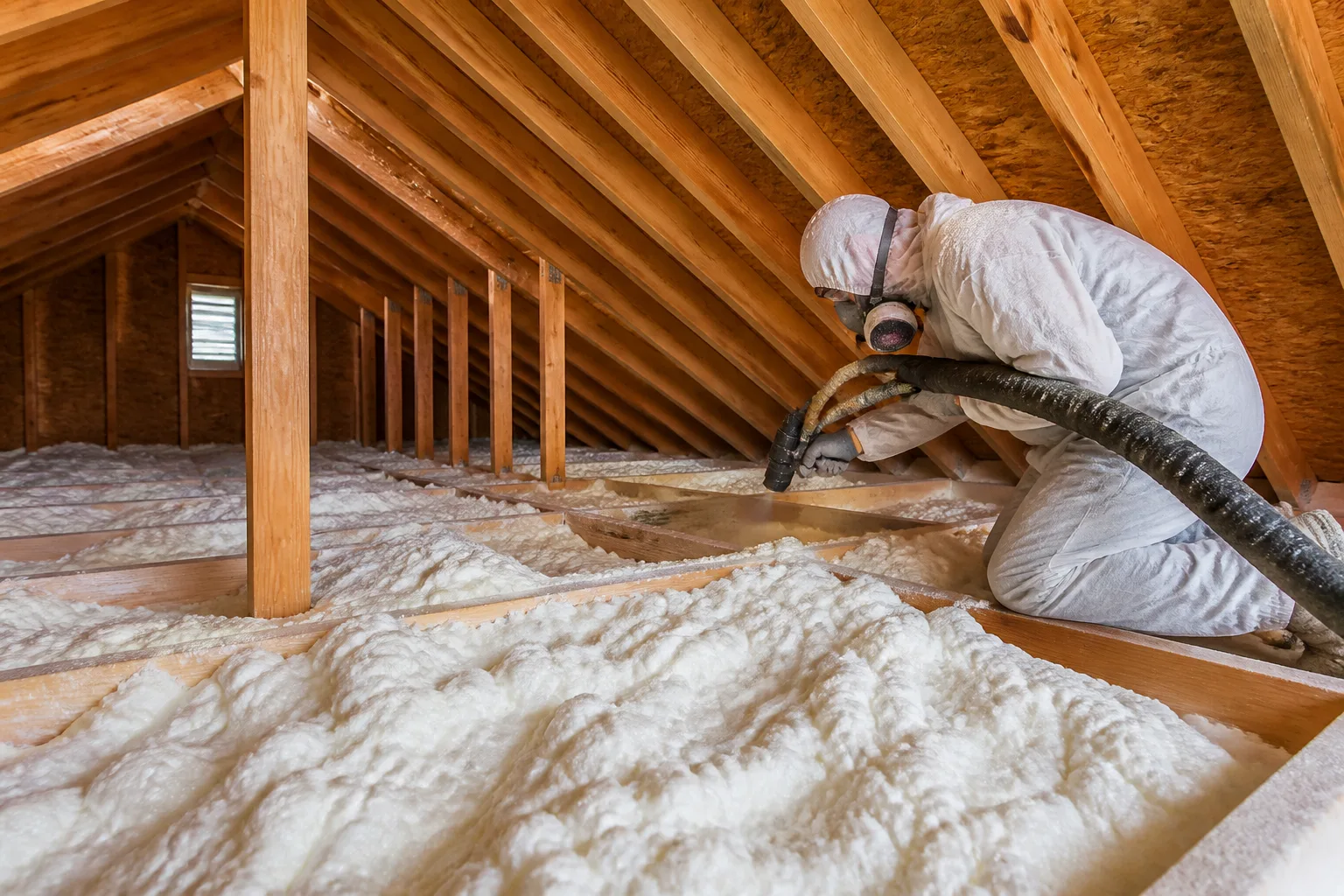
If you’ve never watched open-cell spray foam go in, it’s genuinely surprising. The foam exits the gun as a warm, cream-colored liquid and begins expanding within seconds. It rises like bread dough in fast motion, filling rafter bays and wall cavities, growing to roughly 100 times its initial volume in under a minute. It cures to a soft, sponge-like texture – open-cell foam is squishy to the touch, not hard like closed-cell. That softness is why it fills irregular cavities so thoroughly. It conforms to every nail, every wire, every gap in the framing.
The timeline for a typical Los Angeles attic runs like this. Technicians arrive in the morning, mask windows and vent openings, and lay drop cloths across all floor surfaces they’ll pass through. The spraying itself usually takes two to four hours for an average attic. The foam needs about eight hours to fully cure and stop off-gassing. We recommend waiting a full 24 hours before letting children or pets back into the attic space, and we tell homeowners to keep the attic access closed during that window. After trimming and clean-up, you’ll get a photo of the finished space before our van pulls away.
One practical note for Los Angeles homeowners: spray foam installation generates heat as it cures. On a 90-degree August day in the Valley, an attic that’s already hot will get hotter during application. We schedule foam jobs for early mornings during summer months when possible, and we use quiet tools when children are sleeping. That’s part of the Cedarwell Care Promise that every Thistledown technician works under.
Before you commit to any spray foam project, make sure you have a written price in hand. Not a range. Not a verbal estimate. A written number that accounts for the square footage, the target R-value, the prep work, and the clean-up. That’s the standard we’ve held since 2003, and it’s the only way to compare bids fairly.
When to Call a Pro
Spray foam insulation is not a weekend project. The two-part chemical system requires specialized equipment, precise temperature control for the curing reaction, and trained application technique. A poorly mixed batch can fail to cure properly, leaving you with a sticky mess inside your walls that requires professional remediation. The chemical components are also respiratory irritants during application and curing. This is one of those jobs where the DIY risk far outweighs any savings. If you’re in Los Angeles and you’re considering Icynene, get a professional evaluation first. We’ll tell you if it’s the right product for your assembly, and we’ll tell you if it isn’t.
Icynene vs. the Alternatives: A Quick Los Angeles Comparison
- Icynene open-cell (MD-R-210): R-3.7 per inch, water-blown, GWP of 1, GREENGUARD Gold, best for unvented assemblies and cathedral ceilings inland.
- Closed-cell spray foam: R-6 to R-7 per inch, HFC-blown (GWP 700 – 1,430), air and vapor barrier in one, best for coastal unvented assemblies and limited-depth cavities.
- Blown-in fiberglass (Owens Corning, Johns Manville, Knauf): R-2.2 to R-2.7 per inch, lowest installed cost, best for existing vented attics with flat ceilings.
- Blown-in cellulose (GreenFiber): R-3.2 to R-3.8 per inch, recycled content, good air-sealing properties when dense-packed, best for retrofit vented attics.
- Rockwool batts: R-4.2 per inch, fire-resistant, sound-dampening, best for interior wall cavities and ceiling assemblies where noise matters.
The Bottom Line
Icynene attic insulation in Los Angeles earns its place for the right application. In an inland unvented attic or a cathedral ceiling where air sealing matters as much as R-value, its water-blown formula and GREENGUARD Gold certification make it a legitimate green-building choice. In a standard vented attic with a flat ceiling, blown-in fiberglass or cellulose will give you more R-value per dollar, and any honest contractor should tell you so. The key is matching the product to the assembly, understanding the vapor dynamics of your specific Los Angeles microclimate, and getting a written price before anyone picks up a spray gun. If you’re in Los Angeles and need help deciding, Thistledown Attic Insulation offers free estimates. Call (909) 768-6501 and we’ll walk your attic with you, explain what we see, and put the number in writing before any work begins.
Frequently Asked Questions
Icynene spray foam in Los Angeles typically costs $2.50 to $4.50 per square foot for a 3-inch application in an unvented attic, depending on access, prep work, and total square footage. A full attic retrofit ranges from $4,000 to $9,000. Call (909) 768-6501 for an exact written quote – estimates are free.
Yes, once cured. Icynene carries GREENGUARD Gold certification for low VOC emissions, and we recommend keeping children and pets out of the attic for 24 hours after installation. During application, the chemical reaction is a respiratory irritant, so only trained technicians with protective equipment should be in the space.
Yes, when applied at the correct thickness. At R-3.7 per inch, Icynene needs about 8 to 10 inches to meet R-30 to R-38 ceiling requirements in Los Angeles climate zones. In an unvented cathedral ceiling, a 2×6 rafter cavity filled with Icynene achieves about R-20, which meets code in most LA climate zones for that assembly type.
Sometimes, but it requires analysis. Open-cell Icynene is vapor-permeable, which means homes in Santa Monica, Venice, or San Pedro need a vapor retarder evaluation to prevent condensation against the roof sheathing. A hybrid assembly using a thin layer of closed-cell foam against the sheathing plus Icynene in the remaining cavity often solves the problem.
Blown-in fiberglass is significantly less expensive for a standard vented attic. Fiberglass typically costs $1.00 to $2.00 per square foot installed to R-38, compared to $6.00 to $9.00 per square foot for Icynene at the same R-value. Icynene’s value comes in unvented assemblies where it provides air sealing that blown-in products cannot. Call (909) 768-6501 and we’ll help you match the product to your attic.
Written by Neil Barron, Owner at Thistledown Attic Insulation, serving Los Angeles since 2003.
Need Insulation Help?
Call Thistledown Attic Insulation - licensed & insured, here with fast after-hours help in Los Angeles.
(909) 768-6501