
Knauf Attic Insulation in Los Angeles: A Homeowner’s Guide
Knauf attic insulation in Los Angeles is typically installed as EcoBatt fiberglass batts or LS40 loose-fill blowing wool, with most projects running $2,900 to $6,400 depending on attic square footage and the R-value you’re chasing. The short version: Knauf EcoBatt uses a plant-based ECOSE binder instead of phenol-formaldehyde, which means almost no off-gassing in a 140°F LA attic, and it hits the Department of Energy’s R-30 to R-38 ceiling target for our climate zone without overspending. If you’d rather skip the research and get a straight answer on what your attic actually needs, call us at (909) 768-6501.
Most insulation guides quote R-38 as the LA standard. But the DOE’s climate-zone map puts most of Los Angeles in Zone 3, where ceiling targets start at R-30. That 8-point difference can mean $900 to $1,500 you never needed to spend. Here’s what actually matters when you’re choosing Knauf for an LA attic, and where the product genuinely shines versus where something else might suit your house better.
What Makes Knauf EcoBatt Different – and Why It Matters in a Hot LA Attic
Fiberglass insulation has used phenol-formaldehyde as a binding agent for decades. It’s what holds the glass fibers together in a batt. The problem in Los Angeles is heat. A vented attic over a 1950s or 60s tract home in Van Nuys, Torrance, or the San Fernando Valley regularly hits 130°F to 140°F between June and October. Formaldehyde off-gassing increases with temperature. So the insulation sitting directly above your ceiling is its most chemically active exactly when your family is home, windows closed, AC running.
Knauf’s ECOSE binder replaces phenol-formaldehyde with a bio-based resin made from rapidly renewable plant materials. It’s still a binder, it still holds the fibers, but it does not release formaldehyde as it cures or as the attic heats up. Knauf’s own published emissions data shows VOC levels drop to negligible within 24 hours of installation. That’s a meaningful answer for parents who ask us: “What exactly is going above my daughter’s bedroom?” We can point to the product and say: no formaldehyde, period.
- ECOSE binder: plant-based, no phenol-formaldehyde, no acrylics, no added dyes
- Off-gassing timeline: negligible VOC emissions within 24 hours of install per Knauf’s data
- Why it matters in LA: high attic heat accelerates formaldehyde release in traditional batts
- Fiberglass content: minimum 50% recycled glass by weight, much of it post-consumer
One thing we tell every Los Angeles homeowner: this is not a niche green product with compromised performance. EcoBatt meets the same ASTM standards as any premium fiberglass batt. You’re not trading thermal performance for air quality. You’re getting both, and that combination is hard to beat in our climate.
Which Knauf Product Fits Which LA Attic Configuration
Los Angeles housing stock varies wildly, and the right Knauf product depends on how your attic is built. We’ve insulated attics in 1920s bungalows in Highland Park with knob-and-tube wiring still present, 1970s ranch styles in Westchester with tiny access hatches, and 1990s tract homes in Valencia with truss systems. Each attic wants a different installation method.
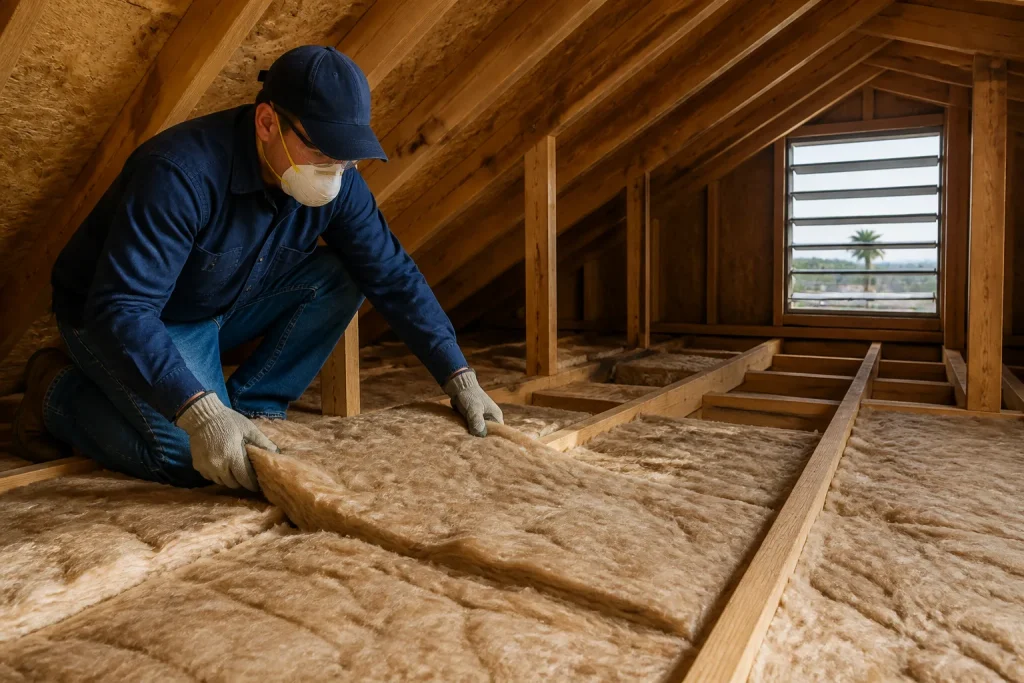
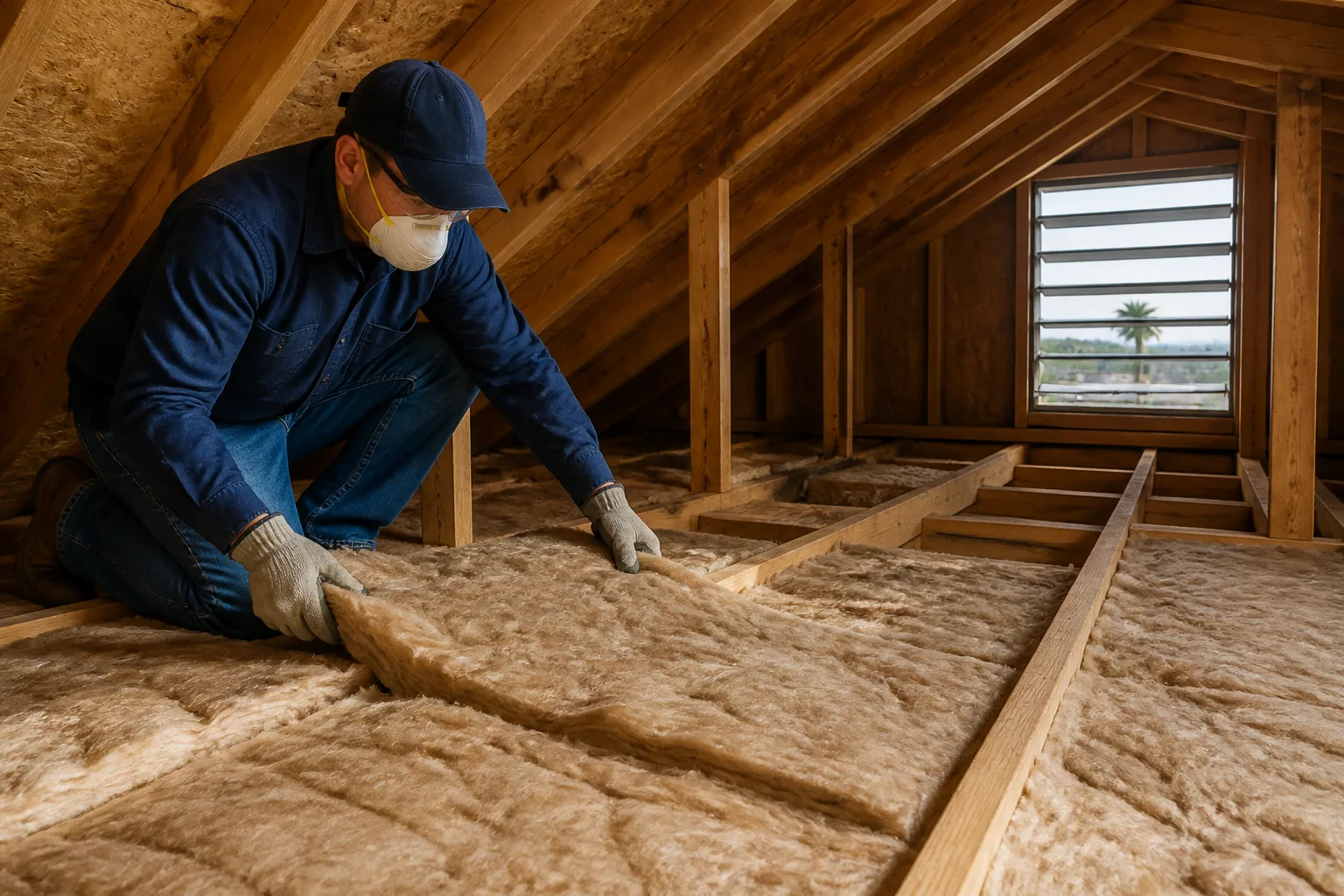
Knauf EcoBatt R-30 and R-38: Best for attics with standard joist spacing (16″ or 24″ on center) where we’re laying batts between floor joists. This is the workhorse product for most LA homes with a vented attic and an accessible hatch. Batts are fast, clean, and easy for a future electrician or HVAC tech to move aside and put back.
Knauf R-15 Comfort batt: Designed for 2×4 wall cavities. In LA, we rarely use this in attics unless a homeowner is finishing attic space into a playroom or home office. Walls in Zone 3 technically want R-13, but R-15 earns compliance credits under California Title 24 and costs only pennies more per square foot.
Knauf LS40 blowing wool: This is loose-fill fiberglass, blown into the attic to a specified depth. It’s the right call for attics with irregular joist spacing, low clearance, lots of cross-bracing, or areas where batts would leave gaps. LS40 also settles predictably, which matters in Los Angeles because the permit office and Title 24 inspectors want to see the installed depth matches the declared R-value on day one, not after settlement.
| Knauf Product | Best Use in LA | R-Value Range | Approximate Cost/Sq Ft |
|---|---|---|---|
| EcoBatt R-30 | Vented attics, standard joist spacing | R-30 | $0.55 – $0.85 |
| EcoBatt R-38 | Older homes where deeper coverage is wanted | R-38 | $0.70 – $1.00 |
| LS40 Blowing Wool | Irregular attics, hard-to-reach areas | R-30 to R-60 | $0.50 – $0.80 |
| R-15 Comfort Batt | Finished attic walls, 2×4 cavities | R-15 | $0.65 – $0.95 |
Prices are installed ranges for the Los Angeles market and vary by attic condition, access, and how much old insulation needs removal first.
What R-Value Does a Los Angeles Attic Actually Need?
Here’s the honest answer most contractors won’t give you: R-30 is enough for most of Los Angeles. The DOE Climate Zone 3 map places nearly all of LA County – from Santa Monica to Pasadena to Long Beach – in Zone 3, with ceiling R-value recommendations starting at R-30. Mountain-adjacent areas like parts of the Angeles National Forest foothills fall into Zone 4, where R-38 makes sense. But for most of the basin and valley, R-38 is comfort-overkill that costs real money.
California Title 24, which governs attic insulation in Los Angeles, sets mandatory minimums rather than maximums. When you pull a permit for an attic insulation project, Title 24 requires R-30 in most of LA, and the inspector will verify installed depth with a ruler. Blown Knauf LS40 to R-30 requires roughly 10.25 inches of settled depth. EcoBatt R-30 compress-fit into 2×10 joists handles the same requirement in batts.
Where spending more does make sense: unvented or “hot roof” assemblies, which are common in Los Angeles homes where the attic was converted, or where the ceiling is sloped and there’s no usable attic space at all. In those cases, we’re often pairing Knauf with a closed-cell spray foam like Icynene or Demilec to hit R-30 while also handling the air-sealing and moisture control that batt insulation alone cannot provide. That’s a different conversation, and it’s one worth having with someone who understands how LA’s marine layer interacts with unvented roof decks.
There’s also the cool-roof angle. Los Angeles has pushed cool-roof rebate programs through LADWP for years, and Title 24’s cool-roof requirements have been in place since 2014 for many roof replacements. A cooler roof surface lowers attic temperatures by 20°F to 40°F in summer, which means your attic insulation works less hard. In practical terms, a home with a compliant cool roof over R-30 Knauf insulation performs about as well as an uncoated roof over R-38. Before you overspend on R-value, check whether your roof already bought you some thermal headroom.
Vented vs. Unvented Attics: Where Knauf Excels, Where It Needs Help
Most pre-1980 Los Angeles tract homes have vented attics: soffit vents at the eaves, maybe a gable vent or two, sometimes a whirlybird or powered attic fan. In a properly vented attic, Knauf EcoBatt or LS40 is close to a perfect product. Air moves through the attic, carries away moisture and hot air, and the fiberglass does its job at the thermal boundary: your ceiling.
But unvented attics are a different animal. Homes in areas like Brentwood, Pacific Palisades, and Bel Air often have complex rooflines, cathedral ceilings, or enclosed rafter bays where ventilation simply isn’t possible. In those assemblies, fiberglass alone – Knauf included – has a weakness: air movement through the insulation. When warm interior air leaks into an unvented rafter bay and hits a cooler roof deck, it condenses. Fiberglass does not stop air. Over time, that condensation wets the insulation, reduces its R-value, and invites mold into the roof decking. We’ve pulled wet, sagging fiberglass out of more than a few hillside homes in Los Angeles where someone installed batts in an unvented rafter bay and called it good.
That’s not a knock on Knauf. It’s a limitation of the entire fiberglass batt category. In unvented LA assemblies, the right solution is often closed-cell spray foam from a brand like Icynene or Demilec, which stops both heat transfer and air movement. Sometimes we do hybrid: spray foam at the roof deck for the air seal, then Knauf EcoBatt below it to hit the R-value target. The point isn’t that one product wins everywhere. The point is the product has to match the attic. When it does, Knauf is excellent. When it doesn’t, no brand of batt saves you.
Title 24, Permits, and What Los Angeles Inspectors Look For
If you’re having attic insulation installed in Los Angeles, the city cares about three things: the product’s labeled R-value, the installed depth or thickness, and the coverage continuity. Title 24 has required attic insulation in new construction for years, and when you alter or add insulation beyond a certain threshold in an existing home, a permit and inspection come with it.
Knauf EcoBatt and LS40 both carry the printed R-value on the product itself, and inspectors check for that label. They also check depth markers. With LS40, we install depth rulers throughout the attic before blowing so the inspector can see at a glance that the settled depth meets the R-30 or R-38 requirement. There’s no arguing with a ruler.
One Title 24 detail Los Angeles homeowners often miss: existing attics with no insulation at all are a compliance trigger. If you own a pre-1970 home in neighborhoods like Eagle Rock, Leimert Park, or Reseda where the attic has never been insulated, bringing it up to R-30 isn’t just comfort – in many renovation scenarios it’s a requirement to pull a permit for other work. We’ve walked plenty of Los Angeles houses where a kitchen remodel got held up because the attic above it didn’t meet current minimums.
That’s the kind of thing that’s hard to know from a YouTube video. A quick attic inspection before you plan other renovations can save a permit headache down the line. We do those inspections free as part of an estimate.
What Parents Should Know: Off-Gassing, Dust, and the Baby in the Next Room
We insulate a lot of attics in Los Angeles while a baby naps two rooms over from the hatch. It changes how we work. Quiet tools, slow movements, and a product choice we can defend to a parent who asks the right question: “What’s going into the air up there?”
With Knauf EcoBatt, the answer is straightforward. No phenol-formaldehyde in the binder means, per Knauf’s testing, VOC emissions drop to negligible levels within 24 hours of installation. The product is also GREENGUARD Gold certified for low chemical emissions, which is the same certification parents look for in cribs and school furniture. That’s about as clean as fiberglass gets in 2025.
There’s also the dust factor during install. Any attic insulation job kicks up fiberglass particles during installation. That’s unavoidable, regardless of brand. What matters is how the crew contains it. We lay drop cloths from the front door to the attic hatch, wear shoe covers the entire time we’re in the house, tape off the work area, and run a HEPA-filtered vacuum behind ourselves. Before we leave, we photograph the clean-up. It’s part of the Cedarwell Care Promise, and it’s non-negotiable on every Los Angeles job we run.
If anyone in your household has severe respiratory sensitivities – asthma, chronic allergies, a newborn preemie – tell us before we start. We will plan the install for when the house is emptiest and extend the clean-up protocol. That’s not an upsell. It’s just how the work should be done.
Knauf vs. Other Major Brands: Where It Fits in the LA Market
Thistledown installs eight insulation brands, and Knauf earns its place on the truck because of the ECOSE story and competitive pricing. But choices exist for a reason.
Owens Corning’s PINK Next Gen Fiberglas also uses a plant-based binder and carries a strong brand recognition with Los Angeles homeowners. CertainTeed’s Sustainable Insulation line competes on acoustics and has excellent sound-control properties, which matters in dense LA neighborhoods where freeway noise is part of the deal. Rockwool (stone wool) is heavier, denser, and naturally fire-resistant – useful for homes in wildfire-adjacent areas of the Santa Monica Mountains or San Gabriel foothills. GreenFiber is a cellulose product made from recycled paper, and it’s a solid budget choice for blown-in applications.
Where Knauf differentiates is the combination of GREENGUARD Gold certification, price, and availability. It’s widely stocked in the Los Angeles supply chain, it’s straightforward for inspectors, and it’s a product we can install in a house with pets and small children without a list of caveats. We also offer pet-safe product options where a choice exists, which matters for the dog sleeping in the hallway during the install.
One anecdote from the field: we pulled a collapsing EcoBatt install out of a garage-conversion attic in Torrance last month. Previous contractor had friction-fit batts into rafter bays without any air-sealing and no ventilation. The batts were drooping, the drywall showed moisture staining at the seams, and the homeowner had been told the job was done right. That’s the reality of the low-bid world in Los Angeles: the product was fine, the installation was the problem. We re-insulated the same space with a hybrid Knauf and Icynene closed-cell approach, air-sealed what should have been sealed, and the homeowner saw the difference in the first week.
When to Call a Pro vs. What’s Safe to Handle Yourself
Adding an extra layer of unfaced fiberglass batt in an open, easily accessed, vented attic is a task a careful Los Angeles homeowner can do over a weekend. Roll out the new batts perpendicular to the existing layer, avoid covering any recessed lights unless they’re IC-rated, and keep insulation out of the soffit vents. That last one is where DIY attics go wrong most often in LA. Block a soffit vent and you’ve turned a vented attic into an unvented one, along with all the moisture problems that follow.
But call a professional if any of these apply:
- Your attic has vermiculite insulation (pre-1990) that may contain asbestos – do not disturb it, do not blow or batt over it without testing
- You see evidence of rodents, water stains, or mold; those need remediation before insulation
- Your attic hatch is small, you can’t stand comfortably, or you have any mobility constraints
- Recessed lighting exists and you’re not certain whether the fixtures are IC-rated
- The attic assembly is unvented or has cathedral ceilings
- You need to meet Title 24 compliance or have a permit pulled for another renovation
Insulation work involves working above a ceiling, in heat, often around sharp framing nails. If you’re not comfortable with any of that, it’s not a character flaw. Call someone who does it every day.
Related services in Los Angeles: Attic Insulation in Los Angeles and Spray Foam Insulation in Los Angeles.
The Bottom Line
Knauf attic insulation is a strong choice for most Los Angeles homes. The ECOSE binder means no formaldehyde off-gassing in a city where attics routinely cook at 140°F. EcoBatt batts handle vented attics cleanly. LS40 blowing wool fills irregular cavities. And R-30 is sufficient for most of LA, which means you don’t need to pay for R-38 unless you’re in a Zone 4 pocket or you simply want the extra margin. Match the product to your attic’s configuration, ventilate properly, and Knauf will perform.
If you’re in Los Angeles and want an honest read on what your attic actually needs, Thistledown Attic Insulation offers free estimates with a written price before any work begins. Call (909) 768-6501 and a live person will answer. We’ve been doing this since 2003, and every job is backed by the 365-Day Done Right Promise.
Frequently Asked Questions
Yes. Knauf EcoBatt uses a bio-based ECOSE binder with no phenol-formaldehyde, which means negligible VOC emissions within 24 hours of installation. It’s GREENGUARD Gold certified for low chemical emissions, the same standard applied to children’s furniture. We install it regularly in Los Angeles homes with babies, kids, and pets, and we offer pet-safe product options where a choice exists. If you have specific sensitivity concerns, call (909) 768-6501 and we’ll talk through your house before quoting anything.
Most Knauf attic insulation projects in Los Angeles run $2,900 to $6,400, depending on attic square footage, R-value target, and whether old insulation needs removal. Batts typically run $0.55 to $1.00 per square foot installed; blowing wool runs $0.50 to $0.80 per square foot installed. You’ll get a written price before any work starts – that’s non-negotiable with us. Call (909) 768-6501 for an exact quote.
R-30 meets the DOE’s ceiling recommendation for Climate Zone 3, which covers most of Los Angeles. R-38 makes sense in Zone 4 pockets, like foothill communities at higher elevation, or if you just want extra thermal margin. California Title 24 requires R-30 in most of LA when insulation is installed under permit. Before paying for more R-value than you need, call (909) 768-6501 and we’ll tell you straight what your attic warrants.
Knauf fiberglass batts and blowing wool work well in vented attics, but in unvented assemblies fiberglass alone can’t prevent warm air from reaching a cool roof deck and condensing. For unvented attics or cathedral ceilings in Los Angeles, the right approach is often closed-cell spray foam or a hybrid: spray foam air seal at the roof deck with Knauf below it for R-value. We carry both Knauf and spray foam brands like Icynene and Demilec, so the recommendation matches the attic, not the truck’s inventory. Call (909) 768-6501 for an inspection.
Written by Neil Barron, Owner at Thistledown Attic Insulation, serving Los Angeles since 2003.
Need Insulation Help?
Call Thistledown Attic Insulation - licensed & insured, here with fast after-hours help in Los Angeles.
(909) 768-6501