
Rockwool Attic Insulation in Los Angeles: A Homeowner’s Guide
Rockwool attic insulation in Los Angeles costs between $2.10 and $3.80 per square foot installed, with most 1,200-square-foot attics landing between $4,500 and $7,800 depending on depth and product line. The bigger story is fire resistance: Rockwool is made from spun volcanic basalt that does not burn, does not melt below 2,150°F, and carries a Class A fire rating no fiberglass or cellulose product can match. If you’re reading this because your insurer just asked about attic fire mitigation, keep going. And if you’d rather skip the research and get a written price for your specific attic, call (909) 768-6501, and we’ll walk you through it.
Why Los Angeles Insurers Care About What’s in Your Attic
After the Woolsey Fire and the Eaton Fire, homeowners across Los Angeles County watched their renewal letters change tone. ZIP codes like 91001 in Altadena, 91024 in Sierra Madre, and 90265 in Malibu saw non-renewals spike as carriers reassessed wildfire exposure block by block. What surprised a lot of families was how specific the mitigation requests got: defensible-space photos, ember-resistant vent screens, Class A roof coverings, and in a growing number of cases, documentation of non-combustible or limited-combustible attic insulation.
The logic is straightforward. During a wind-driven fire event, embers enter attics through vents, gable openings, or gaps in the eaves. If the first material that ember lands on is flammable, the fire has a head start. Cellulose insulation, even when treated with borate fire retardants, is still recycled paper at its core. Fiberglass won’t sustain a flame on its own, but the kraft-paper facing on many batts will, and the resin binders in loose-fill fiberglass can off-gas and degrade under direct flame exposure. Rockwool, by contrast, is stone. It passes ASTM E136, which means it is classified as non-combustible, and it wins a Class A fire rating on its face. For a homeowner assembling a FAIR Plan application or a fire-mitigation package for a private carrier, that test result is documentation an underwriter can actually use.
We’ve helped homeowners in the San Gabriel foothills put together exactly that paperwork. One customer in Pasadena’s Hastings Ranch neighborhood was staring down a non-renewal from a major carrier and needed proof that her attic had been upgraded with a non-combustible product. We installed Rockwool Comfortbatt to R-38, photographed every step, and provided the product’s ASTM E136 classification for her insurance file. She renewed at a lower premium than she’d been quoted for the FAIR Plan, and the insulation stays there doing its job regardless of what happens in the next fire season.
What “Melts Above 2,150°F” Actually Means in a Structure Fire
Most insulation marketing talks about R-value. With Rockwool, the more useful number is the melting point. Rockwool stone wool is spun from basalt rock and recycled slag, fired at over 2,900°F to form the fiber, then mechanically bonded. The finished product does not melt until temperatures exceed 2,150°F. A typical residential structure fire burns between 1,100°F and 1,600°F in the room of origin. That means a Rockwool layer can sit directly above the fire, absorb the heat, and hold its shape without dripping, collapsing, or feeding the flames, at least until the fire department arrives.
Fiberglass, for comparison, is glass. It softens and loses structural integrity around 1,000°F to 1,200°F depending on the specific product. It won’t burn on its own, but it will melt, slump, and expose the ceiling joists and roof decking above it. Cellulose is treated paper. Treatment helps, but no amount of borate changes its fundamental chemistry: under direct flame, it chars, and in older attics where the treatment has degraded over decades, it can smolder.
For Los Angeles homeowners in Wildland-Urban Interface zones, that difference is not theoretical. CAL FIRE designates WUI territory across huge swaths of the county, including most of the Santa Monica Mountains, the Verdugo Hills, the San Gabriel foothills, and significant portions of the West Valley. If you live in Tujunga, Sunland, La Crescenta, Topanga, Woodland Hills, Rancho Palos Verdes, or anywhere in the Santa Monica Mountains corridor, you are almost certainly inside a mapped WUI severity zone. Rockwool’s non-combustibility is one of the few insulation attributes a building inspector or insurance underwriter will specifically ask to see documented.
Rockwool Product Lines: Safe’n’Sound vs. Comfortbatt vs. TopRock DD
Rockwool makes three product families that matter for Los Angeles attics, and they answer different problems. The mistake we see most often is homeowners buying Safe’n’Sound for a thermal job because the name sounds reassuring, then discovering it’s a sound-control batt with a lower R-value per inch.
Rockwool Comfortbatt
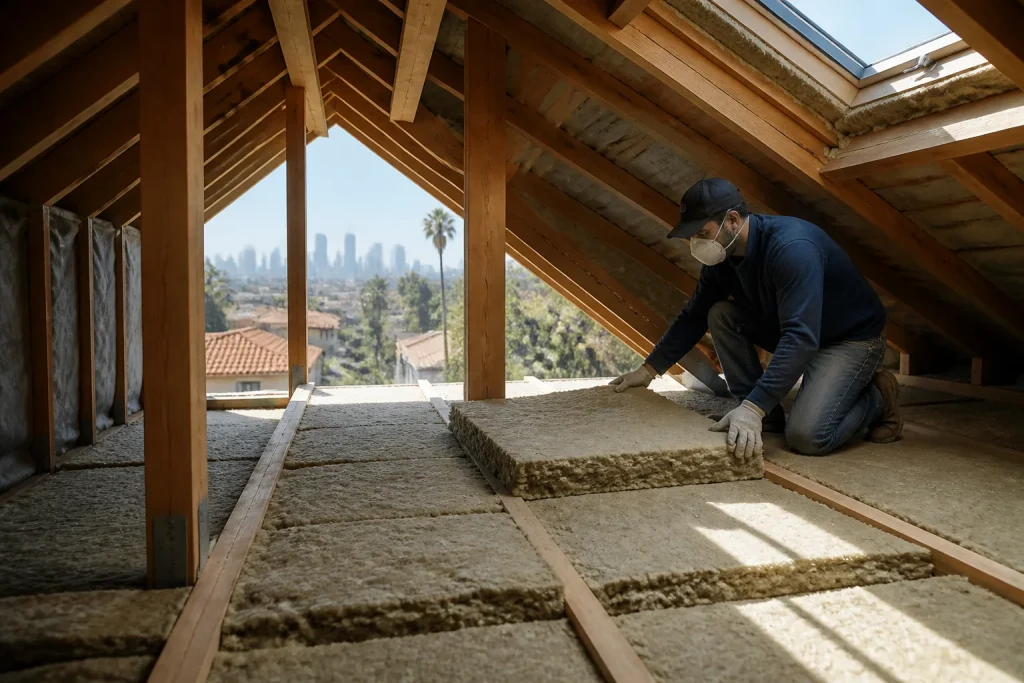
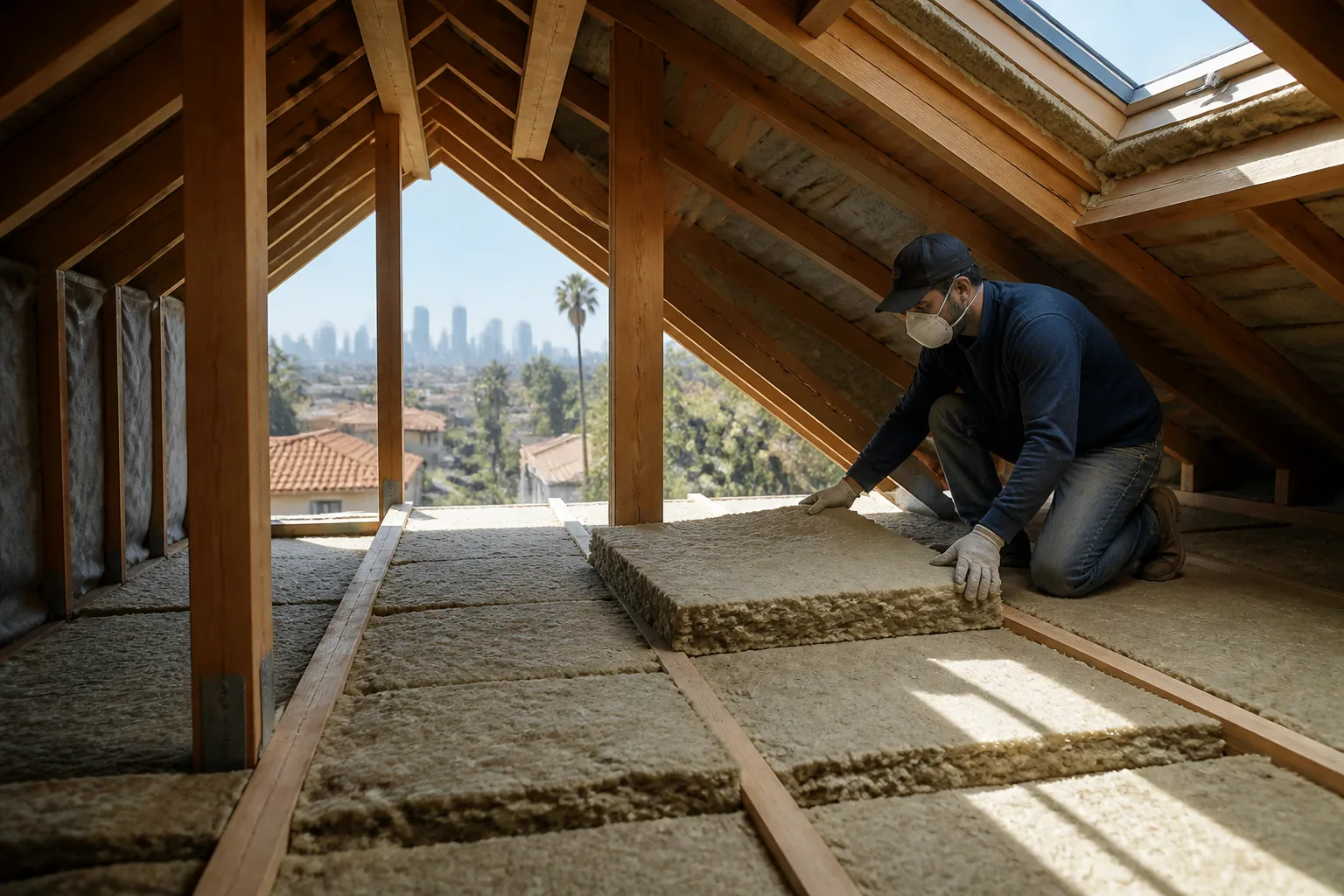
Comfortbatt is the thermal workhorse. It comes in R-15, R-23, and R-30 batts designed for standard residential framing, and it carries the ASTM E136 non-combustible rating. For a typical Los Angeles attic floor, Comfortbatt R-30 laid between 2×10 joists gets most homes to California Title 24 requirements with room to add more. This is the product we install most often in WUI-zone homes where fire documentation matters.
Rockwool Safe’n’Sound
Safe’n’Sound is a sound-attenuation batt, about 3 inches thick, designed for interior walls and floors between living spaces. It carries the same non-combustible classification and adds an STC rating bump of roughly 5 to 8 points when properly installed in a wall assembly. What parents near the 405 or the 10 actually care about is the noise floor: consistent freeway drone, sirens, and the low rumble of trucks. Safe’n’Sound in attic knee walls or between the attic and bedrooms below does take the edge off. But if your attic is unconditioned and you need thermal performance too, Safe’n’Sound alone is not the play. Some homes combine both: Comfortbatt on the attic floor for heat, Safe’n’Sound in walls under the roofline for sound.
Rockwool TopRock DD
TopRock DD is the product that matters for mid-century hillside homes with sloped cathedral ceilings, a very Los Angeles architectural condition. Houses built in the 1950s and 1960s in neighborhoods like Mount Washington, Echo Park, Silver Lake, and the Hollywood Hills often have exposed beam ceilings or shallow roof cavities where a conventional attic doesn’t exist. TopRock DD is a two-layer system: a denser top panel (the DD stands for dual density) bonded to a softer, resilient under-layer. It goes directly under roof decking on sloped applications, delivers R-21 in a 5.5-inch cavity, and holds up in a roof assembly where gravity is working against every other batt product. If a contractor quotes you “Rockwool in the roof” for a post-and-beam ceiling, TopRock DD is the specific board they should be naming.
The Weight Question: Older LA Homes and Load Checks
Stone wool is dense. Comfortbatt weighs roughly 2 to 3 times what a fiberglass batt of equivalent R-value weighs. In a house with 2×4 ceiling joists, that matters, and this is a real Los Angeles issue because so much of our pre-1970 housing stock was framed light. A 1958 ranch in the San Fernando Valley, a 1947 bungalow in Long Beach, a 1962 hillside house in Burbank: these structures were designed for R-11 fiberglass or less, and nobody in 1958 was planning for R-38 stone wool.
Before we quote a Rockwool install on any home with 2×4 joists, we check deflection tables and joist spacing. A 2×4 ceiling joist at 16 inches on center spanning 11 feet has a live-load deflection limit that a full-depth Rockwool pack can push against, especially in older homes where the lumber has dried and checked over 60 or 70 years. The fix is usually straightforward: reduce the target R-value, supplement with a lighter product, or in some cases sister the joists. But the point is that the check happens, and it happens before any price goes in writing. We pulled a quote out of a garage in Eagle Rock last month where a previous contractor had proposed R-38 Rockwool on 2×4 joists with no load review at all. The ceiling would have held, probably, but the drywall screws were working loose within a year on similar jobs we’ve seen. Not worth it.
Sound Control for Freeway-Adjacent Los Angeles Homes
One benefit Rockwool brings to Los Angeles that gets under-discussed is sound attenuation. Stone wool is denser and more porous than fiberglass, which makes it a better acoustic damper. In practical terms, an attic floor insulated with Rockwool Comfortbatt transfers less freeway noise into bedrooms than the same R-value in fiberglass.
We work with families along the I-10 corridor in Culver City and West Adams, along the 405 in Sherman Oaks and Torrance, and along the 110 in Highland Park and South Pasadena. The parents we talk to don’t ask about STC ratings at first. They ask about whether their kid will sleep through the night once the attic is opened up. The honest answer: insulation alone won’t silence a freeway. But a dense, fibrous material like Rockwool, installed at full depth and tight to the joists, takes a measurable chunk out of the low-frequency rumble that fiberglass lets through. For a nursery under the roofline, every decibel of that drone that goes away is a real quality-of-life gain. When a product, combined with good air sealing, can also reduce what the HVAC has to fight, we see lower energy use and quieter rooms together.
R-Value vs. Fire Rating: What Actually Matters for Your Attic
Here’s the tension every Los Angeles homeowner should understand before choosing a product. Fiberglass Owens Corning or Johns Manville batts will get you to R-38 for less money per square foot than Rockwool. Knauf produces a similar value. If your attic is in a low-fire-risk area, far from WUI zones, and your only goal is energy code compliance, fiberglass is a perfectly reasonable engineering choice. It’s what we install in many homes, and we’ll never tell you otherwise.
But if your insurer is asking about attic fire mitigation, if you live in a WUI severity zone, or if you simply want the strongest fire resistance available in a batt product, Rockwool answers a question fiberglass cannot. The math is simple: no fiberglass or cellulose product on the market carries an ASTM E136 non-combustible classification. Rockwool does. For some homes, that one test report is worth more than the R-value difference, because it affects whether the policy gets renewed at all. We also offer GreenFiber cellulose where code allows it and where the budget calls for it. The point is matching the product to the house and the family’s actual risk profile, not defaulting to one brand for every job.
When to Call a Pro
Attic insulation is not inherently dangerous the way electrical panel work or high-tension garage springs are, but it is miserable, dusty, and physically demanding work in a confined space that can reach 130°F in a Los Angeles summer. Rockwool’s weight makes it harder to haul and cut than fiberglass. If your attic has vermiculite insulation that predates 1990, it may contain asbestos, and disturbing it without testing is a real health hazard: we do not touch it until a lab clears it. If your attic has knob-and-tube wiring, insulation cannot cover it safely, and you need an electrician involved before any insulation contractor begins. And if your ceiling joists are 2x4s on a house built before 1980, a load check is the difference between a successful install and a sagging ceiling. These are the cases where a trained crew pays for itself.
Related services in Los Angeles: Attic Insulation in Los Angeles and Spray Foam Insulation in Los Angeles are two paths we walk homeowners through depending on their attic’s geometry and their air-sealing goals. Some homes benefit from spray foam at the roofline; others do better with batts on the attic floor. We’ll tell you which one makes sense for your house after we walk it.
The Bottom Line
Rockwool is not the cheapest attic insulation in Los Angeles, and for many homes it’s not the necessary choice. But for WUI-zone homeowners, anyone navigating a fire-mitigation insurance requirement, or families near freeways who value the acoustic damping, it solves problems other insulation products fundamentally cannot. The key numbers to remember: Class A fire rating, ASTM E136 non-combustible classification, melting point above 2,150°F, and a density that makes it both heavier and quieter than fiberglass. If you’re in Los Angeles and need help figuring out what your attic actually calls for, Thistledown Attic Insulation offers free estimates with exact written pricing before any work starts – call (909) 768-6501. You’ll get a live person, not a voicemail tree.
Frequently Asked Questions
It depends on where you live and what your insurer requires. In WUI zones or anywhere fire documentation matters, Rockwool’s non-combustible classification justifies the premium, which typically runs 25% to 40% over fiberglass. In low-risk areas where energy code compliance is the only goal, fiberglass from Owens Corning or Johns Manville works fine at a lower installed cost. Call (909) 768-6501 and we’ll tell you which side of that line your ZIP code falls on.
Yes, in specific cases. Underwriters reviewing fire-mitigation packages want documented upgrades to the home’s ignition resistance, and a non-combustible attic insulation classification is one of the line items they recognize. Homeowners in WUI areas including Malibu, Topanga, and the San Gabriel foothills have used Rockwool installation documentation as part of successful renewal applications. It’s not a guarantee against non-renewal, but it is evidence in your file.
Most Rockwool attic insulation jobs in Los Angeles fall between $2.10 and $3.80 per square foot installed, with a typical 1,200-square-foot attic floor ranging from $4,500 to $7,800 depending on target R-value, product line, and access conditions. Your exact written price arrives before any work begins. Call (909) 768-6501 for a free estimate specific to your attic.
It helps, but it doesn’t eliminate. Stone wool’s density makes it measurably better than fiberglass at absorbing low-frequency traffic drone, which is the exact kind of noise that carries from the 405, the 10, and the 110 into nearby bedrooms. Proper air sealing around the attic floor makes a bigger difference than insulation alone. Combined, they take a real edge off the constant hum.
Yes. Rockwool is inert, does not off-gas, does not support mold growth, and contains no formaldehyde. It’s a product we’re comfortable installing in homes where children sleep directly beneath the attic we’re working in. We also wear shoe covers, lay drop cloths from the front door to the attic hatch, and photograph the clean-up before we leave. That’s the Thistledown Attic Insulation standard, and it applies to every job.
Written by Neil Barron, Owner at Thistledown Attic Insulation, serving Los Angeles since 2003.
Need Insulation Help?
Call Thistledown Attic Insulation - licensed & insured, here with fast after-hours help in Los Angeles.
(909) 768-6501