
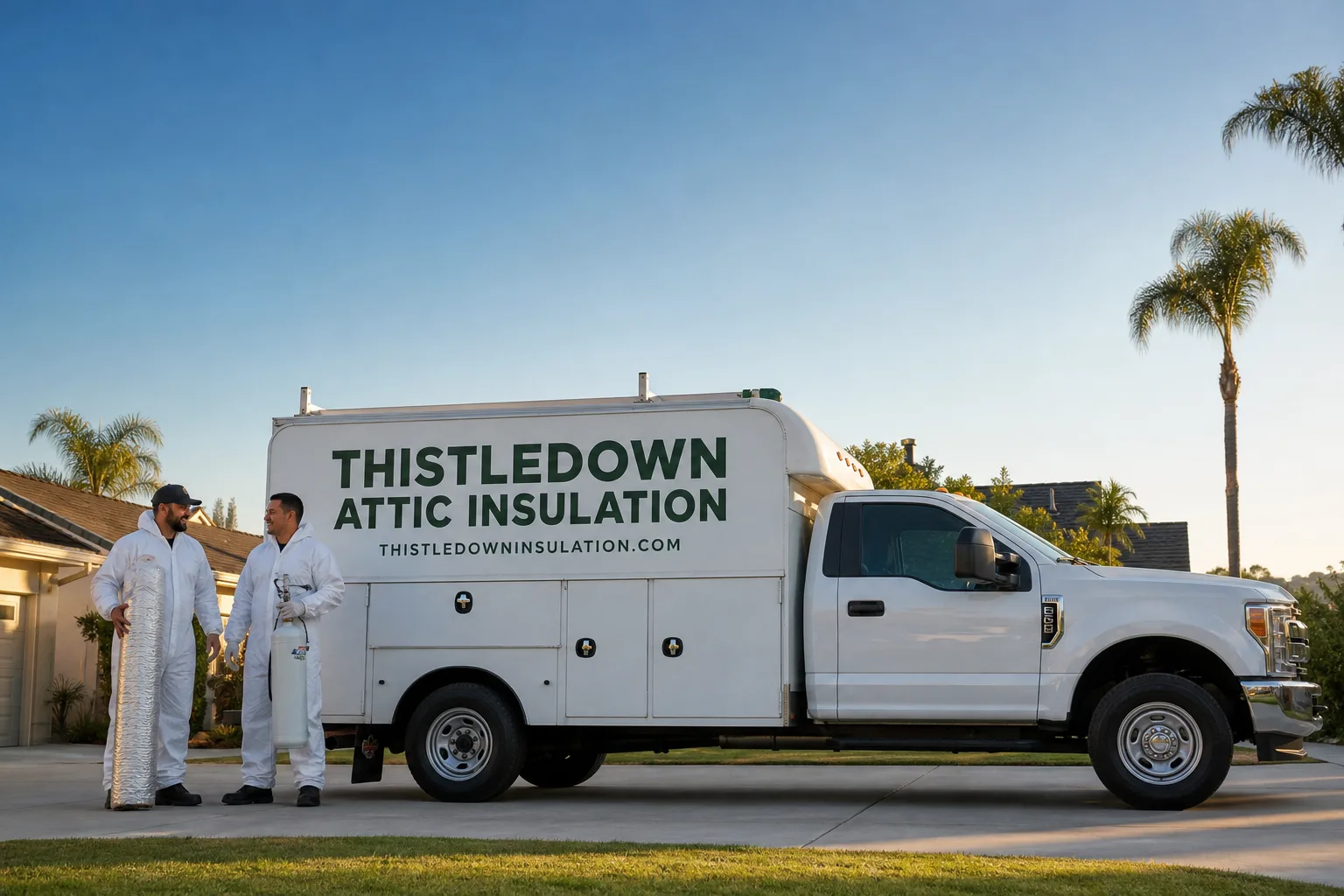
Radiant Barrier Installation Across the United States
Radiant barrier installation means fastening a reflective foil layer to the underside of your roof deck so the sun’s heat bounces back out instead of soaking into the attic. Done right, it keeps upstairs rooms cooler on long summer afternoons, takes strain off the air conditioner, and protects the insulation you already paid for. We’re Thistledown Attic Insulation, a Cedarwell-family company serving homeowners nationwide since 2003, and we put the price in writing before any work starts. A live person answers every call, any hour, at (909) 768-6501.
What Radiant Barrier Installation Actually Does
Most of the heat that reaches your attic in summer arrives as radiant energy. The sun heats the shingles, the shingles heat the roof deck, and the deck radiates that heat straight down at your attic floor. Insulation slows heat that moves by touch, but it does a poor job against radiant heat. A radiant barrier is a thin sheet of aluminum foil bonded to a backing material, and it reflects most of that radiant energy back toward the roof before it ever reaches the insulation.
You need radiant barrier installation when your roof gets hours of direct sun, when upstairs bedrooms run hot even though your attic insulation is already at the recommended depth, or when ductwork runs through the attic and the air inside it is warm by the time it reaches a vent. Thistledown Attic Insulation installs it as a partner to insulation, never a substitute for it. See our Attic Insulation page for how the two layers work together.
Where It Pays Off Most
Radiant barrier earns its keep in sunny, hot regions where the cooling bill is the big one. In cold northern climates the benefit is small, and we will tell you so on the phone rather than sell you something that will not pay back. Our estimator asks about your roof color, roof pitch, attic layout, and where your ducts run before recommending anything.
What a Radiant Barrier Will Not Do
It will not fix a thin or settled insulation layer, it will not seal air leaks, and it will not cure a ventilation problem. If your attic needs one of those first, the written quote says so and puts the steps in the right order.
Types of Radiant Barrier We Install
There are three common ways to put a reflective surface in an attic, and the right one depends on the framing, the roof access, and your budget.
Foil Stapled to the Rafters
Foil sheeting stapled to the underside of the rafters is the most common method. The sheets run from the ridge down to the soffit, and we leave a clear air gap between the foil and the roof sheathing. That gap matters. Foil that lies flat against wood conducts heat instead of reflecting it, so we space it and fasten it taut.
Foil Laid Over the Attic Floor
Some attics only allow foil on the floor, usually when the roof deck is too low or too cramped to reach. This works, but dust settles on the foil over time and dulls its reflectivity. We tell you plainly when the rafter method is the better choice for your house.
Spray-On Radiant Coating
A reflective paint-like coating can be sprayed on the roof deck from inside the attic. It suits oddly framed attics where sheets will not lay flat. It reflects less than foil sheeting, so we only recommend it when the other methods will not fit.
What Radiant Barrier Installation Costs
Radiant barrier installation typically runs $800 to $2,500 for a standard single-family attic, depending on roof deck square footage, attic access, and the type of barrier you choose. A small, easy-to-reach attic sits at the low end. A large attic with cramped corners, multiple roof planes, or a lot of ductwork to work around costs more because the crew spends more hours on their backs in tight spaces.
When radiant barrier is added during an insulation project, the combined cost usually lands between $2,300 and $6,700, since blown-in work runs $1,500 to $4,200. Your exact number is written down before any material is ordered, and it is the number on your invoice. For a fuller breakdown, see our Attic Insulation pricing.
How Thistledown Installs Radiant Barrier
Good installation comes down to details that most homeowners never see, which is exactly why we photograph them. Before the foil goes up, we check the roof deck for leaks, stains, and damaged sheathing. Foil over a wet roof deck traps moisture, so any leak gets fixed or flagged first.
Next we confirm the ventilation. A radiant barrier must never block the soffit vents or the ridge vent, because that would choke the airflow your attic depends on. We keep the foil clear of intake openings and cut it to leave the vent channels open. If your vent balance is off, our crew can correct it as part of the same visit through our Attic Ventilation service.
Then we fasten the sheets with heavy-duty staples, overlap the seams, and trim around framing, chimneys, and wiring. Foil is conductive, so we keep it well away from electrical connections and recessed light housings that need clearance. Last, we vacuum the work path, remove every scrap, and take photos of the finished attic and the clean floors before leaving.
Radiant Barrier and Your Existing Insulation
Radiant barrier and insulation do different jobs, and the best results come from using both. Insulation resists heat flowing through material. Radiant barrier stops heat traveling as radiation across the open attic space. When the barrier cuts the heat load first, your fiberglass or cellulose has far less heat to fight, so it performs closer to its rated R-value through the hottest hours of the day.
If your insulation is thin, compressed, or full of gaps, we usually recommend fixing that before or alongside the barrier. Our Blown In Insulation crews can top up the attic floor on the same visit, so you pay for one trip and one cleanup. If the old material is soiled or soaked, removal comes first and the written quote lists each step with its own price.
Ductwork in the Attic
Ducts running through a hot attic lose cooling before the air reaches your rooms. A radiant barrier above the ducts lowers the air temperature around them, which helps the system deliver colder air and run shorter cycles. If the ducts are leaking or the wrap is falling off, we point that out as well.
Is Radiant Barrier Worth It for Your Home?
It depends on three things: how sunny your climate is, how much of your cooling load comes from the attic, and what is already up there. A single-story house with a dark roof in a hot region gets the most out of it. A two-story home with a small attic gets less. A house in a cold, cloudy climate may get almost nothing from it.
We would rather talk you out of a job that will not pay back than install it and have you disappointed in July. When you call (909) 768-6501, we ask about your roof, your attic, and your cooling bills, then give you an honest answer on whether radiant barrier makes sense or whether insulation, air sealing, or ventilation should come first.
Signs You Should Call About Radiant Barrier
- Upstairs rooms that stay hot after sunset. If the bedroom is still warm at ten at night, the roof deck is probably dumping stored heat into the attic long after the sun goes down.
- An air conditioner that runs nonstop in summer. When the system cycles all afternoon and still cannot reach the thermostat setting, heat coming through the attic is a common cause.
- Cooling bills that keep climbing. If rates and habits have not changed but the bill has, a hot attic is often part of the answer.
- Hot ductwork in the attic. Touch a duct on a summer afternoon. If it feels warm instead of cool, the air inside is gaining heat before it reaches your rooms.
- Insulation at full depth, rooms still too warm. That points to radiant heat, which insulation alone does not stop.
Our Process, Step by Step
- 1
Call and honest conversation. You reach a live person at (909) 768-6501, any hour, any day. We ask about your roof, your attic, and which rooms run hot. No script, no voicemail tree.
- 2
Attic inspection with photos. A uniformed technician arrives on time, puts on shoe covers, and lays drop cloths to the attic hatch. We check the roof deck, vents, ducts, and current insulation depth.
- 3
Written price before any work. You get one specific quote naming the barrier type, the square footage, and the total. That number is what you pay.
- 4
Careful installation. We fasten the foil with the correct air gap, keep every vent open, and protect your home with the Cedarwell Care Promise.
- 5
Cleanup, photo proof, and the Done Right Promise. We vacuum, haul away every scrap, and photograph the finished attic. Then the job is covered by our 365-Day Done Right Promise.
Where We Work
Thistledown Attic Insulation serves homeowners and businesses across the United States through local crews who carry the same Cedarwell Care Promise into every home. Our teams arrive in uniform, cover floors before they walk, explain prices before they work, and photograph the cleanup before leaving. Wherever your attic is, the standards stay the same.
Frequently Asked Questions About Radiant Barrier Installation
Radiant barrier installation is the process of fastening reflective foil to the underside of your roof deck or rafters so it reflects the sun’s radiant heat away from the attic. It works alongside your insulation, not in place of it, and it helps most in hot, sunny climates.
Most attics run between $800 and $2,500, depending on roof deck square footage, access, and the type of barrier. Call (909) 768-6501 and you get your exact number in writing before any material is ordered.
A typical single-family attic takes four to six hours. Large attics, tight access, or added insulation or ventilation work can stretch that to a full day. We give you a timeline in writing before the job starts.
In hot, sunny regions it usually helps, mostly by keeping the attic and the ductwork in it cooler. The savings depend on your roof, your insulation, and your climate, which is why we ask questions first and tell you honestly if it will not pay back.
Yes, in many attics. Foil can be attached to the rafters or roof deck without disturbing the insulation below. If the old insulation is soiled, wet, or very thin, we recommend fixing that during the same visit.
Every job is backed by our 365-Day Done Right Promise. If it is not done right, we make it right, with no debate and no fine print.
Schedule Your Radiant Barrier Installation Today
Call (909) 768-6501 and a live person answers, any hour, any day. Tell us how hot the upstairs gets and we will schedule an inspection with a background-checked technician, give you a written price before any work starts, and back the job with our 365-Day Done Right Promise. The estimate is free, the cleanup is photographed, and the number you are quoted is the number you pay. Call us today.
Written by Neil Barron, Owner at Thistledown Attic Insulation, serving homeowners across the United States since 2003.