
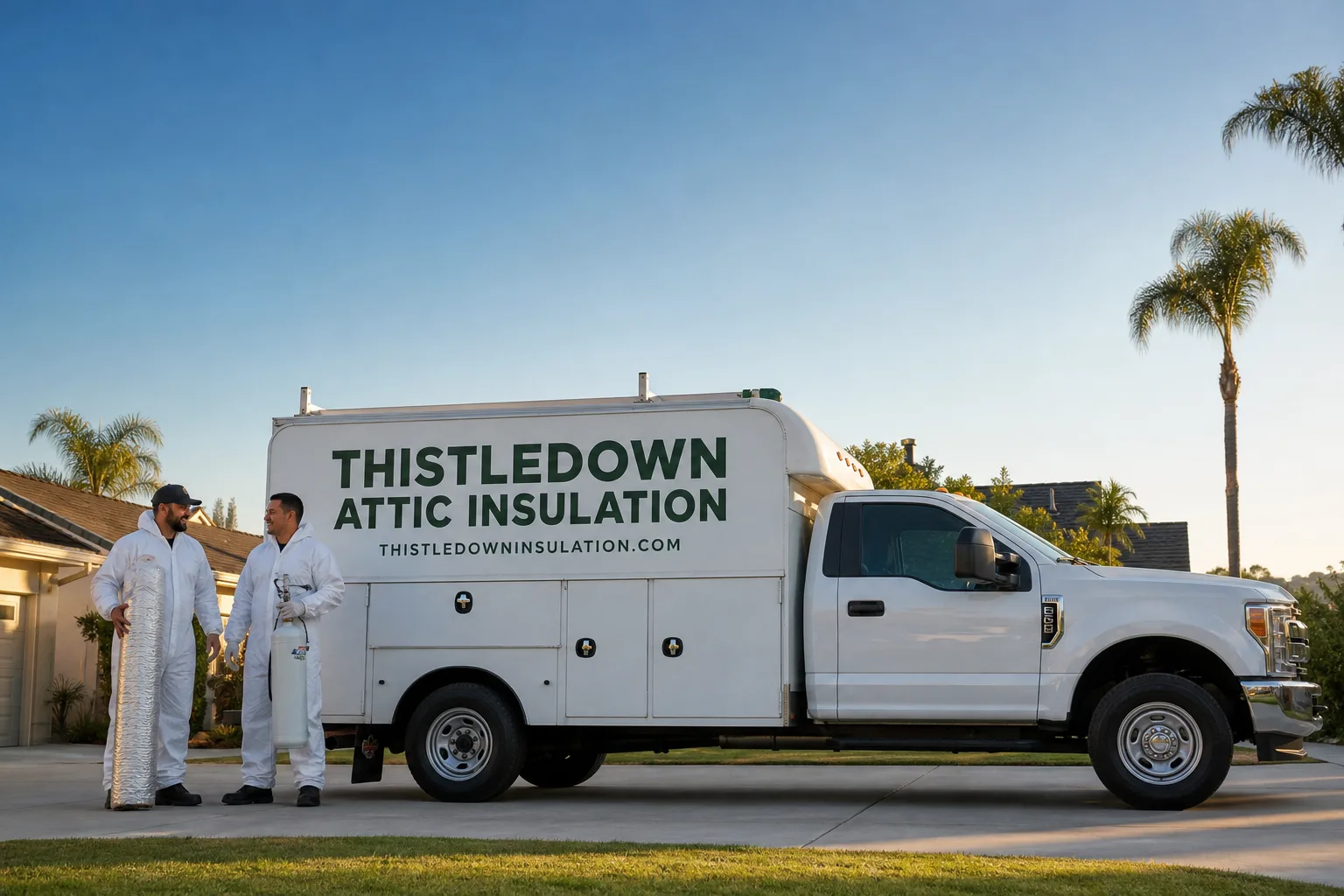
Fast, Reliable Spray Foam Insulation Across Apple Valley
Spray foam insulation in Apple Valley typically costs $2,800 – $7,400 for a full attic or wall project, with most jobs completed in one to two days. We know Apple Valley homes because we work in them every week – from the 1980s tract neighborhoods off Bear Valley Road to newer builds near Jess Ranch. Our crews arrive in uniform, lay drop cloths from the front door to the attic hatch, and put a written price in your hand before any foam leaves the truck. Call (909) 768-6501 and you’ll get a live person, not a voicemail tree, any hour of the day or night.
Why Thistledown Attic Insulation Is Apple Valley’s Preferred Spray Foam Insulation Company
We’re an independently owned Cedarwell-family company, which means we answer to a Care Promise on every visit: clean up like it’s our own home, ask before we move anything, respect quiet hours, and explain the price before the work. Apple Valley homeowners keep calling us back because we treat a house on Kiowa Road the same way we’d treat a house on Rancherias Road – shoe covers on, photo of the clean-up before we leave, and a 365-Day Done Right Promise behind every job. If it’s not done right, we make it right. No debate, no fine print.
Neil Barron leads our team, and he’s built the crew around one habit: being specific before being fast. You’ll know exactly which brand goes near the baby’s room. You’ll know why we chose open-cell or closed-cell for your walls. You’ll know your exact number before anyone picks up a tool. That’s not a sales pitch – it’s the only way we work.
Spray Foam Wall Insulation in Apple Valley
Spray Foam Wall Insulation in Apple Valley is the single best answer to the town’s 40-degree-plus daily temperature swing, because it air-seals and insulates in one pass. Most Apple Valley tract homes from the 1980s – 2000s boom went up with fiberglass batts that leave the top plates and electrical penetrations open. When the attic hits 150°F and the night drops to the upper 20s, those gaps drive a convective loop inside the wall cavity. You can have R-30 in the attic and still feel drafty walls because air is moving through them. Spray foam stops that movement at the source.
Wall spray foam in Apple Valley runs $1.80 – $3.10 per board foot for open-cell and $2.60 – $4.50 per board foot for closed-cell, depending on depth and access. A typical 1,800-square-foot exterior wall retrofit lands between $3,200 and $6,800. You’ll have your written number before we start.
Open-Cell for Interior Walls and Attics
Open-cell foam expands to fill every gap and quiets sound transfer between rooms – a real benefit in Apple Valley homes where the kids’ rooms sit under a hot roof deck. It breathes, so it won’t trap moisture in a vented attic. We pair it with air-sealing at the top plates to stop the convective loop the High Desert climate creates.
Closed-Cell for Exterior Walls and Rim Joists
Closed-cell adds structural rigidity and acts as a vapor barrier, which matters when Mojave dust and wind-driven air push through unsealed sheathing. It’s the right call for Apple Valley homes retrofitted from swamp coolers to central AC, where the old duct chases and bypasses were never sealed for the new mechanical load.
Rim Joist Spray Foam in Apple Valley
Rim Joist Spray Foam in Apple Valley is the quiet upgrade that fixes a problem most homeowners can’t see: the gap where the foundation meets the floor framing. In the Victor Valley’s 50 – 60 mph wind events, outside air gets driven straight through that junction. In summer, the same gap lets 150°F attic-adjacent air seep into the floor system. Sealing the rim joist with closed-cell spray foam in an average Apple Valley home costs $900 – $2,100 and takes a single afternoon.
This one detail changes how the whole house feels. The floors stop reading cold in December. The back bedrooms hold temperature in August. And because closed-cell foam cures rigid, it also helps block the fine alkaline Mojave dust that seeps into older homes through rim joist cracks after every wind season.
Slab-on-Grade Homes Built for Swamp Coolers
Apple Valley has thousands of slab-on-grade homes that started life with evaporative coolers. When central AC replaced the swamp cooler, nobody sealed the old duct penetrations and framing gaps. We find those bypasses and close them before spraying, so the foam actually works as a thermal break rather than just covering a leak.
Garage Ceilings and Attic Transitions
Garage ceilings under occupied rooms are another spot where Apple Valley heat pours in. We spray the garage ceiling perimeter and rim area to keep heat out of the room above. It’s a half-day job most families schedule before summer hits the High Desert.
Trusted Brands We Service in Apple Valley
We install and service Spray Foam Insulation systems from Icynene, Demilec, Owens Corning, and Johns Manville, matched to the job rather than whatever’s on sale. For Apple Valley customers, that matters in a specific way: the right open-cell foam for a vented attic on a low-pitched roof isn’t the same product as the closed-cell foam that belongs on a rim joist facing Mojave wind-blown dust. We stock those brand lines so your job doesn’t stall waiting on a shipment from down the hill, and we can pull whatever your project needs the same week we quote it.
Common Spray Foam Insulation Problems We See in Apple Valley Homes
- Loose-fill migrated off the exterior wall plates. High-wind events push blown insulation away from the edges of the attic, leaving a bare strip above the exterior walls. We’ve measured the resulting cavity temps during winter and it’s the difference between a sealed top plate and a cold wall.
- Alkaline Mojave dust in the insulation. Fine dust infiltrates unsealed penetrations, compresses batts, coats radiant barriers, and quietly strips R-value. It’s nearly invisible during a normal attic glance, which is why we inspect with a camera and test cavity depth before recommending anything.
- Swamp-cooler-era bypasses never sealed after AC retrofits. The 40-degree daily swing pushes air through those old paths nonstop. The AC runs longer, the upstairs rooms never settle, and added insulation on top does almost nothing because the air movement defeats it.
- Wind-driven air at rim joists. The junction between foundation and floor framing leaks in both directions. We see it on nearly every Apple Valley home built before 2010, and it’s one of the cheapest fixes with the fastest comfort payoff.
Pricing for Spray Foam Insulation in Apple Valley, CA
Here’s what we actually quote in Apple Valley, not a vague range that hides the real number. Open-cell attic spray foam on an 1,800-square-foot home runs $3,100 – $5,400. Closed-cell wall retrofits land between $3,200 and $6,800. Rim joist sealing runs $900 – $2,100. Garage ceiling projects typically fall in the $1,400 – $2,900 range. What moves the number: access, existing insulation removal, and how many bypasses we’re sealing. You’ll get a written price before any work starts – that part never changes, and the estimate is free. Call (909) 768-6501 to schedule the walkthrough.
We Also Serve Cities Near Apple Valley
Our crews cover the full Victor Valley. If you’re in Hesperia, Victorville, Adelanto, or Lucerne Valley, the same team and the same 365-Day Done Right Promise applies. Apple Valley is our home base for High Desert spray foam work, and we dispatch locally from our Inland Empire office to keep response times tight through the pass.
Serving Apple Valley, CA - Our Local Coverage Area
We’re based in the Apple Valley area and know this community well. Use the map below to see our service coverage - if you’re nearby, we can almost certainly help.
FAQs About Spray Foam Insulation in Apple Valley
Because Apple Valley’s wind and temperature swing defeat loose-fill before you ever notice. The 50 – 60 mph gusts migrate blown insulation off the wall plates, and the 40-degree daily swing drives air through every unsealed gap. Spray foam air-seals first and insulates second. Adding more loose-fill on top of unsealed bypasses is like adding more water to a bucket with a hole in the bottom. Call (909) 768-6501 and we’ll show you the difference with a camera inspection.
It changes where we spray first. Swamp-cooler-era homes have duct chases, roof penetrations, and framing gaps that were never sealed for a closed AC system. We seal those bypasses before any foam goes in, then spray the top plates and rim joists to stop the convective loops the AC retrofit never addressed. It’s a specific sequence of work for a specific Apple Valley housing stock, and it’s the same sequence we’ve used on dozens of retrofit homes out near Kiowa Road and Apple Valley Road.
No. Closed-cell and open-cell spray foam are both rated for sustained temperatures far beyond what a 150°F attic reaches, and unlike fiberglass batts, they don’t lose thermal performance because of convection. The real risk in Apple Valley attics is under-sealing, not over-heating the foam. Foam installed correctly against the roof deck or wall plates will hold its R-value for decades.
That fine Mojave alkaline dust compresses batts and coats surfaces, quietly cutting R-value without a sign. In wind-prone areas near Outer Highway 18 and the open desert stretches toward Lucerne Valley, dust intrusion through unsealed penetrations is a primary cause of insulation underperformance. Spray foam’s air-sealing eliminates most of the entry paths for that dust, which protects both the foam and your home’s air quality.
Yes, and that dual-extreme condition is exactly why spray foam is the right product here. Closed-cell foam provides both a thermal break and an air barrier, which is what a house needs when the daily temperature swing exceeds 40 degrees. It performs in both heating and cooling seasons, unlike the minimum Title 24 amounts of fiberglass that Apple Valley’s tract era was built to, which perform poorly in both directions. Call (909) 768-6501 and we’ll walk you through the right depth and product for your walls.
Written by Neil Barron, Owner at Thistledown Attic Insulation, serving Apple Valley homeowners with the Cedarwell Care Promise and a 365-Day Done Right Promise.