
Fast, Reliable Spray Foam Insulation Across Blythe
Spray foam insulation in Blythe is not a home upgrade you compare against new countertops. It is the difference between an attic that bakes at 160°F and one that stays close to the temperature of the rest of your home. We install open-cell and closed-cell spray foam in Blythe homes built between the 1950s and 1980s, most of which were never insulated to California’s current Title 24 code. Our crews know what a 115°F July day does to a low-pitched roof over a Palo Verde Valley home, because we work under those roofs every week. Call (909) 768-6501 and we will give you a written price before any work starts.
Why Thistledown Attic Insulation Is Blythe’s Preferred Spray Foam Insulation Company
Blythe homeowners call us because their attics are telling them something is wrong. The upstairs never cools below 80°F in August. The AC runs all afternoon and the living room still feels warm by 5 p.m. We have worked in homes near the Palo Verde Valley Fairgrounds, in the older grid streets north of I-10, and in manufactured-home communities along Lovekin Boulevard. What we find is consistent: compacted fiberglass reading R-8 to R-12, ducts leaking cooled air into unconditioned attic space, and rim joists that were never sealed. Our Spray Foam Insulation team specifies foam to reach the R-49 target Blythe’s climate actually requires, not the R-38 number imported from cooler coastal markets.
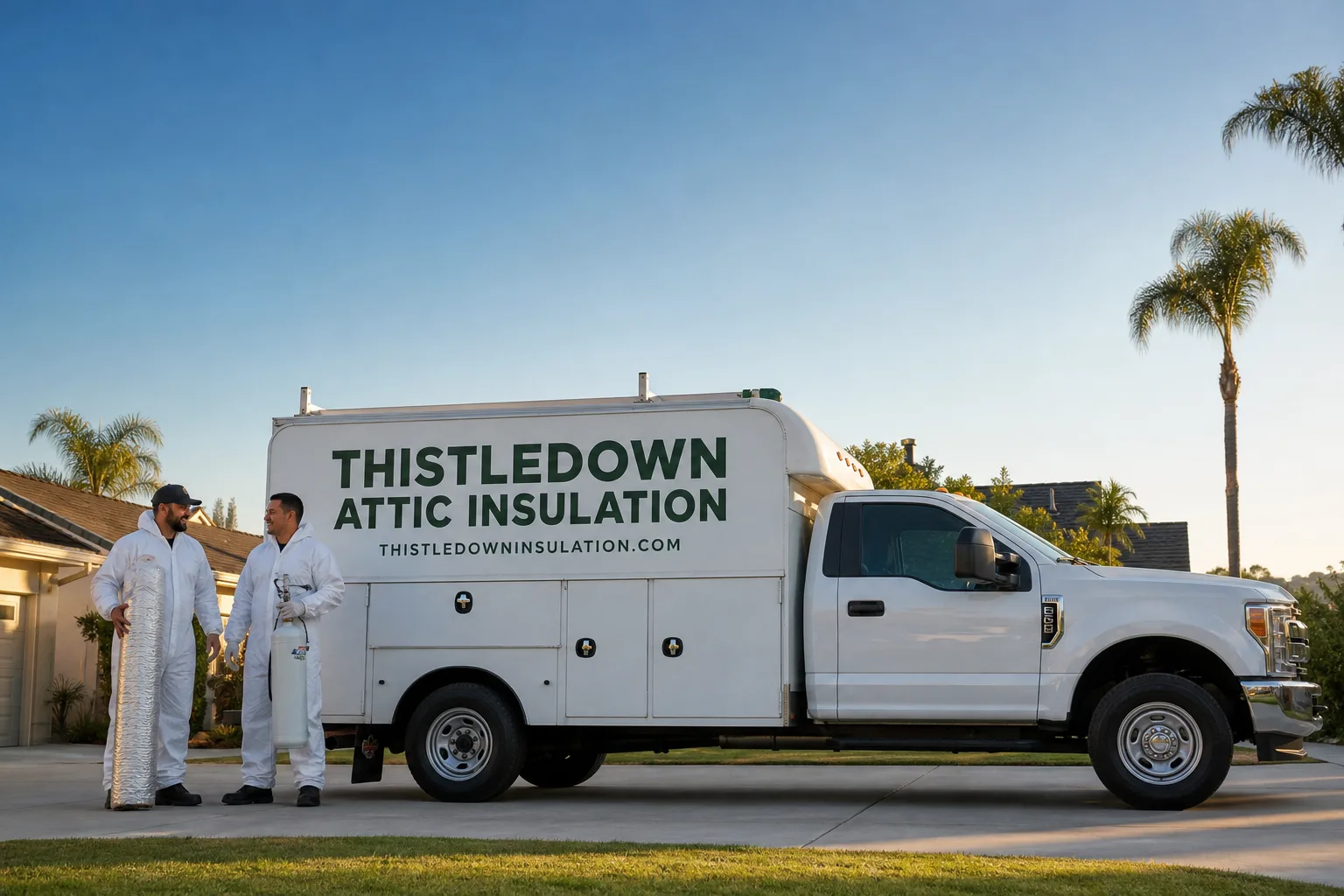
Every Thistledown crew member is background-checked and arrives in uniform. We lay drop cloths from the front door to the attic hatch and wear shoe covers the entire time we are inside your home. When the job is done, we photograph the clean-up and leave you with that photo before the van pulls away. Neil Barron runs our crews, and he holds every job to the Cedarwell Care Promise: clean up like it is our own home, ask before we move anything, respect quiet hours, and explain the price before the work. A live person answers our phone 24 hours a day, seven days a week. No voicemail trees.
Rim Joist Spray Foam in Blythe
Rim joist spray foam in Blythe addresses a problem nearly every older home here shares. The rim joist, the band of framing lumber that sits on top of your foundation wall where floor joists meet the outside, is almost never insulated in homes built before the 1980s. In Blythe, that means a continuous ring of unsealed wood around the entire perimeter of your home, letting hot desert air press into the living space and, near the Colorado River, letting marginally humid air ride along with it. We see this in houses throughout the older sections of Blythe, where rim joists baked for decades show hairline cracks that only make infiltration worse.
Typical rim joist spray foam in Blythe runs $1,800 to $3,200 for a full single-story perimeter, depending on access and whether we are also sealing the sill plate. The work usually takes one day. We remove any degraded fiberglass, apply two inches of closed-cell foam, and the difference in interior temperature near exterior walls is often noticeable the same evening.
What the closed-cell foam does at the rim
Closed-cell foam at the rim joist does three jobs at once. It air-seals the gap where floor framing meets the foundation. It insulates the wood itself, which otherwise conducts outdoor heat straight through to the flooring above. And it adds structural rigidity to a part of the framing that takes heavy loads in older Blythe homes.
Rim joists in manufactured homes
Manufactured and mobile homes around Blythe have a different framing profile than site-built houses, but the air-infiltration problem is often worse. Skirting traps hot air, and the belly board underneath rarely has any insulation at the perimeter. We route closed-cell foam into the rim area and along the perimeter boxing where access allows, which cuts the stack effect that pulls hot air up through the walls all afternoon.
Crawl Space Spray Foam Insulation in Blythe
Crawl space spray foam insulation in Blythe matters because so many of the city’s older homes sit on raised foundations with open or loosely vented crawl spaces. That space under your floors connects directly to the desert air outside. In July, the air under a Blythe home can hit 130°F before 10 a.m., and your floors are the only barrier between that heat and your living room. The Colorado River’s proximity adds slightly more humidity than you find in pure Mojave Desert communities, which means the underside of your home is not just hot, it is hot and faintly damp. Spray foam seals both problems.
Costs for crawl space spray foam in Blythe run $2,500 to $5,400 for a typical 1,200 to 1,800 square foot home, depending on clearance height and the condition of the existing vapor barrier. The work takes one to two days.
Sealing the crawl space perimeter
We apply closed-cell foam to the crawl space walls rather than the floor joists above. That moves the thermal boundary to the perimeter of the crawl space and turns the whole area into a semi-conditioned buffer. Homeowners in the older neighborhoods around Eucalyptus Street and Vine Avenue tell us their floors feel dramatically different within a day of the work being done.
Humidity and the Colorado River
Blythe’s location along the river means crawl spaces here pick up moisture from the soil and the air in ways Indio or Twentynine Palms do not. Closed-cell spray foam acts as a vapor barrier as well as an insulator, so a sealed perimeter wall keeps that river-adjacent humidity from reaching your floor framing. Open-cell foam is not recommended for this application in Blythe because it is vapor-permeable.
Trusted Brands We Service in Blythe
We install spray foam systems from Owens Corning, Johns Manville, and Icynene, which means we can match the right product to the specific job. A 1960s stucco home near First Street benefits from a different foam profile than a 1980s manufactured home out near the agricultural fields. For homes with pets and kids, we choose pet-safe product options wherever a choice exists, so your dog can stay home during the install. Because we are an independently owned Cedarwell-family company, we are not locked into a single supplier. We pick the foam that fits your roofline, your framing, and your budget, and you get that decision explained in writing before we open a single canister.
Common Spray Foam Insulation Problems We See in Blythe Homes
- Compacted blown-in fiberglass reading R-8 to R-12. Decades of 150°F-plus attic temperatures bake the loft out of fiberglass until it collapses into a thin mat. A home that started at R-30 may now be performing at R-10, and the homeowner is paying to cool an attic that is essentially uninsulated.
- Duct systems losing cooled air in unconditioned attics. We find disconnected collars, crushed flex ducts, and gaping holes at boots in a large share of the older Blythe homes we walk. Every cubic foot of cooled air that leaks into a 150°F attic before reaching a bedroom register is money spent on nothing.
- Uninsulated rim joists and crawl space walls. Older homes in the Palo Verde Valley were built before energy codes existed. The rim joist and crawl space perimeter were simply never on the original builder’s list, and they remain unsealed decades later.
- River-adjacent humidity degrading existing insulation. Homes closer to the Colorado River pick up enough ambient moisture to turn fiberglass batts damp and sagging. Spray foam, applied correctly, does not absorb that moisture the way degraded fiberglass does.
Pricing for Spray Foam Insulation in Blythe, CA
Blythe spray foam pricing breaks down roughly like this: open-cell foam in an existing attic typically runs $1.20 to $1.80 per board foot installed, while closed-cell foam runs $0.90 to $1.50 per board foot on top of an additional $1.50 to $2.50 per square foot for the application itself. Rim joist work is generally $1,800 to $3,200 for a full perimeter. Crawl space sealing lands between $2,500 and $5,400. A full attic roof deck application in a 1,400 square foot Blythe home, including air sealing and removal of old material, usually falls between $4,800 and $7,900. You will have your exact number in writing before we touch a rafter. Call (909) 768-6501 for a free estimate, and bring any competing quotes you have. We will explain what is actually different about them, line by line.
We Also Serve Cities Near Blythe
Our crews regularly work in Mecca, Coachella, Twentynine Palms, and Indio. Each of those desert communities has its own housing stock and its own heat profile, but all of them share the same core problem: under-insulated attics fighting a climate that demands R-49. If you live just outside Blythe, call (909) 768-6501 and we will schedule a walkthrough. For more on the full scope of Spray Foam Insulation in Blythe and nearby areas, we are happy to talk through your specific roofline.
Serving Blythe, CA - Our Local Coverage Area
We’re based in the Blythe area and know this community well. Use the map below to see our service coverage - if you’re nearby, we can almost certainly help.
FAQs About Spray Foam Insulation in Blythe
Because Blythe’s summer attic temperatures routinely exceed 150°F, and R-38 is a target calculated for milder California climate zones. The California Energy Commission places Blythe in climate zone 15, which calls for R-49 attic insulation. Contractors who import R-38 assumptions from Palm Springs or Indio are working to a coastal or mid-desert standard that under-serves this city. We specify to R-49 or better. Call (909) 768-6501 and we will walk your attic with a thermal camera and show you exactly what your current insulation is performing at.
No. Spray foam does not adhere reliably to deteriorated fiberglass, and burying compacted material under foam traps dust and can create odor issues. We remove the old material first, air-seal the attic floor, then apply the foam. The removal is included in our written quote, so there is no surprise line item on the day of the job.
Closed-cell spray foam is a vapor barrier, which is what you want in a Blythe crawl space where river-adjacent humidity is higher than in the pure Mojave Desert. Open-cell foam is vapor-permeable and will allow that moisture to reach your floor framing. For crawl spaces in this city, we recommend closed-cell on the perimeter walls every time. A live person can explain the difference and quote your specific home at (909) 768-6501.
It helps enormously. When we apply spray foam to the roof deck, the attic becomes a semi-conditioned space, and the ducts running through it stop losing cooled air to a 150°F oven. Alternatively, we can air-seal and insulate the attic floor while wrapping the ducts themselves. We assess which approach fits your home and budget, and the recommendation goes in your written quote.
Spray foam installed correctly lasts the life of the home. It does not settle, compact, or lose loft the way fiberglass does after decades of 150°F-plus attic temperatures. The blown-in fiberglass we find in older Blythe homes is often performing at R-8 to R-12 after 40 years. Spray foam at R-49 is still R-49 in 40 years. That is the argument for doing this once, correctly.
Written by Neil Barron, Owner at Thistledown Attic Insulation, serving Blythe since the company’s founding in 2003.