
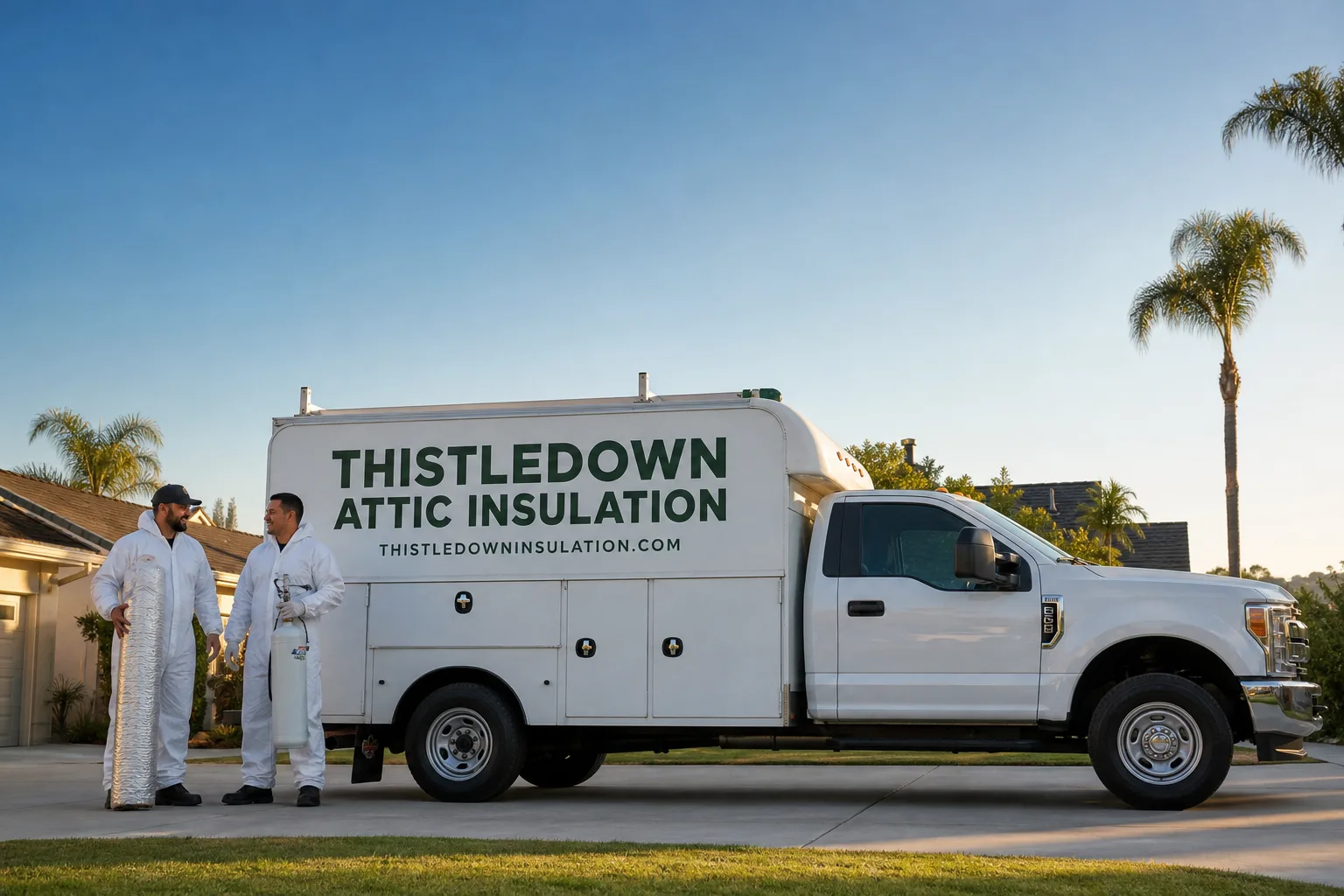
Fast, Reliable Spray Foam Insulation Across Corona
Spray foam insulation in Corona typically costs $2.50 to $5.50 per square foot installed, with a standard 1,200-square-foot attic retrofit running $3,000 to $6,600. Most Corona homes we see were built between 1988 and 2008 with insulation that never matched what the climate actually demands. Closed-cell foam for a garage ceiling or rim joist job usually lands between $1,800 and $3,400. You get your exact written price before any work begins, and our Corona crews answer calls around the clock at (909) 768-6501.
Corona is not like other Inland Empire cities. The Temescal Valley corridor walls the city off from any coastal cooling, so attics here bake in ways that Anaheim or even Riverside never experience. That changes what your insulation has to do. It also changes which products make sense and where. We treat every Corona house as its own problem to solve, and we start by looking at the attic the way it actually behaves in July, not the way a product sheet describes it.
Why Thistledown Attic Insulation Is Corona’s Preferred Spray Foam Insulation Company
Homeowners in Corona call us because we explain what is happening before anyone picks up a tool. Our Spray Foam Insulation team has worked through hundreds of attics across the city’s master-planned communities, and we know where these tract homes fail. The original R-30 batt in a 1996 Eagle Glen home has almost certainly settled. The ductwork above your ceiling is losing cooling capacity before air reaches the register. These are the details we point out on the estimate, with a photo, before you commit to anything.
Every Corona job is handled by background-checked, uniformed technicians who follow the Cedarwell Care Promise. That means shoe covers from the front door to the attic hatch, drop cloths across your hallway, and a photo of the clean-up before we leave. If your baby is napping, we work quietly. If your dog is home, we choose pet-safe products where a choice exists. Thistledown is the soft fluff of the thistle, one of nature’s lightest insulators. The name is a promise about how carefully we work, and it applies just as much to your floors as to your roofline.
We coordinate our Corona scheduling from our Inland Empire office, which means response time to most Corona ZIP codes is same-day or next-day. We answer every call with a live person, 24 hours a day, seven days a week. No voicemail trees, no next-business-day callbacks. If it is 9:00 on a Saturday night in South Corona and your attic hatch is letting 150°F air pour into the hallway, you will reach a human who can talk to you about it.
Garage Spray Foam Insulation in Corona
Garage spray foam insulation in Corona is one of the most common calls we get, and for good reason. A garage ceiling in a 1990s tract home typically shares a wall or ceiling assembly with the house, but nobody insulated it when the home was built. That means the garage becomes a heat reservoir in summer and a cold sink in winter, and the rooms above or beside it pay the price. In Corona, where summer garage temperatures regularly exceed 110°F, that is a real problem.
We apply closed-cell spray foam directly to the garage ceiling and rim joist areas, which does two things at once. It stops the heat transfer through the ceiling, and it seals the gaps along the wall-to-ceiling junction where hot air likes to move. A typical Corona garage ceiling job runs $1,600 to $2,900 depending on square footage. We will quote it in writing before we start, and the price you see is the price you pay.
Rim Joist Sealing for Attached Garages
The rim joist, the board that runs around the top of your foundation wall, is one of the leakiest spots in a Corona home. Builders in the 1990s and 2000s rarely insulated it, and air moves through it easily. We seal rim joists in attached garages with closed-cell foam, which blocks air movement and keeps garage heat from bleeding into the home’s framing.
Garage Ceiling Applications
For garages with living space above, we insulate the ceiling cavity itself. For garages that sit beneath the attic, that work usually happens at the rim joist and the wall-to-ceiling junction. Either way, the goal is a sealed, thermally stable garage that doesn’t add load to your HVAC system. In Corona, where the garage door is often on the south or west side of the house, that load is real.
Closed Cell Spray Foam Insulation in Corona
Closed cell spray foam insulation in Corona is our default recommendation for attics and rim joists because of the temperatures involved. Closed-cell foam has a higher R-value per inch, usually around R-6.5 to R-7, and it also acts as an air and vapor barrier. In a Corona attic that hits 150°F, that air-sealing property matters as much as the R-value. Gaps at the roof-to-wall junction and around recessed can lights are where the heat actually gets in. Closed-cell foam seals those gaps and insulates them in one pass.
We use closed-cell products from trusted manufacturers like Owens Corning, Johns Manville, and Knauf, and we choose the specific formulation based on what the attic needs. A typical closed-cell attic retrofit in Corona runs $3,000 to $6,000. Garages and rim joists fall on the lower end of that range. The written quote you get before work begins includes everything, including the clean-up photo at the end.
Roof-to-Wall Junction Sealing
This is the single most common bypass point we document in Corona attics. The joint where the roof framing meets the top of the exterior wall was rarely sealed in production-built homes from the 1990s and 2000s. When our techs run an IR camera through a Eagle Glen attic, the junction often glows hot. Closed-cell foam applied at that junction stops the air passage instantly.
Recessed Light Bypass Treatment
Recessed can lights are another hole in the ceiling that most tract home builders forgot to seal. The can sits in a hole cut into the drywall, and hot attic air pours through the gap around it. We air-seal and insulate around these fixtures with closed-cell foam where code allows, and we document every one we find in the job photos we share with you.
Trusted Brands We Service in Corona
We install products from eight insulation brands, including Owens Corning, Johns Manville, Knauf, and Rockwool, and we stock materials locally for fast turnaround on Corona jobs. The right product depends on the attic and the family. Some Coronal homeowners prefer Rockwool for its sound-dampening and fire resistance. Others want closed-cell foam for the air-sealing benefit. We match the product to your house, your budget, and your family’s needs, not to whatever is left on the truck. Pet-safe options are available where a choice exists for the specific product line.
Common Spray Foam Insulation Problems We See in Corona Homes
- Settled original R-30 batt insulation. Batt insulation in attics built before 2008 has often compressed to an effective R-18 or lower, leaving the top plate and roof-to-wall junction exposed to 150°F+ attic air.
- Unsealed ductwork in unconditioned attics. Many Corona tract homes route HVAC ducts through the attic, where the cooling air loses temperature before reaching the register. Sealing and insulating the attic envelope fixes the root cause rather than chasing the symptom.
- Santa Ana wind pressurization. The 91 Freeway corridor funnels wind that pushes hot attic air through gaps the original production builder skipped. This is a failure mode our other Inland Empire crews rarely see at the same intensity.
- Thermal bypass at roof-to-wall junctions and recessed lights. These two spots light up on IR cameras in almost every 1990s-era Corona home we inspect. They are the primary driver behind $400 to $500 summer electric bills even when the HVAC unit is relatively new.
Pricing for Spray Foam Insulation in Corona, CA
Here are the ranges we quote for Corona homes:
- Garage ceiling spray foam: $1,600 – $2,900
- Rim joist spray foam sealing: $800 – $1,800
- Closed-cell attic retrofit (1,200 sq ft): $3,000 – $6,000
- Open-cell attic retrofit (1,200 sq ft): $2,200 – $4,400
- Spray foam roof deck (underside of roof sheathing): $4,500 – $8,000
These numbers are for Corona’s market and assume typical access and standard framing. What moves the number is square footage, attic height, and how much air-sealing the job requires. You will always get a written price before any work starts, and that price is fixed. Call (909) 768-6501 for a free estimate. No obligation, and we will give you the number in writing the same day.
We Also Serve Cities Near Corona
Our Spray Foam Insulation in Corona team also handles jobs in Norco, Chino, Chino Hills, and Irvine. If you’re a few miles away and need the same attention to detail and written pricing, call (909) 768-6501 and ask about our scheduling for your area.
Serving Corona, CA - Our Local Coverage Area
We’re based in the Corona area and know this community well. Use the map below to see our service coverage - if you’re nearby, we can almost certainly help.
FAQs About Spray Foam Insulation in Corona
Attics in Corona regularly reach 150°F or more during summer afternoons because the Santa Ana Mountains block any cooling marine influence. At those temperatures, existing batt insulation loses much of its effectiveness and any gaps in the attic envelope leak hot air into the home. Spray foam, especially closed-cell, insulates and seals in one pass, which directly addresses the heat load rather than just adding more fiberglass on top. Call us at (909) 768-6501 and we will document your attic temperature and show you where the heat is getting in.
Corona itself is inland, but some local homeowners ask about coastal salt-air influence, and the answer is that spray foam does not directly address metal corrosion. What it does address is the thermal cycling that makes garage hardware expand and contract. A stable garage temperature reduces condensation on metal surfaces, which slows corrosion. For actual corrosion protection on springs and tracks, galvanized coatings and stainless hardware are the solution.
Almost certainly yes, but we will prove it before you spend a dollar. The R-30 batt installed in 1990s Eagle Glen homes has typically settled to an effective R-18 in the areas that matter most, and the roof-to-wall junction was never sealed. One homeowner in Eagle Glen called us after a $480 summer electric bill. Our tech found the same settled batt and bypass points. After sealing with closed-cell foam and adding insulation, the following August bill dropped to roughly $290. Your exact situation may differ, but the pattern is common enough that it is worth a look.
Santa Ana winds funnel through the 91 Freeway corridor and pressurize the building envelope, pushing attic air through the gaps that production builders left behind. Spray foam’s air-sealing property is what makes it worth the cost in Corona specifically. Closed-cell foam seals the roof-to-wall junction and recessed light openings, which are the primary paths that wind-pressurized air uses to reach the living space. If those gaps remain open, even new insulation pays partial dividends.
Open-cell foam is lighter, less expensive, and expands to fill framing cavities, but it allows vapor to pass through and has a lower R-value per inch. Closed-cell foam is denser, adds structural stiffness, and acts as an air and vapor barrier. For Corona attics that hit 150°F, we typically recommend closed-cell at the roof-to-wall junction and around bypass points, with open-cell or blown-in insulation in the main attic floor depending on your budget and goals. We will explain the trade-offs in plain English on the estimate, and you will have the written price for each option.
Written by Neil Barron, Owner at Thistledown Attic Insulation, serving Corona with spray foam and attic insulation since 2003.