
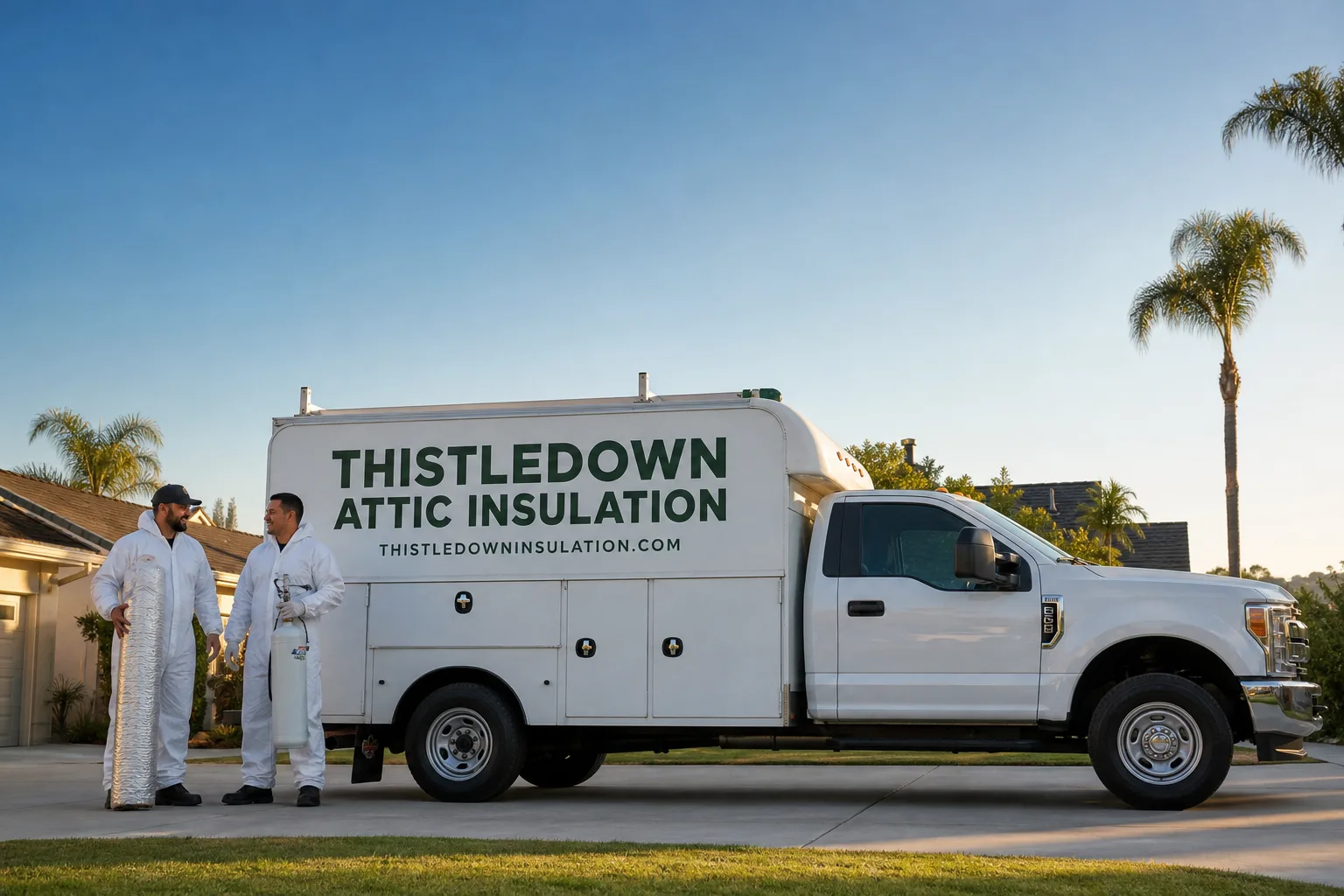
Fast, Reliable Spray Foam Insulation Across Crestline
Spray foam insulation in Crestline costs between $2,200 and $7,800 for most residential jobs, with garage ceiling applications running $1,400 to $3,600 and crawl space work typically landing between $1,800 and $4,500. The numbers depend on square footage, access, and how much old material needs to come out first, but you’ll have a written price before anyone picks up a tool. We send crews up Highway 18 to Crestline regularly, and we know these cabins, their quirks, and what happens when a 1960s A-frame meets a mountain winter with no insulation. Call (909) 768-6501 and a live person answers, any hour.
Why Thistledown Attic Insulation Is Crestline’s Preferred Spray Foam Insulation Company
Crestline homeowners keep calling us because we understand what these houses actually are. Most of the homes up here along Lake Drive, around Lake Gregory, and back through the Cedarpines Park side were built as weekend cabins between the 1950s and 1970s. They were never meant to be lived in through a December with overnight lows in the teens. Crawl spaces on pier-and-beam foundations sit open to freezing air. Attics framed for nothing heavier than a little fiberglass dust are now expected to hold back snow load and heating bills. We treat every Crestline job as a retrofit, not a standard install.
Neil Barron leads our team, and he’s trained every technician to work in tight, steep, mountain-access situations without making a mess of your home. Background-checked, uniformed crew members put shoe covers on at the front door and lay drop cloths from the entry to the attic hatch or crawl access. We answer our own phones 24/7, so when you call at 7 a.m. on a Saturday before the snow hits, you get a person who can schedule your Spray Foam Insulation assessment, not a voicemail tree.
We’ve earned our place in Crestline by doing the unglamorous work other crews skip: removing rodent-destroyed batts, sealing rim joists from the crawl side, and documenting everything with photos before we leave. The 365-Day Done Right Promise means if the foam doesn’t perform the way we described, we come back and make it right. No debate, no fine print.
Crawl Space Spray Foam Insulation in Crestline
Crawl Space Spray Foam Insulation in Crestline is rarely a simple coat-and-go job because most of these cabins sit on raised foundations with original pier-and-beam construction that has been open to mountain air for fifty or sixty years. The job involves removing whatever old insulation is down there (often none, or fiberglass that mice have turned into nests), sealing the rim joists with closed-cell foam, and applying foam to the subfloor underside to stop freezing air from coming up through the floorboards. In Crestline, a typical crawl space job runs $1,800 to $4,500 depending on square footage and whether we’re doing removal plus sanitation before new foam goes in.
Rim Joist Sealing on Raised Foundations
On a Crestline cabin with pier-and-beam support, the rim joist is the open border where freezing air slips in between the foundation and the floor framing. We spray closed-cell foam along the entire perimeter to create a continuous thermal and air block. This also closes the primary entry point for mice and squirrels, which matter as much as the temperature up here.
Removal and Remediation Before Foam
If the original batt insulation in your crawl space has been burrowed through by rodents, spraying over it just traps the contamination. We pull the old material, sanitize the framing, and then apply foam directly to clean wood. A written quote covers the full scope, so you know the remediation cost before we start.
Garage Spray Foam Insulation in Crestline
Garage Spray Foam Insulation in Crestline usually targets two surfaces: the ceiling below a bedroom or living space, and the exterior garage walls where the cold gets in around the door framing. Many Crestline A-frames have bedrooms over garages or carports converted to garages later, and the ceiling between them was never insulated. In Crestline, garage spray foam typically runs $1,400 to $3,600 depending on whether we’re doing just the ceiling or the full perimeter walls and door surrounds.
Garage Ceiling Spray Foam
We apply open-cell foam to the garage ceiling underside to keep the room above warmer and quiet. For a 1960s cabin where kids sleep above the garage, this is one of the most immediate comfort upgrades a Crestline homeowner can make. The foam also seals the leaks that let garage odors drift upward.
Garage Perimeter and Door Surrounds
Closed-cell foam around the garage door framing and exterior walls cuts the wind that pushes through gaps in older cabin construction. We mask and tarp the floor so no foam residue lands on vehicles or stored gear, and we clean up fully before leaving. You get a photo of that clean-up, every time.
Trusted Brands We Service in Crestline
We install and maintain spray foam systems from Owens Corning, Johns Manville, and Icynene, which lets us match the right product to each Crestline structure. For a crawl space with heavy rodent pressure, we’ll steer you toward a closed-cell Icynene product that cures hard enough to deter re-burrowing. For an open attic that needs air-seal plus thermal resistance, an open-cell Owens Corning product often makes more sense. We keep Crestline-area stock organized by job type, so scheduling doesn’t stall waiting on materials from down the hill. And we service what we install, so if a follow-up is ever needed, we don’t have to research your system from scratch.
Common Spray Foam Insulation Problems We See in Crestline Homes
- Rodent tunnels through closed-cell foam: Pack rats and mice in Crestline will burrow into spray foam if entry points aren’t fully sealed first. We see tunnels running along the crawl space perimeter and through attic gable ends, creating thermal breaks that let freezing air bypass the foam entirely. Our remediation process includes finding and sealing every entry point before new foam goes in.
- Poor adhesion on legacy A-frame wall cavities: Dusty 1950s framing with old batt residue makes spray foam peel if the surface isn’t prepared first. We see this most often where original fiberglass batts were left in place and someone sprayed over them. Proper preparation means removing old material and cleaning the framing before application.
- Off-gassing and incomplete curing in unvented attics: Crestline’s daytime warmth followed by rapid nighttime freezes stresses the curing process. In an unvented roof deck, foam applied too thick in one pass can retain solvents and leave a lingering odor for weeks. We manage pass thickness and cure time with the mountain temperature swings in mind.
- Skips and voids behind knee walls: Many A-frame cabins have short knee walls where the roofline meets the floor, and these cavities are awkward to reach with a spray gun. Amateur crews leave voids, and the homeowner never knows until January. We inspect every knee wall with a thermal camera after application and fix gaps before we call the job done.
Pricing for Spray Foam Insulation in Crestline, CA
We Also Serve Cities Near Crestline
The same crews that work in Crestline also handle spray foam jobs in Crestline and the surrounding mountain communities, including Lake Arrowhead and Running Springs, plus the valley cities of Highland and San Bernardino. Dispatch and scheduling coordinate from our Inland Empire office, so a Crestline appointment can usually be set within a few days. We send local teams who know the mountain roads and the building styles along Highway 18.
Serving Crestline, CA - Our Local Coverage Area
We’re based in the Crestline area and know this community well. Use the map below to see our service coverage - if you’re nearby, we can almost certainly help.
FAQs About Spray Foam Insulation in Crestline
Spray foam makes more sense because it seals gaps, while batts simply sit in them. A 1960s A-frame in Crestline has irregular cavities, exposed rim joists, and enough construction gaps that batts leave cold bridges everywhere. Spray foam expands to fill odd shapes and blocks air movement, which is the bigger problem at 4,500 feet. And when rodents burrow into batts, the insulation fails completely, while closed-cell foam resists that damage far better. Call (909) 768-6501 and we’ll walk through what makes sense for your cabin’s specific layout before you commit to anything.
Yes. Spray foam is actually the best fit for raised pier-and-beam foundations because it seals the rim joists and creates a continuous thermal barrier across the subfloor underside. We spray closed-cell foam directly onto the joists and subfloor from below, and it holds to the framing even in Crestline’s freeze-thaw conditions. Many of the raised-foundation cabins around Lake Gregory and along Highway 138 have had this exact treatment, and the difference in floor temperature is immediate. Call (909) 768-6501 for a free crawl space assessment with a written price.
Closed-cell spray foam handles Crestline’s freeze-thaw cycles better than any other insulation because it’s rigid and moisture-resistant. The repeated expansion and contraction of mountain temperatures has no effect on properly-cured foam, unlike fiberglass which settles and loses R-value. Snow sitting on a roof deck can’t soak into closed-cell foam the way it would into batt material. The key is proper cure time during installation, which is why we manage pass thickness carefully when temperatures are swinging. Call (909) 768-6501 and ask us about winter scheduling, since we do install through the colder months with adjusted techniques.
Closed-cell foam resists rodent damage far better than fiberglass batts, but no material is completely rodent-proof if entry points remain open. In Crestline, mice, pack rats, and squirrels will try to burrow into any attic insulation if they can get in. The difference: closed-cell foam can’t be nested in the way batts can, so damage is limited to the tunnel itself rather than total destruction. We seal entry points as part of every spray foam job. For a free inspection of your attic and a written quote that includes rodent-sealing, call (909) 768-6501.
Yes, especially if the cabin has living space above the garage or you keep vehicles and tools up there through the mountain winter. Garage spray foam in a Crestline cabin costs $1,400 to $3,600 and usually pays back in lower propane or electric heat within two to three seasons. It also keeps the garage floor a few degrees warmer, which matters when your car sits overnight at 4,500 feet in January. Call (909) 768-6501 and we’ll give you a written number for your specific garage before any work is scheduled.
Written by Neil Barron, Owner at Thistledown Attic Insulation, serving Crestline and the San Bernardino Mountains.