
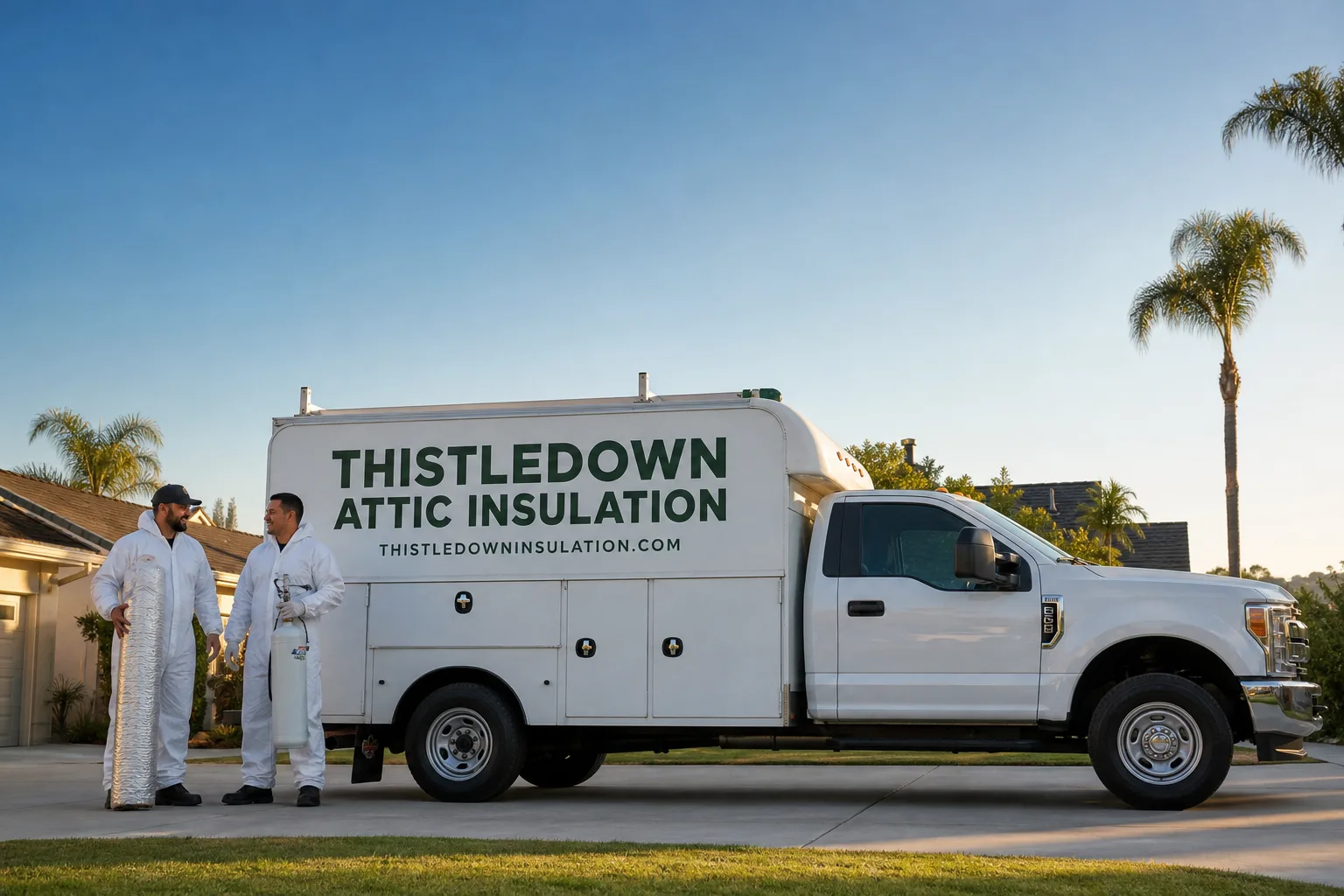
Fast, Reliable Spray Foam Insulation Across Diamond Bar
Spray foam insulation in Diamond Bar isn’t a luxury add-on. It’s the single most effective fix for homes built between the late 1950s and 1980s that are now fighting 100-degree summers with R-11 wall batts and settled attic fill. Most Diamond Bar homes were framed and insulated to standards that wouldn’t pass a Title 24 inspection today. Our crews work throughout Diamond Bar weekly, from the ridgelines above Summitridge Park to the split-levels off Diamond Bar Boulevard, and we’ll have a written price in your hand before any foam leaves the rig. Call (909) 768-6501 and a live person picks up, day or night.
Why Thistledown Attic Insulation Is Diamond Bar’s Preferred Spray Foam Insulation Company
Diamond Bar homeowners keep calling us back because we treat the house like it’s our own. That’s not a slogan. It’s the Cedarwell Care Promise: shoe covers at the front door, drop cloths across the hallway, a photo of the clean-up before we leave. Our technicians are background-checked and uniformed, so you know exactly who’s walking past the kids’ rooms. Neil Barron, who leads the Thistledown team, insists on one rule above all: the written price comes first. Not an estimate range. Not a ballpark. A number on paper before we touch a rafter.
We also know Diamond Bar’s hills. The homes up here aren’t like the flat-lot construction in Walnut or Chino Hills. Split-level attics, kneewalls with odd angles, rim joists sealed into hillside foundations – these are the houses we work on every week. And because we stock products from Owens Corning and Demilec locally, we’re not waiting on a warehouse in another county when your attic is cooking at 155°F.
Crawl Space Spray Foam Insulation in Diamond Bar
Crawl Space Spray Foam Insulation in Diamond Bar is one of the most overlooked upgrades in this city’s older homes, and it’s also one of the highest-ROI fixes we do. Many 1960s and 70s tract homes off Diamond Bar Boulevard and in the neighborhoods near Lorbeer Middle School were built with vented crawl spaces that now draft cold air up through the floor joists every winter night when temperatures dip into the mid-30s. Spraying closed-cell foam across the subfloor and rim joists seals those pathways and keeps the living space above dramatically warmer. In Diamond Bar’s market, a typical crawl space sealing project runs $2,800 to $6,500 depending on square footage and access.
Hillside Foundation Rim Joists
Homes built into the Puente Hills often have a rim joist system that’s partially buried or hard-banded against the hillside. These junctions leak air all year, and they’re prime spots for closed-cell foam. We see the difference immediately: floors stop feeling cold in January, and the HVAC doesn’t run as long on summer afternoons.
Crawl Space Off-Gassing Concerns
One failure we see in older Diamond Bar tract homes is standard open-cell foam applied in poorly ventilated crawl spaces, which leads to odor complaints that linger for weeks. We specify Demilec closed-cell for these applications because the formulation and cure profile suit tight, low-airflow spaces. It’s a product choice that matters.
Garage Spray Foam Insulation in Diamond Bar
Garage Spray Foam Insulation in Diamond Bar is the answer for homeowners with attached garages that turn into ovens by 2 PM and bake the rooms above them. In Diamond Bar specifically, the hilltop and ridge-sited homes with full western exposure see attic temperatures exceeding 150°F in July and August. An uninsulated garage ceiling transmits that heat straight into bedrooms and bonus rooms overhead. We spray closed-cell foam directly onto the garage ceiling and the shared wall between garage and living space. Typical cost for a two-car garage ceiling in Diamond Bar runs $1,900 to $4,200.
Garage Ceiling vs. Roof Deck
Attached garages benefit from a different approach than spray foam roof decks. We foam the ceiling plane, not the roofline, keeping the garage itself as a buffer zone while stopping heat from climbing into conditioned space above. This is standard practice for Diamond Bar homes built in the 1970s and 80s with bonus rooms over the garage.
Kneewall Sealing at the Garage Transition
Where the garage meets the main attic, irregular kneewalls and sloped transitions are common in split-level Diamond Bar homes. These seams are where hot air pours through. Closed-cell foam seals them completely, including the uneven surfaces that batts can’t handle.
Trusted Brands We Service in Diamond Bar
We install and service spray foam systems from Owens Corning, Johns Manville, Knauf, Rockwool, CertainTeed, Icynene, Demilec, and GreenFiber. That matters in Diamond Bar because the right product changes with your home’s architecture. A hilltop home with 150°F attic exposure needs a high-temp formulation like Icynene or Demilec closed-cell, not a generic open-cell from a one-brand installer. We keep local stock ready for Diamond Bar jobs, so when a ridge-sited home needs a foam that won’t shrink and crack under full southern exposure, we’re not waiting on shipping. For more detail on our full Spray Foam Insulation service line, see how each product fits different housing types.
Common Spray Foam Insulation Problems We See in Diamond Bar Homes
- Foam shrinkage and cracking on ridge-sited attics. When summer attic temperatures push past 150°F, standard open-cell foam can degrade, shrink, and crack, reopening air leaks exactly where the heat enters. We see this most on homes along the ridgelines north of the 60 freeway with little tree canopy.
- Off-gassing and odor complaints in older tract homes. Homes built in the 1960s and 70s often have poorly ventilated crawl spaces, and applying standard open-cell foam down there produces odors that drag on for weeks. Closed-cell Demilec is the safer specification.
- Adhesion failure on dusty, irregular attic surfaces. Decades of dust and irregular framing in 1960s-era Diamond Bar attics means spray foam won’t bond properly unless the surface is prepped first. A crew that skips prep is a crew you’ll call back.
- Santa Ana wind infiltration through the original building envelope. The canyons and ridgelines around Diamond Bar funnel Santa Ana winds straight into homes with deteriorated original insulation, and spray foam applied at the roofline and rim joists is the most effective air seal against it.
Pricing for Spray Foam Insulation in Diamond Bar, CA
Spray foam insulation pricing in Diamond Bar runs higher than flatland cities because the hillside geometry and older housing stock demand more prep and more product. Here’s what we’re seeing in this market: open-cell attic applications run $4,500 to $9,800; closed-cell attic and roof deck applications run $7,000 to $15,000; rim joist sealing runs $1,200 to $3,000; garage ceiling work runs $1,900 to $4,200; crawl space sealing runs $2,800 to $6,500. Every one of these comes with a written price before we start, and the 365-Day Done Right Promise behind it. Call (909) 768-6501 for a free estimate. No surprise line items. Ever.
We Also Serve Cities Near Diamond Bar
Our crews cover Diamond Bar plus Walnut, Pomona, Chino Hills, and Rowland Heights. If you’re just over the city line, the same written-price guarantee and same-day response still apply. Learn more about how we serve Spray Foam Insulation in Diamond Bar and the surrounding neighborhoods here.
Serving Diamond Bar, CA - Our Local Coverage Area
We’re based in the Diamond Bar area and know this community well. Use the map below to see our service coverage - if you’re nearby, we can almost certainly help.
FAQs About Spray Foam Insulation in Diamond Bar
Diamond Bar’s hillside and ridge-sited homes see attic temperatures above 150°F every summer, and standard open-cell foam was never built for that kind of sustained thermal load on irregular rooflines. Foam shrinks, cracks, and off-gasses, reopening the air leaks you paid to close. That’s exactly why we specify high-temp closed-cell formulations like Icynene and Demilec for these homes. Call (909) 768-6501 for an exact recommendation.
Yes. Spray foam is the most effective air-sealing material we install, and it’s especially useful on Diamond Bar’s canyon and ridgeline homes where Santa Ana winds push straight through the original 1960s-era building envelope. Applying closed-cell foam at the roofline, kneewalls, and rim joists blocks those wind-driven drafts. Get a written quote by calling (909) 768-6501.
Closed-cell spray foam is the right specification for most Diamond Bar homes from this era because it bonds directly to the irregular, dusty surfaces that make batt or blown-in insulation fail. It also adds structural rigidity to older framing and handles the 150°F attic temperatures on ridge-sited exposures. We stock Owens Corning, Demilec, and Icynene formulations specifically for these conditions. Call (909) 768-6501 to talk through your attic’s specific geometry.
Garage spray foam targets the ceiling plane and the shared wall between garage and living space, not the roofline above. In Diamond Bar’s single-family tract homes, especially those with bonus rooms over the garage, we’re sealing heat at the point of transfer rather than conditioning an unheated garage. Typical cost runs $1,900 to $4,200. Call (909) 768-6501 for an exact number.
Not always, but it’s recommended. Radiant barrier works alongside spray foam on hilltop and ridge-sited Diamond Bar homes with full southern or western exposure, where attic temperatures routinely exceed 150°F. We pair the two when the roofline geometry supports it. A free assessment will tell you whether it’s needed for your specific home. Call (909) 768-6501.
Why This Page Is Different
Here’s the thing most spray foam guides won’t tell you about Diamond Bar: this city’s homes were built for a coastal climate that doesn’t exist here. The master-planned tracts of the 1960s through the 1980s used R-11 and R-13 wall batts and thin attic layers, assuming a mild Southern California weather pattern. But the Pomona Valley’s inland heat corridor regularly pushes summer highs 15 to 25 degrees hotter than coastal communities just 30 miles west, and Santa Ana events drive wind through aging building envelopes every fall. A generic spray foam job that works in a flat, shaded community will fail on a Diamond Bar ridgeline. The foam has to be engineered for the thermal load, the hillside geometry, and the specific failure modes this city’s housing stock produces. That’s not marketing. It’s physics, and it’s the reason we spec high-temp closed-cell foam here as standard practice.
Last summer, our crew was called to a hillside home off Diamond Bar Boulevard where the attic was hitting 155°F by 2 PM. The homeowner had previously blown in GreenFiber cellulose, but it had settled and was letting hot air pour through the old R-11 wall batts. We removed the degraded material and sprayed Icynene closed-cell foam across the roofline and kneewalls, sealing the irregular geometry of the split-level attic. The result was a 22°F drop in attic temperature and a noticeable reduction in HVAC runtime that evening. That’s what we mean by a Diamond Bar-specific specification.
Call Thistledown for Spray Foam Insulation in Diamond Bar, CA
If your Diamond Bar home is fighting the heat with 1960s-era insulation, we’re ready to look at it. Every job starts with a written price. Every visit includes shoe covers, drop cloths, and a photo of the clean-up before we leave. Every product is matched to your attic’s specific geometry and thermal exposure, not pulled off a generic shelf. And every job is backed by the 365-Day Done Right Promise: if it’s not done right, we make it right. No debate. No fine print. Call (909) 768-6501 now and talk to a live person. We answer 24/7.
Written by Neil Barron, Owner at Thistledown Attic Insulation, serving Diamond Bar and the surrounding cities.