
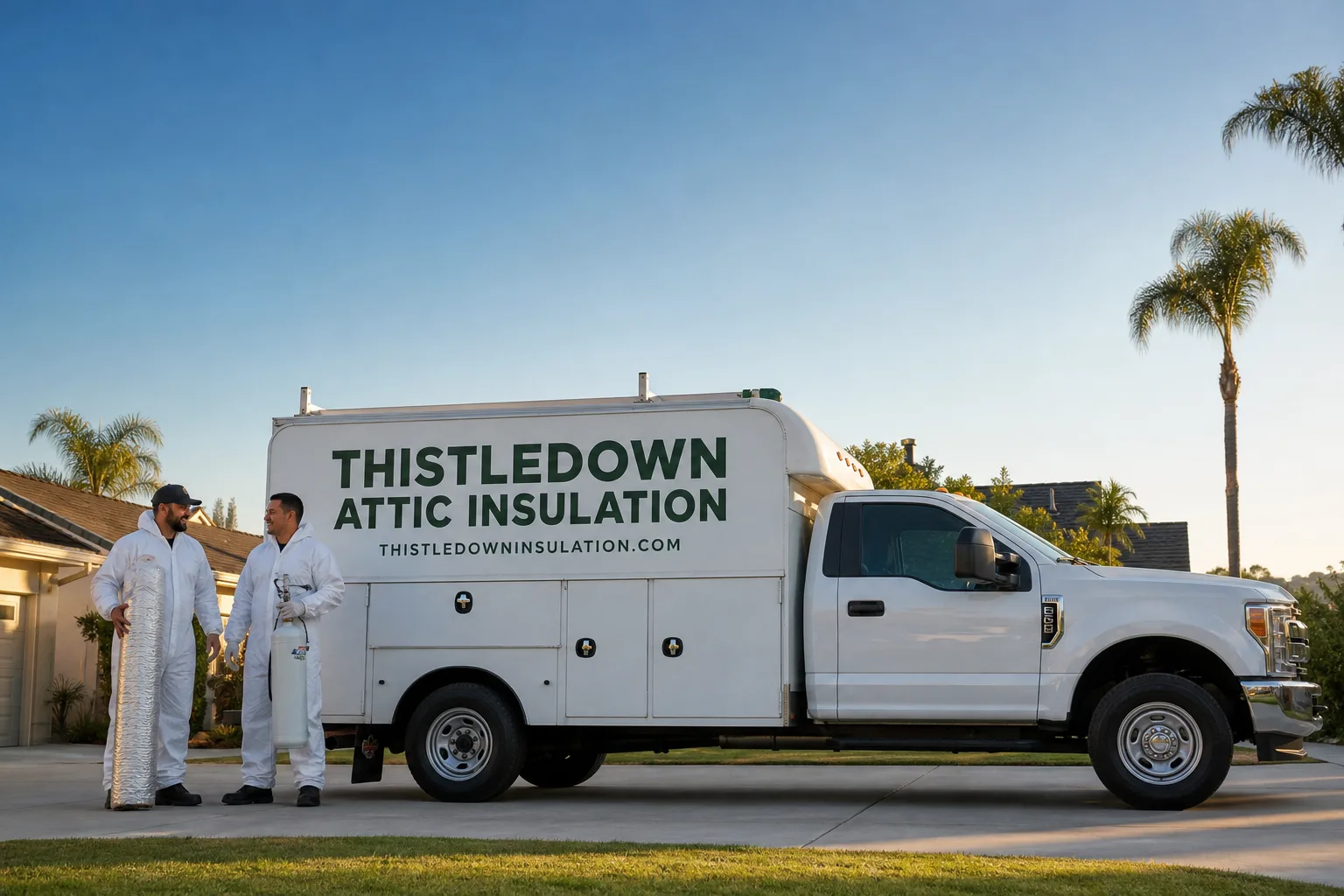
Fast, Reliable Spray Foam Insulation Across East Whittier
Spray foam insulation in East Whittier typically costs $3.50 to $7.50 per square foot installed, depending on whether you’re sealing an attic, rim joists, or a garage ceiling. Most East Whittier homes we see were built between 1950 and 1975, which means attics with settled fiberglass at R-9 to R-11 and wall cavities that were never insulated under the energy codes we have today. You’ll get a written price before anyone picks up a tool, and our crews are on site throughout East Whittier most weeks – call (909) 768-6501 and a live person answers.
Why Thistledown Attic Insulation Is East Whittier’s Preferred Spray Foam Insulation Company
East Whittier homes ask more of insulation than most people realize. The Puente Hills sit directly to the south and west, cutting off the marine layer that keeps coastal LA neighborhoods mild. That means attic temperatures here climb past 150°F in July and August, and the air inside those attics stays dry – two conditions that change how spray foam should be applied. Most insulation crews treat East Whittier like any other LA suburb. We don’t, because we’ve spent enough time in these ranch tracts to know the difference.
Every Thistledown crew member is background-checked and uniformed, so you know exactly who is walking through your front door. We lay drop cloths across your hallway, wear shoe covers from the entry to the attic hatch, and leave a photo of the clean-up before the van pulls away. That’s the Cedarwell Care Promise, and it’s non-negotiable on every job. Neil Barron has built our team around a simple standard: explain the price before the work, protect the home during the work, and stand behind the result for a full year with our 365-Day Done Right Promise.
Spray Foam Insulation Contractors in East Whittier
Spray Foam Insulation Contractors working in East Whittier have to understand county permitting, salt-air corrosion, and the specific failure patterns of 1950s-1970s ranch construction. Our spray foam crews start every East Whittier project by inspecting the existing attic condition – settled fiberglass, roof deck fasteners, and any sign of moisture or rodent activity – before choosing the foam system. Because East Whittier is unincorporated LA County, any spray foam insulation project that requires a permit goes through LA County Building & Safety, not a city office. That means different forms, longer review cycles, and county inspector scheduling. We handle that paperwork for you.
Closed-Cell Base Coat for East Whittier Heat
Open-cell foam sprayed in a single thick pass during an East Whittier summer heat spike cures with a crusted, brittle top layer. The blowing agent flashes too fast in a 150°F, low-humidity attic. We solve this with a thin closed-cell Demilec base coat that cures slower, then build open-cell Icynene on top. It’s a two-step process that most contractors skip because it takes more time – but it’s the only way to get a stable, long-lasting seal in this climate.
The salt-air exposure that rusts garage door opener chains along Mulberry Drive and La Subida also attacks attic roof deck fasteners. We inspect those before any foam touches the deck. Foam over rusted or oil-contaminated metal delaminates within a season or two. We’d rather tell you what we found and fix it before we seal it in.
Spray Foam Attic Insulation in East Whittier
Spray Foam Attic Insulation in East Whittier homes usually targets the attic first, because that’s where heat concentrates and where energy loss is most concentrated in a single-story ranch. Most East Whittier attics we open have settled fiberglass batts at R-9 to R-11 – well below today’s standards – and uninsulated wall cavities that let heat radiate through drywall all afternoon. A typical attic spray foam job in East Whittier runs $4,000 to $9,000 depending on square footage and whether we’re doing open-cell between joists or full closed-cell at the roofline.
Bringing R-9 Attics Up to R-30 and Beyond
We got a call from a 1962 stucco ranch off Mulberry Drive, near the East Whittier City School District boundary. The homeowner’s attic fiberglass had settled to about R-9, and the garage door opener chain was already rust-orange from years of salt-air exposure – the same corrosion that had eaten into the metal roof deck fasteners. We first replaced the failing opener chain with a stainless unit, then applied a 2-inch closed-cell Demilec base coat across the rafters before blowing open-cell Icynene between the joists to bring the attic to about R-30. After the foam cured, the homeowner’s summer garage temperature dropped roughly 15°F and the new chain showed no corrosion during our 90-day follow-up.
For raised-floor homes on the older parcels, we often find uninsulated crawl spaces adding a second thermal bypass. Rim joist spray foam closes that gap, and we’ll point it out during the estimate – with a written price for that work too, so you decide before we start.
Trusted Brands We Service in East Whittier
We install Spray Foam Insulation using products from eight manufacturers, including Owens Corning, Johns Manville, and Icynene. For East Whittier specifically, we stock Demilec closed-cell foam locally because it handles the low-humidity, high-heat attics here better than faster-curing alternatives. GreenFiber and Knauf round out the selection when a pet-safe or budget-conscious option fits the job better. You get a specific product recommendation based on your attic’s condition and your family’s needs – not whatever foam happens to be on the truck that day.
Common Spray Foam Insulation Problems We See in East Whittier Homes
- Crusted open-cell foam from summer heat spikes. Single-pass open-cell applications in 150°F low-humidity attics flash too fast, creating a brittle crust that cracks within months. We fix this with a slower-curing closed-cell base layer.
- Foam delamination over rusted roof decks. Salt air from the Pacific corridor rusts metal roof deck fasteners, and foam applied over that corrosion loses its bond within one or two seasons. Every East Whittier job starts with a corrosion inspection.
- Foam over settled R-11 fiberglass. Spraying foam without removing or correcting the old settled batt traps dust, rodent debris, and odors beneath the new layer. We address the existing attic condition before any foam is applied.
- County permitting confusion. East Whittier is unincorporated, so permits go through LA County Building & Safety – a different process than incorporated Whittier or La Habra. Homeowners who try to handle this themselves often hit unexpected delays.
Pricing for Spray Foam Insulation in East Whittier, CA
Attic spray foam insulation in East Whittier runs $4,000 to $9,000 for most single-story ranch homes. Rim joist spray foam typically runs $1,200 to $2,800. Garage ceiling spray foam runs $1,500 to $3,500 depending on whether we’re sealing an attached garage ceiling or the band joists above it. Open-cell foam costs $3.50 to $5.00 per square foot installed; closed-cell runs $5.00 to $7.50. These are the prices for this housing stock, at this heat load, with the product choices we recommend for East Whittier attics. You’ll have your exact written number before any foam is sprayed. Call (909) 768-6501 for a free estimate.
We Also Serve Cities Near East Whittier
Our East Whittier crews regularly work in the surrounding communities. If you’re in Los Angeles, San Diego, San Jose, or San Francisco and need spray foam insulation installed to the same standard – written price, clean floors, and a 365-day guarantee – we can schedule your job with the same attention to detail.
Serving East Whittier, CA - Our Local Coverage Area
We’re based in the East Whittier area and know this community well. Use the map below to see our service coverage - if you’re nearby, we can almost certainly help.
FAQs About Spray Foam Insulation in East Whittier
Yes. Salt air from the Pacific corridor corrodes metal roof deck fasteners and garage door hardware, and spray foam applied over that corrosion delaminates within one or two seasons. Every East Whittier spray foam job starts with a corrosion inspection, and we recommend stainless replacement hardware where the rust has already set in. Call (909) 768-6501 to schedule an inspection – estimates are free.
Because East Whittier sits in the Puente Hills rain shadow, attic temperatures pass 150°F in summer while humidity stays low. Open-cell foam’s blowing agent flashes too fast in those conditions, leaving a crusted, brittle top layer that cracks and opens air paths. We use a slower-curing closed-cell base coat before building up open-cell, which prevents the crust from forming at all.
Some do, and because East Whittier is unincorporated, those permits go through LA County Building & Safety rather than a city office. County permitting has different forms, longer cycle times, and inspector scheduling through the county. We handle the permitting process for you and will tell you during the estimate whether your project needs it.
A typical East Whittier ranch attic tests at R-9 to R-11 due to settled fiberglass. A closed-cell base coat plus open-cell build-up brings attics to R-30 or higher, and closed-cell at the roofline can reach R-38 to R-49 depending on rafter depth. The difference in attic temperature is immediate – we’ve measured 15°F summer drops after a single job.
Yes. Salt-air exposure rusts garage door opener chains, hinges, and springs faster in East Whittier than inland cities. If your attic hatch is in the garage, we’ll inspect that hardware during the estimate. The fix is simple – galvanized or stainless replacement parts – and it’s better to catch it before foam seals the attic and makes future access harder.
Written by Neil Barron, Owner at Thistledown Attic Insulation, serving East Whittier with spray foam and attic insulation since 2003.
Ready to get a written price for your East Whittier home? Call (909) 768-6501 today – a live person answers, 24 hours a day, 7 days a week. We’ll schedule your free estimate, walk you through the exact product we recommend for your attic, and put the number in writing before any work begins. Shoe covers on, drop cloths down, photo of the clean-up before we leave. That’s how every Thistledown job works.