
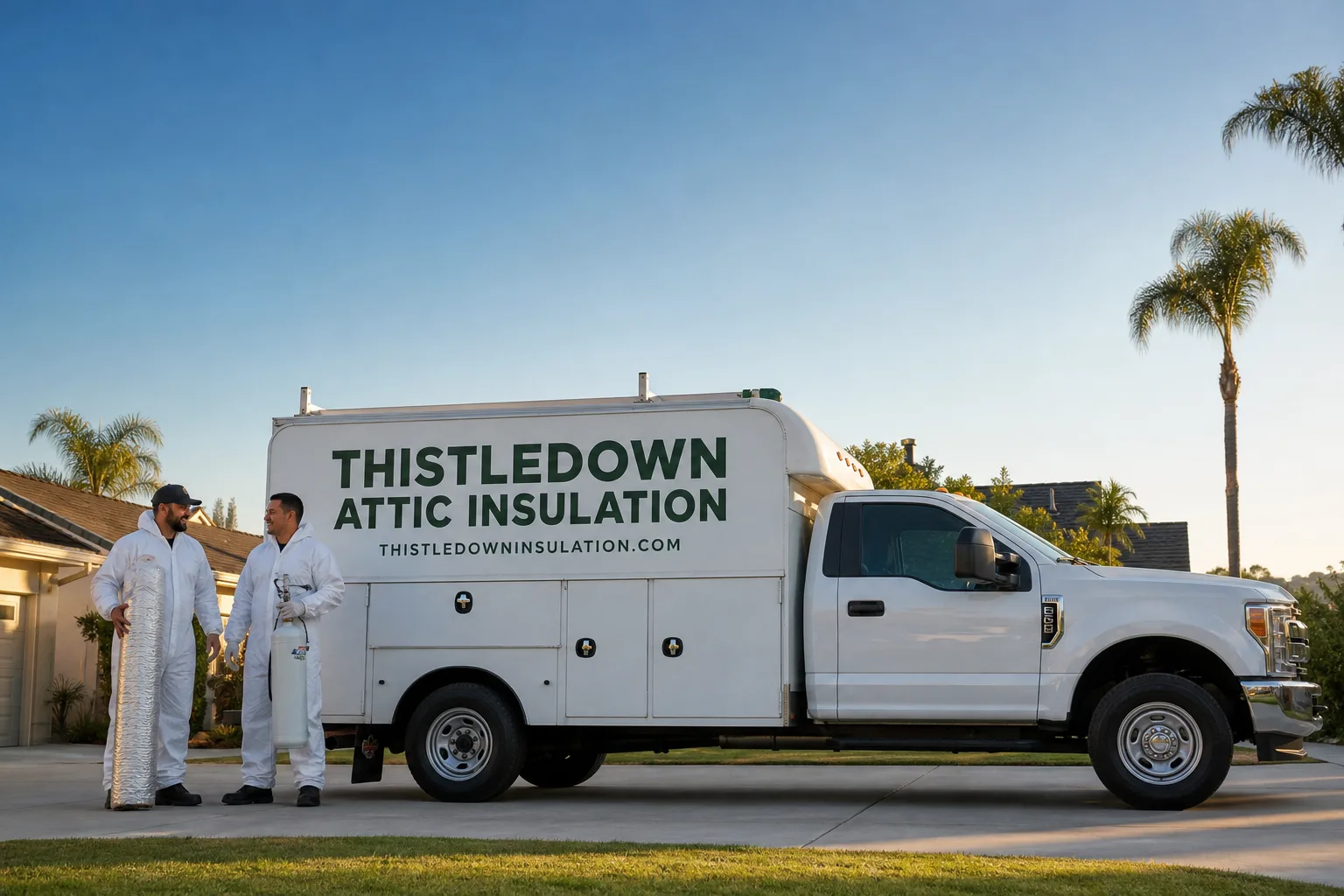
Fast, Reliable Spray Foam Insulation Across Eastvale
If you own a home in Eastvale built between 2004 and 2016, your attic was insulated to a Title 24 code that is now two cycles out of date. That matters because attic temperatures here routinely pass 150°F in July and August. We install Spray Foam Insulation that seals the builder-era flaws in Eastvale’s tract homes and brings the thermal envelope up to what the climate actually demands. Crews reach most Eastvale neighborhoods within 60 to 90 minutes from our Inland Empire dispatch office. For a free written estimate, call (909) 768-6501.
Why Thistledown Attic Insulation Is Eastvale’s Preferred Spray Foam Insulation Company
Eastvale homeowners tend to know their neighbors, and word travels fast when a crew leaves shoe covers on, drop cloths down, and a photo of the clean-up before pulling away. That’s how we’ve built our name here. Neil Barron leads our team, and he holds every job to the Cedarwell Care Promise: clean up like it’s our own home, ask before we move anything, respect quiet hours, and explain the price before the work. On a recent job off Hamner Avenue, the homeowner watched us air-seal recessed cans that had been leaking attic heat into the upstairs hallway for a decade. They called us back two weeks later for their garage ceiling.
Every visit includes background-checked, uniformed technicians. You know exactly who is walking through your front door. You get a written price before we touch anything. And if it’s not done right, the 365-Day Done Right Promise means we make it right, no debate. Call (909) 768-6501 and a live person answers, 24 hours a day.
Spray Foam Insulation Contractors in Eastvale
Spray Foam Insulation Contractors in Eastvale work with a housing stock that is nearly uniform in age and construction method. Your home was likely built by a volume builder during the mid-2000s to mid-2010s boom, which means the attic has settled blown fiberglass or batt insulation at code minimums, unsealed top-plate penetrations, and no radiant barrier. Our job is to correct what the original builder passed inspection on but never actually optimized for the Chino Valley heat. A typical Eastvale spray foam project runs $3,200 to $9,800 depending on square footage and whether we’re doing the attic floor, the roof deck, or both.
Open-Cell and Closed-Cell Applications
Open-cell foam expands to fill gaps and is excellent for sound dampening between floors in two-story Eastvale homes. Closed-cell foam adds structural rigidity and a vapor barrier, which matters when we’re flashing the underside of a roof deck on a 2010 tract home that had zero radiant barrier installed originally. We match the product to the house, not the other way around.
Rim Joist and Garage Ceiling Work
Rim joists are the single biggest air-leak point in a two-story Eastvale home’s framing. We spray them from the inside, sealing the gap between the floor system and the foundation wall. Garage ceiling spray foam is increasingly popular in Eastvale because so many homeowners have converted garages into home offices, gyms, or playrooms, and a 105°F summer day turns an uninsulated garage into an oven by noon.
Spray Foam Attic Insulation in Eastvale
Spray Foam Attic Insulation in Eastvale means treating the attic as a conditioned space rather than a vented afterthought. In a city where nearly every home is the same two-story tract style with 2,500 to 4,000 square feet under a dark shingle roof, the attic is the single largest thermal liability. We typically spray the attic floor with open-cell foam to a depth that reaches current code R-values, or we flash the roof deck with closed-cell foam to create a fully conditioned attic. Attic floor spray foam in Eastvale runs $3,000 to $7,500 for a typical two-story home. Roof deck work runs $6,500 to $14,000.
Air-Sealing Before Foam
No amount of foam fixes an unsealed recessed can light. Before we spray, we locate every penetration: HVAC boots, can lights, wire chases, top plates. Then we seal them. Then the foam goes down. Skipping step one is why some Eastvale homeowners still get a hot upstairs after an insulation job that should have solved it.
Radiant Barrier Considerations
Eastvale homes from this era almost never got radiant barriers. If your attic is vented and we’re spraying the floor, adding a radiant barrier to the underside of the roof deck can cut radiant heat gain by up to 40%, which keeps the attic air temperature down and reduces the cooling load on the foam itself.
Trusted Brands We Service in Eastvale
We install Owens Corning, Johns Manville, Knauf, Rockwool, CertainTeed, Icynene, Demilec, and GreenFiber products. For Eastvale homes, we most often reach for Icynene closed-cell for roof deck work and Johns Manville open-cell for attic floors. We keep the common accessory stock for each brand on our trucks, so when we quote a Monday job, we have the material to start Monday. No waiting on a distributor shipment in Riverside. Ask us about pet-safe product options where a choice exists. We’ll tell you exactly what’s going into your attic and what it means for the air your kids and your dog breathe.
Common Spray Foam Insulation Problems We See in Eastvale Homes
- Unsealed recessed can lights through the top plate. The single most common builder-cut corner in Eastvale’s 2004 to 2016 housing stock. Six-inch cans punched through framing and never air-sealed create a direct chimney from the living room to a 150°F attic. We find this flaw house after house, street after street.
- Settled original batt insulation. The R-13 fiberglass installed when Eastvale was built has compressed and settled, leaving ceiling zones far below current code minimums. The upstairs bedrooms, in particular, fight a losing battle against afternoon heat radiating through a dark-shingled roof.
- Missing radiant barriers. Original construction in Eastvale rarely included them, which means the roof deck absorbs full solar load and radiates it into the attic space. Spray foam without a radiant barrier fix is a partial solution, and we’ll tell you that honestly.
- Foam over unsealed penetrations. Some contractors spray right over the gaps. That traps the leak instead of stopping it. We see this on retrofit jobs where a previous company skipped the air-sealing step. Air sealing always comes first.
Pricing for Spray Foam Insulation in Eastvale, CA
Here’s what you can expect to pay in Eastvale for spray foam work. Attic floor open-cell spray foam runs $3,000 to $7,500 for a typical 2,800 to 3,500 square foot two-story home. Roof deck closed-cell flashing runs $6,500 to $14,000 depending on roofline complexity and access. Rim joist spray foam runs $1,800 to $4,200. Garage ceiling work runs $1,400 to $3,100. The variables are square footage, access clearance in the attic, and whether existing insulation needs removal first. You get a written price before we start. No ranges that balloon, no “we’ll see when we get in there.” Call (909) 768-6501 for a free estimate, and you’ll have the number on paper before anyone touches a rafter.
We Also Serve Cities Near Eastvale
Our crews regularly work in Eastvale and the surrounding Inland Empire communities, and we take projects in Los Angeles, San Diego, San Jose, and San Francisco when the job requires our particular approach to builder-era air sealing. Wherever we work, the same Cedarwell Care Promise applies: shoe covers, drop cloths, written pricing, and a clean-up photo before we leave.
Serving Eastvale, CA - Our Local Coverage Area
We’re based in the Eastvale area and know this community well. Use the map below to see our service coverage - if you’re nearby, we can almost certainly help.
FAQs About Spray Foam Insulation in Eastvale
Because Eastvale’s homes share a builder-era defect that blown insulation can’t fix: unsealed recessed can lights and top-plate penetrations that actively pull 150°F attic air into the living space. Adding more blown fiberglass on top of those leaks just buries them. Spray foam air-seals first, then insulates, which addresses both the conductive and convective heat gain. Call (909) 768-6501 and we’ll explain what’s above your upstairs hallway before we quote it.
Yes, and it’s the most effective solution for the hot-upstairs problem in Eastvale’s large two-story tract homes. The upstairs is hot because heat rises from the first floor, radiates down from a 150°F attic, and pours through unsealed penetrations around the ceiling. Spray foam on the attic floor or roof deck interrupts that heat path at the source. We see the biggest comfort gains in homes off Schleisman Road and Archibald Avenue where the original batt has settled to half its rated depth.
Since nearly every Eastvale home came from the same builders during the same 2004 to 2016 window, we can predict the framing layout, the rafter spacing, the can-light placement, and the existing insulation depth before we even climb into your attic. That means we arrive knowing which product fits: typically Icynene closed-cell for roof deck flashing on tight attics, and Johns Manville open-cell for attic floors where we need maximum expansion around odd framing details. Predictability keeps your price accurate.
No, when installed correctly for Eastvale’s diurnal climate pattern, spray foam does not cause moisture problems. The concern arises when closed-cell foam is applied directly to the underside of a roof deck in a vented attic without addressing the dew point. Eastvale’s cool winter nights with occasional frost mean we calculate dew point placement during the design, not after the foam is sprayed. We use the right product thickness for the assembly. Done right, closed-cell foam is a vapor barrier that keeps winter moisture out of the roof deck and summer humidity out of the attic.
Yes, and it’s a smart time to do it. If your Eastvale home is still under builder warranty and you’re having an insulation contractor inspect the attic anyway, adding spray foam to rim joists or a garage ceiling is a modest project that pays off immediately. The builder won’t cover air-sealing upgrades, but they also won’t void your warranty for it. We keep the work clean and documented, so you have before and after photos for your records. Call (909) 768-6501 and we’ll walk through what a tune-up in Eastvale typically includes.
Written by Neil Barron, Owner at Thistledown Attic Insulation, serving Eastvale since 2003 through the Cedarwell family of independently owned insulation companies.
Ready to fix what the builder left behind? Call (909) 768-6501 for a free, written spray foam insulation estimate in Eastvale. A live person answers, day or night.