
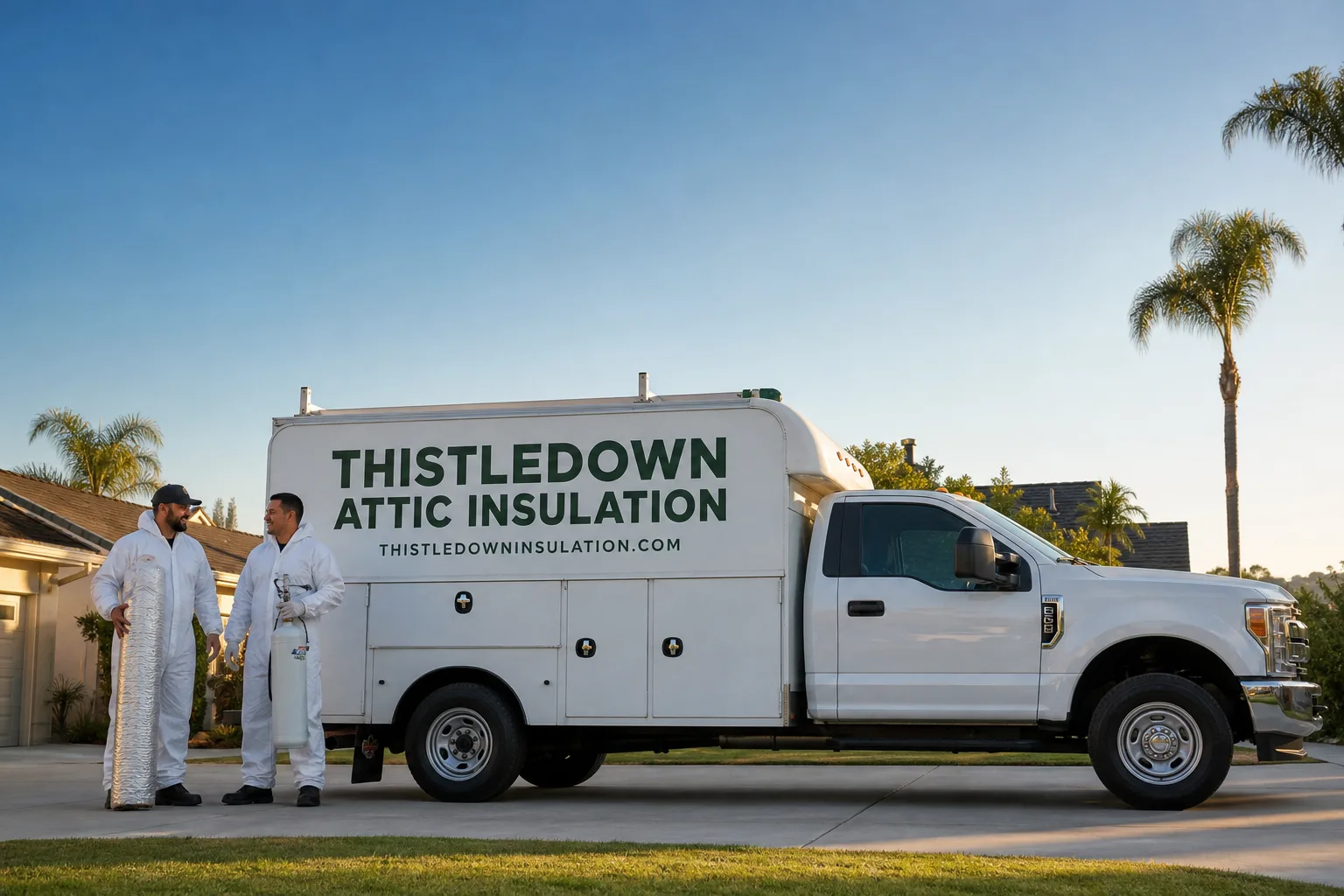
Fast, Reliable Spray Foam Insulation Across Fontana
Spray foam insulation in Fontana typically costs $2.40 – $6.80 per board foot installed, depending on whether you need open-cell or closed-cell foam. Most jobs are completed in one day. Fontana’s heat is unlike what coastal homeowners deal with: attic spaces here routinely exceed 150°F in July and August, and the difference between a properly air-sealed foam job and the original R-19 fiberglass in most local tract homes is the difference between an AC that cycles and an AC that never stops. Call (909) 768-6501 for a written quote before anyone picks up a tool.
We know Fontana’s housing stock because we’re in it every week. The stucco-over-2×4-frame tract homes east of the I-15, the older neighborhoods near the former Kaiser Steel mill site, the newer subdivisions along Sierra Avenue. Each has its own set of attic problems, and we’ve seen most of them more than once.
Why Thistledown Attic Insulation Is Fontana’s Preferred Spray Foam Insulation Company
We’re a Cedarwell-family company offering Fontana Reflectix service, independently owned, and we answer to one standard: the Cedarwell Care Promise. That means shoe covers at the door, drop cloths across your hallway from the front entry to the attic hatch, and a photo of the clean-up before our van leaves your driveway in Fontana. Neil Barron leads our crew, and he holds every technician to the same expectation: clean up like it’s your own home.
The 365-Day Done Right Promise backs every job we do in Fontana. If it’s not done right, we make it right. No debate, no fine print. You’ll also get a written price before any work starts, so the number you approve is the number you pay. Our Spray Foam Insulation team carries eight brand lines, which means we match the right product to your attic rather than pushing whatever is on the truck.
Calls are answered by a live person 24/7. When your attic is 150°F and your AC hasn’t cycled off in a week, you’ll talk to a human on the first ring, not a voicemail tree. That matters in Fontana, where heat waves arrive fast and don’t leave quietly.
Spray Foam Wall Insulation in Fontana
Spray Foam Wall Insulation in Fontana’s stucco-over-2×4 framed homes addresses a problem most homeowners never see: unsealed wall cavities that let 110°F outside air slip behind the drywall. The job involves removing a section of exterior stucco or working from the interior drywall side, then applying foam directly into the stud bays where it expands, seals, and bonds. In older Fontana homes with no meaningful wall insulation, this is often the single highest-impact comfort upgrade we can make.
Expect open-cell wall foam to run $2.40 – $4.20 per board foot and closed-cell to run $3.50 – $6.80 per board foot. A typical single-story Fontana exterior wall retrofit lands between $4,800 and $9,500. We’ll give you the exact written number after an attic and wall inspection, never before we’ve actually looked.
How it works in a Fontana home
We access the stud bays through a series of small openings, either from inside or outside depending on your siding and interior finish. The foam expands to fill every void, then we patch and repaint. Drop cloths stay down the whole time, and quiet tools come out if a kid is napping upstairs.
The Fontana heat factor
In Fontana’s Climate Zone 10, a wall that leaks air is a wall that leaks money. Open-cell foam in walls slows that heat gain dramatically, which is why we recommend it so often in the post-1985 tracts. It’s not a luxury here. It’s the difference between a bedroom that stays at 78°F and one that climbs past 85°F on a 108°F day.
Rim Joist Spray Foam in Fontana
Rim Joist Spray Foam in Fontana homes seals the band joist area where the foundation meets the first-floor framing. That thin strip of wood sits directly above the foundation wall, and in most local homes built before 2005 it was never air-sealed or insulated at all. The result is a steady leak of air into and out of the house at the exact point where your floor meets the wall.
Standing in a Fontana garage or crawl space, you can often feel the draft. On winter nights when the temperature dips below 40°F, that rim joist becomes a cold shelf that chills the entire floor above it. Sealing it with closed-cell foam costs $700 – $1,200 for a typical two-story home here and usually takes half a day. It’s one of the fastest paybacks in Fontana insulation work.
A common setup in Fontana basements and crawl spaces
Many Fontana homes have raised foundations with accessible crawl spaces rather than full basements. We spray closed-cell foam directly onto the rim joist from inside the crawl space, covering the entire band area in one pass. The foam seals air leaks and adds R-value in a single step.
Why we pair it with attic work
If you’re already having us foam the attic roofline, adding rim joist foam is a marginal cost with outsized results. Air escaping through the rim joist pulls replacement air down from the attic through interior wall cavities. Seal both ends and the house finally stops acting like a chimney.
Trusted Brands We Service in Fontana
We install products from Owens Corning, Johns Manville, Knauf, Rockwool, Icynene, Demilec, and GreenFiber. For Fontana’s heat profile, we lean on Icynene and Demilec closed-cell formulas for rim joists and rooflines, while open-cell Owens Corning and Johns Manville products work well for interior wall cavities. Because we stock local supplies for quick turnaround in Fontana, we can usually schedule your job within a week of the written estimate. The product gets matched to your attic, your walls, and your family’s sensitivity to chemicals. Not the other way around.
Common Spray Foam Insulation Problems We See in Fontana Homes
- Settled R-19 blown fiberglass in 1980s – 2000s stucco tract homes. The original insulation compacts over decades, dropping from R-19 to around R-11. Worse, the top plates were never air-sealed, so 150°F attic air gets pulled straight into the living space.
- Open bypasses that make air-sealing the real job. Recessed lights, duct chases, and plumbing penetrations all leak. Spray foam applied over these openings without first removing the old insulation and sealing the top plates traps heat instead of stopping it.
- Santa Ana wind infiltration through unsealed rim joists and wall penetrations. Fontana’s location below Cajon Pass funnels high-velocity winds that push through every unsealed gap. A foam job that ignores the rim joist and wall top plates leaves those leaks fully intact, so the house still drafts in winter.
- Hot-weather installation failures from under-equipped crews. In a 150°F Fontana attic, off-ratio chemical mixing or thin foam application causes poor adhesion, curing problems, and lingering odors. We inspect substrate dust and attic temperature before spraying, because the foam needs a clean, stable surface to bond.
Pricing for Spray Foam Insulation in Fontana, CA
Open-cell spray foam in Fontana runs $2.40 – $4.20 per board foot. Closed-cell runs $3.50 – $6.80 per board foot. A typical attic roofline in a 1,800-square-foot Fontana tract home falls between $6,500 and $12,000, and wall cavity retrofits land between $4,800 and $9,500. Rim joist work runs $700 – $1,200. Your exact written price covers material, labor, the full clean-up, and the 365-Day Done Right Promise. We’ll walk the attic with you before quoting, and you’ll have the number in writing before any work starts. Call (909) 768-6501 for a free estimate.
We Also Serve Cities Near Fontana
Our crews work throughout the Inland Empire, including Spray Foam Insulation in Fontana and the surrounding communities. If you’re in Bloomington, Rialto, Rancho Cucamonga, or Riverside, we’ll bring the same written price, shoe covers, and one-day turnaround. Dispatch is coordinated from our Inland Empire office, so scheduling stays fast even for neighborhoods right on the Fontana border.
Serving Fontana, CA - Our Local Coverage Area
We’re based in the Fontana area and know this community well. Use the map below to see our service coverage - if you’re nearby, we can almost certainly help.
FAQs About Spray Foam Insulation in Fontana
Spray foam is better because it air-seals while it insulates. Your existing R-19 fiberglass has likely settled to around R-11 and was never air-sealed at the top plates, which means 150°F attic air has been leaking into your Fontana home for decades. Adding more fiberglass on top of that leaky assembly doesn’t stop the air movement; it just buries the problem under more material. Spray foam, applied after the old insulation is removed and the top plates sealed, stops that air transfer completely. Call (909) 768-6501 and we’ll inspect your attic before quoting anything.
No. We always remove settled fiberglass before foaming. In the Sierra Avenue corridor east of the I-15, our crew foamed the attic roofline of a 1990s stucco two-story where the original R-19 had settled to about R-11 and the top plates were never sealed. Using Icynene spray foam, we air-sealed the bypasses around recessed lights and duct chases that were pulling 150°F attic air into the bedrooms. The homeowner reported their AC no longer ran near-continuously during the next 108°F week. Spraying foam over old fiberglass without removing it and sealing the top plates traps heat instead of stopping it.
Santa Ana winds funneled through Cajon Pass drive air through every unsealed penetration in your walls, rim joists, and attic. A spray foam job that only addresses the attic roofline leaves those wall and rim joist leaks intact, so the house still drafts in winter and still pulls heat in summer. The foam has to reach the rim joists and wall top plates to close those wind-driven pathways. Fontana’s position below the Pass makes air-sealing more critical here than in most of the Inland Empire.
Title 24 Climate Zone 10 requires R-38 minimum in attics, and most Fontana homes from the 1980s – 2000s were built to R-19 or R-22. Closed-cell spray foam delivers roughly R-7 per inch, so 5.5 inches meets the R-38 requirement in a fraction of the depth fiberglass would need. That matters in Fontana’s dense tract homes, where attic clearances are tight and roofline angles are steep. Open-cell foam at R-3.7 per inch needs about 10 inches, which isn’t always possible in low-slope roof assemblies. We measure your actual clearance before recommending a product.
Yes. We work regularly in the original neighborhoods near the former Kaiser Steel mill site and today’s Auto Club Speedway area, where many homes have no meaningful attic insulation at all. These houses often need full air-sealing plus foam from scratch, and the project scope is different than it is in the post-1985 tracts. Call (909) 768-6501 and Neil Barron will schedule an inspection to see exactly what’s behind your walls and above your ceilings.
Written by Neil Barron, Owner at Thistledown Attic Insulation, serving Fontana since 2003.