
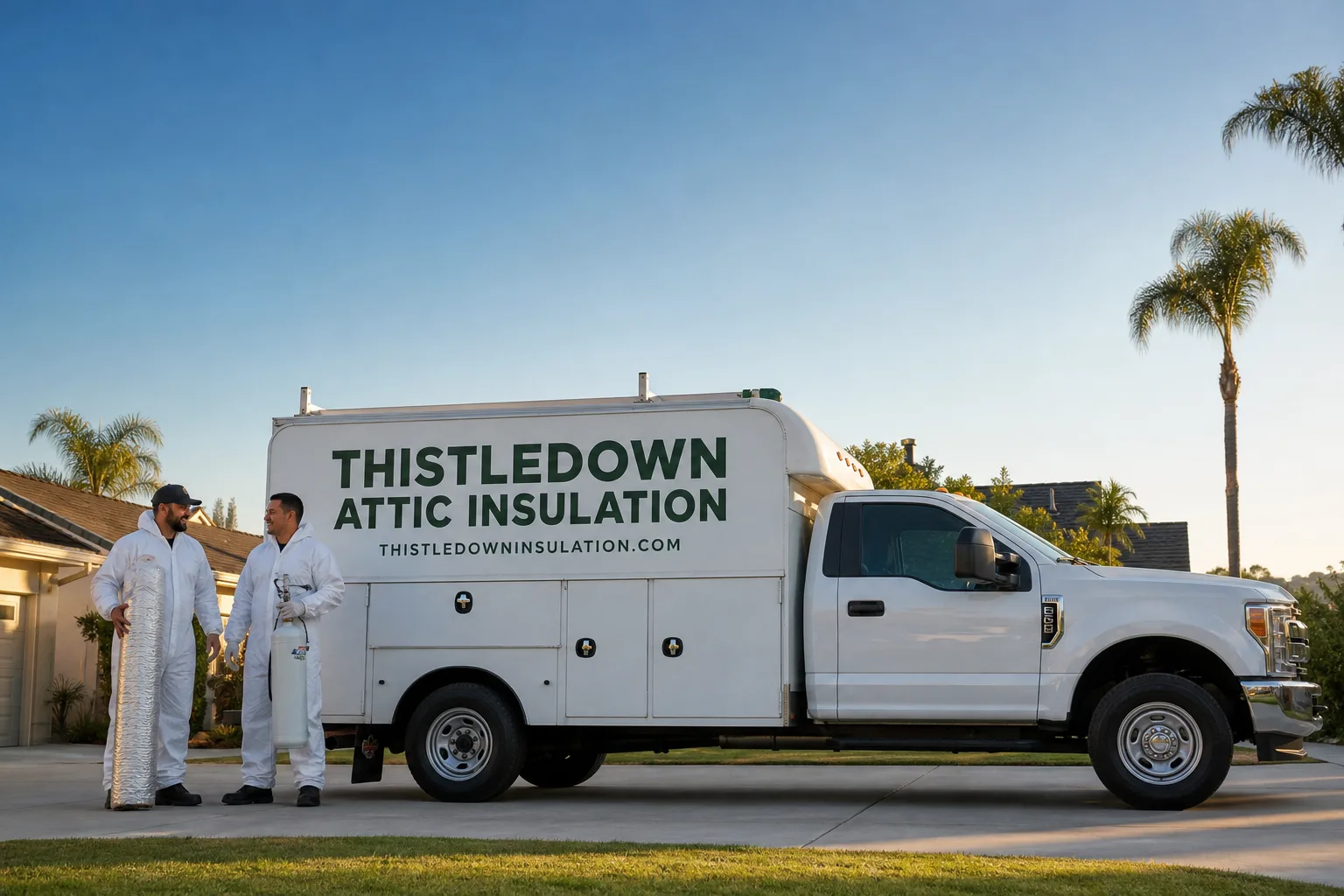
Fast, Reliable Spray Foam Insulation Across Good Hope
Spray foam insulation in Good Hope costs roughly $2,100 to $7,800 for a typical attic or garage project, with full roof-deck applications running higher. The county’s permit process and inspection lead times shape that number more than most other factors. We’re Thistledown Attic Insulation, a Cedarwell-family company, and we work in Good Hope every week. Our crews know the Perris Valley heat, the older tract-home attics, and the Riverside County inspection rhythm. Call (909) 768-6501 and you’ll get a live person, a written price before work starts, and a crew that treats your home like their own.
Why Thistledown Attic Insulation Is Good Hope’s Preferred Spray Foam Insulation Company
Good Hope homeowners don’t ask us to be the cheapest. They ask us to be the crew that shows up clean, explains the foam, and leaves without a trace. Every technician is background-checked and uniformed, and every visit includes shoe covers and drop cloths from the front door to the attic hatch. The 365-Day Done Right Promise backs every job: if it’s not done right, we make it right. No debate, no fine print.
We know this community is unincorporated, which means a permit-triggering insulation job goes through Riverside County Building and Safety, not a local city office. That changes scheduling, inspection timing, and how we plan the spray-to-cure window. Local crews who don’t work Good Hope regularly get surprised by that. We plan around it.
Our call line is answered by a live person 24/7, so when a Good Hope homeowner calls at 7 a.m. before work or 9 p.m. after the kids are down, someone picks up. That matters here. Good Hope is spread out, and nobody wants to leave a voicemail at a call center and hope for a callback.
Spray Foam Insulation Contractors in Good Hope
Spray foam insulation contractors in Good Hope handle two very different jobs: sealing the building envelope and insulating the attic assembly. Most of the homes we service are 1990s-to-2000s tract builds permitted under older Title 24 standards. R-19 batts in the attic. Poorly sealed top plates. Recessed can lights leaking conditioned air straight into a 150°F attic. A competent Good Hope contractor starts with air sealing, then applies the foam.
Open-Cell Versus Closed-Cell
Open-cell foam runs about $0.50 to $1.20 per board foot in Good Hope. It’s softer, more forgiving, and works well on attic floors and rim joists where you need an air barrier more than maximum R-value per inch. Closed-cell runs $1.20 to $2.40 per board foot and adds structural rigidity plus a vapor barrier. On Good Hope roof decks, where the diurnal swing hits 70-plus degrees, closed-cell often makes sense.
Rim Joist and Garage Applications
Slab-on-grade construction is common in Good Hope, so floor insulation is rarely the issue. But rim joists leak. A 2-inch closed-cell rim joist package typically runs $800 to $1,600 depending on perimeter length. Garage ceilings under living space run $1,500 to $3,200. The detached workshops scattered across Good Hope acreage have their own foam needs, which we’ll cover below.
Spray Foam Attic Insulation in Good Hope
Spray foam attic insulation in Good Hope means choosing between a vented attic with foam on the floor or an unvented assembly with foam on the roof deck. Given the Perris Valley’s 105°F summer days and upper-30s winter nights, the roof-deck approach stops heat before it enters the attic at all. A typical 1,400-square-foot Good Hope tract home attic runs $3,400 to $6,900 for closed-cell on the roof deck, or $2,100 to $4,200 for air sealing plus open-cell on the attic floor.
The Roof Deck Option
When we spray the underside of the roof deck, the attic becomes semi-conditioned space. Ductwork stops baking. The furnace doesn’t fight 150°F air. For Good Hope homes with HVAC equipment in the attic, this is often the single biggest comfort upgrade available. We use Icynene closed-cell on most roof decks here because its adhesion holds up to the expansion-contraction cycling this valley dishes out.
The Attic Floor Option
Air sealing first, then open-cell foam over the attic floor, then blown Owens Corning fiberglass to hit target R-value. This is the more economical path and works well when ductwork is in the conditioned envelope or the homeowner plans to replace HVAC later. The key in Good Hope is never spraying foam over old R-19 batts without sealing the bypasses first. Foam seals the surface; it can’t seal what’s underneath it.
Trusted Brands We Service in Good Hope
We install from a range of brands so the product matches the job, not the other way around. Icynene and Demilec are our closed-cell workhorses on Good Hope roof decks. Owens Corning and Johns Manville give us blown and batt options for hybrid assemblies. GreenFiber provides a pet-safe blown-in choice for families who want the dog in the house during the work. We stock the materials Good Hope jobs actually need, and our crews arrive with what the quote promised. No “we’ll be back next week with the rest.”
Common Spray Foam Insulation Problems We See in Good Hope Homes
- Foam sprayed over unsealed bypasses. Production tract homes from the 1990s and 2000s have open top plates, wire penetrations, and recessed cans everywhere. Spray the foam without sealing those first, and the attic still pumps heat into the bedrooms. We air-seal before we spray, every time.
- Open-cell sprayed too thin on roof decks. A thin open-cell pass on a Good Hope roof deck lets the 150°F summer attic keep driving the AC hard, and the winter swing invites condensation on the underside of the deck. We spec the thickness to the assembly, not to the lowest bid.
- Closed-cell adhesion failures in detached workshops. Dusty or unprimed metal or wood decks in a Good Hope workshop can shed closed-cell foam within a season. The valley’s expansion-contraction cycling pulls the foam loose if adhesion was never verified. We check substrate condition before the pour.
- Ignoring the county inspection timeline. Good Hope is unincorporated, so Riverside County Building and Safety handles inspections. Their inspectors cover a wide rural territory. Homeowners who book late and expect a same-week sign-off get frustrated. We plan the two-week spray-to-inspection window around that reality from day one.
Pricing for Spray Foam Insulation in Good Hope, CA
Here’s what Good Hope homeowners can expect to pay, based on the jobs we bid most often. Rim joist spray foam: $800 to $1,600. Garage ceiling under living space: $1,500 to $3,200. Attic floor air sealing plus open-cell foam: $2,100 to $4,200. Closed-cell roof deck for a 1,400-square-foot attic: $3,400 to $6,900. Detached workshop projects vary widely with square footage and substrate condition; most land between $1,800 and $5,500. You’ll get your exact written number before any foam touches your home. Call (909) 768-6501 for a free estimate, and we’ll tell you what the job needs, not what the truck happens to carry.
We Also Serve Cities Near Good Hope
Our crews work Good Hope and the surrounding territory every week. We regularly send Spray Foam Insulation teams into Los Angeles and San Diego when the job calls for it, and we handle projects in San Jose and San Francisco for clients who know our work from the Inland Empire. If you’re just outside Good Hope, call and ask. We’ll tell you straight if we can get a crew to you this week.
Serving Good Hope, CA - Our Local Coverage Area
We’re based in the Good Hope area and know this community well. Use the map below to see our service coverage - if you’re nearby, we can almost certainly help.
FAQs About Spray Foam Insulation in Good Hope
Yes, in most cases. Good Hope is unincorporated Riverside County, so any spray foam job that changes the building envelope or triggers a building inspection routes through Riverside County Building and Safety. We handle the permit paperwork, and we plan the spray-to-inspection window around the county’s rural scheduling lead times. Call (909) 768-6501 and we’ll tell you whether your specific project needs a permit before you spend a dollar.
No, not if the attic bypasses are still open. A 1990s Good Hope tract home has top plates, wire penetrations, and recessed cans leaking conditioned air into the attic. Foam over the surface helps, but the bypasses keep leaking. We air-seal first, then spray. That sequence is what actually moves the needle on summer heat gain. One crew, one trip, one written price.
Good Hope’s Perris Valley climate swings from 105°F summer highs to upper-30s winter nights, a 70-degree diurnal range. That favors closed-cell foam on roof decks because it holds its adhesion through repeated expansion and contraction. Open-cell works well on attic floors and rim joists where the thermal stress is lower. We match the foam to the surface and the season, not a one-size-fits-all spec.
Yes, and we do it regularly. Good Hope acreage is full of detached workshops and garages with metal or wood decks, dust, and no primer. We check substrate condition before spraying, because closed-cell foam that hasn’t verified adhesion will pull loose within a season in this valley’s thermal cycling. Written price first, background-checked uniformed crew at your gate, photo of the clean-up before we leave.
Two to four weeks is comfortable, mostly because of the county inspection lead time. Riverside County Building and Safety inspectors cover a large rural territory, so a same-week sign-off is rare. We’ll give you a realistic timeline when you call, and the 365-Day Done Right Promise means the calendar never rushes the work. Call (909) 768-6501 and we’ll walk you through the schedule for your specific project.
Written by Neil Barron, Owner at Thistledown Attic Insulation, serving Good Hope as part of the Cedarwell family since 2003.
Ready for a written price and a clean job? Call Thistledown Attic Insulation at (909) 768-6501. A live person answers, day or night. Shoe covers on at the door, photo of the clean-up before the van pulls away, and a number in writing before we touch your attic.