
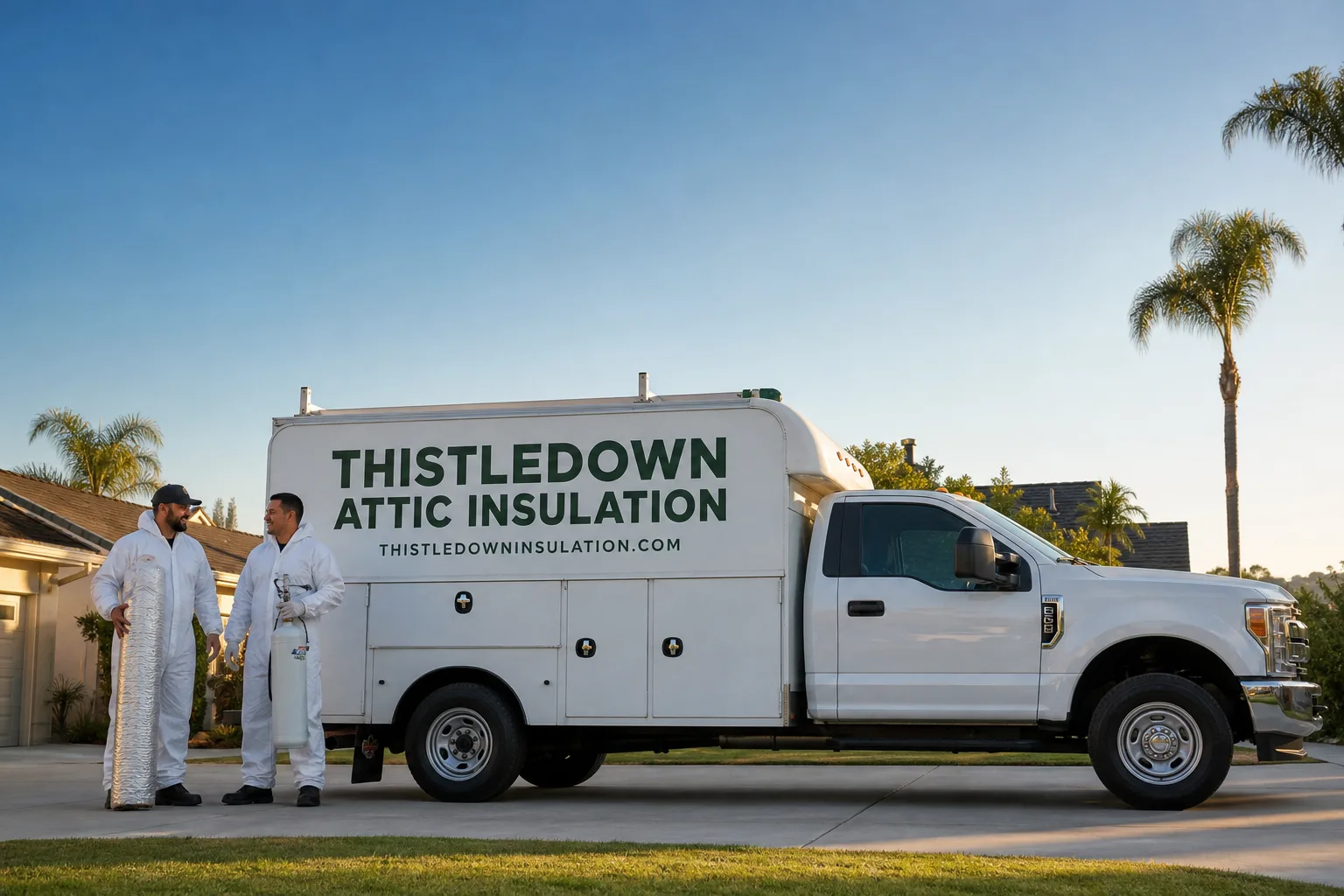
Fast, Reliable Spray Foam Insulation Across Simi Valley
Spray foam insulation in Simi Valley does different work than it does in Moorpark or Thousand Oaks, and the reason is simple: this valley traps heat. Summer attic temperatures here routinely pass 150°F, and most of the homes we step into were built between 1965 and 1985, before California’s Title 24 energy codes existed. That combination means thousands of Simi Valley families are cooling attics that were never insulated for this climate. Our crews work these neighborhoods every week. If you want a straight answer about what your attic needs and what it will cost, call (909) 768-6501 and a live person will pick up.
Why Thistledown Attic Insulation Is Simi Valley’s Preferred Spray Foam Insulation Company
We are an independently owned Cedarwell-family company, founded in 2003. Neil Barron leads our team, and he holds every job to the same standard: a written price before any work begins, background-checked and uniformed technicians on site, and a 365-Day Done Right Promise that means exactly what it says. If it’s not done right, we make it right. No debate, no fine print.
Simi Valley homeowners call us because our crews understand what a 1970s tract home off Erringer Road or a hillside property near the Santa Susana Knolls actually needs. We lay drop cloths across your hallway and wear shoe covers from the front door to the attic hatch. Before we leave, we photograph the cleanup. That’s the Cedarwell Care Promise, and it’s not an upsell. It’s how we work.
You can reach us at any hour. A live person answers, 24/7, not a voicemail tree. When your attic hits 155°F in July and the AC can’t keep up, you don’t want a callback tomorrow.
Spray Foam Wall Insulation in Simi Valley
Spray Foam Wall Insulation for Simi Valley’s 1960s and 1970s wood-frame tract homes often means going into wall cavities that never had insulation in the first place. Builders in that era skipped wall insulation on many homes, and four decades of Southern California heat has not improved the situation. We inject either open-cell or closed-cell foam into existing wall cavities, sealing air gaps that fiberglass batts can’t reach. In Simi Valley, a wall cavity retrofit on a typical 1,500 to 2,000 square foot single-story home runs $4,800 to $9,600 depending on cavity access and which foam is right for your walls. You’ll have your exact written number before we touch a stud.
Closed-Cell for Exterior Walls
Closed-cell spray foam adds structural rigidity and acts as an air and vapor barrier in one step. That matters in Simi Valley because winter rain cycles can push moisture into unsealed wall cavities, especially on the east-facing slopes near the foothills. Closed-cell keeps that moisture out while insulating at roughly R-6.5 per inch.
Open-Cell for Interior Partitions
Open-cell foam is softer, quieter, and costs less per board foot. We recommend it for interior walls where sound control matters more than moisture sealing, like bedrooms near a busy street or a home office off the 118 corridor. It’s not the right product for every wall, and our team will tell you plainly when it isn’t.
Rim Joist Spray Foam in Simi Valley
Rim Joist Spray Foam in Simi Valley homes is one of the highest-impact upgrades we do, because the rim joist, the band of framing where your floor meets the foundation wall, leaks conditioned air all day. In a valley-trap climate like ours, that means cool air pouring out in August while 110°F air pushes in. We seal rim joists with closed-cell spray foam from Icynene or Demilec, cutting both air movement and conductive heat transfer at the foundation line. A full rim joist sealing job on a typical Simi Valley tract home runs $1,400 to $3,200. It’s a half-day job and one we can usually schedule within a few days of your call.
Why Ember Screening Is Not Optional
Simi Valley’s north and east edges sit in a Wildland-Urban Interface zone. Wind-driven fire events are not hypothetical here. When we spray rim joists in those hillside-adjacent tracts, we coordinate ignition-resistant vent baffling and check that soffit vents have ember screening. Exposed foam edges are flammable, and a skipped screen turns a good insulation job into a fire risk.
The Valley-Trap Problem
Homes at the bottom of the basin, around neighborhoods near Tapo Canyon and Sequoia, hold heat differently than hillside homes. Rim joist sealing works in both settings, but we adjust the foam thickness and venting detail based on how your specific lot sits. There is no one-size answer, and we will not pretend otherwise.
Trusted Brands We Service in Simi Valley
We install spray foam from Icynene, Demilec, Owens Corning, and Johns Manville. That matters because not every job wants the same product. A 1972 tract home with no wall insulation and a WUI fire-zone location often gets closed-cell Icynene. A garage ceiling over a finished bonus room might do better with Demilec open-cell. We carry these product lines and know their application differences. If your existing insulation contractor quoted you one brand and one brand only, ask yourself why. We match the product to the attic, not the other way around.
Common Spray Foam Insulation Problems We See in Simi Valley Homes
- Foam sprayed over original R-11 batts: In 1965 to 1985 tract attics, closed-cell foam applied directly on top of degraded fiberglass batts traps heat instead of blocking it. Attic temperatures still climb past 150°F in August, and the homeowner paid for a fix that didn’t fix anything.
- Skipped ember screening on hillside homes: Rim joist spray foam without ignition-resistant vent baffling and soffit ember screens leaves exposed foam edges vulnerable during wind-driven fire events. North and east Simi Valley tracts especially need this coordination.
- Open-cell foam in pre-Title 24 walls: Homes built before California energy codes lack the vapor barriers newer construction includes. Open-cell spray foam in those wall cavities can wick moisture from winter rain cycles and lose R-value over time.
- Unsealed soffit vents under-performing: Many older Simi Valley homes have soffit vents installed but not baffled, so attic airflow is uneven. Spray foam applied without addressing vent baffling reduces the system’s overall performance and can shorten shingle life on low-slope gable roofs.
Pricing for Spray Foam Insulation in Simi Valley, CA
You deserve real numbers. Here is what our work typically runs in Simi Valley: wall cavity spray foam, $4,800 to $9,600; rim joist sealing, $1,400 to $3,200; garage ceiling application, $1,100 to $2,700; and a full attic spray foam retrofit, $5,500 to $12,000 depending on square footage and whether we are removing old batts first. A roof deck application falls in the $6,000 to $13,000 range. Your written price comes before any work starts, and it includes shoe covers, drop cloths, and cleanup. Call (909) 768-6501 for a free estimate. Estimates are free, and a live person answers.
We Also Serve Cities Near Simi Valley
Our crews also work in Moorpark, Oak Park, Thousand Oaks, and Westlake Village. If you’re on the edge of Simi Valley or just over the grade, we’ve likely been on your street. For more on what we do throughout the region, see our Spray Foam Insulation work. For a closer look at local service, visit our Simi Valley page.
Serving Simi Valley, CA - Our Local Coverage Area
We’re based in the Simi Valley area and know this community well. Use the map below to see our service coverage - if you’re nearby, we can almost certainly help.
FAQs About Spray Foam Insulation in Simi Valley
Simi Valley sits in a landlocked basin ringed by hills, so summer highs run 10 to 15°F above coastal cities like Ventura or Oxnard. Attics here routinely exceed 150°F in July and August, and air conditioning runs hard for five-plus months. Coastal homes do not face that thermal load, which is why spray foam’s air-sealing and high R-value per inch matter more here than 20 miles west.
Yes. Homes in Wildland-Urban Interface zones need ignition-resistant vent baffling and ember-screened soffit vents when spray foam is applied. Standard open-cell attic application is not appropriate for exposed foam edges in fire-prone areas. We coordinate these details on every hillside-adjacent job. Call (909) 768-6501 and we’ll walk you through what your specific lot requires.
Yes, and it’s one of the most effective retrofits we do. We inject foam into wall cavities through small access points, sealing air gaps and adding R-value without gutting your drywall. Closed-cell foam is usually the right call for exterior walls in these older homes because it also acts as a moisture barrier. Expect $4,800 to $9,600 for a typical single-story home.
Rim joist sealing stops conditioned air from leaking where your floor framing meets the foundation. In a low-slope gable home with a hot attic, that leak is often the largest single source of air movement. Sealing rim joists with closed-cell foam typically cuts cooling runtime noticeably, and in Simi Valley’s summer climate, that shows up on your next SCE bill.
If your home was built between 1965 and 1985, it’s likely. Original R-11 fiberglass batts settle and degrade over four-plus decades, often dropping to R-6 or lower in real-world performance. We can inspect your attic, measure what’s up there, and give you a written price for a spray foam retrofit. The inspection is free, and you’ll know exactly what you have before you decide anything.
Thistledown is the soft fluff of the thistle, one of nature’s lightest insulators. The name is a promise about how carefully we work. If you’re ready to see what spray foam can do for your Simi Valley home, call us at (909) 768-6501. A live person answers, day or night, and your estimate is free.
Written by Neil Barron, Owner at Thistledown Attic Insulation, serving Simi Valley and surrounding communities.