
Last updated October 8, 2026
The Complete Guide to Insulation in Los Angeles
The attic of a home in Reseda routinely hits 150°F in July, hotter than Death Valley’s air temperature, yet most insulation guides treat Los Angeles as one uniform “mild climate” and recommend the same R-value for every neighborhood. This guide does the opposite. We’ll map insulation choices to Los Angeles’s actual zip-code climate zones, explain why radiant barriers matter more than extra R-value in the San Fernando Valley, and show you what a written quote should itemize before you compare bids. By the end, you’ll know exactly which questions to ask any insulation crew in Los Angeles, and why the answer is different for a 1950s stucco bungalow in West Adams than for a coastal home in Santa Monica.
Quick Answer
Insulation in Los Angeles is not a one-size-fits-all product decision. The right insulation type and R-value depends on which of Los Angeles’s three micro-climate zones your home sits in: coastal (R-30 to R-38 attic insulation), inland valley (R-38 to R-49 plus a radiant barrier), or foothill (R-38 to R-49 with air-sealing as the priority). Homes built before 1980 in Los Angeles typically need air-sealing and insulation upgrades together, because stucco construction and recessed can lights leak far more air than the insulation alone can compensate for.
Table of Contents
- Los Angeles’s Three Climate Zones, Mapped by ZIP Code
- What R-Value Does Your Los Angeles Home Actually Need?
- Why Radiant Barrier Matters More Than Added R-Value in the Valley
- The 1950s – 1970s Stucco Problem: Air-Sealing Before Insulation
- Wildfire Smoke and Attic Ventilation: Tightening the Envelope to Breathe Easier
- Insulation Types Available for Los Angeles Homes
- What a Realistic Written Quote Should Itemize
- Common Mistakes to Avoid
- When to Call a Professional
- Frequently Asked Questions
Los Angeles’s Three Climate Zones, Mapped by ZIP Code
Most insulation guides written for “California” fail because they compress Los Angeles into one mild coastal climate. Anyone who has driven from Playa del Rey to Woodland Hills on a summer afternoon knows the temperature can swing 40 degrees in 22 miles. That swing changes what belongs in your attic.
Los Angeles County actually contains three distinct climate zones recognized by the California Energy Commission, and they follow geography more than municipal boundaries. Here’s what each one means for insulation:
- Coastal Zone (ZIP codes along the ocean, including 90291, 90292, 90402, 90403, 90266): Marine layer, mild summers, winter lows rarely below 45°F. Humidity is the enemy here, not heat. Attic insulation is for consistent comfort, not survival. R-30 to R-38 is typically sufficient. Radiant barrier is generally not worth the cost for coastal homes because the attic rarely gets hot enough to justify it.
- Inland Valley Zone (91303, 91306, 91335, 91356, 91401, 91605, 91606 across the San Fernando Valley): Summer attic temperatures of 140°F to 160°F are routine. Winter nights dip to the 30s in December and January. This is where insulation earns its keep. R-38 to R-49 attic insulation plus a radiant barrier delivers measurable cooling-cost differences from the first summer.
- Foothill & Canyon Zone (91042, 91214, 91390, 91342, 91001 near the Angeles National Forest and Verdugo Mountains): Higher diurnal swing than either coastal or valley zones: hot dry days, cold nights, and more exposure to Santa Ana wind events. Air-sealing matters more than extra R-value here, because wind-driven air leakage can erase the benefit of 6 extra inches of insulation.
The practical takeaway: a home in Tarzana and a home in Mar Vista are not buying the same insulation product. If a contractor gives you a blanket recommendation before asking your ZIP code, that’s a signal they’re quoting from a national playbook, not a Los Angeles one.
What R-Value Does Your Los Angeles Home Actually Need?
R-value measures resistance to heat flow: higher numbers mean better resistance. The California Building Code (Title 24) sets minimums by climate zone, but the minimum is often not the smart money. In our experience across thousands of Los Angeles attics, the following ranges represent the practical sweet spot for each zone:
- Coastal Los Angeles homes: R-30 to R-38. Beyond R-38, you’re paying for insulation that the marine layer never lets earn its keep. Spend the difference on air-sealing instead.
- San Fernando Valley homes: R-38 to R-49 for attic insulation, and seriously consider a radiant barrier. The Valley’s summer attic heat is the single largest cooling load for typical homes here.
- Foothill homes near Angeles National Forest: R-38 to R-49, with air-sealing first. Foothill homes lose a surprising amount of conditioned air to wind-driven infiltration through gaps in the thermal envelope.
Attic insulation in Los Angeles is the highest-impact installation because heat rises. A well-insulated attic floor changes how the whole house behaves in summer and winter. Wall insulation matters less here than in cold climates, and the payback period is longer. If you’re working with a limited budget, do the attic first, then air-sealing, then walls if needed.
For a deeper look at matching insulation to Los Angeles neighborhoods, see our guide to Attic Insulation in Los Angeles.
Why Radiant Barrier Matters More Than Added R-Value in the Valley
R-value resists conductive heat transfer, which happens when heat moves through a material. But a San Fernando Valley attic in August gets hot mainly through radiant heat transfer – the sun’s energy radiating through the roof deck and heating everything it touches. Adding R-49 fiberglass insulation helps against conducted heat, but it does almost nothing to stop radiant heat from making the underside of your roof deck feel like a skillet.
A radiant barrier is a reflective surface, typically foil-faced, installed on the underside of the roof rafters. It reflects a large share of the radiant heat back toward the roof before it can enter the attic air space. Field measurements of Valley homes consistently show radiant barrier reducing attic temperatures by 20 to 30 degrees on peak summer afternoons. That’s the difference between a 145°F attic and a 120°F attic, and that difference travels straight down into your upstairs bedrooms.
For homes under a low-slope roof, which is common in mid-century Reseda and Canoga Park tracts, the roof deck sits closer to the living space and gets fewer attic volume to buffer the heat. Radiant barrier is the most cost-effective upgrade you can make in those homes. It’s also worth noting: radiant barrier does not replace insulation. It works alongside it. The two are solving different heat-transfer problems.
The 1950s – 1970s Stucco Problem: Air-Sealing Before Insulation
Los Angeles built a huge share of its housing stock between 1950 and 1975, and those homes share a construction signature: stucco over wood frame with recessed can lights, wall fireplaces, and no house wrap. The stucco looks solid, but it leaks air at dozens of hidden seams: plumbing penetrations under sinks, wiring penetrations through top plates, recessed can fixtures that were never sealed, and the big one – the attic hatch.
Here’s the part most insulation guides skip: you can blow R-49 fiberglass into a 1965 Sherman Oaks attic and still have a hot upstairs hallway if the air leaks are unaddressed. Air leaking from conditioned space into the attic carries heat in summer and moisture in winter, and insulation does not stop air movement. Fiberglass batts are particularly poor at it; air passes right through them. This is why Los Angeles homes built in this era benefit from air-sealing before, or at minimum alongside, insulation.
The proper sequence is:
- Inspect the attic floor and top plate for visible gaps around plumbing, wiring, and duct registers.
- Seal those gaps with a durable sealant or foam rated for high-heat attic environments.
- Replace or box recessed can lights with sealed, rated fixtures before insulating over them.
- Weatherstrip the attic hatch or pull-down stair to create an actual seal.
- Then install or upgrade the insulation to the R-value target for your climate zone.
Skipping steps one through four is the most common reason a fresh insulation job fails to move the needle on comfort or bills in older Los Angeles homes.
Wildfire Smoke and Attic Ventilation: Tightening the Envelope to Breathe Easier
Los Angeles wildfire smoke seasons have gotten longer and more intense. During a smoke event, particles enter the home through a variety of paths, and a poorly sealed attic is a major one. Attic air gets drawn into the living space through recessed lights, gaps around the attic hatch, and interior wall cavities. Once that smoky air is inside the thermal envelope, your HVAC system recirculates it through every room.
This is where the insulation and air-sealing conversation intersects with family health. The same air-sealing work that improves energy efficiency – sealing the top plate, gasketing the attic hatch, replacing leaky can lights – also reduces the amount of particulate-laden attic air entering the home during wildfire season. A tighter envelope means you control what enters the breathing space.
There’s a ventilation balance to honor, however. Attics need airflow to manage moisture and keep the roof deck dry, and sealing an attic too aggressively without proper ventilation can create condensation problems. The solution is not to eliminate attic ventilation – it’s to separate the attic from the living space properly, then ventilate the attic on its own terms. In Los Angeles, that means the combination of a sealed attic floor and adequate soffit-to-ridge or gable ventilation above it. Fresh air for the home comes from a filtered intake, not from the attic.
Insulation Types Available for Los Angeles Homes
The right insulation product depends on your home’s construction, your climate zone, and whether anyone in the house has chemical sensitivities, as covered in The Complete Spray Foam Insulation Guide for Los Angeles Homeowners. Here’s how the main types compare for Los Angeles applications:
- Fiberglass batt insulation (Owens Corning, Johns Manville, Knauf, CertainTeed): Familiar and affordable. Best for open attic floors with regular joist spacing and no obstructions. Performs poorly if compressed or if air moves through it. For Los Angeles attics, we recommend batts only when the attic floor is fully accessible and the home has been air-sealed first.
- Blown-in fiberglass or cellulose (GreenFiber): Excellent for irregular attic floors, tight spaces, and retrofit jobs where pushing batts into corners is impractical. Cellulose, made from recycled paper treated for fire resistance, deadens sound better than fiberglass. Blown-in products settle slightly over time, so slightly over-install.
- Mineral wool batts (Rockwool): Water-repellent, fire-resistant, and does not encourage mold. A strong choice for Los Angeles coastal homes where humidity is the concern. Rockwool also holds its shape better than fiberglass in areas with wind-driven air movement.
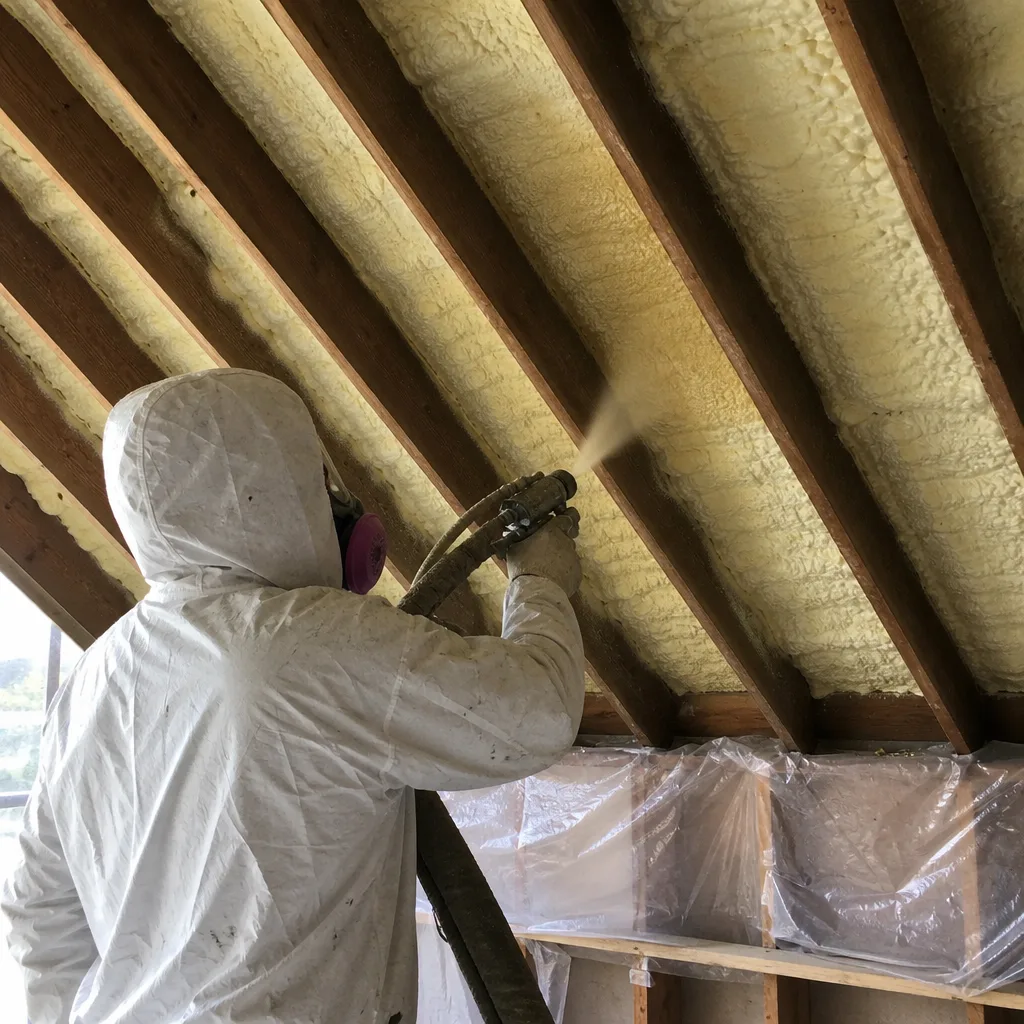
- Spray foam insulation (Icynene, Demilec, CertainTeed open- and closed-cell): The only material that both insulates and air-seals in one installation. Closed-cell spray foam adds structural rigidity and is the single best choice for foam-sealing the attic floor gaps described in the stucco section above. It costs more upfront, but for older Los Angeles homes with complex attics, it’s often the highest-value upgrade. We’ve written more on this at Spray Foam Insulation in Los Angeles.
Some families ask specifically about pet-safe or low-VOC options. Where a choice exists among the eight brands we install, we match the product to the household – including homes with birds (which have sensitive respiratory systems), cats, and dogs. The conversation starts with a simple question: who sleeps and breathes in this house?
What a Realistic Written Quote Should Itemize
Most Los Angeles insulation quotes fail because they arrive as a single number: “Attic insulation – $3,200.” That number doesn’t tell you what product you’re getting, what R-value they’re installing to, what’s included, or what’s not. A written quote you can actually compare line by line is the single best defense against the bait-and-switch patterns common in the insulation trade.
Here’s what a real written quote from a serious contractor should itemize, line by line:
- Exact product and brand – “Owens Corning AttiCat blown-in fiberglass” or “Icynene Classic open-cell spray foam,” never just “insulation.”
- Target R-value by area – “R-38 in the main attic floor, R-19 over the garage” – with square footage calculated separately for each zone.
- Air-sealing scope – specific penetrations sealed, can lights addressed or replaced, attic hatch weatherstripped. If air-sealing isn’t a line item, ask why.
- Prep and protection details – shoe covers, drop cloths, furniture or floor protection, and how the crew will access the attic.
- Removal of old or damaged insulation, if applicable – is it included or a separate charge?
- Clean-up and disposal – exactly what gets removed from the property and who handles it.
- Timeline and crew count – start time, expected duration, number of technicians.
At Thistledown Attic Insulation, every customer receives a written price before any work starts. Not an estimate range. A written number, line by line, that doesn’t change unless the scope changes and you approve the change first. That standard comes from the Cedarwell Care Promise, and it’s non-negotiable on every job we do in Los Angeles. If a crew won’t put the number in writing before starting, that is a red flag regardless of how good the price sounds over the phone.
Common Mistakes to Avoid
- Insulating over existing problems without addressing them. A slow roof leak or rodent damage under new insulation becomes a bigger problem in six months. The attic should be inspected and any moisture or pest issues resolved before insulation goes in.
- Buying the highest R-value without air-sealing. In a 1962 Valley Glen home with leaky can lights and an unsealed top plate, R-60 insulation will underperform R-38 installed with proper air-sealing. Spend on sealing first.
- Ignoring the attic hatch. A single unsealed attic hatch can leak more conditioned air than all the supply duct joints combined. It’s cheap to seal and frequently skipped.
- Installing a radiant barrier without understanding its limits. Radiant barrier is not a substitute for insulation, and it does nothing in a coastal attic that never gets hot. It’s a Valley and foothill tool.
- Buying based on price per square foot alone. The lowest price often excludes the air-sealing, the hatch sealing, the clean-up, and the written warranty. Compare line items, not bottom lines.
- Choosing spray foam without verifying the installer’s experience with your specific roof assembly. Closed-cell spray foam applied incorrectly can trap moisture against the roof deck in Los Angeles’s coastal humidity. The installer’s track record with your attic type matters more than the product brand.
- Skipping the post-work clean-up photo. After the job, you should have visual proof of what the attic looks like and that the floors are clean. We photograph the clean-up before we leave, every time, as part of the Cedarwell Care Promise.
When to Call a Professional
Insulation work takes place in a hot, confined attic space above your family’s sleeping areas, and it carries real safety considerations: high attic temperatures in Los Angeles summer, exposure to old fiberglass or rodent droppings, and the risk of falling through an unfloored ceiling. If your attic has recessed can lights, knob-and-tube wiring, or visible water staining, those are professional-scope items that require assessment before any insulation touches them. Most homeowners also lack the equipment to safely work at attic temperatures above 120°F without risking heat exhaustion, which is why DIY vs Professional Insulation: The Los Angeles Homeowner’s Decision Guide matters for your safety.
Thistledown Attic Insulation offers free estimates in Los Angeles – call (909) 768-6501 and a live person answers, 24/7. We’ll schedule the attic assessment, put the written price in your hands before any work begins, and leave the house with the floors as clean as we found them.
Frequently Asked Questions
Attic insulation in Los Angeles typically ranges from $1,800 to $4,500 depending on square footage, product type, and whether air-sealing is included. Your written quote should itemize the exact product, R-value, air-sealing scope, and clean-up, so call (909) 768-6501 for a free estimate based on your actual attic rather than a national average.
Coastal Los Angeles homes generally need R-30 to R-38, San Fernando Valley homes need R-38 to R-49 plus a radiant barrier, and foothill homes need R-38 to R-49 with air-sealing as the priority. The right answer depends on your specific ZIP code and home construction, which is why a generic recommendation is a warning sign.
You need a radiant barrier if you live in the San Fernando Valley or foothills under a low-slope or dark-colored roof. Coastal homes gain little from radiant barrier because their attics rarely get hot enough to justify the cost.
Yes. Sealing the attic floor, gasketing the attic hatch, and replacing leaky recessed can lights reduces the amount of smoke-laden attic air drawn into your living space during Los Angeles wildfire events. Proper attic ventilation above the sealed envelope keeps the roof deck dry while keeping the particulate out.
Spray foam insulation from brands like Icynene and Demilec is safe once fully cured, and installation can be scheduled around household routines. For families with pets or chemical sensitivities, we discuss product options including low-VOC and pet-safe choices before any material is specified.
Do the attic first. In Los Angeles’s climate, the attic floor is the highest-impact insulation job because heat rises, and it delivers faster comfort and energy improvements per dollar than wall insulation. Most pre-1980 Los Angeles homes should pair attic insulation with air-sealing for a complete thermal envelope.
The Bottom Line
Los Angeles insulation decisions should follow the climate zone, not a national chart. Coastal homes need modest R-value and moisture-aware products. Valley homes need R-38 to R-49 plus a radiant barrier to fight the summer attic heat. Foothill homes need air-sealing first to handle wind-driven leakage. Older stucco construction in Los Angeles demands air-sealing before insulation to deliver real results, and wildfire smoke gives families one more reason to seal the attic floor properly. Get a written, line-item quote, compare it honestly, and choose a crew that treats your floors, your pets, and your bottom line with care.
Written by Thistledown Attic Insulation‘s owner Neil Barron, serving Los Angeles since 2003. Thistledown is the soft fluff of the thistle, one of nature’s lightest insulators, and the name is a promise about how carefully we work.