
Last updated October 8, 2026
DIY vs Professional Attic Insulation: What’s Safe to Do Yourself
Adding fiberglass batts over existing insulation in an accessible Los Angeles attic is a legitimate Saturday project for a healthy adult with a dust mask and a headlamp. Air-sealing around a recessed light fixture in a pre-2002 home is not, because those older fixtures often sit in ceiling drywall containing asbestos joint compound, and disturbing it without testing is a California Health and Safety Code violation. Most guides blur these two tasks into one “insulation project” and tell you to hire a pro for everything. That’s not honest. This guide draws the line task by task, so you know exactly what you can safely handle, what you should not touch, and where spending professional money actually pays for itself in a Los Angeles attic.
Quick Answer
Laying unfaced fiberglass batts over existing attic insulation in an accessible, dry, vermiculite-free attic is safe for most DIYers in Los Angeles, provided the attic has adequate ventilation and no asbestos or knob-and-tube wiring concerns. Air-sealing, spray foam application, vermiculite disturbance, attic ventilation changes, and any work in pre-2002 homes with recessed lighting should be handled by a trained insulation professional in California. For a detailed breakdown of what’s safe to tackle yourself versus what requires a pro, see our DIY vs Professional Insulation: The Los Angeles Homeowner’s Decision Guide.
Table of Contents
- The Task-by-Task Safety Matrix
- What’s Genuinely Safe to DIY
- What Require a Professional (and Why)
- California Asbestos and Lead Rules Before You Start
- The Real Math on Renting a Blower Machine
- Why Air-Sealing Is the Task Everyone Skips
- Los Angeles Attic Configurations That Fail DIY Installs
- Title 24 Documentation and Resale Problems
- Common Mistakes to Avoid
- When to Call a Professional
- Frequently Asked Questions
- The Bottom Line
The Task-by-Task Safety Matrix
Insulation work is not one project. It’s a series of distinct tasks, and each carries its own risk profile. Here’s how we break it down in attics across Los Angeles, from Echo Park bungalows to Valley ranch homes.
| Task | DIY Status | Key Risk or Requirement |
|---|---|---|
| Laying unfaced batts over existing insulation | Generally safe | Dust, heat; require mask, gloves, headlamp |
| Blowing loose-fill fiberglass or cellulose | Moderate, two-person job | Coverage consistency; machine rental and cleanup |
| Air-sealing gaps around plumbing and wiring | Safe with right materials | Fire-rated caulk or expanding foam at penetrations |
| Air-sealing around recessed lights | Not DIY in pre-2002 homes | Potential asbestos in ceiling drywall joint compound |
| Spray foam application (open or closed cell) | Not DIY | Chemical exposure; requires respirator and training |
| Removing or disturbing vermiculite insulation | Not DIY, ever | May contain asbestos; California requires testing |
| Adding insulation around knob-and-tube wiring | Not DIY | Fire hazard; requires electrician and code compliance |
| Installing or changing attic ventilation | Not DIY in most cases | Roof structure changes; permits often required |
Notice what this table does not say. It does not say “hire a professional for all insulation work.” It says the line moves depending on your home’s age, wiring type, and existing insulation material. A 2008 tract home in Santa Clarita with a clean attic and basic fiberglass batts is a different job than a 1954 Mid-City bungalow with original plaster ceilings and a recessed can light in every room.
What’s Genuinely Safe to DIY
Let’s start with what an attentive homeowner can do without calling anyone. The key phrase is “accessible attic with no complicating factors.” If you can stand or kneel on joists, see the attic floor, and confirm there’s no knob-and-tube wiring, no vermiculite, and no asbestos-suspect ceiling texture, these tasks are within reach.
Laying unfaced fiberglass batts over existing insulation
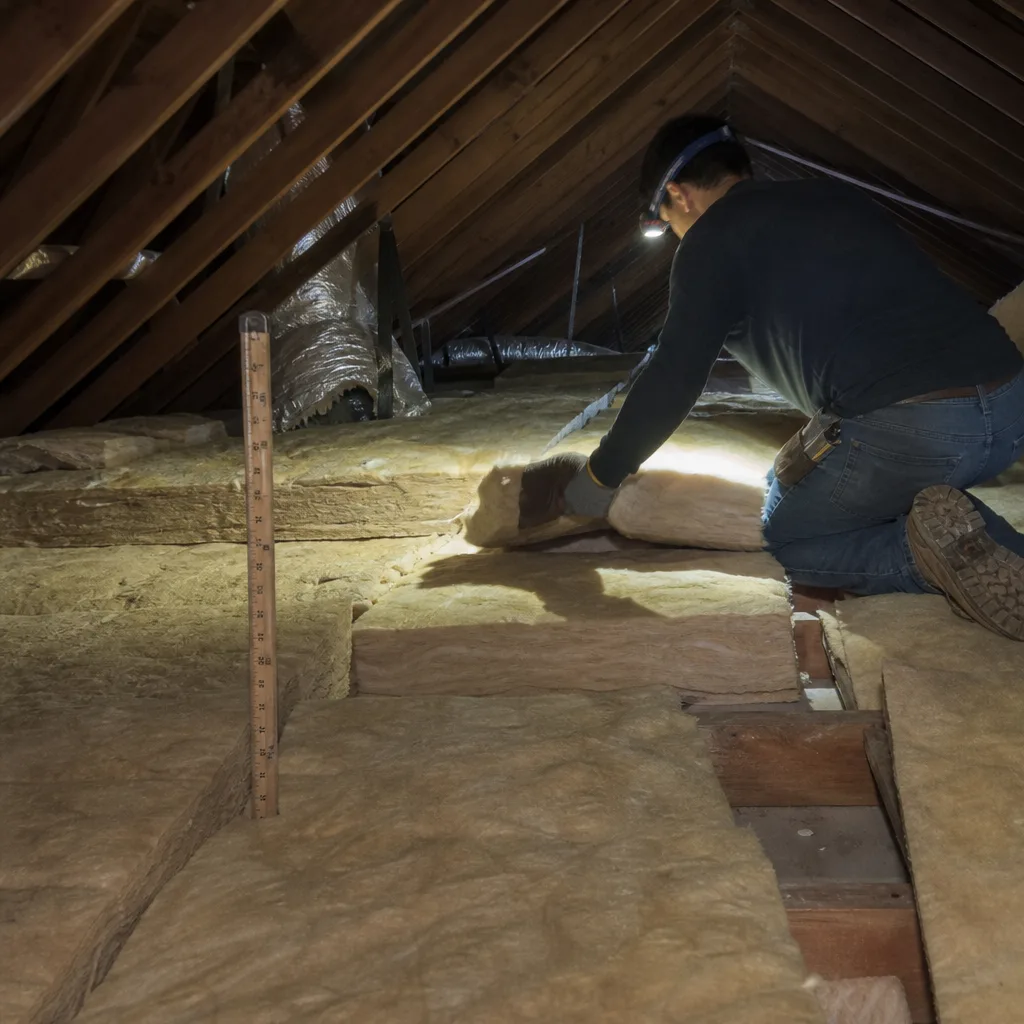
This is the most forgiving entry point. Unfaced batts, meaning batts without a paper or foil vapor barrier, can be laid perpendicular across existing joists. The second layer runs at a 90-degree angle to the first, which breaks the thermal bridging along the joist tops. This is the task most Los Angeles homeowners can do in a single morning. You need knee boards, a dust mask rated for fiberglass, long sleeves, gloves, and a bright headlamp. You do not need a contractor. But you do need an honest look at what’s below the batts you’re covering. If there’s any sign of water staining, rodent activity, or old wiring, stop and call someone before layering new insulation over a problem.
Air-sealing simple penetrations with fire-rated caulk
Plumbing vents, electrical wire penetrations, and top plates where walls meet attic floors are all sealable with fire-rated caulk or low-expansion foam. This task matters more than the insulation itself, which we’ll get to in the air-sealing section. The work is slow, unglamorous, and done on your knees. It is also legal, safe, and genuinely effective for a DIYer. The rule: only seal around penetrations you can see clearly. Do not seal around recessed fixtures unless you know the fixture is IC-rated (insulation contact rated) and the ceiling below has been tested or the home is post-2002. More on that below.
Installing a radiant barrier in a vented attic
In Los Angeles, where summer attic temperatures routinely hit 140°F, a radiant barrier stapled to the underside of roof rafters reduces heat gain into the living space. This is physically demanding work in a hot, cramped space, but it’s not technically complex. You staple foil-faced panels or rolls to the rafters, leaving a gap at the ridge for ventilation. The risk is heat exhaustion, not code violation. Go up at 6 a.m. in the summer, bring water, and be done before the attic turns into an oven.
What Require a Professional (and Why)
Some tasks are not a matter of skill. They’re a matter of chemistry, electricity, or law.
Spray foam application
Open-cell and closed-cell spray foam require two-component chemical mixing that happens in the spray gun. The application demands a respirator, protective suit, and controlled temperature conditions. Off-ratio spray foam – meaning the two chemicals did not mix correctly – can off-gas for months and sometimes requires complete removal. This is not a Home Depot rental situation. Brands like Demilec and Icynene require trained installers. A professional crew in Los Angeles handles this with the proper equipment, and the material cost alone makes DIY attempts financially irrational when a bad batch means tearing out everything you sprayed.
Vermiculite insulation removal or disturbance
Vermiculite was installed in some Los Angeles attics before 1990. The EPA estimates a significant portion of vermiculite mined in Libby, Montana, contains asbestos. California law requires testing before disturbing any suspect material. If you see small, accordion-shaped, silvery-brown pebbles in your attic, do not walk through them, do not vacuum them, and do not remove them yourself. Leave the attic and call a professional. Thistledown Attic Insulation handles Los Angeles attics where vermiculite is present, coordinating testing and removal before any new insulation goes in.
Air-sealing around recessed lights in pre-2002 homes
This is the task we return to repeatedly, because it’s the one most guides gloss over. Homes built before 2002 in Los Angeles often have recessed can lights surrounded by drywall mud that contains asbestos. The asbestos is in the joint compound, not the drywall itself, but sanding, scraping, or aggressive caulking can release fibers. California Health and Safety Code requires asbestos testing before any disturbance in a pre-2002 building. A professional insulation crew working in these homes follows containment protocols, uses the right air-sealing method for the fixture type, and knows when a licensed asbestos contractor needs to be involved instead. This is not fearmongering. It’s the law, and it’s the difference between a $400 air-sealing job and a $4,000 asbestos remediation.
Knob-and-tube wiring conflicts
Homes built before roughly 1940 in Los Angeles may still have knob-and-tube wiring in the attic. Insulation cannot be placed over or around this wiring. The wires need air space to dissipate heat. Covering them with fiberglass or cellulose creates a fire hazard. The correct fix is to have an electrician replace or disconnect the knob-and-tube first, then insulate. A professional insulation estimator will spot this in the first five minutes of an attic inspection.
California Asbestos and Lead Rules Before You Start
California has some of the strictest asbestos and lead regulations in the country. Here’s what applies to attic insulation work in Los Angeles.
Asbestos. California Health and Safety Code Section 19827.5 requires asbestos testing before renovation or demolition in buildings constructed before 2002. This includes drilling, sanding, scraping, or otherwise disturbing drywall joint compound, ceiling texture, or suspect insulation materials. A DIYer who skips this step and disturbs asbestos-containing material is violating state law and creating a health exposure in their own home.
Lead. Homes built before 1978 may contain lead-based paint. While lead in attic insulation itself is unusual, lead paint on attic access doors, trim, or older framing dust can be disturbed during insulation work. The EPA’s Renovation, Repair, and Painting (RRP) rule requires certification for any firm that disturbs lead paint in pre-1978 homes. Professional insulation companies in Los Angeles follow RRP protocols when working in older homes.
Vermiculite. The California Department of Public Health recommends treating all vermiculite as potentially asbestos-containing until tested. Testing costs $50 to $100 and takes about a week. If you’re planning insulation work in a Los Angeles attic and see any granular, shiny material, get the test before anyone steps foot up there.
The Real Math on Renting a Blower Machine
Home Depot and Lowe’s rent attic blow-in machines, and the marketing around DIY blown insulation makes it sound like you’re saving thousands. Here’s the honest math from our experience in Los Angeles attics.
The rental itself is cheap. A typical machine rents for about $70 per day. The insulation material, whether Owens Corning AttiCat fiberglass or GreenFiber cellulose, costs roughly the same whether you buy it retail or a contractor purchases it wholesale. So far, so good. The savings look real.
Hidden costs start stacking. You need a second person to feed the hopper while you run the hose in the attic. That’s a full day for two adults. You need a truck or SUV to transport the machine and the bales. You need the machine returned on time or you pay extra days. You need to dispose of the empty bags and any overfill. And here’s the cost most people miss: blown insulation requires precise coverage at a specific depth to hit the R-value you’re paying for. DIY jobs routinely end up at R-30 when the homeowner intended R-49, because the hose is hard to aim, the depth markers get buried, and no one measured when they finished. A professional attic insulation crew in Los Angeles has calibrated machines, depth markers, and a second person checking coverage as the job progresses.
The second trip problem. If you finish your DIY blow-in and realize the coverage is uneven, or you left a low spot over the baby’s room, you’re renting the machine again, buying more material, and spending another weekend in a 130-degree attic. The per-hour savings disappear quickly. This is the math that pushes many Los Angeles homeowners toward professional installation after one DIY attempt.
Why Air-Sealing Is the Task Everyone Skips
Air-sealing is the invisible work that makes insulation work. Here’s the principle: insulation slows conductive heat transfer through materials. It does nothing to stop air moving through gaps. A fiberglass batt stuffed around a plumbing vent still lets attic air flow past it. Air-sealing is the task of closing those gaps with caulk, foam, or gaskets before insulation goes in.
In our experience across Los Angeles attics, air-sealing accounts for roughly 40% of the energy benefit of an insulation upgrade. A perfectly insulated attic with unsealed penetrations still leaks conditioned air into the attic space. The DIY instinct is to skip air-sealing because it’s tedious, it doesn’t photograph well, and no one sees it when the job is done. But skipping it means paying for R-49 insulation performance while getting R-30 results.
The safe version of this task for DIYers is simple: seal plumbing vents, wire penetrations, and top plates with fire-rated caulk or low-expansion foam. Leave recessed lights, flue pipes, and bathroom exhaust fans alone unless you know the fixture ratings and the age of your ceiling assembly. This is where hiring a professional changes the outcome. A spray foam insulation professional in Los Angeles air-seals as part of the installation, using materials that won’t melt against hot fixtures and knowing which gaps matter most. The difference shows up on your energy bill, not in a photo.
Los Angeles Attic Configurations That Fail DIY Installs
Los Angeles homes have attic configurations that differ from the textbook illustrations in DIY guides. Here are the ones we see fail most often in the field.
Unfinished access hatches with no pull-down stair. Many LA homes built before 1980 have a small ceiling hatch, often in a hallway closet, with no ladder. The DIYer balances a step stool on a chair to get up there, which is dangerous before the insulation work even starts. The hatch itself is almost never insulated or weatherstripped, which means the attic access is a thermal hole in the ceiling. A professional crew brings a proper ladder, protects the closet floor, and seals and insulates the hatch as part of the job.
Knee walls in Storybook and Spanish Revival homes. Older Los Angeles homes, particularly in neighborhoods like Silver Lake, Los Feliz, and Hancock Park, often have knee walls where the roofline meets short vertical walls. These cavities are hard to reach, hard to air-seal, and frequently missing insulation entirely. DIYers either skip them, because the access is too tight, or stuff batts in without addressing the air leaks around the framing. The result is a partially insulated attic that still loses conditioned air around the knee wall.
Split-level attics with multiple drops. Homes in the San Fernando Valley and westside hills frequently have split-level floor plans with attics that step down over different rooms. Each level change creates a vertical wall in the attic that must be insulated and air-sealed. DIYers working from a single attic access point often can’t see or reach these drops. The insulation looks complete from the access point, but the far corners and step-downs are bare.
Homes in wildfire zones with ember-resistant venting. Los Angeles hillside homes in wildfire risk zones now have ember-resistant attic vents with fine mesh screens. These vents are more restrictive than standard vents, which affects attic airflow. Adding insulation without assessing the ventilation balance can create moisture problems. A professional will check the vent setup and calculate whether additional intake or exhaust ventilation is needed before adding insulation.
Title 24 Documentation and Resale Problems
California’s Energy Code, Title 24 Part 6, requires documentation when insulation is added during a renovation. Here’s what that means for DIY work in Los Angeles.
When insulation is installed as part of a permitted project, the installing contractor signs a CF-2R form certifying the installed R-value and type. If insulation is added as a standalone project without a permit, which is common for retrofit work, the documentation requirement is less formal but the resale implications remain. Homebuyers in Los Angeles increasingly ask for proof of insulation levels, and a seller who cannot provide documentation may face a reduction in perceived value or a request for a professional assessment before closing.
DIY insulation work rarely comes with documentation. You have no receipt showing the R-value installed, no third-party verification, and no one to answer for uneven coverage. When you go to sell, a home inspector checks the attic with a flashlight, sees inconsistent insulation depth, and the buyer follows up. By contrast, professional installation from a company like Thistledown Attic Insulation and our Attic Insulation services comes with a written price before any work starts, documentation of the installed materials and R-value, and a 365-Day Done Right Promise that transfers confidence to the next buyer. That paper trail is worth money when the house changes hands.
Common Mistakes to Avoid
- Sealing recessed lights without checking the home’s age. Pre-2002 Los Angeles homes may have asbestos in the ceiling joint compound around the fixture. Testing costs under $100. Skipping it risks a health exposure and a code violation.
- Using vapor barriers in Los Angeles attics. LA’s climate does not require a vapor barrier in the attic insulation assembly. Adding one traps moisture and grows mold. Unfaced batts or blown insulation are the right products here.
- Covering attic soffit vents with blown insulation. Ventilation needs open airflow from the soffits to the ridge. Burying soffit vents under new insulation creates heat and moisture problems in the attic, which shortens the life of the roofing materials.
- Compressing fiberglass batts to make them fit. Compressed fiberglass loses R-value because it works by trapping air. Stuffing an R-30 batt into a 2×6 cavity does not give you R-30. It gives you less, and you paid for insulation you won’t get the benefit from.
- Working in a hot attic without hydration or ventilation. Los Angeles attics hit 130°F or higher in summer. Heat exhaustion is a real risk, and emergency calls for attic collapses, while rare, happen when a homeowner steps between joists. Use knee boards and work in the early morning.
- Skipping the air-sealing step. Insulation without air-sealing is half a job. You’ll spend the money and still feel drafts. Air-sealing first, or as part of the same job, is the order of operations that produces the energy savings.
- Failing to inspect for water intrusion before insulating. Adding insulation over a slow roof leak hides the leak until the decking rots. In Los Angeles, where roof leaks are easy to miss between winter rains, a pre-insulation moisture check is worth the time.
When to Call a Professional
Call a professional when your Los Angeles attic has vermiculite insulation, knob-and-tube wiring, pre-2002 recessed lighting, signs of water damage, or structural concerns like cracked joists or sagging decking. Call when the attic is a split-level design, a Storybook home with knee walls, or a wildfire-zone house with ember-resistant vents that changed the airflow. Call when you’re planning spray foam of any kind. And call when you want the job documented, air-sealed properly, and covered by a written price and a workmanship promise. Thistledown Attic Insulation installs attic and spray foam insulation in Los Angeles with products from Owens Corning, Johns Manville, and Demilec, and a written price before any work starts. If you’re not sure which task applies to your attic, call (909) 768-6501 for a free estimate, and we’ll tell you straight whether it’s a Saturday project or a pro job.
Frequently Asked Questions
Yes, it’s safe to install unfaced fiberglass batts over existing attic insulation in most Los Angeles homes, provided you wear a dust mask, gloves, long sleeves, and work only in attics with no vermiculite, knob-and-tube wiring, or pre-2002 recessed lighting concerns. The task itself is low-risk; the complications come from house-specific factors that most DIY guides do not mention.
Attic insulation in Los Angeles typically runs between $1,500 and $4,000 for a full attic in a standard single-family home, depending on attic size, access difficulty, existing insulation condition, and the R-value target. Thistledown Attic Insulation provides a written price before any work begins, so there’s no range guessing after the fact. Call (909) 768-6501 for an exact quote.
Standalone retrofit insulation work does not typically require a permit in Los Angeles, but the work must comply with California Title 24 energy standards, and the installed R-value should be documented for resale. If the project includes structural changes, new ventilation, or electrical work, those portions may require permits. A professional installer can tell you which applies to your home.
No, spray foam insulation should not be installed by a DIYer. The two-component chemical system requires a trained technician, a respirator, protective gear, and controlled temperature conditions to cure correctly. Off-ratio spray foam can off-gas for months and sometimes requires complete removal. Brands like Demilec are installed by certified professionals only.
Los Angeles homeowners typically recover attic insulation costs in three to six years through lower cooling and heating bills, with the fastest payback in homes that had little or no existing attic insulation. Air-sealing performed at the same time shortens the payback period further because it stops conditioned air from leaking into the attic.
Thistledown Attic Insulation schedules free estimates in Los Angeles quickly, and a live person answers the phone 24 hours a day, 7 days a week. Call (909) 768-6501 and we’ll schedule an attic inspection and written price, no obligation.
The Bottom Line
The DIY-vs-pro question for attic insulation comes down to which specific tasks are safe and legal for a homeowner to perform, not whether the entire project is beyond you. Laying batts, air-sealing simple penetrations, and installing a radiant barrier are within reach for a careful DIYer in a compatible Los Angeles attic. Vermiculite, recessed lights in pre-2002 ceilings, spray foam, knob-and-tube conflicts, and Title 24 documentation are not. The best approach is an honest attic inspection first. If you’re in Los Angeles and want an expert read on which side of the line your attic falls, call Thistledown Attic Insulation at (909) 768-6501. We’ll tell you what we’d do ourselves and what we’d hire someone for, and you’ll have a written price before any work starts.
Written by Neil Barron, Owner at Thistledown Attic Insulation, serving Los Angeles since 2003.