
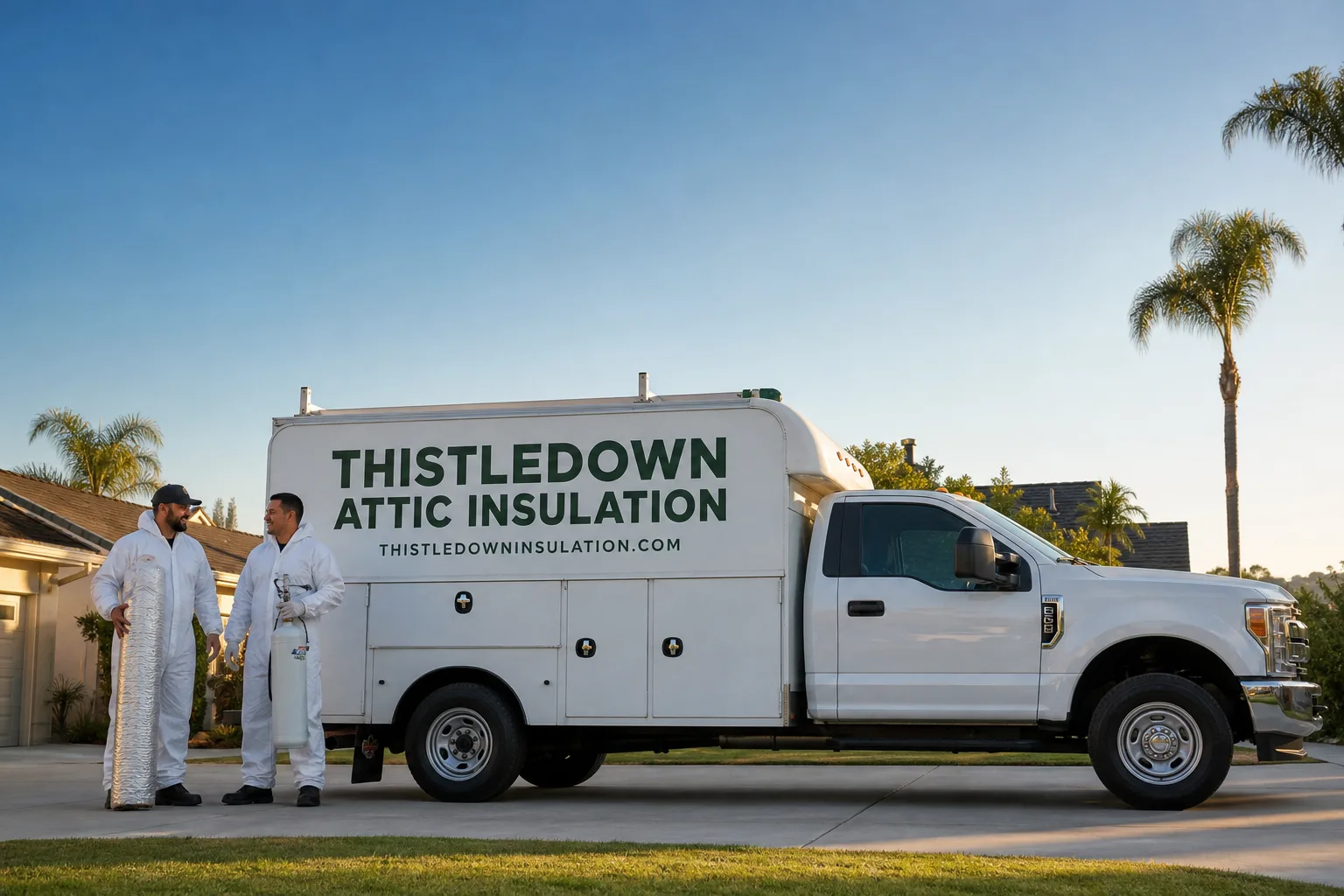
Fast, Reliable Attic Insulation Across Boyes Hot Springs
Attic insulation in Boyes Hot Springs is a different job than it is ten miles south in Petaluma or anywhere along the 101 corridor. The Valley of the Moon creates a thermal trap that swings attics between damp, fog-soaked winter nights and low-90s summer afternoons, and the resort cottages here, some dating to the 1910s, were never built for either. We know this because we work these attics every week. When you call us at (909) 768-6501, you’ll reach a live person, and we’ll talk through what your attic actually needs before anyone schedules a visit.
Why Thistledown Attic Insulation Is Boyes Hot Springs’s Preferred Attic Insulation Company
Boyes Hot Springs homeowners deal with a specific set of problems: knob-and-tube wiring that predates modern insulation standards, balloon-frame wall chases that carry air straight from the crawlspace to the attic, and fog-driven moisture that mats down whatever insulation is up there. We see these patterns on Fetters Hot Springs Road, along Boyes Boulevard, and in the cottage clusters off Verano Avenue. Our crews know these houses because we have been inside enough of them to know what to expect before the ladder goes up. The uniformed technician who arrives at your door is background-checked, and they’ll put on shoe covers before they step inside. We lay drop cloths along the hallway, and when the job is done, you’ll see a photo of the cleanup before our van pulls away.
We are an independently owned Cedarwell-family company, founded in 2003, and our work here is held to the Cedarwell Care Promise: clean up like it’s our own home, ask before we move or touch anything, respect your time and quiet hours, and explain the price before the work. Every job carries our 365-Day Done Right Promise. If something isn’t done right, we make it right. No debate, no fine print.
Insulation Contractors in Boyes Hot Springs
Insulation contractors in Boyes Hot Springs work against a clock the rest of Sonoma County doesn’t feel. The marine fog that pours off San Pablo Bay and settles into the valley floor doesn’t just cool the air. It moves moisture into attics, into fiberglass batts, into the open wall cavities of the old balloon-frame cottages. A contractor who doesn’t understand that moisture cycling will quote a simple top-up and leave the real problem untouched. We approach every Boyes Hot Springs attic with the assumption that moisture and air movement are already at work, because in this valley, they always are.
A typical Attic Insulation job here runs from $2,400 to $6,800 depending on square footage, access difficulty, whether the existing insulation is matted or compacted, and whether electrical remediation is needed. You’ll get a written price before we start, never after.
Blown-In and Top-Up Work
Many Boyes Hot Springs attics from the cottage era have a thin layer of original insulation that has been beaten flat by years of moisture cycles. A top-up brings the R-value up to current Title 24 targets without a full tear-out. We run $1,800 to $3,400 for most top-up projects, depending on depth and square footage.
The Knob-and-Tube Sequencing
If your cottage still has original knob-and-tube wiring, that changes the entire sequence. California code won’t allow us to bury live knob-and-tube under blown-in insulation. The wiring has to be addressed by a licensed electrician first. That pushes the insulation timeline out, and we’ll tell you that on the first call rather than discovering it with bags of cellulose already in your driveway.
Attic Ventilation in Boyes Hot Springs
Attic Ventilation in Boyes Hot Springs does more than move hot air out. It dries the attic between fog cycles. Without balanced intake and exhaust ventilation, a Boyes Hot Springs attic holds onto moisture for days, and that’s what kills insulation performance faster than any summer heat wave. In the old resort cottages, the original ventilation was a louvered gable vent at best, which creates no reliable airflow. We see this all over the neighborhood between Verano Avenue and the Sonoma Developmental Center land.
We include a ventilation assessment with every attic insulation quote because adding insulation to a poorly ventilated attic in this valley makes the moisture problem worse, not better. Balanced intake and ridge ventilation lets the attic dry between fog events. A full ventilation retrofit alongside insulation typically adds $900 to $2,200 depending on the roofline and what’s already there.
Air-Sealing the Top Plates
Balloon-frame construction left the wall cavities open at the top. That means the air in your crawlspace moves straight up through the walls and into the attic. Insulating alone won’t stop it. We air-seal those top-plate chases with foam before blown-in goes in, and that single step often makes a bigger comfort difference in these old cottages than the insulation itself.
Gable Vent to Ridge Conversion
On the cottage rooflines along Fetters Hot Springs Road, we regularly convert the old gable vent setup to continuous ridge plus soffit intake. This creates cross-ventilation that a single gable vent on one end never could. It also prevents the louvered vent rust and bird nesting that plague those old boxes.
Trusted Brands We Service in Boyes Hot Springs
We install Johns Manville and Knauf batt products, GreenFiber cellulose for blown-in, and Rockwool mineral wool when fire resistance is the priority. The post-wildfire preference for mineral wool in this corridor is real, and for Boyes Hot Springs homeowners whose rebuild or renovation is tied to Fire Safe Council recommendations, Rockwool is often the right call. We have inventory staged locally for fast turnaround in Boyes Hot Springs, and we can match the right product to your attic rather than pushing whatever is on the truck.
Common Attic Insulation Problems We See in Boyes Hot Springs Homes
- Fog-driven moisture compression. The marine layer that settles in the Valley of the Moon pushes moisture into attic batts, which get heavy, wet, and flat. By the time the summer heat arrives, the R-value is already gone and the subfloor below stays perpetually damp.
- Knob-and-tube wiring conflicts. The 1910s through 1940s cottages throughout Boyes Hot Springs often still have active knob-and-tube runs feeding ceiling fixtures. Under California code, we can’t legally cover those with blown-in insulation, so the job sequencing has to account for an electrician.
- Balloon-frame air bypasses. The old resort cottages were framed with wall cavities open at the top, so air moves freely from the crawlspace to the attic. Adding insulation without sealing those chases just moves the draft into the attic instead of stopping it.
- Post-fire material mismatches. Homeowners in this corridor are rightly asking for fire-resistive insulation like Rockwool. Older cellulose-and-fiberglass attics get flagged for material upgrades rather than simple top-offs, especially after the Sonoma Valley fire rebuilding environment changed the local conversation.
Pricing for Attic Insulation in Boyes Hot Springs, CA
A typical attic insulation project in Boyes Hot Springs runs $2,400 to $6,800. Top-ups land in the $1,800 to $3,400 range. Ventilation work adds $900 to $2,200. Full replacement of matted, moisture-damaged insulation with air sealing and blown-in cellulose or mineral wool averages $4,200 to $7,900 depending on attic size and access. The written price you get from us is the price you’ll pay. We put it in writing before any work begins, every single time.
We Also Serve Cities Near Boyes Hot Springs
Our crews cover the surrounding Sonoma Valley communities, including Boyes Hot Springs, Sonoma, Petaluma, Rohnert Park, and Cotati. If you’re a few miles outside the Springs and your attic feels like a sauna in July or an icebox in January, call us. We’ll tell you straight whether we can help and when we can get there.
Serving Boyes Hot Springs, CA - Our Local Coverage Area
We’re based in the Boyes Hot Springs area and know this community well. Use the map below to see our service coverage - if you’re nearby, we can almost certainly help.
FAQs About Attic Insulation in Boyes Hot Springs
It’s not a roof leak. It’s the Valley of the Moon fog cycle. Marine air off San Pablo Bay settles into the valley floor on winter nights, and that moisture gets drawn into your attic and absorbed by the insulation. Fiberglass and old batts don’t recover from repeated saturation. They compress and lose R-value. The fix includes drying the attic between fog events with proper ventilation and choosing insulation that handles moisture cycling better than the original matting. Call us at (909) 768-6501 and we’ll scope it honestly.
No, and anyone who says otherwise is putting you at risk. California code prohibits burying live knob-and-tube wiring under blown-in insulation. The wiring must be assessed and remediated by a licensed electrician before we open a single bag of cellulose. We’ve seen this enough on the cottage blocks off Verano Avenue and Fetters Hot Springs Road that we flag it on the first call, not after we’ve already started. The electrical work moves first, then we insulate.
For most of the resort-era cottages here, mineral wool makes a strong case. Rockwool is non-combustible, resists moisture better than old fiberglass, and fits the post-wildfire material preference in this corridor. GreenFiber cellulose is also an excellent product and often the right choice for open attics needing deep blown-in coverage. For Boyes Hot Springs specifically, our recommendation usually leans toward Rockwool if fire resistance is your primary concern, and cellulose if you want maximum coverage per dollar. Both are here on the truck, so the quote reflects what’s actually in your attic, not what’s convenient.
The heat trap means your attic has to perform at both ends. Summer afternoons push into the low 90s on the valley floor while winter nights sit damp and cold. That means R-value alone isn’t the whole answer. The insulation has to resist moisture absorption during fog cycles and still hold its loft. We build Boyes Hot Springs attics to a target that works for both seasons, not just one. Most cottages here need R-38 to R-49 depending on ceiling configuration, and a 1920s bungalow with a low-slope roof will need a different approach than a mid-century ranch. Call (909) 768-6501 for a free estimate and we’ll scope your specific roofline.
No. The drafts are coming from below. The open wall cavities in balloon-frame construction run continuously from the crawlspace to the attic, so air and moisture travel straight up through the walls regardless of what’s in the attic. Insulation without air-sealing those chases just moves the problem. We seal the top plates and any accessible chases before blown-in goes in. That’s the step that makes the upstairs feel like the rest of the house on a low-90s afternoon.
Written by Neil Barron, Owner at Thistledown Attic Insulation, serving Boyes Hot Springs and the Sonoma Valley since 2003.