
Fast, Reliable Attic Insulation Across Big Bear City
Attic insulation in Big Bear City is not the same job it is down the mountain. Your cabin sits at 6,752 feet, where January nights drop near 20°F and the roof carries roughly 59 inches of snow each winter. A house built in the 1960s as a summer fishing retreat was never designed for that load, and it shows up as ice at the eaves, a furnace that runs all weekend, and rooms that never warm up. We work in Big Bear City every week, and we know what these cabins look like inside the walls. Call (909) 768-6501 and we’ll walk you through what your attic actually needs.
Why Thistledown Attic Insulation Is Big Bear City’s Preferred Attic Insulation Company
We have spent enough time in Big Bear City attics to recognize your house by its roofline. The A-frames off Mill Creek Road, the gable-roofed cabins near the airport, the 1950s bungalows along Big Bear Boulevard: the construction tells you what you’ll find before you climb the ladder. Shallow rafter bays. No venting. Original batts that have been snow-loaded into cardboard-thin strips.
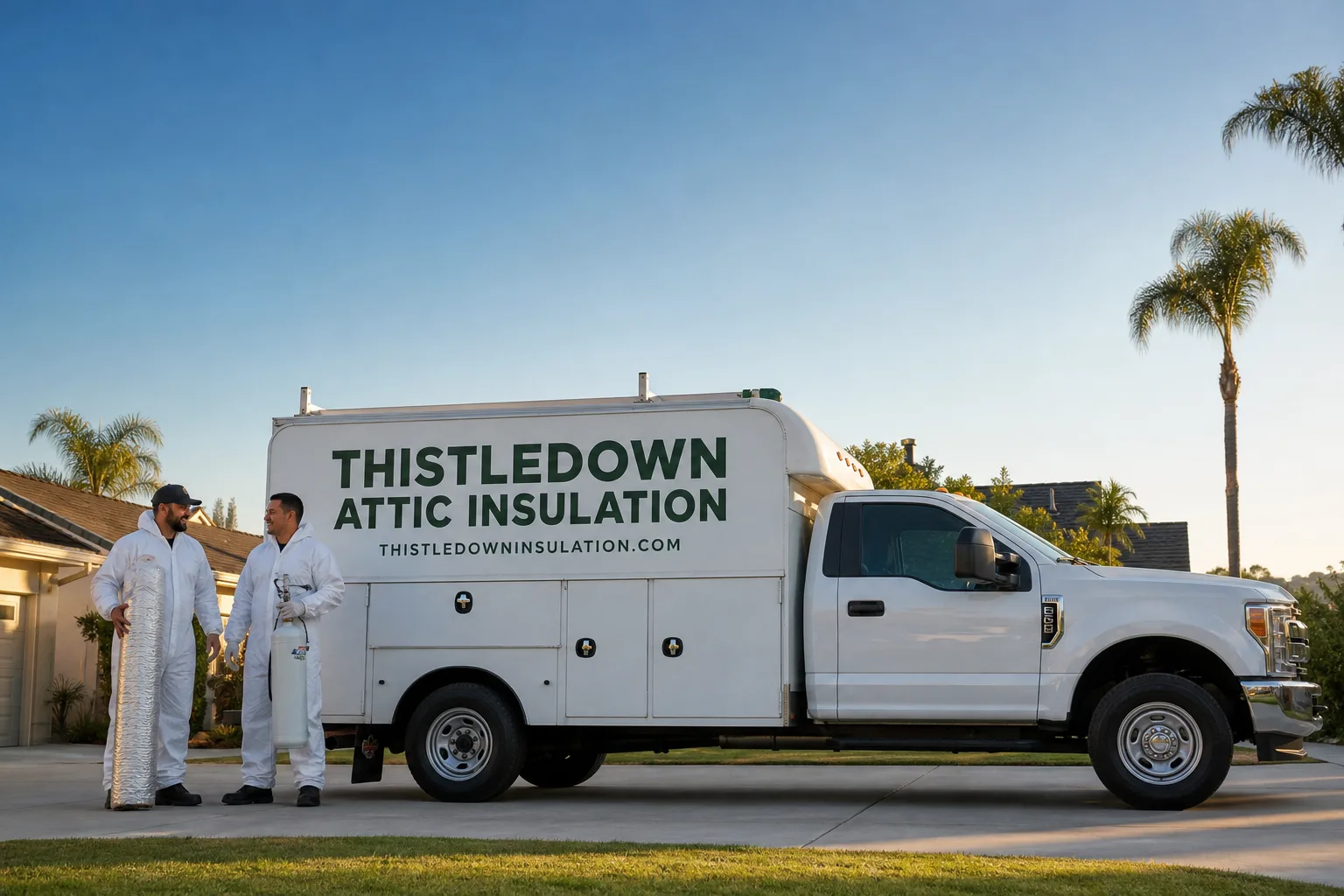
Our crews arrive in uniform, background-checked, and wearing shoe covers from the front door to the attic hatch. We lay drop cloths across your hallway before hauling in a single hose. And before any work starts, you have a written price in your hand. That is our Attic Insulation standard: no open-ended estimates, no surprises on the invoice, no crew that starts without your signature.
Neil Barron runs our operation, and he holds every Big Bear City job to the 365-Day Done Right Promise. If something is not right, we make it right. No debate, no fine print.
Blown In Insulation in Big Bear City
Blown In Insulation is our most common recommendation for Big Bear City cabins because it is the only way to fill a shallow, irregular cavity evenly. In a 1960s A-frame with rafter bays that vary from four inches to eight inches deep, fiberglass batts leave voids and air paths that defeat the whole assembly. Loose-fill, blown in at the correct density, flows around framing members and settles into the same shape as the ceiling. A typical blown-in attic insulation job in Big Bear City runs $1,800 to $3,400 for a standard cabin footprint, depending on target depth, access, and whether we are air-sealing first.
Air-Sealing Before We Blow
A cabin built before 1980 rarely has any kind of air barrier at the ceiling plane. Warm air leaks around light fixtures, plumbing chases, and the gaps where interior walls meet the ceiling. If we skip this step, you are effectively blowing insulation over a screen door. In Big Bear City, where that warm air also melts snow and freezes into ice dams at the eaves, air-sealing is not an add-on. It is the job.
Venting a Steep A-Frame Pitch
Most Big Bear City A-frames have no venting path from soffit to ridge. That means whatever insulation we add will trap moisture and degrade from below and snowmelt will refreeze at the roofline. Installing baffles to restore airflow through the steep pitch is often the first physical step, before any insulation goes in.
Insulation Contractors in Big Bear City
Insulation Contractors who work the Inland Empire market are calibrated for Riverside heat, not Big Bear City cold. The person who insulates a tract home in Yucaipa is rarely prepared for a cathedral ceiling with no soffit access and a homeowner who needs the cabin warm by Friday night. When you hire Thistledown, you get a crew that has actually worked inside the housing stock we have up here: wood-frame cabins, A-frames, and chalets built between the 1940s and the early 1980s. Typical attic insulation replacement in Big Bear City runs $2,200 to $4,600, with the higher end reflecting steep pitches, shallow cavities, and the air-sealing and venting work these older buildings almost always require.
What We Check Before We Quote
Before we write a number, we inspect the rafter depth, look for existing venting, check for signs of snow-load compression in the old batts, and identify any air bypasses at the ceiling plane. In a Big Bear City cabin, the attic usually tells us what it needs within ten minutes. That inspection is free, and your written quote follows.
Working While You Are Away
Many Big Bear City cabins sit empty Monday through Friday during ski season. If you can’t be on site, we coordinate access, send photos before and after, and leave a shot of the clean-up before the van pulls away. You get the same written price and the same 365-Day Done Right Promise whether you are at the kitchen table or watching from down the hill.
Trusted Brands We Service in Big Bear City
We install Owens Corning, Johns Manville, and GreenFiber products regularly, and we choose the brand based on what the cavity actually needs. A shallow A-frame rafter bay with poor access often calls for GreenFiber loose-fill because it gets full depth at low weight. A standard attic floor over a gable-roofed cabin might take Owens Corning or Johns Manville blown fiberglass just as well. We keep the common materials stocked for Big Bear City jobs, which means fewer weather delays and no waiting on a truck from down the hill. Where a pet-safe product choice exists, we make it, so the dog can be home during the job.
Common Attic Insulation Problems We See in Big Bear City Homes
- Snow-compressed batts. Successive seasons of heavy snow load on a shallow roof cavity compresses fiberglass batts into a dense mat that loses most of its R-value. We see 1960s cabins where the original R-19 batts measure under three inches thick, performing closer to R-8.
- No air barrier at the ceiling plane. Warm air rises through ceiling gaps, melts snow at the roof deck, and the melt refreezes as ice at the eaves. This snowmelt-and-refreeze cycle is common across Big Bear City roofs, and insulation without air-sealing will not stop it.
- Blocked ventilation over steep pitches. Batt insulation pushed up against an A-frame roof deck without baffles traps moisture and decays from below. The batts look fine from the attic side and are failing on the roof side where you cannot see them.
- Friday-night thermal shock. Cabins that sit unoccupied all week drop close to outdoor temperature, then get hit with a full crank of heat on Friday evening. These extreme temperature swings degrade insulation faster than steady-state occupancy and make a poorly sealed cabin nearly impossible to bring up to livable temperature before Saturday morning.
Pricing for Attic Insulation in Big Bear City, CA
Here are the real ranges for Big Bear City, not the inflated numbers you see on national sites. Blown-in attic insulation on a standard cabin footprint typically runs $1,800 to $3,400. Full attic insulation replacement, including air-sealing and baffle installation where needed, runs $2,200 to $4,600. A simple attic insulation top-up over existing, still-serviceable material runs $900 to $1,700. Your exact written number comes before any work begins, and it does not change mid-job. Call (909) 768-6501 for a free estimate and we will measure your attic and hand you a price.
We Also Serve Cities Near Big Bear City
Our crews cover Big Bear City and the surrounding mountain communities, including Lucerne Valley, Running Springs, Yucaipa, and Mentone. If you live anywhere in the San Bernardino Mountains or just below them, we will come measure your attic and give you a written quote. Dispatch and scheduling are coordinated from our Inland Empire office, with crews dispatched to Big Bear City regularly.
Serving Big Bear City, CA - Our Local Coverage Area
We’re based in the Big Bear City area and know this community well. Use the map below to see our service coverage - if you’re nearby, we can almost certainly help.
FAQs About Attic Insulation in Big Bear City
Yes, blown-in insulation is typically the best choice for steep A-frame pitches in Big Bear City because it fills the shallow, irregular rafter cavities evenly without leaving the voids and air gaps that batts create. The key is pairing it with baffles to keep a vent path open under the roof deck; without baffles, insulation pressed against the steeply pitched roof deck will trap moisture and degrade from below. Call (909) 768-6501 and we’ll assess your specific pitch.
Yes, and for Big Bear City cabins the insulation matters more, not less, because the building drops to near-outdoor temperature every week and then gets hit with a blast of furnace heat on Friday night. That thermal cycling stresses the envelope, and a poorly insulated and unsealed cabin can take all night to reach a comfortable temperature. A properly insulated and air-sealed cabin recovers in an hour or two and holds heat through Saturday morning.
Ice at the eaves on Big Bear City roofs is usually a sign that warm interior air is leaking through the ceiling plane, melting snow at the roof deck, and refreezing when it reaches the cold eave line. Adding insulation without air-sealing first will not stop this. We seal the ceiling bypasses before we add insulation, which cuts the melt source and reduces ice dam formation.
Sometimes, but in many Big Bear City cabins the old batts are too snow-compressed or moisture-degraded to build over. Adding new material on top of failed insulation is like putting a clean shirt over a wet one. We assess the condition of the existing material during the free inspection and only recommend a top-up when the base is still sound.
Our same standards apply whether you live there full-time or visit on weekends: written price before work begins, shoe covers and drop cloths at every visit, and a photo of the clean-up before we leave. If you can’t be on site, we coordinate access and send before-and-after photos so you can see exactly what was done and that the space was left the way we found it.
Call Thistledown for a Written Price Before Any Work Begins
If your Big Bear City cabin will not hold heat on a cold February night, or your eaves are icing up, or you simply suspect the original insulation from the 1960s has given up, call (909) 768-6501. We will inspect your attic for free, explain exactly what we found, and hand you a written price before anyone picks up a tool. We install the right insulation for a 6,752-foot climate, we air-seal like the cabin depends on it because it does, and we leave your house cleaner than we found it. Shoe covers on every boot. A photo of the clean-up before we go. That is the Thistledown way, and it applies to every job in Big Bear City.
Written by Neil Barron, Owner at Thistledown Attic Insulation, serving Big Bear City with written-price insulation work since 2003.