
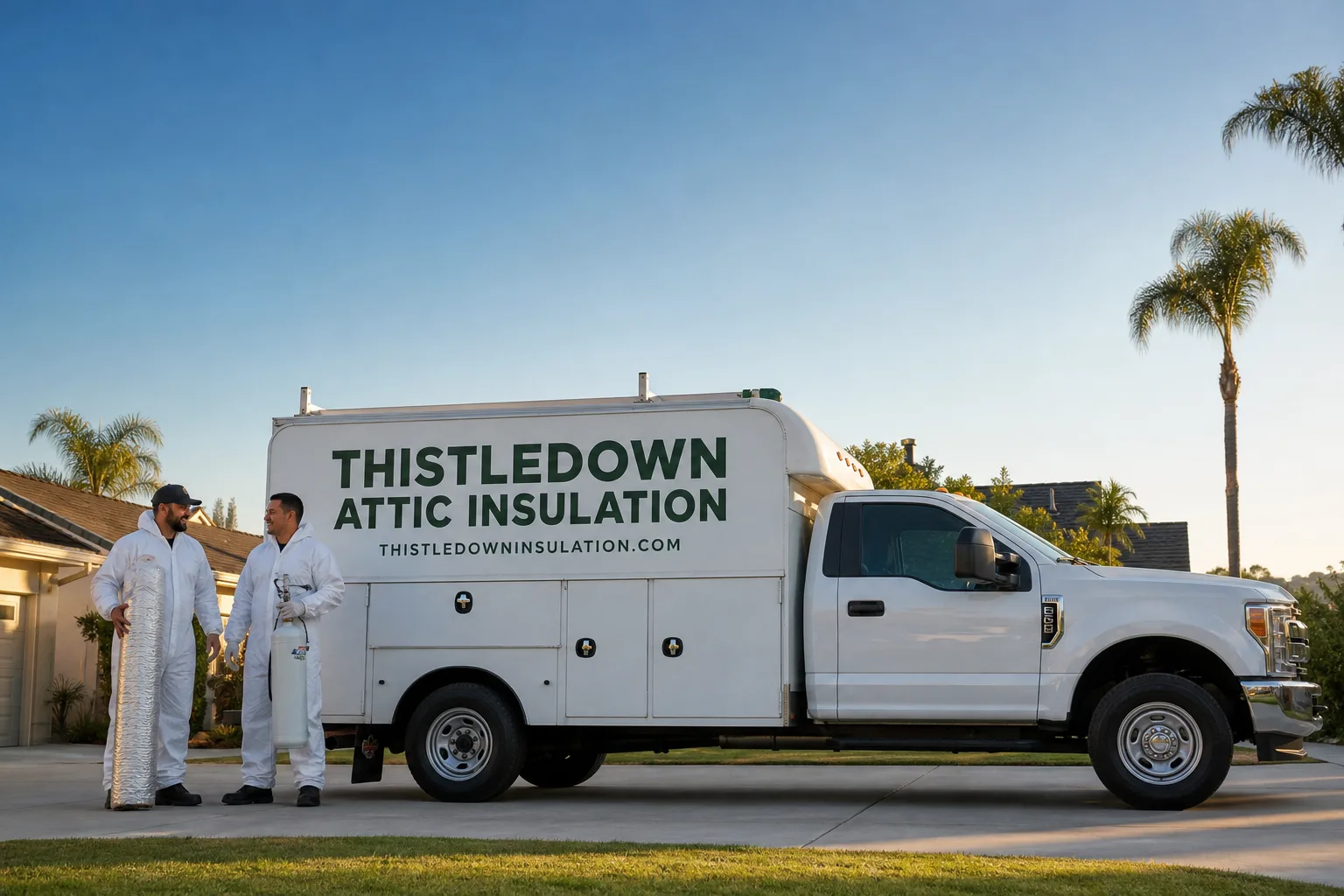
Fast, Reliable Attic Insulation Across Calabasas
Attic insulation in Calabasas costs between $1,800 and $7,500 for a typical luxury home, with mineral wool and closed-cell spray foam running higher than standard fiberglass due to the fire-zone code requirements most of the city falls under. We’ll have a written price in your hands before any work begins, and our crews reach most Calabasas neighborhoods within 60 to 90 minutes of your call. If your attic is baking the upstairs bedrooms and the AC can’t keep up, call us at (909) 768-6501 and a live person will answer, day or night.
We know the homes here. The 1990s semi-custom off Mulholland Highway with the vaulted great room that leaks conditioned air through can-light penetrations. The post-Woolsey rebuild on Park Granada that inherited mismatched insulation from the original footprint. The 5,000-square-foot Mediterranean off Las Virgenes Road with a finished bonus room over the garage that turns into an oven by 3 p.m. These aren’t generic attics, and they don’t get generic solutions.
Why Thistledown Attic Insulation Is Calabasas’s Preferred Attic Insulation Company
We’re a Cedarwell-family company, and we bring the Cedarwell Care Promise to every Calabasas job: shoe covers from the front door to the attic hatch, drop cloths laid across your hallway, and a photo of the clean-up before the van leaves your driveway. The thistle’s downy fluff is one of nature’s lightest insulators, and it’s where our name comes from. The name is a promise about how carefully we work. No other Attic Insulation team in the area makes that promise the way we do.
Our technicians arrive background-checked and in uniform, so you know exactly who’s walking through your door. They ask before moving anything, respect quiet hours when kids are napping, and explain the price before the work, not after. That’s the C.A.R.E. standard we’re held to on every visit, in every home, no exceptions.
Neil Barron, our lead, has built this company since 2003 on a simple rule: put the number in writing first, then do the work like it’s your own attic. Calabasas homeowners tell us the same thing, that the written price and the clean-up photo are why they call us back and why they tell their neighbors.
How Calabasas’s Fire-Zone Rules Change Your Attic Insulation
Here’s something that only applies to Calabasas, not to your friends over the hill. Most of this city sits in a state-designated Very High Fire Hazard Severity Zone, which means California Building Code Chapter 7A governs what can go into your attic assembly. Standard kraft-faced fiberglass batts, while cheap, increasingly fall short of what the fire-zone spec calls for in conditioned attics and where assemblies meet exterior vents. Mineral wool from Rockwool or Johns Manville and intumescent-treated products are what we spec on Calabasas jobs, because they don’t just insulate better; they resist fire spread in ways that matter here. Head into Agoura Hills or Westlake Village and the code conversation shifts. Here, it’s the first question we help you answer.
On top of the code, Calabasas’s bowl-shaped valley geography traps heat. When summer temperatures push past 100°F and Malibu sits 15 degrees cooler fewer than 10 miles away, your attic can hit 150°F. That kind of sustained heat breaks down low-density fiberglass fast and turns air leaks into energy bills you feel every month. The right insulation here isn’t a luxury upgrade. It’s the thing standing between you and an AC system that runs all day and still loses the fight by late afternoon.
Attic Ventilation in Calabasas
Attic ventilation in Calabasas is the difference between an attic that breathes and an attic that bakes. The Santa Monica Mountains block marine airflow, so without proper intake and exhaust venting, heat gets trapped under your roof deck and radiates down into the living space for hours after sunset. Homes along the Calabasas Hills and the ridges off Piuma Road feel this most acutely, where direct sun exposure is relentless from mid-morning until dusk.
Most Calabasas attics we inspect are under-ventilated, full stop. The original 1980s and 1990s builds often have ridge vents but no soffit intake, or soffit vents that someone buried under blown-in insulation. That imbalance chokes the airflow and pushes attic temperatures even higher. Fixing it usually means adding baffles at the eaves, clearing the intake path, and sometimes rebalancing the exhaust side. On a typical Calabasas home, ventilation correction plus air-sealing runs $800 to $2,400 depending on roofline complexity. The hip roofs we see across the Oaks and Mont Calabasas add ridge length and corners that make proper vent placement a real calculation, not a guess.
Ventilation First, Insulation Second
We won’t blow new insulation into an attic that can’t breathe. If your ventilation is short, the new material fights a losing battle. In Calabasas, where attic temps routinely exceed 150°F, we correct airflow before adding R-value.
What a Ventilation Fix Looks Like
We clear clogged soffits, fit baffles to keep insulation from blocking intake, and verify the math on your exhaust venting. The result is an attic that drops 20 to 30 degrees in summer, which extends the life of your insulation and gives your AC room to work.
Radiant Barrier in Calabasas
A radiant barrier in Calabasas isn’t a gimmick, it’s geometry. The valley heat-trap means your roof deck radiates heat downward all afternoon, and a radiant barrier stapled under the rafters reflects a meaningful share of that radiant heat back toward the roof instead of letting it soak into your attic floor. In Calabasas’s custom-home stock, we install radiant barrier as a complement to insulation, not a replacement for it.
Retrofit radiant barrier installation in Calabasas typically runs $1,200 to $3,800 depending on attic size and access. Houses over 4,000 square feet with complex hip rooflines, the norm along Mulholland and near Calabasas Country Club, are at the upper end because the rafter bays are harder to reach. But the payoff is real. Homeowners who combine a radiant barrier with proper insulation and ventilation report attic temperature drops of 25 to 35 degrees in peak summer. That’s the difference between a bonus room over the garage that’s usable and one that drives everyone downstairs.
Where Radiant Barrier Earns Its Keep
Radiant barrier works hardest in Calabasas attics with direct sun exposure and limited shade. If your roof line faces southwest along the hills, you’re a prime candidate. We recommend it on almost every attic we insulate here because the heat load is simply higher than in coastal-adjacent cities.
Combining Radiant Barrier with Mineral Wool
The strongest Calabasas assembly we install pairs a radiant barrier under the rafters with Rockwool mineral wool on the attic floor. The barrier blocks radiant heat, the mineral wool holds the conductive heat back, and the ventilation carries away what’s left. It’s a three-layer defense built for this city’s specific heat profile.
The Woolsey Fire Rebuild Factor
If your home is a post-2019 rebuild, you probably already know the building code changed under you. The Woolsey Fire destroyed or damaged a meaningful number of Calabasas structures, and the homes that rose in their place had to meet updated Title 24 energy standards and Chapter 7A fire-zone rules simultaneously. Most contractors did the minimum on insulation; we see the result weekly. Rebuilds with mismatched materials, new closed-cell spray foam butted against surviving old batts with no continuous air barrier, and attic floors that were never air-sealed before insulation went in. We fix these correctly. We are one of the few local crews that genuinely understands how the Chapter 7A material spec and the Title 24 performance spec have to work together in a Calabasas attic.
Trusted Brands We Service in Calabasas
We install and maintain insulation systems built on Johns Manville, Knauf, Rockwool, and CertainTeed products, and we keep Calabasas-specific inventory on hand for fast turnaround. Rockwool mineral wool gets the most calls from Calabasas homeowners because of the fire-zone requirement. Johns Manville and Knauf batts are the workhorses for non-fire-zone areas and top-ups. CertainTeed is our go-to for homeowners who want a single brand across the whole envelope. When we install a material, we can service it later, and we stock what Calabasas attics actually need, not what’s cheapest to order.
Common Attic Insulation Problems We See in Calabasas Homes
- Degraded kraft-faced batts failing under fire-zone rules. Homes built before Chapter 7A enforcement often have fiberglass batts that have collapsed to R-11 or worse after years of 150°F attic spikes. They don’t meet the current spec, and they’re not doing their thermal job either.
- Vaulted great rooms with open can-light penetrations. The custom ceilings everyone loves in Calabasas are enemies of a tight thermal boundary. Air leaks through can-light housings and around top plates undo the work insulation is supposed to do.
- Mismatched insulation on Woolsey rebuilds. New closed-cell spray foam or mineral wool butted against surviving old batts with no continuous air barrier between them. The seams leak air, and the old material drags down the performance of the new.
- Finished bonus rooms over garages that bake. Bonus rooms above unconditioned garage spaces have floor assemblies that radiate heat upward. Without insulation on the garage ceiling and air-sealing at the perimeter, these rooms run 10 to 15 degrees hotter than the rest of the house.
Pricing for Attic Insulation in Calabasas, CA
A full attic insulation replacement in Calabasas runs $3,200 to $7,500 for a typical 3,500 to 5,000-square-foot home, depending on whether we’re installing mineral wool under the fire-zone spec or a standard fiberglass assembly. Top-ups range from $1,500 to $3,000. Radiant barrier adds $1,200 to $3,800. Ventilation correction runs $800 to $2,400. Air-sealing is typically $600 to $1,800 as a standalone job. Every project gets a written price before any work starts, and our 365-Day Done Right Promise means if something isn’t right, we make it right. Call (909) 768-6501 for a free estimate, and you’ll know your exact number before anyone picks up a tool.
We Also Serve Cities Near Calabasas
Our crews serve Calabasas and the surrounding communities, including Topanga, Agoura Hills, Oak Park, and Westlake Village. So if your attic is in one of those cities and your insulation needs the same level of care, we’ll bring the same written pricing and the same clean-up standard to your door.
Serving Calabasas, CA - Our Local Coverage Area
We’re based in the Calabasas area and know this community well. Use the map below to see our service coverage - if you’re nearby, we can almost certainly help.
FAQs About Attic Insulation in Calabasas
Yes. Most of Calabasas falls under California Building Code Chapter 7A, which requires fire-rated or non-combustible attic insulation materials like mineral wool or intumescent-treated products in many assemblies. Standard kraft-faced fiberglass batts often fall short of the spec. For an exact answer on your home, call (909) 768-6501 and we’ll check your address against the current code map.
Calabasas sits in a bowl-shaped valley ringed by the Santa Monica Mountains, which block marine airflow and trap heat. Malibu, fewer than 10 miles away over the mountains, gets ocean air. Your attic can hit 150°F while theirs barely reaches 115°F. That’s why we recommend radiant barrier and mineral wool in Calabasas more often than we do in coastal-adjacent cities. A free attic inspection will tell you exactly how much heat your roof is holding.
Homes rebuilt after the 2018 Woolsey Fire had to meet updated Title 24 and Chapter 7A requirements, but we regularly find rebuilds where insulation was rushed or mismatched against surviving original material. If your street has a mix of original homes and post-2019 rebuilds, your insulation needs will differ from your neighbor’s. We’ll assess what you actually have before recommending what to change.
Yes, this is one of the most common projects we handle in Calabasas. Bonus rooms over garages bake in summer because the garage below is uninsulated and the floor assembly radiates heat upward. We insulate the garage ceiling, air-seal the perimeter, and often add a radiant barrier to the attic above the bonus room. The result is a room that’s actually comfortable in August.
Expect a thorough walkthrough that takes 45 to 90 minutes. We’ll inspect your attic access, measure insulation depth, check ventilation, test for air leaks around can lights and top plates, and photograph everything. You’ll receive a written line-item price before we leave, and we’ll explain what each line means. No pressure, no vague ranges. Call (909) 768-6501 to schedule yours.
Written by Neil Barron, Owner at Thistledown Attic Insulation, serving Calabasas since 2003.