
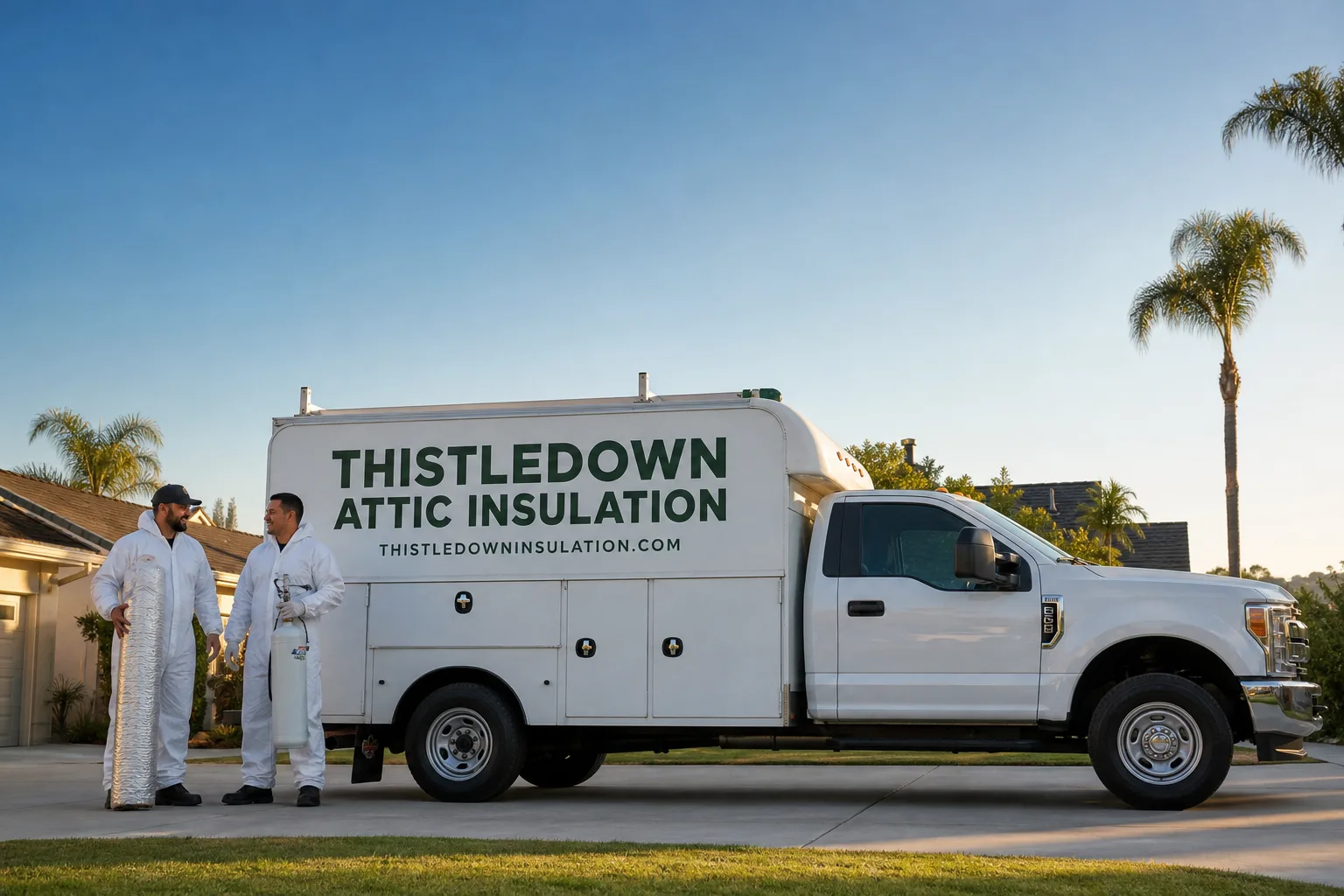
Fast, Reliable Attic Insulation Across Topanga
Attic insulation in Topanga runs on a different set of rules than the rest of Los Angeles County. The canyon sits entirely inside a state-designated Very High Fire Hazard Severity Zone, which means every insulation product we specify here has to clear Chapter 7A Wildland-Urban Interface flame-spread and ignition-resistance requirements. Most basin contractors never pull a material data sheet for that. We do it on every Topanga job, including the 1950s-to-70s cabins with board-and-batten siding and no sheathing that make up so much of this canyon’s housing stock. Call Thistledown Attic Insulation at (909) 768-6501 and you’ll get a written price before anyone touches a rafter.
Why Thistledown Attic Insulation Is Topanga’s Preferred Attic Insulation Company
Topanga homeowners don’t hand out trust easily, and they shouldn’t have to. Our crew shows up in uniform, background-checked, with shoe covers on before the front door closes. That matters in a community where half the houses are custom owner-built cabins with quirks you won’t find in any tract home. We’ve worked off Old Topanga Canyon Road, Topanga Canyon Boulevard, and the narrow switchbacks above Fernwood, and we plan every visit around the driveway realities those roads create.
Neil Barron leads our team, and he holds every job to the Cedarwell Care Promise: clean up like it’s our own home, ask before we move anything, respect the family’s time and quiet hours, and explain the price before the work starts. We carry an eight-brand line including GreenFiber, Owens Corning, and Johns Manville, so we match the product to the attic and the family, not the other way around. And every job is backed by the 365-Day Done Right Promise. If it’s not done right, we make it right. No debate.
Response time to Topanga is same-day for emergency callouts and within 24 to 48 hours for scheduled estimates. A live person answers our phone 24/7, so you’ll never sit through a voicemail tree when you need to know whether the insulation above the nursery is safe.
Attic Mold Removal in Topanga
Attic Mold Removal in Topanga usually means tearing out insulation that absorbed moisture from the marine fog that sits on the PCH end of the canyon for weeks at a stretch. When an attic can’t dry out, mold moves into the fiberglass batting or blown-in cellulose, and the air that circulates down through the house picks up spores along the way. We remove the contaminated material, treat the affected framing, and prep the space for fresh insulation that suits the microclimate where your house actually sits.
Full Removal and Disposal
We bag and haul out everything that’s compromised, down to the last compressed batt wedged behind the rafter tails. The old material goes through proper disposal channels, not into a canyon gully.
Air-Sealing Before New Insulation
Once the attic is empty, we air-seal the top plate, can-light penetrations, and any gaps where warm house air was leaking into the cavity. That step is what keeps the next insulation install from turning into a mold problem again.
Attic Insulation Removal in Topanga
Attic Insulation Removal in Topanga gets called for when a rodent family has taken up residence, a roof leak soaked the existing batts, or the original material from a 1960s cabin build has settled into a thin, useless layer. Older Topanga homes rarely had a proper vapor profile or ventilation plan, so what’s up there is often decades old and doing nothing except holding canyon dust. We remove it completely, inspect what’s underneath, and give you a clean attic ready for material that actually fits the framing.
Rodent and Pest Remediation Prep
When animals have nested in the insulation, we pull everything out so the pest-control phase can happen properly. Insulation full of droppings and urine can’t be “topped up” and shouldn’t be left under new material.
Pre-Renovation Clearing
If you’re tearing into a wall or roof assembly to meet Chapter 7A WUI requirements, the old insulation has to come out before the new ignition-resistant assembly goes in. We time our removal around your framing contractor’s schedule so nobody’s waiting idle.
Trusted Brands We Service in Topanga
We install GreenFiber blown-in, Owens Corning batts, and Johns Manville products in Topanga attics regularly, and we keep the ordering channels warm so material arrives on schedule even with canyon access constraints. Some Topanga jobs call for fiberglass, some for blown-in cellulose, and a few for injection foam behind board-and-batten siding. We don’t push one brand; we read the framing, the WUI requirements, and the family’s sensitivity concerns, then specify accordingly. Pet-safe options exist in several product lines, and we’ll walk you through which ones make sense for your house before you sign anything.
Common Attic Insulation Problems We See in Topanga Homes
- Pre-code cabins with no sheathing. Board-and-batten siding nailed straight to studs means standard batt installs don’t have a cavity that holds insulation the way a tract home does. We typically specify injection foam or dense-pack from the exterior and still have to pull a WUI flame-spread data sheet on the product.
- Irregular stud-bay depths from owner-built framing. We measured one 1962 cabin off Old Topanga Canyon Road where bay widths varied by nearly three inches across a single wall. Loose fill settles unevenly in those conditions, which is exactly when thermal bypasses form along the top plate.
- The canyon’s microclimate gradient cooking one side of the house. A home near the 101 end can run 20 to 30 degrees hotter on a summer afternoon than one down by PCH. Cutting one R-value spec for the whole house ignores that reality and leaves east-facing attics baking while west-facing rooms stay damp.
- Insulation that meets Title 24 but fails Chapter 7A. The VHFHSZ designation applies to every retrofit in Topanga, not just new construction. Standard fiberglass that passes Title 24 may lack the flame-spread rating required in this zone, and a surprising number of contractors never check.
Pricing for Attic Insulation in Topanga, CA
Attic insulation pricing in Topanga typically lands between $1,800 and $6,500 depending on square footage, access, and what’s currently up there. A standard blown-in insulation top-up on a 1,200-square-foot attic runs $1,800 to $3,200. Attic batt insulation replacement across the same footprint runs $2,800 to $5,500. Full attic insulation removal with disposal adds $1,200 to $2,600. Attic mold removal with treatment and air-sealing runs $2,400 to $5,000. Baffles and ventilation prep runs $600 to $1,800. WUI-compliant material specifications can add 10 to 20 percent over basin pricing because we’re pulling data sheets and documenting flame-spread ratings on every product we install here. You’ll have your exact number in writing before any work begins. Call (909) 768-6501 for a free estimate.
We Also Serve Cities Near Topanga
Our crews cover Calabasas, Santa Monica, Agoura Hills, and Oak Park, bringing the same Attic Insulation standards and written-price promise to every job. If you’re in a neighboring community and wondering whether your attic needs the same WUI material review we give every Attic Insulation in Topanga home, call and ask. The answer depends on your fire hazard zone, and we’ll tell you straight.
Serving Topanga, CA - Our Local Coverage Area
We’re based in the Topanga area and know this community well. Use the map below to see our service coverage - if you’re nearby, we can almost certainly help.
FAQs About Attic Insulation in Topanga
Chapter 7A applies to every retrofit and renovation in Topanga’s Very High Fire Hazard Severity Zone, including insulation work on existing cabins. Any material we specify has to clear flame-spread and ignition-resistance requirements, and we document that with the manufacturer’s data sheet before installation.
We typically inject closed-cell foam into the stud bays from the exterior and finish with a WUI-compliant ignition-resistant assembly. The irregular bay depths in those old cabins make blown-in or batt products settle unevenly, so injection foam is usually the only retrofit path that doesn’t require gutting the interior. Call (909) 768-6501 and we’ll walk through what your specific wall assembly needs.
Two reasons: the WUI material documentation adds labor and product-sourcing time, and the access realities of canyon roads and steep lots mean crews haul material farther by hand on many jobs. A hundred feet of hose drag up a switchback costs time, and we price that honestly up front. You’ll see the written number before work starts, so nothing about the cost should surprise you on invoice day.
Yes, and in most Topanga homes we recommend it. Attics here collect decades of canyon dust, marine-fog moisture, and often rodent activity. We remove everything, inspect the framing, air-seal the leaks, and then install material matched to the WUI requirements and your specific microclimate. Estimates for removal and replacement are free.
We pull from GreenFiber, Owens Corning, and Johns Manville among our eight brand lines, selecting products with the flame-spread data sheets that clear Chapter 7A for the specific assembly we’re working in. For board-and-batten cabins with no sheathing, we often specify injection foam. For standard attic floors in newer Topanga builds, blown-in options from GreenFiber or batt systems from Owens Corning are common. We’ll show you the data sheet before we install anything. Call (909) 768-6501 and ask for Neil’s team.
Contact Thistledown Attic Insulation in Topanga
If you live in Topanga and your attic needs insulation work done right, call us at (909) 768-6501. You’ll reach a live person, not a voicemail tree. We’ll schedule a walkthrough, put the written price in your hand before anyone picks up a tool, and show up with shoe covers, drop cloths, and a plan for the specific attic you have. Thistledown is the soft fluff of the thistle, one of nature’s lightest insulators. The name is a promise about how carefully we work.
Written by Neil Barron, Owner at Thistledown Attic Insulation, serving Topanga since 2003.