
Last updated October 8, 2026
The Complete Attic Insulation Guide for Los Angeles Homeowners
Here’s a number most Los Angeles homeowners have never heard: an uninsulated attic in the San Fernando Valley can hit 140°F on a July afternoon, while your living room sits at 72°F. That 68-degree difference means your air conditioner is not just cooling your house. It is fighting a losing battle against a radiant heat panel sitting directly above your ceiling drywall. The Department of Energy publishes a tidy map suggesting R-38 for Los Angeles attics, but that map does not tell you that a 1962 Lakewood-style tract home with 2×4 rafters needs a fundamentally different installation strategy than a 1994 stucco build in Granada Hills. This guide covers what actually matters for Los Angeles homes: the three climate zones that split LA County, the rebates LADWP and SoCalGas are paying out this year, and why wildfire smoke changed the air-sealing conversation permanently. For The Complete Guide to Insulation in Los Angeles, see our dedicated resource.
Quick Answer
The right attic insulation for a Los Angeles home depends on your climate zone, your roof structure, and your home’s age. Most LA homeowners need between R-30 and R-38 of blown-in insulation, with coastal homes requiring less than inland Valley homes. Spray foam makes sense for unvented attics and cathedralized ceilings common in Spanish-style builds. A professional assessment costs nothing, and our Attic Insulation services include a written price before any work starts. Call (909) 768-6501 for a free estimate.
Table of Contents
- Los Angeles Climate Zones: What R-Value You Actually Need
- Insulation Types That Survive a Los Angeles Attic
- Air Sealing and Wildfire Smoke: Why LA Homes Need a Different Approach
- LADWP and SoCalGas Rebates: What You Can Get Right Now
- Los Angeles Attic Structures: Low-Slope, Cathedralized, and Unvented
- What a Proper Installation Looks Like, Step by Step
- Common Mistakes to Avoid
- When to Call a Professional
- Frequently Asked Questions
- The Bottom Line
Los Angeles Climate Zones: What R-Value You Actually Need
Los Angeles County spans three IECC climate zones: 3B along the coast, 4B through the basin and much of the Valley floor, and 5B in the high desert communities like Palmdale and Lancaster. That is a bigger range than the difference between San Diego and Seattle, and it fundamentally changes what “enough insulation” means for your house.
Recommended attic insulation levels by Los Angeles area:
- Coastal zone 3B (Santa Monica, Venice, Long Beach, Redondo Beach): R-30 is adequate. Attic temperatures rarely exceed 85°F. Blown-in fiberglass or cellulose handles the mild cooling load without overpaying for performance you will never use.
- Basin and Valley zone 4B (downtown, Mid-City, Burbank, Northridge, Woodland Hills): R-38 is the minimum that makes sense. Attic temperatures commonly exceed 120°F in summer. This is where the DOE recommendation applies without qualification.
- High desert zone 5B (Palmdale, Lancaster, Santa Clarita edges): R-49 is worth serious consideration. Winter nights drop below freezing, and summer attic temperatures match the Valley. You are insulating against cold as much as heat.
In our experience across Los Angeles, most 1950s through 1980s tract homes were built with R-11 fiberglass batts, or nothing at all. A home built in 1962 in Lakewood or Reseda will often have three or four inches of compressed, dust-choked insulation that performs closer to R-6. Upgrading from R-6 to R-38 is not a marginal improvement. It is a five-fold increase in thermal resistance, and the comfort change is noticeable within a week.
Building codes in Los Angeles County require R-38 for new construction in most areas, but existing homes are exempt unless you are doing a major remodel. That means thousands of LA homes are sitting at a fraction of code minimum without the owner ever knowing.
Insulation Types That Survive a Los Angeles Attic
Not all insulation performs equally when an attic bakes at 110°F for three straight weeks. Some materials sag, some hold moisture, and a few are simply the wrong tool for the job. Here is what works in Los Angeles attics and why.
Blown-In Fiberglass
Blown-in fiberglass is the most common choice for LA attics, and for good reason. It fills irregular joist bays completely, settles predictably, and performs consistently at high temperatures. Unlike batt insulation, there are no gaps at the edges where heat sneaks through. For most Los Angeles homes with standard vented attics and accessible roof lines, blown-in fiberglass from Owens Corning or Knauf delivers the best balance of performance and cost. We typically install 12 to 14 inches to achieve R-38, which covers the entire attic floor in a single pass.
Cellulose
GreenFiber cellulose is made from recycled paper treated with borate fire retardant. It performs slightly better than fiberglass at stopping airflow, which matters for wildfire smoke infiltration, and it offers better sound deadening between floors. Cellulose is heavier than fiberglass, so we verify ceiling drywall is properly fastened before recommending it in older LA homes where drywall nails have loosened over decades of settling.
Spray Foam
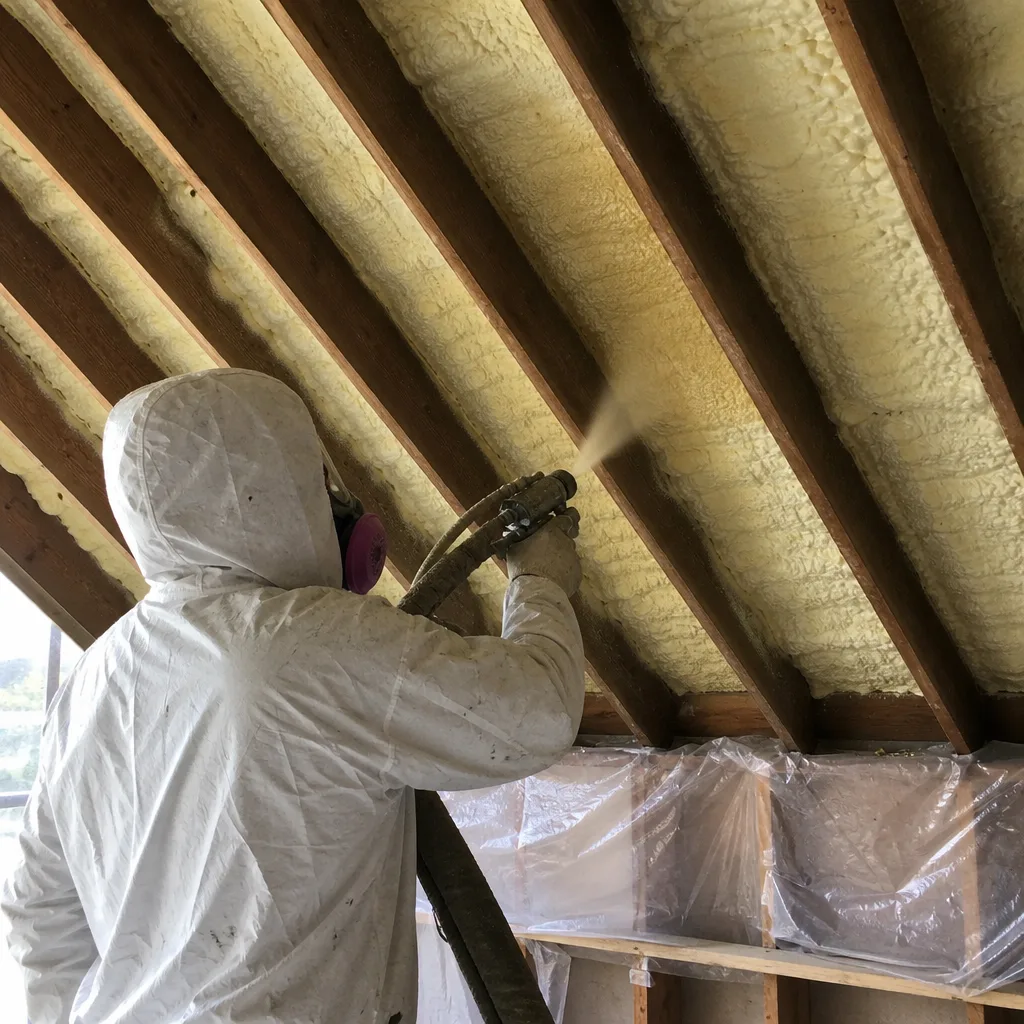
Spray foam is the only practical choice for unvented attics, cathedralized ceilings, and the low-slope roof profiles found throughout older Los Angeles neighborhoods like Silver Lake and Echo Park. Open-cell Icynene foam creates an air seal and insulates simultaneously, which solves the fundamental problem that vented attics were never designed for in Spanish-style and mid-century homes. Closed-cell Demilec foam adds structural strength and acts as a moisture barrier, which is important in coastal zones where marine layer fog routinely penetrates attic spaces. Spray foam insulation in Los Angeles costs more than blown-in products, but for roof assemblies that cannot be properly vented, it is the only solution that prevents condensation and mold inside the roof deck.
Batts
Fiberglass batts are rarely the right primary insulation for a Los Angeles attic. They leave gaps at every joist, pipe, and electrical wire, and in a 130°F attic, gaps measurably reduce performance. We use batts primarily for walls, or for topping off specific areas in cathedralized ceilings where spraying is not feasible. If an installer proposes batt insulation for a flat attic floor, ask why.
Air Sealing and Wildfire Smoke: Why LA Homes Need a Different Approach
National insulation guides treat air sealing as an optional add-on. In Los Angeles, after the wildfire smoke seasons of 2020 and 2025, air sealing is not optional. It is the difference between a house that stays clean inside during a smoke event and one where every vent and electrical penetration pulls outdoor air into the living space.
Your attic is connected to your living space in dozens of ways you cannot see. Recessed light fixtures, bathroom fan housings, electrical junction boxes, plumbing vents, and the attic hatch itself all create pathways for air to move between the attic and the rooms below. In summer, hot attic air pushes down through these gaps. During wildfire smoke events, fine particulate matter rides the same paths, and standard HVAC filters were never designed to handle PM2.5 concentrations from a nearby burn.
Here is what proper air sealing in a Los Angeles attic involves, in order:
- Locate every penetration between the attic and living space, including wall top plates, which are the most overlooked leak point in tract homes.
- Seal penetrations with foam sealant or caulk rated for high-temperature attic conditions. Standard caulk fails when the attic hits 130°F, so product selection matters.
- Address recessed lights by confirming they are IC-rated before any insulation touches them, then sealing the housing gaps.
- Weatherstrip and insulate the attic hatch, which is typically a bare plywood panel leaking conditioned air all year.
- Verify bathroom and kitchen exhaust fans vent to the exterior, not into the attic, which is a code violation found in a surprising number of LA homes.
We air-seal every attic before adding insulation, not as an upsell but as a necessary first step. Adding insulation on top of leaky penetrations is like wearing a down jacket over a torn base layer.
LADWP and SoCalGas Rebates: What You Can Get Right Now
Los Angeles homeowners are in an unusual position: both major utilities offer attic insulation rebates that can cover a meaningful portion of a professional installation. The programs change periodically, so check current amounts before signing a contract, but the fundamentals remain consistent.
LADWP Rebates
LADWP customers (which includes most of the city of Los Angeles proper) can qualify for attic insulation rebates through the utility’s Home Energy Improvement Program. The program pays a per-square-foot amount for upgrading attic insulation to specified R-value thresholds. Homes with little or no existing insulation typically qualify for the full rebate amount. There is no smoke-test here: you need documented R-value before and after, which a professional installer provides as part of the job file.
SoCalGas Rebates
SoCalGas customers in Los Angeles County (primarily outside the LADWP service territory) can access attic insulation rebates through the Energy Savings Assistance Program or the Home Upgrade Program. The Home Upgrade Program combines insulation with air sealing and pays out more when both measures are completed together. This aligns with what we have been saying all along: sealing and insulating simultaneously is the right approach, and the rebate structure rewards it.
Federal Tax Credits
Beyond utilities, the federal government offers a 30% tax credit on insulation materials through the Energy Efficient Home Improvement Credit, capped at $1,200 per year for insulation and air sealing combined. That credit is available to all Los Angeles homeowners regardless of utility provider and can be claimed for the cost of materials, though not installation labor.
Rebate and credit landscape summary for LA homeowners:
- LADWP: Per-square-foot rebate for attic insulation upgrades meeting R-value targets
- SoCalGas: Rebates through Home Upgrade Program, higher payout when air sealing is included
- Federal: 30% tax credit on insulation materials, up to $1,200 annually
- Stacking: Utility rebates and federal tax credits can be combined on the same project
Thistledown Attic Insulation documents every installation in a way that supports rebate applications, which means you are not left assembling paperwork on your own.
Los Angeles Attic Structures: Low-Slope, Cathedralized, and Unvented
The single biggest variable in attic insulation for LA homes is not climate, and it is not budget. It is roof structure. Los Angeles has one of the most architecturally diverse housing stocks in the country, and the insulation strategy that works in a standard gable-roofed Valley ranch does not transfer to a low-slope mid-century in the flats or a 1920s Spanish colonial in West Adams.
Low-Slope Roofs
Homes built throughout the 1950s and 1960s in neighborhoods like the San Fernando Valley, Lakewood, and Westchester often have low-slope or near-flat roofs with minimal attic clearance. In many cases, there is no accessible attic at all: the roof deck sits directly on ceiling joists. Blown-in insulation is impossible in these assemblies. The solution is spray foam applied to the underside of the roof deck, which insulates the structure from above and eliminates the need for attic ventilation. This is one of the most common situations where we recommend spray foam insulation in Los Angeles over blown-in products.
Cathedralized Ceilings
Spanish-style and Mediterranean homes built throughout the 1920s and 1930s often feature vaulted or cathedralized ceilings with no attic space at all. The ceiling drywall is attached directly to the roof rafters, leaving a cavity of four to six inches that must be filled with closed-cell foam to hit any meaningful R-value. Attempting to insulate these with batts creates condensation problems because warm interior air reaches the cold roof deck and condenses inside the cavity. Closed-cell Demilec or Icynene foam solves this by creating a continuous air and vapor barrier, as detailed in The Complete Spray Foam Insulation Guide for Los Angeles Homeowners.
Unvented Attics
Some LA homes have attics that were never properly vented: no soffit vents, no gable vents, no ridge vent. Insulating these spaces with fiberglass or cellulose traps moisture and creates mold. The only correct approach is to convert the attic to an unvented assembly by applying spray foam to the underside of the roof deck. This turns the attic into conditioned space, which is actually a performance upgrade because it removes hot attic air from the equation entirely.
Standard Vented Attics
The classic Los Angeles tract home, whether built in 1955 or 1995, usually has a vented attic with accessible joist bays and a peaked roof. This is the ideal candidate for air sealing followed by blown-in insulation. The work takes one day, costs less than spray foam alternatives, and delivers immediate comfort improvements in the rooms directly below the attic.
What a Proper Installation Looks Like, Step by Step
If you have never watched a professional insulation crew work, you might imagine a couple of guys with a blower hose and a prayer. A proper attic insulation job in Los Angeles involves careful preparation, because the difference between a clean job and a good job is what happens before any insulation leaves the truck.
Here is the process we follow on every attic, and what you should expect from any installer you hire:
- Assessment and written price: A technician inspects the attic, measures existing insulation, identifies air leaks, and documents everything with photos. You receive a written price before any work starts. If a company will not put a number in writing, find another company.
- Preparation: We lay drop cloths across the hallway and the path to the attic hatch. Shoe covers go on at the front door. Furniture is protected, and we ask before moving anything. If family members or pets are home, we use quiet tools and timed work around nap schedules where we can.
- Air sealing: Every penetration between the attic and living space is sealed with high-temperature-rated products. This includes the attic hatch, which receives weatherstripping and a foam board lid.
- Ventilation check: We verify soffit vents are not blocked and install baffles where needed so insulation does not restrict airflow from the eaves. Restricted soffit ventilation is one of the most common causes of premature roof deck failure in Los Angeles homes.
- Insulation installation: The blower hose runs through the attic hatch, and insulation is applied to the specified depth. We use a depth gauge to hit the target R-value consistently across the entire attic floor, not just where convenient.
- Clean-up and documentation: We vacuum the work area, remove all debris, and take a photo of the clean-up before leaving. You see the finished job, including before-and-after shots of the attic itself.
One thing that sets our work apart at Thistledown Attic Insulation home is that every job is covered by the 365-Day Done Right Promise. If the insulation is not done right within the first year, we make it right. No debate, no fine print, no conditional excuses.
Common Mistakes to Avoid
We see the same problems in Los Angeles attics over and over, whether from previous DIY attempts or from installers who cut corners. Here are the mistakes that cost homeowners real money in energy bills, comfort, and sometimes structural damage:
- Adding insulation without air sealing first. Blowing R-38 over leaky penetrations is like closing the shutters but leaving the windows open. Air sealing is the prerequisite step, not an option, especially in Los Angeles where smoke season makes leaks a health issue.
- Blocking soffit vents with new insulation. This is the classic installer error. Insulation piles up to the roof deck and chokes off ventilation, which leads to heat and moisture buildup under the roof sheathing. Proper baffles prevent this, and many crews skip them.
- Guessing at R-value instead of measuring. A visual inspection does not tell you whether you have R-11 or R-30. You need depth measurements and a density check. An installer who quotes a price without measuring is guessing.
- Insulating over knob-and-tube wiring. Homes built before 1950 in Los Angeles may still have knob-and-tube wiring in attics. Insulation over this wiring creates a fire hazard and is prohibited by code. The wiring must be addressed first.
- Using the wrong product in an unvented attic. Blown-in fiberglass or cellulose in an attic with no ventilation will trap moisture and grow mold. Unvented attics require spray foam. This is a conditional truth, not a preference.
- Ignoring the attic hatch. A bare plywood hatch leaks more conditioned air than most people believe. Insulating and weatherstripping the hatch costs an extra 20 minutes and improves performance measurably.
- Choosing the cheapest quote without comparing scope. Two bids for “attic insulation” can mean completely different things. One might include air sealing, baffles, hatch treatment, and cleanup documentation. The other might be a blower hose through a hole. Get the written scope, not just the price.
When to Call a Professional
Attic insulation is not a casual weekend project for most Los Angeles homeowners. The work takes place in a confined, hot, and potentially dangerous space, and doing it wrong creates problems that hide until they become expensive. Call a professional if your attic contains vermiculite insulation from before 1990 (which may contain asbestos), if you have knob-and-tube wiring, if your attic is inaccessible or has less than three feet of headroom, or if you have any doubt about whether the existing insulation is properly installed. Also call a professional if you simply want it done right, documented, and covered by a real warranty. Thistledown Attic Insulation offers free estimates in Los Angeles, a written price before any work starts, and the 365-Day Done Right Promise on every job. Call (909) 768-6501 to schedule your assessment.
Frequently Asked Questions
Attic insulation in Los Angeles typically ranges from $1,800 to $4,500 for a standard 1,200 to 2,000 square foot home, with spray foam projects running higher due to material costs. Your exact price depends on the attic size, current insulation depth, accessibility, and whether air sealing is included. Call (909) 768-6501 for a written quote, which you receive before any work begins.
Most Los Angeles homes need R-38, but coastal homes in climate zone 3B can perform well at R-30, while high-desert areas like Palmdale and Lancaster benefit from R-49. The right answer depends on your specific climate zone, not a national map. A professional assessment determines what your home actually needs.
DIY blown-in insulation is cheaper in materials, but most DIY installations achieve lower effective R-value due to inconsistent depth and missed air sealing. You also forgo utility rebates, which often require professional installation documentation. For a typical Los Angeles home, professional installation with rebates applied is competitively priced with DIY once you account for equipment rental and your own time.
Blown-in fiberglass and cellulose insulation lasts 30 to 50 years in a Los Angeles attic, but performance degrades if the material gets compressed, wet, or displaced by contractors working in the space. Spray foam lasts the life of the building when installed correctly. If your home is from the 1960s and has never been re-insulated, it is due.
We answer calls with a live person 24/7, and in many cases we can schedule an assessment within 48 hours. Installation typically requires one day for blown-in insulation and up to three days for spray foam. Call (909) 768-6501 and we will give you a straight answer about timing.
Yes, when combined with proper air sealing. Insulation alone does not stop smoke from entering through attic penetrations, but the air sealing that precedes a proper insulation installation closes the pathways smoke uses to enter the living space. This is one reason air sealing is standard practice in our Los Angeles installations, not an add-on.
The Bottom Line
Los Angeles attics demand a local approach. The right R-value depends on whether you are in Van Nuys or Venice Beach. The right product depends on whether your roof is peaked or flat, vented or sealed. And the right installation always starts with air sealing, because a Los Angeles attic that leaks air is a problem in every season: heat in August, smoke in September, and cold in January. Upgrading your attic insulation is one of the few home improvements that pays you back every month on your utility bill while making your house more comfortable. Explore more guides & resources to plan your project. The work is quick, the rebates are real, and a written price should always come before any tools come off the truck.
Call Thistledown Attic Insulation at (909) 768-6501 for a free estimate. A live person answers, every call, 24 hours a day. You will get a written price, shoe covers on the floor, and a photo of the clean-up before we leave.
Written by Neil Barron, Owner at Thistledown Attic Insulation, serving Los Angeles since 2003.