
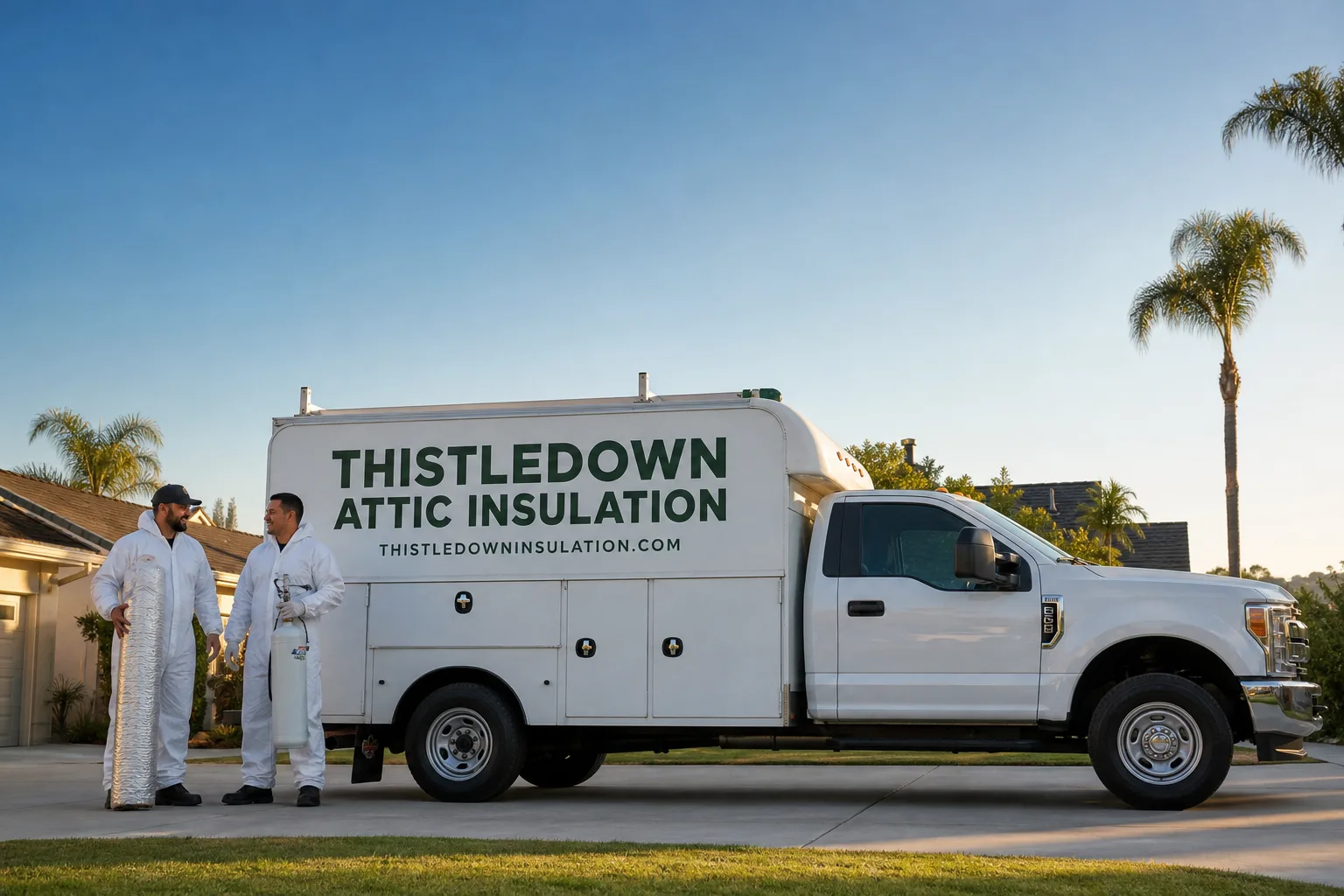
Fast, Reliable Spray Foam Insulation Across Fillmore
Spray foam insulation in Fillmore costs between $2,100 and $7,900 for a typical attic and wall scope, with garage ceiling jobs running $900 to $2,400. The number lands where it does because Fillmore homes sit in a thermal trap: mid-90s summer afternoons with zero coastal cooling, then upper-20s winter nights when cold air drains off the mountains. We get a written price in your hands before anyone picks up a tool. Call (909) 768-6501 and we’ll schedule a scope of your attic, walls, and rim joists, usually within a few days.
We know Fillmore’s citrus-era bungalows and ranch homes differently than a coastal contractor would. A house that looks fine from the street can have wall cavities hollowed out during 1994 Northridge earthquake repairs and never re-insulated. That’s the kind of thing our crews look for before we quote, because it changes the scope and the honest price. If you want an insulation team that checks the walls, not just the attic, you’ll want to talk with us.
Why Thistledown Attic Insulation Is Fillmore’s Preferred Spray Foam Insulation Company
We’re a Cedarwell-family company, founded in 2003 and led by Neil Barron. The crews you’ll see in Fillmore work to the Cedarwell Care Promise: shoe covers and drop cloths from the front door to the attic hatch, quiet tools when children are sleeping, and a photo of the clean-up before the van pulls away. Every visit includes those things. They’re not add-ons and they’re not upsells.
Every Fillmore job gets a written price before work starts, always. That’s not conditional on anything. We also back every job with our 365-Day Done Right Promise: if it’s not done right, we make it right, no debate. Those two guarantees are the reason Fillmore homeowners with kids and pets tend to call us instead of hunting for the lowest bid. You’ll know exactly what product goes near the baby’s room, what the hallway floor will look like after, and what the total is before we start.
Scheduling from our Los Angeles office covers Fillmore directly, and we answer every call with a live person, 24 hours a day. No voicemail trees. If you call at 6 a.m. because you found a cold wall and want to know what it costs to fix, a human picks up.
Garage Spray Foam Insulation in Fillmore
Garage Spray Foam Insulation in Fillmore is one of the highest-value upgrades we do, because most garages here were built as unconditioned storage, not living space. During Santa Ana events, hot dry air pushes through the valley corridor overnight and an uninsulated garage ceiling becomes a heat pump into the rooms above it. We typically spray closed-cell foam directly onto the garage ceiling and rim joist area, sealing the thermal boundary and reducing the temperature swing in the garage by 20 to 30 degrees.
Garage Ceiling Spray Foam
For attached garages with bedrooms above, we spray a continuous layer against the ceiling deck. That closes the gaps fiberglass batts leave at joist ends and around recessed light cans. We use closed-cell foam here because it acts as an air barrier, which matters when the Santa Anas are blowing and dust from the river bottom finds its way into the house.
Rim Joist Spray Foam
The rim joist is where the floor framing meets the foundation wall, and it’s the single most common air leak in Fillmore’s 1920s and 1950s homes. We shoot closed-cell foam into each bay from the crawlspace or basement side. It seals the draft, stops rodent entry points, and does more for comfort than most people expect. A typical rim joist scope in Fillmore runs $1,200 to $3,000 depending on access and linear footage.
Closed Cell Spray Foam Insulation in Fillmore
Closed Cell Spray Foam Insulation in Fillmore is the product we recommend most often for wall cavities and garages, because it adds structural rigidity and acts as an air and vapor barrier in one pass. It’s also the right answer for the empty stud bays left behind after 1994 Northridge earthquake repairs. Where open-cell foam is cheaper but more breathable, closed-cell foam at two inches gives you about R-13 and seals the cavity permanently.
Wall Cavity Retrofit
When we borescope a Fillmore bungalow and find an empty stud bay with new drywall over it, closed-cell foam is the fix. We drill small access points, shoot the foam into the bay, and let it expand to fill the space completely. It bonds to the sheathing and the drywall, so the wall stops moving heat and air. We use low-pressure kits for these retrofits to avoid blowing out old plaster.
Attic Roof Deck Application
For unvented attics in Fillmore, we spray closed-cell foam onto the underside of the roof deck. That moves the thermal boundary from the attic floor to the roofline, which matters when the attic hits 130 degrees in July and the ducts are running through it. Keeping the attic within a few degrees of the house interior reduces cooling load in summer and protects against condensation in winter.
Trusted Brands We Service in Fillmore
We install spray foam from Johns Manville, Knauf, and CertainTeed, and we pair the foam with air-sealing products from Owens Corning and Demilec where the job calls for it. For Fillmore homeowners, that means you’re not locked into one manufacturer’s spec. We choose the foam that matches the cavity depth, the attic configuration, and the moisture exposure, not just whatever is on the truck. If you have a preference or a material allergy concern, tell us during the quote and we’ll work around it.
Common Spray Foam Insulation Problems We See in Fillmore Homes
- Empty stud bays hidden behind Northridge-era patch work. After the 1994 earthquake, wall cavities were opened for structural inspection and repairs. Blown-in cellulose was often vacuumed out and never replaced before new drywall went up. Without a borescope, a contractor would quote the wall as if it were insulated.
- Legacy vermiculite sealed in place. Many citrus-era attics in Fillmore still hold vermiculite or degraded fiberglass from the 1950s and 60s. A careless spray foam application seals that material under the new foam, hiding the original problem instead of solving it. We remove or document legacy material before foaming.
- Under-sprayed eaves and knee walls failing during Santa Ana events. Hot dry air pushed through the valley at night stresses foam that was applied too thin. Coastal specs that work in Ventura don’t hold in Fillmore’s overnight heat spikes. We spray to a depth that accounts for the valley’s thermal trap, not a generic California guideline.
- Mismatched insulation from piecemeal retrofits. One room insulated, the one next to it left bare. That happens when homeowners do partial projects over decades. We find these gaps with a thermal camera and a borescope, then fill them with closed-cell foam so the whole house moves toward one thermal envelope.
Pricing for Spray Foam Insulation in Fillmore, CA
A full attic roof deck scope in Fillmore runs $3,800 to $7,900 for a typical 1,200 to 1,800 square foot ranch. Wall cavity retrofits range from $2,100 to $4,600, depending on how many bays we need to access. Garage ceiling jobs are the smallest scope: $900 to $2,400. Rim joist sealing lands between $1,200 and $3,000. The biggest cost variable in Fillmore is access. A crawlspace with 18 inches of clearance costs less to work in than one with 10 inches, and a 1920s bungalow with original lath and plaster needs more care than a 1980s drywall build. You’ll get your exact written number before we start, and it won’t change mid-job unless you ask us to add scope.
We Also Serve Cities Near Fillmore
Our crews serve Spray Foam Insulation customers throughout the Santa Clara River Valley and into the surrounding foothills. If you’re in Moorpark, Santa Paula, Simi Valley, or Camarillo, we bring the same written-price standard and the same Cedarwell Care Promise to your door. You can learn more about how we work across the region on our Spray Foam Insulation in Fillmore page, or call us directly and we’ll steer you to the right crew.
Serving Fillmore, CA - Our Local Coverage Area
We’re based in the Fillmore area and know this community well. Use the map below to see our service coverage - if you’re nearby, we can almost certainly help.
FAQs About Spray Foam Insulation in Fillmore
Fillmore sits in the Santa Clara River Valley, cut off from the marine layer that cools Ventura and Oxnard. Summer highs run 15 to 20 degrees hotter here, and winter nights drop into the upper 20s when cold air drains off the surrounding mountains. That swing means an insulation spec that works on the coast will underperform in Fillmore. A home here needs an air seal and an R-value sized for both extremes, not just one. Call (909) 768-6501 and we’ll size your scope for the valley, not the coast.
Because wall cavities opened during earthquake repairs were often vacuumed out and closed back up without re-insulation. New drywall over an empty stud bay looks fine from the outside and even feels solid to the touch. A borescope camera sees what’s actually inside. Our crew was called to a 1920s citrus-era bungalow near the Santa Clara River bottom where a Northridge-era patch hid an empty stud bay, making the living room the coldest room in the house. We found it, filled it with closed-cell foam, and brought that cavity back into the thermal envelope before touching the attic. If we quote without looking, we’re guessing, and you’d pay for a guess.
We use closed-cell in Fillmore garages because the valley’s overnight Santa Ana heat events push hot air through eaves and rim joists in a way open-cell foam can’t resist. Closed-cell foam acts as an air barrier and a vapor barrier in one, which matters in a garage that shares a wall or ceiling with living space. Open-cell has its place in some attic applications, but for garage ceilings and rim joists, closed-cell is the right product. We’ll explain the difference with your exact numbers in front of you before you decide.
We install foam from Johns Manville, Knauf, and CertainTeed, and we pair it with air-sealing products from Owens Corning and Demilec where the job calls for it. That matters because different Fillmore homes call for different foam densities and expansion rates. A 1920s lath-and-plaster bungalow needs a gentler retrofit approach than a 1980s drywall ranch. Having eight brand lines lets us match the product to the house, not force the house to fit a single product.
Yes. Mismatched insulation happens when a house gets partial retrofits over decades: one room done, the one next to it bare. We find those gaps with a thermal camera and a borescope, then fill the empty bays with closed-cell foam. The result is one continuous thermal envelope instead of a patchwork. The cost depends on how many bays are empty, which is exactly why we look before we quote. Estimates are free, and a live person answers at (909) 768-6501.
Written by Neil Barron, Owner at Thistledown Attic Insulation, serving Fillmore since 2003.