
Last updated October 8, 2026
Attic Insulation Maintenance Schedule: What to Do and When
Most homeowners in Los Angeles assume attic insulation is a “set it and forget it” upgrade – install it once, ignore it for twenty years. That assumption costs real money. Insulation degrades on a predictable timeline, and the warning signs show up at specific, clockwork moments tied to LA’s seasonal shifts: the first Santa Ana wind event in October, the January cold snap that makes your heater run longer, the April day when your upstairs rooms feel sticky before summer even starts. This guide gives you the exact calendar – what to check, when to check it, what to measure, and which problems you can handle from the attic hatch versus which ones need a trained set of eyes. Thistledown Attic Insulation has provided Attic Insulation services in Los Angeles attics since 2003, and the maintenance schedule below reflects what we actually see in homes from Santa Monica to Pasadena, season after season.
Quick Answer
A practical attic insulation maintenance schedule for Los Angeles homes comes down to three check-ins per year: a January inspection focused on moisture and heating-season performance, an April check for pest activity and cooling prep, and an October inspection after the first Santa Ana winds to catch debris, embers, and pest entry. Between those, you should also check your attic within 48 hours after any strong wind event or heavy rain. Most problems – moisture stains, shifted batts, rodent droppings, dust-caked vents – are visible from the attic hatch with a flashlight, and catching them early prevents the $4,000+ damage scenarios we see when insulation fails quietly for years.
Table of Contents
- Why LA’s Climate Demands a Different Maintenance Schedule
- January: The Moisture Check
- April: The Pest and Cooling-Prep Check
- October: The Santa Ana Wind Check
- After Any Santa Ana or Heavy Rain Event: The 48-Hour Rule
- The $12 Thermometer Test: Detecting Insulation Failure Without Entering the Attic
- How Long Each Insulation Type Actually Lasts in Los Angeles
- Documenting Your Attic: The Annual Photo Record That Protects Your Home Sale
- Common Mistakes to Avoid
- When to Call a Professional
- Frequently Asked Questions
- The Bottom Line
Why LA’s Climate Demands a Different Maintenance Schedule
Most attic maintenance advice online is written for places with four real seasons – freezing winters, humid summers, snow loads on the roof. Los Angeles doesn’t play by those rules. Our home insulation battles happen on a different battlefield: dry heat that bakes attic spaces to 140°F in August, Santa Ana winds that push fine dust and ember material through every vent gap in October and November, and a marine layer that introduces surprising moisture into coastal attics in May and June. The result is that LA homeowners who follow a generic “check your attic in fall” schedule miss real problems that show up on our calendar instead.
Here’s the pattern we’ve seen repeatedly: blown fiberglass or cellulose in a Los Angeles attic loses its rated R-value slowly, maybe 1-2% per year, but it loses performance suddenly when a specific event happens. A raccoon or squirrel tears through a section. A roof leak during a January storm soaks a patch of batts. A bathroom exhaust fan that vents into the attic instead of outside has been pumping moist air up there for three years. None of these happen on a national “fall maintenance” schedule. They happen when LA’s specific seasonal triggers set them off. That’s why the schedule below is built around three specific months and one weather trigger.
We also see a lot of Los Angeles attics that were insulated decades ago and simply don’t meet current performance expectations. Attic insulation in Los Angeles homes built before 1980 often measures R-11 or R-19 – well under the R-30 to R-38 that makes sense in this climate. See our guide to Attic Insulation Warning Signs Every Homeowner Should Know for what underperforming insulation looks like in practice. Maintenance is about more than fixing problems; it’s about knowing when the insulation you have is no longer the insulation you need.
January: The Moisture Check
January in Los Angeles is when your attic reveals whether it stayed dry through the first real rains of winter. Here’s what to do, in order, with a flashlight and about twenty minutes.
- Open the attic hatch and stand still for thirty seconds. Breathe through your nose. You’re checking for a musty, damp smell – that’s the first sign of insulation that got wet and hasn’t dried. If you smell mildew or earth, you have a moisture problem even if you don’t see it yet.
- Shine the flashlight along the underside of the roof decking. Look for dark stains, water rings, or any sheen on the wood. In January, after LA’s first storms, any roof leak will have left its mark already. Stains that are new look darker; older stains have defined edges.
- Check the insulation surface for “compacted channels.” When water drips onto blown insulation, it flattens paths through it as the material settles. Run your light across the top of the insulation at a low angle – channels and depressions will cast shadows. Those are leak paths.
- Inspect the area around any bathroom or kitchen exhaust fans. In January, when windows are closed and cooking and showering happen more, a misdirected vent fan dumps humidity directly into the insulation. Look for condensation on the fan housing or damp insulation within two feet of it.
- Verify that any existing roof leak repairs actually held. If you had a leak repaired in the past year, January is when you confirm it. Previous repair zones are the most likely spot for a repeat.
Moisture is the single most destructive force in a Los Angeles attic, and it’s sneaky because our climate seems dry. But condensation and roof leaks don’t need humidity to do their damage – a single slow drip through the roof decking can soak a 4-foot section of insulation over a month, and that soaked section loses most of its R-value until it dries. If it never dries, mold follows. We see this most often in older homes across Los Angeles neighborhoods like Highland Park and Silver Lake, where roofing underlayments are well past their replacement age.
April: The Pest and Cooling-Prep Check
April in Los Angeles is when attic pest activity becomes visible and when you get your last clean look before summer heat makes the attic uncomfortable to inspect. Rodents, raccoons, and opossums don’t hibernate in LA’s mild winters – they breed, and by April the evidence is hard to miss.
What to look for in April:
- Droppings. Rodent droppings are small, dark, and scattered in trails. Raccoon droppings are larger and usually concentrated in one area, often called a latrine. Squirrel droppings fall somewhere between. Any droppings mean entry points exist.
- Tunnels and trails through blown insulation. Rodents don’t walk on insulation – they burrow through it. Look for depressed channels or cleared paths.
- Shredded material from batts. If you have fiberglass batts, check for areas where the facing has been torn back and the fiberglass pulled apart. Rats and squirrels use batts for nesting material, and a torn batt is a sign they’re using your attic.
- Daylight through the soffit vents or roof edges. From inside the attic on a bright April afternoon, look for any pinpoints of light coming in from outside at the eaves. Those gaps are pest entry points. If a pencil can fit through it, a mouse can too.
- The status of your attic access panel. Is the hatch or pull-down ladder sealed tightly? A surprising number of Los Angeles attics we inspect have access panels that don’t sit flush, leaving a half-inch gap around the edges for both pests and conditioned air.
April is also the right time to prepare for cooling season. Before summer pushes attic temperatures over 130°F, confirm that any installed attic ventilation is working: gable vents should be unblocked by storage boxes, soffit vents should not be covered by insulation (a surprisingly common install error we find in LA attics insulated in the 1990s), and a powered attic fan, if present, should spin up when you switch it on. Blocked ventilation in a Los Angeles summer turns a hot attic into a 150°F oven, and that heat radiates down through your ceiling for hours after sunset. The difference between an attic at 120°F and 145°F is the difference between an AC that cycles normally and one that runs continuously from 3 p.m. to 9 p.m.
When we inspect attics in April across the San Fernando Valley and the Westside, the most common cooling-prep failure is soffit vents buried under years of blown fiberglass. The original installers either didn’t install baffles or the baffles shifted. The fix is straightforward – clear the vent, install or reposition baffles, and the attic’s natural stack ventilation restores itself. That’s a job we handle regularly, and it’s part of what makes attic insulation in Los Angeles a full-system project rather than just a material swap.
October: The Santa Ana Wind Check
October is the highest-risk month for a Los Angeles attic, and almost no generic maintenance guide calls this out. The first strong Santa Ana event of the season – usually mid-to-late October, though sometimes early November – is a stress test for every gap, seam, and vent in your attic envelope.
Santa Ana winds blow from the northeast, off the high desert, at sustained speeds of 40 mph with gusts to 70 mph or more. Those winds carry three things into your attic:
- Fine dust and particulate. Santa Ana wind is abrasive and insidious. It forces itself through the tiniest soffit gaps and carries grit into your insulation. A single strong event can deposit a visible layer of dust on insulation near the eaves. Over years, that dust compacts the insulation surface and reduces performance. More concerning: in fire-adjacent years, the wind carried ash and ember material into attics through unsealed vents – a serious fire-safety concern that no one wants to think about in October.
- Debris. Leaves, small branches, and even palm fronds end up pressed against roof vents and chimney screens. Debris blocking vents is the most common reason an attic stops breathing right when it needs to.
- Pests seeking shelter. Wind events dislodge rodents from outdoor nests and push them toward any structure with a gap. The week after a strong Santa Ana is peak rodent-entry season in Los Angeles. If you hear scurrying in your attic in late October, the wind probably pushed them in.
What to check in October, ideally within 48 hours after the first significant wind event:
- Walk the perimeter of your home and look at every visible vent. Are the screens intact? Is debris jammed against them? Use a broom to clear leaves from any vent that’s blocked, especially down low at the foundation or up near the roofline if you have a ladder and the conditions are safe.
- Check the attic for new dust or ash deposits. Dust concentrated near the eaves after a wind event means air is getting in through soffit gaps.
- Listen for pest activity at dusk. The hour after sunset is when rodents begin to move. Stand in a quiet room upstairs and listen for scratching or scurrying.
- Check that your furnace or heat pump is switching over cleanly. In October, when Los Angeles nights finally drop below 60°F, your heating system turns on for the first time in months. If the duct insulation in the attic has degraded, this is the exact moment the loss becomes obvious – rooms heat unevenly, or the system runs constantly, or you smell something a little stale in the air coming from the registers.
The October heating switchover is a significant diagnostic moment. Ductwork in Los Angeles attics is typically insulated to R-6 or R-8. If that duct insulation was installed years ago and has been compressed, torn, or chewed, the heat your furnace produces loses a meaningful percentage to the unconditioned attic before it ever reaches your rooms. We’ve measured attic ducts in mid-Winter that were losing 25-30% of their output heat through damaged insulation. The first cold snap of October shows you exactly what the summer hid.
After Any Santa Ana or Heavy Rain Event: The 48-Hour Rule
The three seasonal checks above catch the majority of predictable problems. But Los Angeles throws event-specific curveballs, and the right response is a quick, bounded check rather than a full inspection.
Here’s the 48-hour rule: after any Santa Ana wind event with gusts over 50 mph, or any rain event over one inch in 24 hours, spend ten minutes doing these three things:
- Visual vent check from outside. Walk around the house. Look for debris on vents, missing screens, or visible damage to any exterior attic fixtures. You’re looking for the obvious, not doing a roof inspection.
- One-minute attic hatch check. Open the hatch, shine your light around the perimeter of the attic floor you can see, and look for anything new: water stains, displaced insulation, visible debris, new droppings. Don’t enter the attic – just observe from the hatch.
- Downstairs smell and sound check. For the next 48 hours, notice any new musty smell from the vents (indicates water got in) or any new scritching sounds at dusk (indicates something got in).
Ten minutes. That’s the whole event response. The goal isn’t to solve problems – it’s to catch them before they have time to become expensive. A roof leak that gets noticed in 48 hours results in a dried-out attic and maybe a patch of replaced insulation. The same leak noticed in February results in mold growth along the ceiling joists and a $3,000+ remediation quote.
The $12 Thermometer Test: Detecting Insulation Failure Without Entering the Attic
Here’s a technique that takes almost no time and gives you a surprising amount of diagnostic information. Buy a basic probe thermometer – the kind used for grilling or candy – for about $12. You’ll use it three times, on three specific days, in your living space. You never have to enter the attic.
Measurement 1: The summer ceiling test. On a hot August afternoon, around 3 p.m. when the sun has been beating on the roof for hours, place the probe against the ceiling in the middle of an upstairs room. Hold it there for one minute and read the temperature. Now do the same in a downstairs room. If the upstairs ceiling reads more than 5-7°F warmer than the downstairs ceiling, your attic insulation is underperforming. In a well-insulated Los Angeles attic, the ceiling temperature should stay within a few degrees of the indoor air temperature even at peak afternoon heat. A ceiling that reads 85°F in a 75°F room means heat is radiating through the insulation.
Measurement 2: The winter consistency test. On a cold January morning, walk through every room while the heat is running and note where the air from the registers actually feels warm. Rooms that never quite get warm, even when the thermostat says the house is comfortable, often have duct runs passing through poorly insulated or uninsulated attic space. If one bedroom is consistently 3-4°F cooler than the rest of the house, something is wrong with either the duct insulation or the attic insulation above that room.
Measurement 3: The after-sunset differential. On any clear day, take a ceiling temperature reading at 5 p.m. and another at 8 p.m., both in the same upstairs room. A good attic should have radiated enough of its daytime heat by 8 p.m. that the ceiling temperature has dropped noticeably – 10°F or more. If the ceiling is still warm to the touch at 8 or 9 p.m., the insulation is holding heat too long, which usually means either it’s too thin or it’s been compacted and lost its air pockets.
None of this requires climbing into an attic. These are diagnostic signals that something has changed in the thermal barrier between your living space and the attic. When the numbers tell you something’s off, that’s the moment to bring in a professional look – and doing so before you’ve lost a full summer of cooling or a full winter of heating to the attic keeps the cost contained. Our Attic Insulation Troubleshooting: Common Problems and How to Fix Them walks through what professionals check first.
How Long Each Insulation Type Actually Lasts in Los Angeles
Manufacturers publish lifespan estimates, but in our experience those numbers are national averages that don’t reflect what Los Angeles attics actually experience. Here’s what we observe in the field, organized by material.
Blown Fiberglass
Blown fiberglass – the fluffy pink or white stuff – doesn’t rot or attract pests the way organic materials do. In a dry, well-ventilated LA attic, blown fiberglass can perform adequately for 30 to 40 years. But it settles. Over two decades, blown fiberglass can lose 15-20% of its original depth just from gravity and vibration, and any area where a person walked, boxes were stored, or a previous pest problem occurred settles faster. The real degradation early on is from compression, not material failure. We often find Los Angeles attics with fiberglass that was installed at R-38 but now measures R-24 to R-28 simply because it settled. When we inspect, we measure depth at multiple points – not just near the access hatch where it looks undisturbed.
Blown Cellulose
Blown cellulose, made from recycled paper treated with fire retardant, has a shorter practical life in Los Angeles for one specific reason: moisture. Cellulose absorbs and holds moisture far more readily than fiberglass. In a dry attic it can perform well for 20-30 years. In an attic with even a mild recurring moisture problem – a slow roof leak, a humid bathroom vent, a poorly sealed hatch – cellulose compacts dramatically and can support mold growth within a few years. We see this most in older LA homes with flat roofs, where drains and scuppers age and fail quietly. In those houses, cellulose that looks fine from the hatch can be a dense, molded mat in the far corners. If your Los Angeles home has cellulose insulation and has had any roof work done in the past decade, the October moisture check matters more for you.
Fiberglass Batts
Batts lose performance through three mechanisms: compression (from boxes or storage), air gaps around the edges (from sloppy original installation), and pest damage (rats and squirrels love tearing them apart for nesting). In Los Angeles, pest damage is the big one. We routinely see batts that are structurally fine everywhere except the two or three bays where rodents have torn the facing off and pulled fibers into nests. Performance-wise, batts are only as good as their contact with the framing. A batt that’s been lifted and reset several times during cable work, fixture changes, or pest remediation will never fit as tightly as it did originally. Realistic practical life in a Los Angeles attic: 20-30 years, but with a meaningful performance penalty for every one of those years it spent with air gaps or pest damage.
Spray Foam
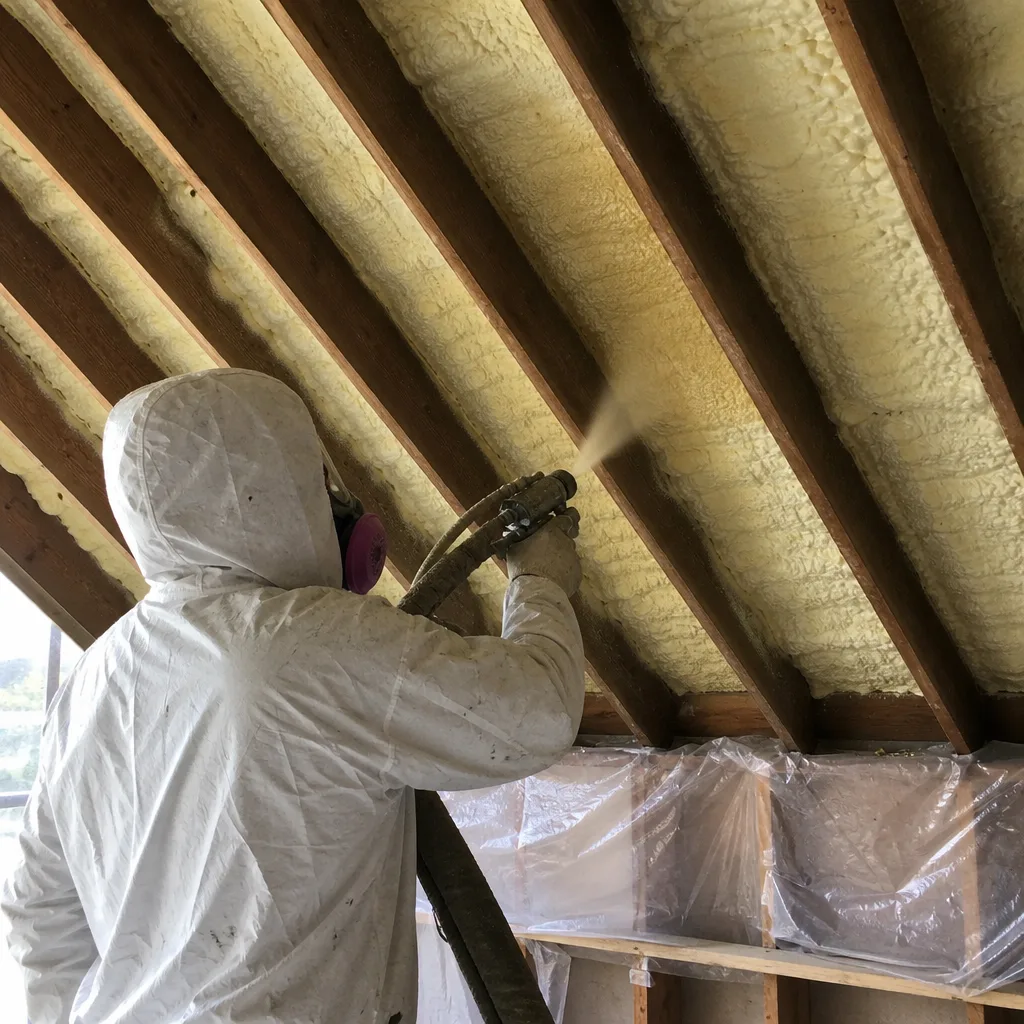
Closed-cell spray foam is the longest-lived insulation we install. In a Los Angeles attic, properly installed closed-cell spray foam can maintain its thermal performance effectively for 50+ years. The foam itself doesn’t settle, doesn’t compress, and pests can’t use it for nesting. This is a primary reason homeowners choose spray foam insulation in Los Angeles when they want a once-and-done solution. What does degrade is the roof decking and framing surrounding the foam if there’s an unaddressed leak – spray foam adheres so tightly that a roof leak can create a trapped moisture zone between the foam and the sheathing, with no visible way to detect it. With spray foam, the maintenance schedule shifts: your checks are about the roof above it, not the insulation itself. Brands we install like Icynene and Demilec produce closed-cell foams that, in our field experience, show no measurable performance loss in attics we’ve revisited after a decade or more.
The practical takeaway for a Los Angeles homeowner: blown fiberglass and batts need depth checks and condition checks every few years; cellulose needs moisture checks; spray foam needs roof-integrity checks. Wrong maintenance for the wrong material means missed problems.
Documenting Your Attic: The Annual Photo Record That Protects Your Home Sale
Here’s a habit that takes fifteen minutes a year and can save you thousands when you sell your home. Once a year – we suggest the January check, since it’s already on your calendar – take a set of dated photos of your attic.
What to photograph:
- The attic as seen from the hatch. That’s the wide shot showing your general condition.
- The insulation surface, close up. Get down low and photograph the texture and depth of the insulation. Include a ruler or measuring tape in the frame if you have one, showing the depth at a few different points. This is your documented R-value evidence.
- The roof decking. Rotate through four quadrants of the attic and photograph the underside of the roof sheathing. These photos are your leak record – or your proof that no leaks existed.
- Any vents or fans. Photograph the soffit vents, gable vents, and any exhaust fan terminations.
- Any areas that concern you. If you saw something in the January check that isn’t urgent but bears watching – a small stain, a slightly sagging section – photograph that specifically, and then re-photograph it next year to see if it changed.
Store the photos with their dates in a labeled folder. When you sell, and a buyer’s home inspector enters the attic and reports something that contradicts what you know about the house, you now have a dated, documented condition trail. You can say: “Here is what the attic looked like in January of every year we owned the home.” That’s powerful. It reframes the conversation from a dispute into a record. This is especially valuable in Los Angeles, where hot market conditions push buyers to inspect quickly and sometimes sloppily, and sellers want every piece of evidence that the home was maintained thoughtfully.
We also recommend photographing before and after any professional work in the attic – insulation removal, pest remediation, duct replacement. The “before” set documents what was found; the “after” set documents what was done. When we install attic insulation in a Los Angeles home, we leave the customer with a complete photo file of the attic condition before and after the work. It’s part of the written record we believe every homeowner deserves.
Common Mistakes to Avoid
- Checking the attic only when something goes wrong. By the time you can feel the failure – rooms too hot in August, too cold in January, odors from the vents – the problem has often been developing for a year or more. The maintenance schedule above is about catching things before you feel them.
- Inspecting from the hatch and calling it done. From the hatch, you can see maybe 15-20% of your attic. The far corners, the eaves, the areas behind duct runs and equipment – those are where real problems hide. A proper inspection moves through the attic or uses a professional with the right access.
- Ignoring the bathroom vent fan. Every exhaust fan that terminates inside the attic is pumping hot, humid air into your insulation every time someone showers. In Los Angeles, where we think of ourselves as living in a dry climate, this feels counterintuitive – but a family of four running two showers a day generates substantial attic moisture over a year. This is the most common problem we find in LA attics that otherwise look fine.
- Treating all insulation as the same. The maintenance a fiberglass attic needs is different from what a cellulose attic needs, which is different again from spray foam. Understanding what you have is step one. If you don’t know, the January check is the time to find out.
- Relying on the previous owner’s word. “The insulation was done in 2005” is often a guess. We’ve inspected attics where the insulation was actually original to a 1960s build despite a seller’s claim. Measure, photograph, and verify rather than assuming.
- Procrastinating on small fixes. A missing vent screen, a shifted baffle, a damp section of insulation near a vent pipe – each is a minor repair on its own. Left for a few years, each one becomes a bigger project. The whole point of a maintenance schedule is that small, regular attention costs less than big, occasional repairs.
When to Call a Professional
Some maintenance tasks are genuinely doable from the hatch with a flashlight. Others aren’t. If you find any of the following in your seasonal checks, it’s time to call a professional rather than attempt a fix yourself. Moisture that has clearly migrated through the insulation, widespread pest contamination, electrical wiring that’s been chewed, anything requiring entry into deep attic spaces with confined crawl areas, or any work involving spray foam application. California OSHA rules govern attic work conditions – the heat, the air quality, the structural access – and professional crews are equipped and trained for those environments.
If you’ve found something that concerns you, or if you simply want a professional assessment of where your attic stands, Thistledown Attic Insulation offers free estimates in Los Angeles – call (909) 768-6501. We’ll inspect what you have, document it in writing, and give you a clear-eyed picture before any work is discussed.
Frequently Asked Questions
In Los Angeles, blown fiberglass typically lasts 30-40 years, batts 20-30 years, blown cellulose 20-30 years in a dry attic but significantly less if moisture intrusion occurs, and closed-cell spray foam 50+ years. Replacement isn’t about hitting a magic age – it’s about measured depth, visible condition, and whether your home’s current insulation actually meets the R-30 to R-38 level that makes sense for this climate. Call (909) 768-6501 for a professional assessment if you’re not sure what you have.
Signs include uneven room temperatures between floors, ceilings that feel warm to the touch in summer, a heater that runs constantly in winter without comfortable results, rising energy costs without a clear cause, musty odors from vents, and visible issues found during your seasonal checks like moisture stains, pest trails, or settled insulation. Any of these warrants a closer look.
Yes, from the attic hatch with a flashlight, you can safely observe conditions across the visible portion of your attic – looking for water stains, pest evidence, settled areas, and visible debris. Full attic entry is a different matter. Attic spaces in Los Angeles reach 130-150°F in summer, and California OSHA rules govern working conditions in confined attic spaces. For anything beyond hatch-level observation, a professional crew with proper safety equipment is the right call.
Yes, and the effect can be substantial. Insulation that has settled, been compressed, or sustained moisture damage loses a meaningful percentage of its thermal performance. Restoring or replacing it means your AC and heater work less to maintain indoor temperature – and in Los Angeles, where cooling drives energy costs for most of the year, an attic performing correctly can reduce summer cooling load significantly. The maintenance schedule above is designed to catch performance loss early.
Attic insulation replacement in Los Angeles generally ranges from $1,500 to $6,000 depending on square footage, insulation type, whether old material needs removal, and whether accessibility improvements are needed. Fiberglass batt or blown fiberglass replacement trends toward the lower end of that range; closed-cell spray foam toward the higher. Every job we do gets Thistledown Attic Insulation‘s written price before any work begins – a fixed number, not an estimate range. Call (909) 768-6501 for your exact number.
In most cases, yes. Homes in Los Angeles built before 1980 frequently have R-11 to R-19 attic insulation, far below the R-30 to R-38 that works well in this climate. Upgrading is one of the highest-return improvements you can make in terms of comfort and energy efficiency, and with professional installation, it’s a one-time project that pays dividends for decades. The annual maintenance schedule in this guide keeps that investment performing.
The Bottom Line
Attic insulation in Los Angeles doesn’t fail randomly – it degrades on a schedule tied to seasonal events, and the homeowners who mark three dates on their calendar catch most problems before they cost real money. January for moisture, April for pests and cooling prep, October for Santa Ana damage and heating-season performance. Ten minutes at the attic hatch, a $12 probe thermometer, and a set of dated photos each year build a maintenance record that protects your comfort, your budget, and your eventual home sale. When you find something that needs professional attention, the call is simple.
Written by Neil Barron, Owner at Thistledown Attic Insulation, serving Los Angeles since 2003.