
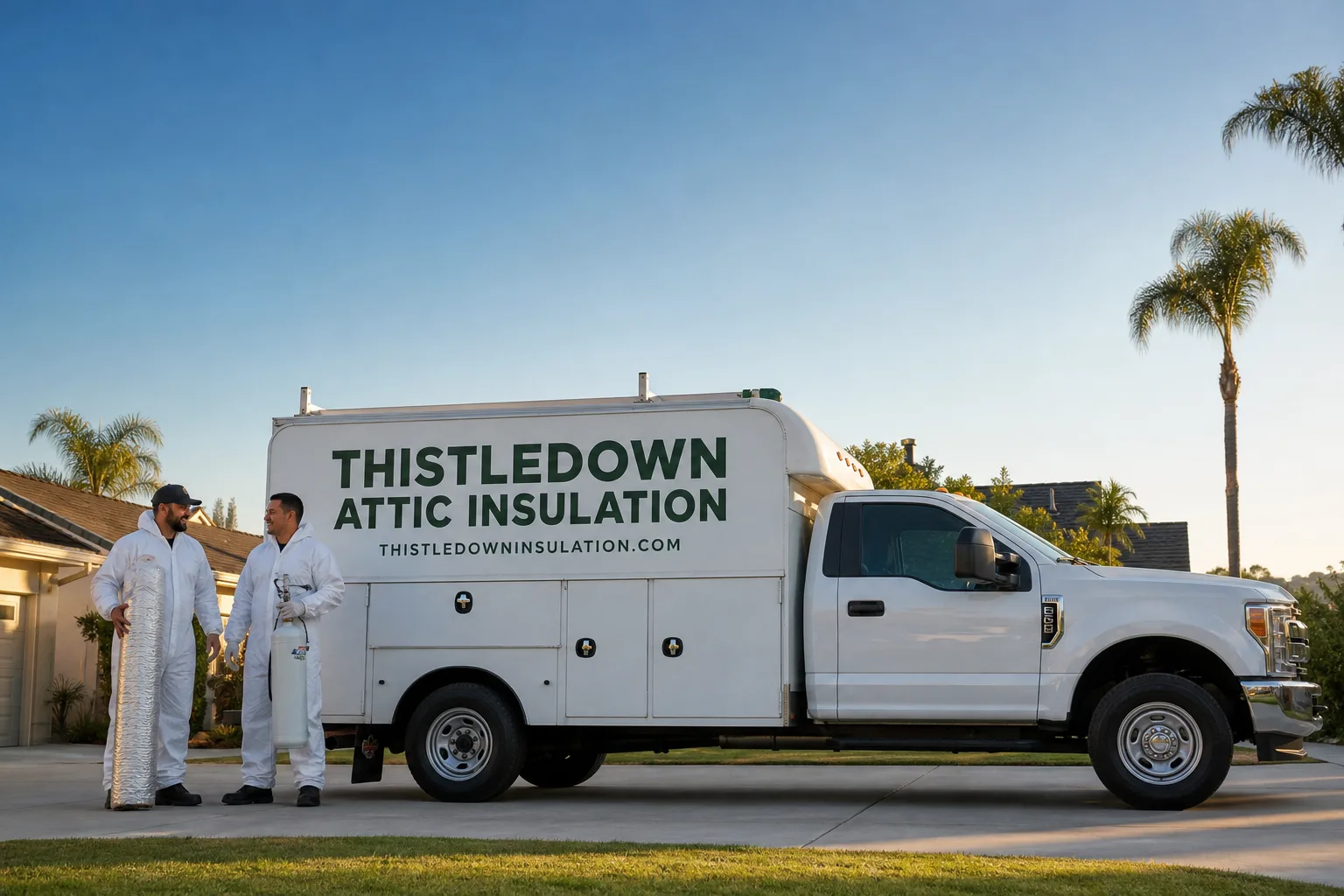
Fast, Reliable Attic Insulation Across Eastvale
Attic insulation in Eastvale is less about adding fluff and more about correcting a single, repeating construction flaw across the city’s 2004 – 2016 tract-built homes. Most attics here carry the original code-minimum blown fiberglass or batts, now settled and underperforming, while unsealed recessed can lights punched through top plates pull cooled air straight into a 150°F attic every July afternoon. Thistledown Attic Insulation knows this housing stock street by street, and we fix it with a written price before any work begins. Call (909) 768-6501 for a free estimate.
Why Thistledown Attic Insulation Is Eastvale’s Preferred Attic Insulation Company
Eastvale homeowners keep our number for one reason: we name the exact problem before we touch the attic hatch. The city’s uniformity means our crew can walk a home off Citrus Street or along Scholar Way and predict what we’ll find, settled R-30 that’s now performing closer to R-19, open-top plate penetrations above recessed lights, and no radiant barrier anywhere in the original build. That’s not guesswork. It’s the same diagnosis we’ve completed in hundreds of nearby tract homes, and it means a faster quote and a tighter scope of work.
We’re an independently owned Cedarwell-family company, held to the Cedarwell Care Promise on every visit. Shoe covers go on at the front door. Drop cloths run from the entry to the attic hatch. Quiet tools when a baby is sleeping. Background-checked, uniformed technicians answer to Neil Barron, and a live person answers our phones 24/7, no voicemail tree. When we finish, you get a photo of the cleaned-up attic before the van leaves your street.
Crews serving Eastvale are dispatched from our Inland Empire office, so response times run short. Same-day and next-day appointments are common. The 365-Day Done Right Promise backs every job: if it’s not right, we make it right, no debate.
Insulation Contractors in Eastvale
Insulation contractors in Eastvale need to understand one thing most out-of-town companies miss: the city was built almost entirely between 2004 and 2016, which means nearly every attic was insulated to a Title 24 minimum that California has since superseded. The job here isn’t difficult to diagnose, but it is repetitive. We find the same settled batts, the same unsealed HVAC boots, and the same unsealed IC-rated recessed can lights in house after house. When you call Thistledown, you’re hiring a contractor who has already mapped this pattern.
Attic Top-Up and Full Replacement
Where original insulation has settled below code or been disturbed by rodents, a top-up may be enough. We blow Owens Corning fiberglass over the existing layer to restore a true R-38 to R-49. Where moisture, vermiculite, or heavy soiling is present, we recommend full removal and replacement, with pricing set in writing before the first bag of material is carried up the ladder.
Air Sealing Around Recessed Cans and Boots
Eastvale’s original builders routinely cut recessed can lights through top plates and left them unsealed. That’s a direct convective chimney between your air-conditioned bedrooms and a 150°F attic. We seal each can with a fire-rated cover, seal HVAC boots at the drywall, and then blow insulation back over the entire plane.
Attic Ventilation in Eastvale
Attic ventilation in Eastvale does double duty: it protects the insulation you just paid for, and it protects the roof deck. Attic temperatures in the Chino Valley regularly exceed 150°F from June through September. Without balanced intake and exhaust ventilation, that heat radiates down into second-story bedrooms no matter how much fiberglass sits on the attic floor. Our Attic Insulation team checks ridge vents, eave vents, and gable vents on every job, because insulation without airflow performs like a blanket over a fever.
Baffles and Soffit Vent Prep
Before we blow new insulation, we install baffles at every soffit vent to keep the airflow path open. Blown fiberglass without baffles piles against the roof deck and chokes off the intake vents. Your attic stops breathing, and your cooling season gets longer. On Eastvale two-story tracts, a plugged soffit line is the difference between a 78°F upstairs and an 82°F one.
Radiant Barrier Retrofit
Original Eastvale construction included no radiant barrier. In a city where summer highs sit 15 to 20 degrees above coastal Orange County just 20 miles west, that’s a meaningful omission. We install radiant barrier under the roof deck to reflect solar gain before it becomes attic heat. Paired with fresh insulation and sealed penetrations, it turns a hot-box attic into a passive thermal boundary.
Trusted Brands We Service in Eastvale
We install and maintain insulation from Owens Corning, Johns Manville, and Knauf, and we match the product to the attic. Pet-safe options exist where a material choice matters, so the dog can stay home during the job. We keep common blow-in equipment and baffle stock staged for Eastvale jobs, which means fewer second trips and a faster turnaround when you schedule your free estimate. You’ll always know the brand going over your head before it’s installed.
Common Attic Insulation Problems We See in Eastvale Homes
- Unsealed IC-rated recessed can lights. Volume builders from the 2005 – 2012 boom punched these through top plates, rated them, and left the drywall gap open. On a July afternoon, we measure attic air at 150°F moving through those cans into the kitchen and bedrooms.
- Settled code-minimum blown fiberglass and batts. Original R-30 has compressed to roughly R-19 in many attics after years of foot traffic, roof work, and gravity. The thermal envelope is quietly failing while the house looks fine from the street.
- Missing radiant barrier. Not one original Eastvale tract we’ve inspected came with a radiant barrier. The roof deck absorbs direct sun and radiates heat into the attic all afternoon, adding load to the AC exactly when it matters most.
- Blocked soffit ventilation. Blown-in insulation from the final builder pass often buries the soffit vents. Without intake airflow, ridge vents pull from nowhere, and the attic becomes a stagnant heat trap.
Pricing for Attic Insulation in Eastvale, CA
In Eastvale’s market, a straightforward attic top-up on a 2,500 sq ft two-story typically runs $1,900 to $3,200, depending on the current R-value and whether baffles need replacing. Full removal and replacement of settled builder-grade insulation runs $3,500 to $5,800. Adding a radiant barrier typically adds $1,400 to $2,400. Air sealing around recessed cans, HVAC boots, and top plates runs $600 to $1,200 as an add-on. You’ll receive your exact written number before any material is loaded into the attic, never an estimate with a spread.
What moves the price: attic square footage, depth of existing insulation, how many recessed cans need sealing, and whether the old material can stay or must be pulled. We’ll walk you through the line items at the estimate. Call (909) 768-6501 and a live person will schedule it.
We Also Serve Cities Near Eastvale
Beyond Eastvale, our crews regularly cover the broader Southern California region, including the Los Angeles basin and Orange County edge. We also take on multi-property clients in San Diego, San Jose, and San Francisco, when the job calls for the same written-price discipline and Cedarwell Care Promise we bring to every Eastvale attic.
Serving Eastvale, CA - Our Local Coverage Area
We’re based in the Eastvale area and know this community well. Use the map below to see our service coverage - if you’re nearby, we can almost certainly help.
FAQs About Attic Insulation in Eastvale
Because Eastvale was built almost entirely by the same handful of volume builders between 2004 and 2016, using plans that placed IC-rated recessed can lights through top plates without air sealing. The rated can stops the fire risk but not the airflow. We can walk a single street off Schleisman Road and find the identical convective leak in nearly every attic. Call (909) 768-6501 for an attic audit, and we’ll show you exactly where your air is going.
Yes. Eastvale sits in the inland Chino Valley, where summer highs routinely exceed 105°F, pushing attic temperatures past 150°F. That heat accelerates settling and bakes the resins out of builder-grade batts. Insulation installed to mid-2000s Title 24 minimums is performing below the current code baseline in most Eastvale attics we inspect.
For most Eastvale two-story tract homes, yes. Original construction included no radiant barrier, and a roof deck absorbing direct sun for 10 hours a day is your single largest source of attic heat. Radiant barrier under the roof deck reflects that energy before it becomes attic air temperature. Pair it with sealed penetrations and fresh insulation for the full effect.
Because insulation and ventilation work as one system. Insulation slows conductive heat transfer. Ventilation removes the convective heat that gets through anyway. In Eastvale, a 150°F attic with poor ventilation will radiate downward into second-story bedrooms even with R-38 overhead. Balanced intake and exhaust airflow plus baffles at every soffit make the insulation perform at its rated value.
Eastvale’s cool winter nights, with occasional frost, create a temperature swing that works the thermal envelope in both directions. A summer-only fix, like adding a radiant barrier without air sealing, leaves the same open penetrations pulling heat out of the home in December. Year-round performance means sealing the leaks, restoring the R-value, and ventilating properly, so the attic handles both the 105°F afternoons and the 35°F mornings. Call (909) 768-6501 for a free estimate and a written price before we touch a rafter.
Written by Neil Barron, Owner at Thistledown Attic Insulation, serving Eastvale through the Cedarwell-family commitment to clean work, honest pricing, and attics that actually hold temperature.