
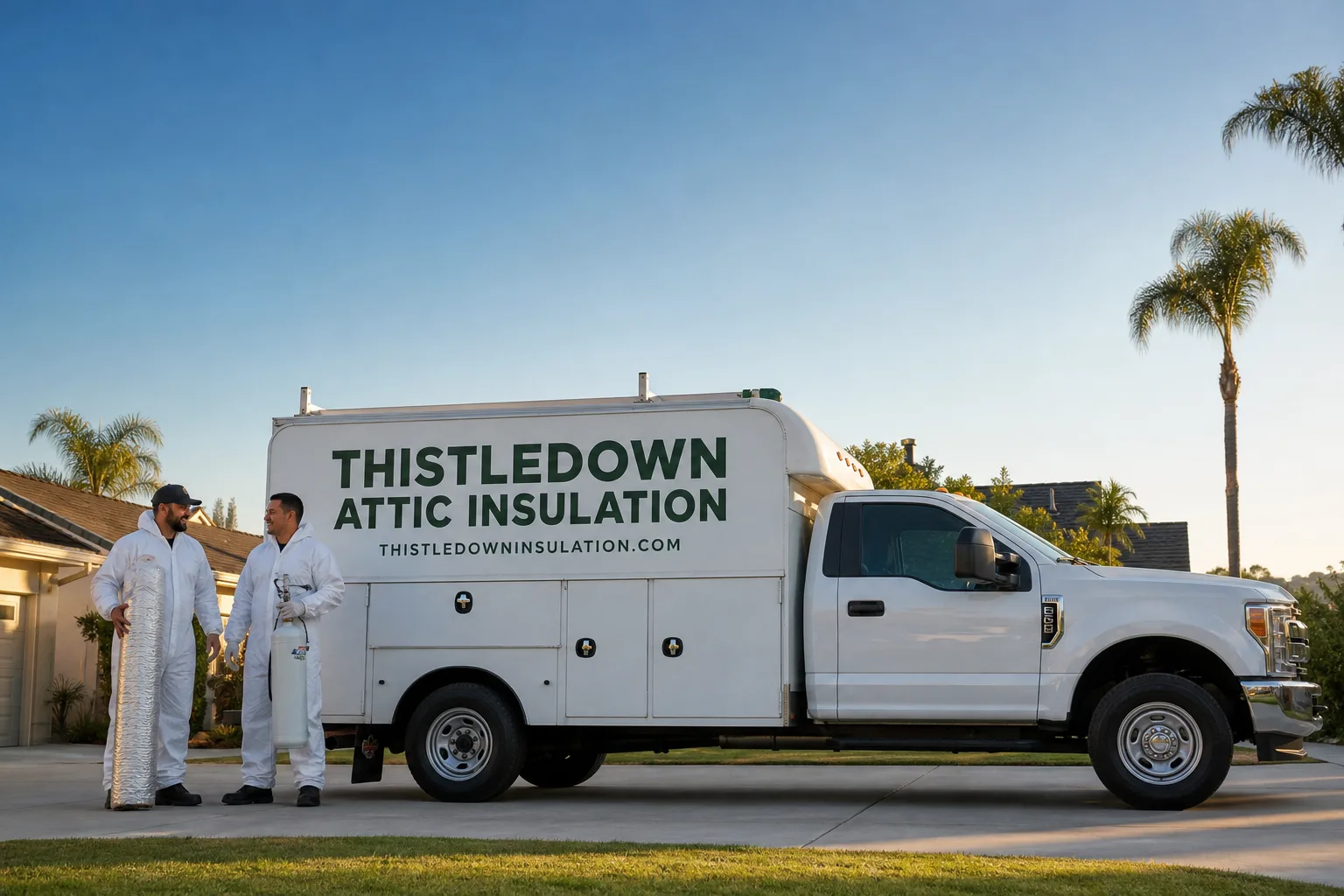
Fast, Reliable Attic Insulation Across Avocado Heights
Attic insulation in Avocado Heights typically runs $1,450 to $3,900 for a full retrofit on a 1,200-square-foot home, and most jobs are completed in a single day. That number covers blown-in fiberglass over an air-sealed attic floor. If you’re in one of the 1950s orchard-tract homes off Don Julian Road or near Avocado Heights Park, your price will land on the higher end because those low-slope roofs and uninsulated wall cavities demand more prep work. Call (909) 768-6501 and we’ll give you a written number before any material hits the attic.
We work throughout Avocado Heights every week. The neighborhoods east of the San Gabriel River and west of the 605, the streets that used to be citrus rows back when Don Julian was a dirt lane: we know these houses. We know what a 1962 tract home sounds like when the attic fan kicks on at 4 p.m. in August. We know where the raccoons get in through the low-slope eaves.
Why Thistledown Attic Insulation Is Avocado Heights’s Preferred Attic Insulation Company
Most of the work we do in Avocado Heights involves houses that were built before insulation was required by code. The original material, if any was installed, is now compressed to a fraction of its rated R-value, or torn up by decades of rodents and roof leaks. Our crews see it every week. The difference is we explain what we’re finding before we ask you to spend anything.
Every Avocado Heights job gets the full Thistledown standard: background-checked, uniformed technicians, shoe covers from the front door to the attic hatch, drop cloths across the hallway, and a photo of the cleaned-up attic before we leave. That’s the Cedarwell Care Promise, and it’s not an upsell. It’s the baseline.
Our Attic Insulation team answers calls with a live person at any hour. Not a voicemail tree. When you call at 9 p.m. because the attic hatch is radiating heat into the upstairs hallway, a person picks up. We’ll schedule a crew in Avocado Heights within the week, and often sooner.
Attic Ventilation in Avocado Heights
Attic Ventilation in Avocado Heights is the difference between an insulated attic that works and one that cooks itself from below. These low-slope orchard-tract roofs trap heat in a way steeper roofs don’t. Without proper airflow, the attic hits 140°F in July, and that heat conducts straight through your ceiling no matter how much insulation sits on the floor. Ventilation is usually handled before insulation goes in.
Soffit And Ridge Flow Corrections
Many Avocado Heights homes have soffits that were painted shut, blocked by blown-in insulation, or never vented properly at all. We clear or install soffit vents, add baffles to protect airflow channels, and confirm ridge or gable exhaust. For most tract homes here, this costs $350 to $900 depending on accessibility and how many vents need work.
When Ventilation Comes First
If your attic hits 130°F or higher on a summer afternoon, or you see condensation on the underside of the roof deck in winter, ventilation needs correcting before you spend money on new insulation. We’ve pulled failed insulation from Avocado Heights attics that had simply been stewing in trapped heat. The material was degraded, not under-specified.
Radiant Barrier in Avocado Heights
Radiant Barrier in Avocado Heights is one of the highest-return additions for these pre-1978 tract homes because it addresses the specific problem of the San Gabriel Valley sun. A radiant barrier stapled to the underside of the rafters reflects the sun’s heat before it ever reaches your insulation. In an orchard-tract home with a low-slope roof, that’s meaningful. The roof is the single largest heated surface of the house from May through October.
Pairing Radiant Barrier With Blown-In Insulation
We usually install a radiant barrier when we’re already doing blown-in attic insulation or an attic insulation top-up. The two work together: the barrier cuts radiant heat gain, and the insulation slows conductive heat transfer. For a typical Avocado Heights ranch, adding a radiant barrier runs $800 to $1,600 depending on attic geometry.
Why Avocado Heights Roofs Benefit More Than Coastal Homes
Homes in western LA County get marine layer relief most summer mornings. Avocado Heights does not. The inland San Gabriel Valley location means the sun hits these roofs hard from mid-morning until sunset, and the low slopes mean more surface area per square foot of attic floor. That’s why a radiant barrier pays back faster here than in Long Beach or Torrance. The math is different for this specific climate.
Trusted Brands We Service in Avocado Heights
We install and top up Owens Corning, Johns Manville, Knauf, and GreenFiber products throughout Avocado Heights, matching the material to the attic and the family. For homes with pets or kids breathing the same air as the attic, we lean toward GreenFiber blown-in and Owens Corning batts where the product choice includes a healthier profile. For dense-pack retrofits in old orchard-tract walls, Knauf and Johns Manville both perform well. We stock common widths and densities for Avocado Heights’s 1950s and 1960s framing, so turnaround on repairs and top-ups is measured in days, not weeks.
Common Attic Insulation Problems We See in Avocado Heights Homes
- Compressed or degraded original insulation. Many 1950s and 1960s tract homes here still have their original batts, crushed flat by decades of foot traffic, rodent activity, and roof work. R-value drops by half or more once material compresses.
- Missing insulation above top plates. The perimeter of the attic floor, where walls meet ceiling joists, was often skipped entirely in original construction. That gap lets the 100°F+ San Gabriel Valley heat pour straight down into bedrooms and hallways.
- Uninsulated wall cavities rendering the attic moot. Attic insulation alone on a 1960s wood-frame tract home leaves the walls as thermal sieves. We see homeowners add R-38 overhead and still run air conditioning constantly because the walls were never dense-packed.
- Low-slope roof heat buildup without ventilation. Orchard-subdivision roofs trap heat, and when ventilation is absent or blocked, the new insulation gets cooked from below. Moisture builds up, batts sag, and the whole assembly degrades years early.
Pricing for Attic Insulation in Avocado Heights, CA
A full blown-in attic insulation project for a standard 1,200 to 1,500-square-foot Avocado Heights ranch runs $1,450 to $3,900. An attic insulation top-up over existing material costs less, typically $700 to $1,600. Attic batt insulation replacement lands between $1,800 and $4,200. If you need attic baffles and ventilation prep alongside new insulation, add $350 to $900. A radiant barrier installation runs $800 to $1,600 on its own, or less when paired with insulation work. Every quote is a written number, given before work begins, always. Call (909) 768-6501 for your exact figure.
We Also Serve Cities Near Avocado Heights
Thistledown Attic Insulation serves the wider Southern California region beyond Attic Insulation in Avocado Heights. Our crews regularly work in Los Angeles, San Diego, San Jose, and San Francisco. If you have a home in one of those cities, the same written-price standard and Care Promise applies.
Serving Avocado Heights, CA - Our Local Coverage Area
We’re based in the Avocado Heights area and know this community well. Use the map below to see our service coverage - if you’re nearby, we can almost certainly help.
FAQs About Attic Insulation in Avocado Heights
No. Avocado Heights is unincorporated Los Angeles County, so permitted attic insulation work goes through the LA County Department of Building and Safety, not a city building department. Some straightforward insulation-only jobs don’t require a permit at all, but when you’re pairing insulation with an HVAC change-out or weatherization work, the county wants a permit and an inspection. We handle the county portal, the scheduling, and the inspector coordination. Call (909) 768-6501 and we’ll tell you what your specific job needs.
Because the walls were never insulated. These orchard-tract homes were built with empty wall cavities, so heat enters through the stud bays even when the attic is well-insulated. Blown-in attic insulation without dense-pack wall treatment only solves part of the envelope. We see this pattern constantly in Avocado Heights, and the fix is adding wall treatment alongside attic work, not just piling more material overhead.
For Avocado Heights homes with low-slope roofs, yes, usually. The ventilation prevents the new insulation from cooking in trapped heat, and the radiant barrier cuts the direct solar load before it reaches the insulation. Skipping either one shortens the life of your new material and leaves real cooling savings on the table. We’ll tell you honestly if your attic can get by without them, but for most of these tract homes, both are worth doing together.
Yes. Summer highs routinely pass 100°F, and winter nights drop into the 30s. That wide swing means insulation works for you in both directions: cutting cooling load in August and holding heat in January. Coastal cities 20 miles west don’t have the same spread, which is why the return on insulation in Avocado Heights is consistently stronger than in milder zip codes.
Yes. We pull the permit, file through the LA County Department of Building and Safety portal, schedule the inspection, and meet the inspector on site. Contractors used to working in incorporated cities like La Puente or Baldwin Park often trip over the county workflow. We don’t. Call (909) 768-6501 and we’ll walk you through the schedule before we start.
Get Your Written Avocado Heights Quote
Thistledown Attic Insulation is a Cedarwell-family company, led by Neil Barron. Every Avocado Heights job starts with a written price and ends with a photo of the cleaned-up attic. We answer the phone 24/7. Call (909) 768-6501 and you’ll get a live person, a straight answer, and an exact number before any work begins.
Written by Neil Barron, Owner at Thistledown Attic Insulation, serving Avocado Heights and the wider San Gabriel Valley.