
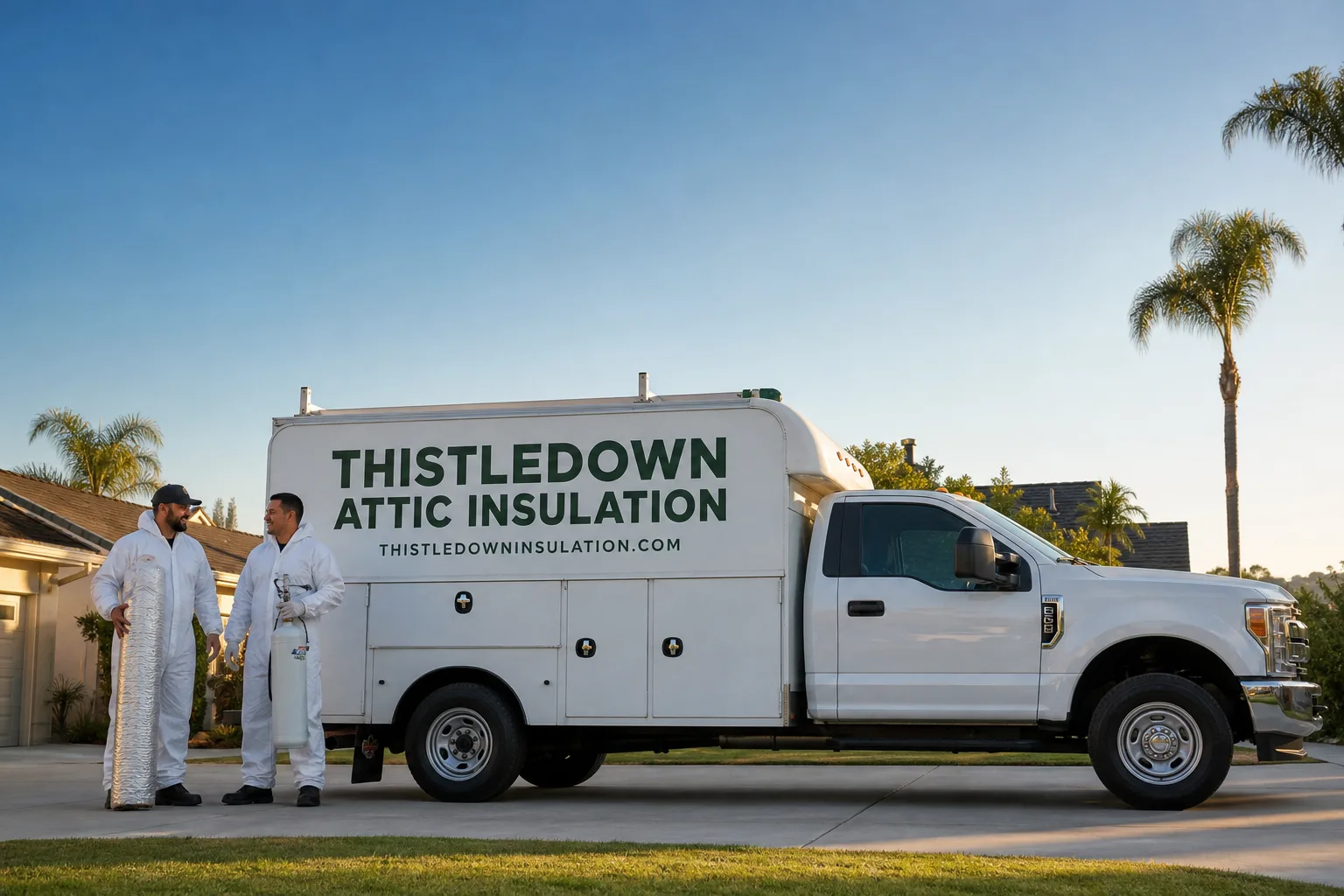
Fast, Reliable Attic Insulation Across Good Hope
Attic insulation in Good Hope is a different job than it is anywhere else in Southern California, because your attic regularly hits 150°F in summer while winter nights dip into the upper 30s. That swing punishes insulation that was never installed for this climate. We’re Thistledown Attic Insulation, a Cedarwell-family company, and we’ve been working in unincorporated Riverside County long enough to know exactly what those Perris Valley temperatures do to a 1990s or 2000s tract home. If your second story won’t hold temperature after 3 p.m., call (909) 768-6501 and we’ll take a look.
Why Thistledown Attic Insulation Is Good Hope’s Preferred Attic Insulation Company
Good Hope homeowners don’t get city-level permitting hand-holding. You deal with Riverside County Building and Safety, which covers a huge rural territory, and that means inspection scheduling runs slower than in Perris or Moreno Valley. We plan for that from the first phone call, so your project timeline doesn’t surprise you mid-job. Neil Barron, our owner, holds every Good Hope project to the same standard: a written price before any work starts, and the 365-Day Done Right Promise behind it. If something isn’t done right, we make it right. No debate.
Our crew shows up in uniform, background-checked, and we lay drop cloths from your front door to the attic hatch. Shoe covers go on before we step inside. When we leave, you get a photo of the clean-up. That’s the Cedarwell Care Promise, and it’s not optional. Four core behaviors guide every visit: Clean up like it’s our own home. Ask before we move or touch anything. Respect your family’s time and quiet hours. Explain the price before the work. A live person answers our phones 24/7, so when you call at 9 p.m. worried about a 156°F attic, you get a human, not a voicemail tree.
Blown In Insulation in Good Hope
Blown In Insulation is the workhorse fix for Good Hope attics because it fills the irregular cavities and bypasses that production builders in the 1990s and 2000s left behind. A typical blown-in project in Good Hope runs $1,800 to $3,400 for a standard 1,200 to 1,800 square foot attic, depending on depth and whether we’re starting from bare framing or topping up existing material. You get your exact written number before we touch a rafter. The job itself takes most of a day: we air-seal the bypasses, blow the insulation to the R-value your attic needs (R-38 is our standard target here), and leave the site clean enough that you’d never know we were there except for the temperature change.
Air-Sealing Before the Blow
No amount of new insulation fixes a leaky thermal envelope. In Good Hope’s production builds, we consistently find unsealed top plates, plumbing chases, and recessed can lights pouring conditioned air into the attic while your AC runs. We seal those first, then blow.
Radiant Barrier Integration
On unshaded south- and west-facing roof planes, we recommend rolling out a radiant barrier across the rafters before or after blowing. It’s the difference between an attic that reads 156°F at 4 p.m. and one that stays in the low 120s. For Good Hope summers, that’s not an upgrade. It’s the baseline.
Insulation Contractors in Good Hope
Insulation Contractors working in Good Hope have to understand two things that city-based crews often miss. First, your permits flow through Riverside County, not a local building office, which affects inspection timing. Second, slab-on-grade construction here means your attic is where nearly all your heat gain and loss happens. A typical full attic insulation replacement in Good Hope runs $2,200 to $4,800, and an insulation top-up over existing material runs $900 to $2,200. Every project gets a written price first.
What a Good Hope Job Actually Looks Like
We pulled a 2003 tract build in the May Ranch area of Good Hope where the original R-19 batts had compressed and pulled away from the framing after years of 105°F-plus swings. After air-sealing the attic bypasses around the top plates and recessed cans, we blew Owens Corning fiberglass to R-38 and rolled out a radiant barrier across the south-facing rafters. The homeowner’s summer attic read 156°F before the job and dropped into the low 120s on the same afternoon the following week.
County Permits, Handled
When a Good Hope job triggers an inspection, we coordinate with Riverside County Building and Safety directly. We don’t ask you to chase paperwork. We schedule the inspection, meet the inspector, and make sure the work passes. Simple as that.
Trusted Brands We Service in Good Hope
We install Attic Insulation using products from Owens Corning, Johns Manville, and GreenFiber, matched to each Good Hope attic and each family. If you have pets, we’ll steer you toward pet-safe options where a choice exists. Because we carry these brands in local stock, turnaround for Good Hope projects stays fast – no waiting on a warehouse shipment from out of state. The right product for a 2003 May Ranch tract home is different from what a 1995 build near the Perris Valley edge needs, and we stock both.
Common Attic Insulation Problems We See in Good Hope Homes
- Batt insulation pulling away from framing. The diurnal temperature swing here – 105°F days, upper-30s nights – makes fiberglass batts expand and contract until they sag or separate from the joists. Bare spots along the roof deck are the tell.
- Unsealed attic bypasses from production builds. Top plates, plumbing chases, and recessed cans in 1990s-2000s tract homes leak conditioned air into the attic all summer. Your R-38 blow won’t perform if the envelope is still leaking.
- R-19 attics that were barely code-compliant then, and aren’t now. Many Good Hope homes were permitted under older Title 24 standards that allowed R-19 in the attic. Current California requirements are far stricter, and the climate has been punishing that thin layer for two decades.
- Attic temperatures past 150°F on south and west roof planes. Without a radiant barrier, insulation’s effective R-value drops during the hottest hours of the day, right when you need it most. This is the single biggest performance killer we document in Good Hope.
Pricing for Attic Insulation in Good Hope, CA
Here’s what Good Hope homeowners can expect, in real numbers. Blown-in attic insulation runs $1,800 to $3,400 for a standard attic. A top-up over existing material runs $900 to $2,200. Full replacement including removal of old, degraded batts runs $2,200 to $4,800. Air-sealing as a standalone service runs $600 to $1,400 depending on how many bypasses we find. Radiant barrier installation runs $1,200 to $2,800 depending on roof plane coverage. Every one of these gets a written price before we start. No ranges after the fact. Call (909) 768-6501 and we’ll walk your attic, measure, and hand you a number on paper.
We Also Serve Cities Near Good Hope
While this page focuses on Attic Insulation in Good Hope, our crews also serve homeowners in Los Angeles, San Diego, San Jose, and San Francisco. If you own property in more than one California market, we may be able to coordinate work across locations. Call (909) 768-6501 and ask.
Serving Good Hope, CA - Our Local Coverage Area
We’re based in the Good Hope area and know this community well. Use the map below to see our service coverage - if you’re nearby, we can almost certainly help.
FAQs About Attic Insulation in Good Hope
Because Good Hope is unincorporated, any attic insulation job that triggers a building inspection is handled by Riverside County Building and Safety, not a city office. County inspectors cover a wide rural territory, so scheduling lead times can run longer than in incorporated neighbors like Perris or Moreno Valley. We factor that into your timeline from the first call and handle the scheduling for you. Call (909) 768-6501 for a straight answer on whether your specific project needs a permit.
No. R-19 was the old Title 24 minimum and it’s nowhere near what a Good Hope attic needs given 150°F summer attic temperatures and upper-30s winter nights. We recommend R-38 or higher for this climate, with air-sealing done first. An R-19 attic in Good Hope costs more to cool every summer than the upgrade would have cost to install. Call (909) 768-6501 and we’ll show you the math for your square footage.
On unshaded south- and west-facing roof planes, a radiant barrier is not an upsell. It’s the difference between an attic that reads 156°F at 4 p.m. and one that stays in the low 120s. Insulation’s effective R-value collapses during the hottest hours without a radiant barrier. If your roof faces south or west with no tree cover, plan for it. We’ll inspect and tell you honestly if your home needs it. Call (909) 768-6501 for a free attic assessment.
Good Hope’s diurnal temperature range – 105°F summer days dropping to upper-30s winter nights – causes repeated expansion and contraction that degrades improperly installed batt insulation faster than in coastal climates. The batts physically pull away from framing and compress, leaving bare spots along the roof deck. The fix is removing the failed batts, air-sealing, and blowing in new material at the correct depth. Call (909) 768-6501 and we’ll tell you what’s salvageable.
Yes, and we’d argue you should. Air-sealing closes the bypasses around top plates, plumbing chases, and recessed cans that let conditioned air pour into your attic all summer. Without it, even a fresh R-38 blow underperforms because the thermal envelope is leaking. That’s why we don’t consider sealing a separate upsell. For Good Hope’s production builds, it’s the first step in every insulation job we do. Call (909) 768-6501 for a written price on air-sealing plus insulation for your specific attic.
Written by Neil Barron, Owner at Thistledown Attic Insulation, serving Good Hope and the Perris Valley. Founded in 2003 as part of the Cedarwell family of independently owned insulation companies.